Skimmers are the quiet specialists of the kitchen: shallow, wide tools that lift food out of hot liquid while the liquid drains away. A good skimmer pulls golden chips from hot oil without a splash, lifts dumplings from boiling water without breaking them, and clears the grey foam from a simmering stock. This guide explains which skimmers are worth buying in 2026, how the mesh, spider, and perforated types differ, and what to check before you buy.
A skimmer works by giving liquid somewhere to go. Its shallow bowl is full of holes or fine wire mesh, so when you lift food from a pot, the oil or water falls straight back through while the food stays in the bowl. That draining action separates a skimmer from a ladle, which carries liquid, and from a slotted spoon, which serves food already on a plate.
Key Takeaways
- A skimmer lifts food from hot liquid while the liquid drains back through its mesh or holes.
- Fine mesh suits skimming foam and lifting small food; a wire spider suits heavy fried food and blanching.
- A handle of at least 30 centimetres keeps your hand clear of hot oil.
- Stainless steel is the safest all-round choice: it will not melt or bend, and it survives the dishwasher.
- Check the mesh is firmly fixed to its rim and the handle is riveted, not glued.
What a Skimmer Actually Is
A skimmer is a shallow, perforated scoop on a long handle, made to work in hot liquid. The bowl is wide and flat rather than deep, so food spreads across it in a single layer and drains fast. The handle reaches the bottom of a deep pot while your hand stays clear of steam and spitting fat. Most skimmers are stainless steel, which handles frying heat without softening, and the best ones are formed from a single piece of mesh or a single stamped disc.
Skimmers have been used for centuries, and the design has barely changed. A cook making stock needs to clear the scum that rises as meat simmers; a cook frying chips needs to lift them out the moment they turn golden. In each case the skimmer does in one smooth movement what tongs or a spoon would do in several fiddly ones.
The Main Types of Skimmer
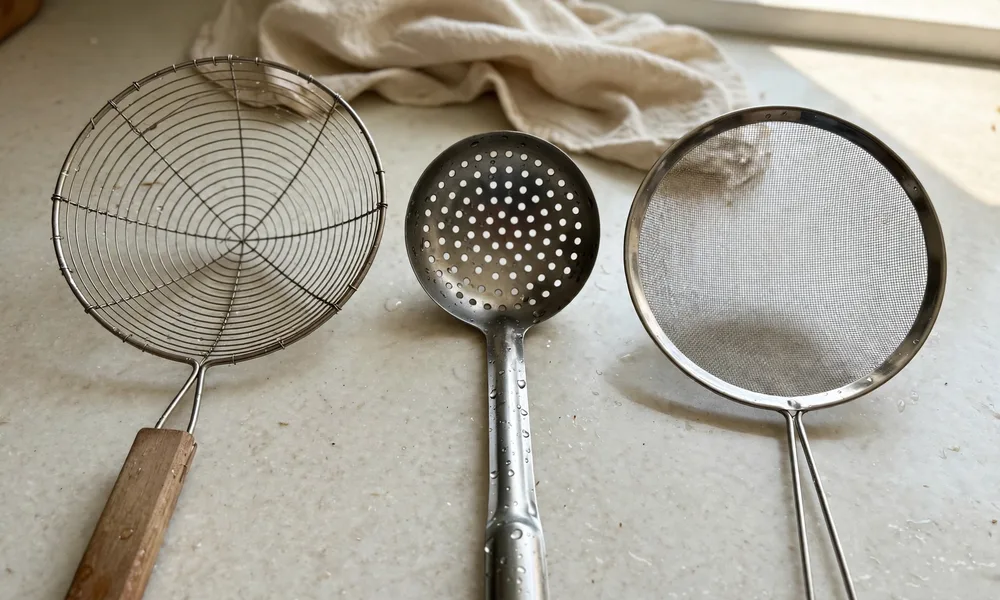
Three types cover nearly every skimmer on sale. The fine mesh skimmer is the all-rounder for foam and small food. The wire spider is the heavy lifter for frying and blanching. The perforated skimmer is the sturdy middle ground for dumplings, vegetables, and poached food.
| Type | Bowl | Best for | Weakness |
|---|---|---|---|
| Fine mesh skimmer | Tight wire mesh | Skimming foam, small food | Bends under heavy loads |
| Wire spider | Open wire basket | Frying, blanching | Small food slips through |
| Perforated skimmer | Stainless disc with holes | Dumplings, vegetables | Slower to drain |
The Fine Mesh Skimmer
The fine mesh skimmer is the one to buy first. Its bowl is a disc of tightly woven stainless mesh, fine enough to catch grains of rice, peas, and the flakes of foam that rise from a simmering stock. It is the best tool for clearing a pot of stock and for lifting small fried food such as prawns. Its weakness is weight: a heavy load can bend a cheap mesh, so look for a thick rim and a mesh that is welded, not just crimped, into it.
The Wire Spider
A spider is a shallow basket of criss-crossed wire, wider and more open than a mesh skimmer, and it is the best tool for frying. Its open wires let oil drain in a second, and the basket holds a large batch of chips, tempura, or doughnuts without crushing them. It is also the right tool for blanching. The gaps are too wide for small food, so keep a mesh skimmer alongside it for the fine work.
The Perforated Skimmer
A perforated skimmer has a solid stainless disc punched with round holes, somewhere between a mesh skimmer and a slotted spoon. It is stiffer than mesh, so it handles heavy dumplings, meatballs, and large vegetables without bending. It drains more slowly than a spider, but where strength matters more than speed, it is the most reliable choice.
Skimmers in Action
A skimmer earns its keep in three everyday jobs. Frying is the first. When chips or fritters turn golden, they need to come out of the oil at once, before they darken or soak up fat. A spider lifts the whole batch in one scoop and the oil drains back into the pot. Trying the same job with tongs means several trips and broken pieces.
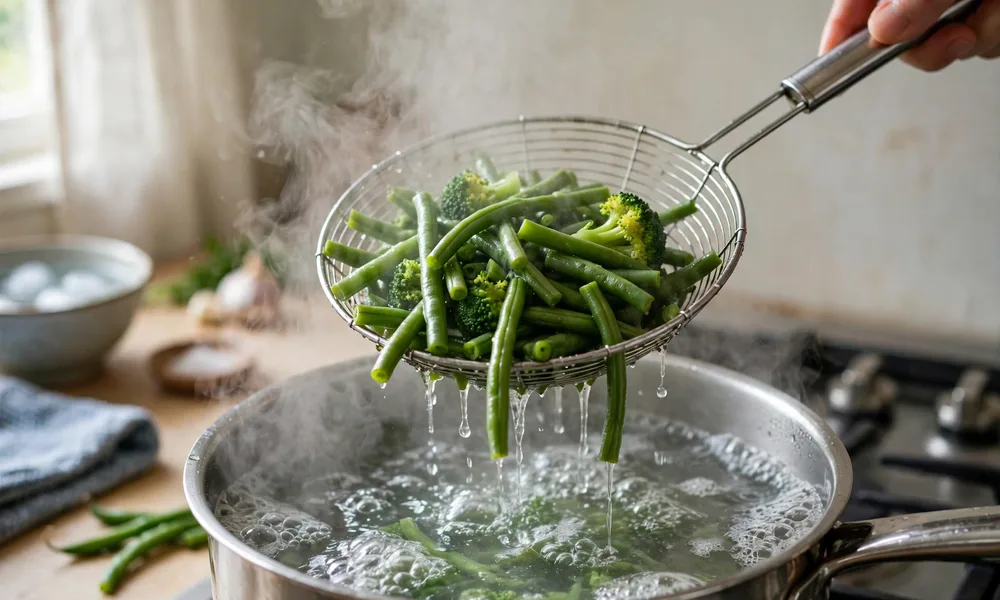
Blanching is the second. Vegetables blanched for a salad or a stir-fry need a minute or two in boiling water, then straight into cold water to stop the cooking. A spider or a perforated skimmer lifts the batch in one movement, and because the bowl is shallow, the vegetables cool fast instead of steaming in a pile.
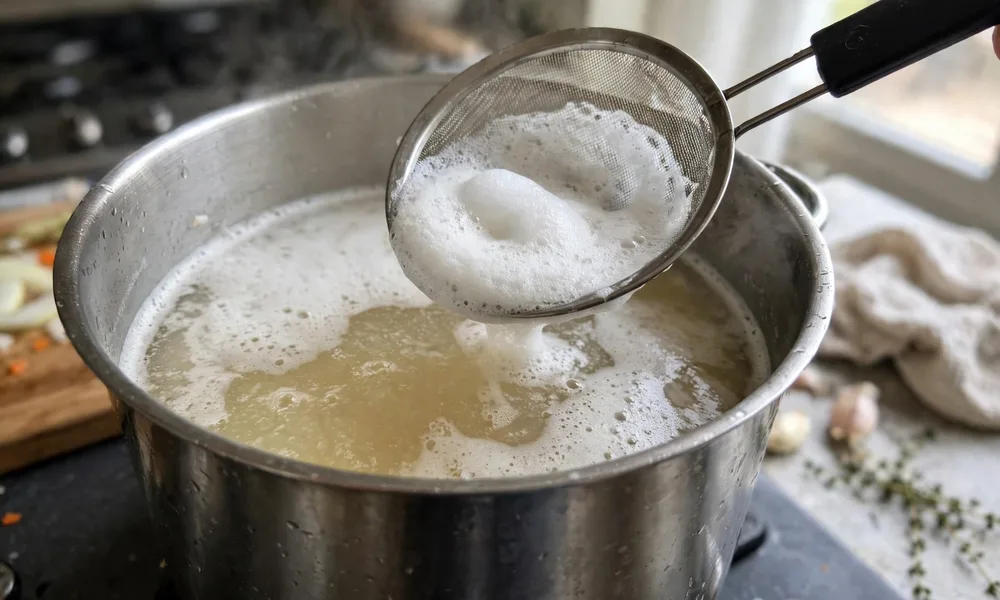
Skimming stock is the third, and it is where the fine mesh skimmer shines. As meat and bones simmer, grey foam and fat rise to the surface, and leaving them in clouds the stock and dulls its flavour. A mesh skimmer drawn slowly across the surface collects the foam in one pass. A clean stock is the difference between a soup that tastes bright and one that tastes muddy.
How to Choose a Skimmer
Choosing a skimmer comes down to four checks. The first is the mesh or holes. Fine mesh suits foam and small food; wide wire suits heavy frying; small round holes suit dumplings and vegetables. If you only buy one, choose a fine mesh one with a sturdy rim.
The second check is the handle. It should be at least 30 centimetres long, so your hand stays clear of hot oil and deep pots, and it should feel balanced when you hold it by the middle: the bowl should sit level, not tip forward. A hanging loop is useful, since skimmers are awkward in a drawer.
The third check is the join. The bowl should be riveted or welded to the handle, with no glue and no wobble. Press the bowl gently against a worktop: a good skimmer feels rigid, while a cheap one flexes at the join. The fourth check is the material. Stainless steel is the safest choice: it will not melt, it survives the dishwasher, and it will not stain. Avoid plastic handles for frying, because a handle that dips into hot oil can soften, and avoid bamboo handles, which crack when repeatedly soaked.
Skimmers Against Ladles, Strainers, and Slotted Spoons
Skimmers are often confused with three neighbours, so it is worth drawing the lines clearly. A ladle is built to carry liquid, with a deep bowl and a pouring rim; a skimmer is built to leave liquid behind, with a shallow perforated bowl. Ladles that pour without the drips serve soup, while a skimmer lifts the dumplings out of it. A kitchen that makes soup needs both.
A mesh strainer is the second neighbour. Strainers pour a whole pot through, catching everything at once, while a skimmer fishes food out while the pot stays on the heat. The top mesh strainers for everyday cooking handle rinsing and straining in bulk, but they cannot lift chips from bubbling oil. Use a strainer when the liquid is finished with; use a skimmer while the cooking is still going on.
A slotted spoon is the third neighbour, and the closest one. Both drain liquid as they lift, but a slotted spoon has a small bowl and short slots, made for serving food from a dish, while a skimmer has a wide bowl and a long handle, made for working inside a hot pot. A slotted spoon serves vegetables at the table; a skimmer pulls them from the boiling water.
Care and Storage
Skimmers are easy to look after. Rinse the mesh straight after use, before oil or starch dries into it, and wash it in hot soapy water with a brush that reaches into the weave. Most stainless skimmers go in the dishwasher, but a quick hand wash keeps the mesh cleaner. Dry the skimmer straight away, especially around the join.
Storage matters. A skimmer left loose in a drawer will bend, snag, and tangle, so hang it from a hook or stand it in a tall crock by the stove. A bent mesh never sits flat again, and a bent spider lets food slip through the gaps.
What to Avoid When Buying
The cheapest skimmers fail in predictable ways. Avoid a mesh that is only crimped into its rim, because the first heavy load of wet food will pull it loose. Avoid a handle joined with glue or a single small spot weld, which will wobble and then snap. Avoid very thin wire, which bends in hot oil, and a bowl too small for your pots.
Also avoid skimmers with a plastic-coated handle if you fry often. The coating looks comfortable in the shop, but a handle that slips into hot oil softens, and a softened handle is a dropped basket of chips. A plain stainless handle gets warm but never fails. One solid stainless skimmer, bought once, will outlast three cheap ones.
Skimmers and Stockpots
A skimmer is only as useful as the pot it works in. Deep stockpots need a long-handled skimmer, wide frying pans suit a spider, and a narrow saucepan needs a small mesh skimmer that fits inside without catching the sides. What is the best stockpot for soups and stocks covers the sizes and materials for a household that makes stock regularly, and a fine mesh skimmer is the natural partner for any of them.
Checklist: Before You Buy a Skimmer
- Pick the type for your cooking: fine mesh for foam and small food, a spider for frying.
- Check the mesh is welded or firmly riveted into a thick rim, with no wobble.
- Choose a handle of at least 30 centimetres, with a hanging loop for storage.
- Hold the skimmer by its middle: the bowl should sit level, not tip forward under its own weight.
- Buy stainless steel and avoid plastic-coated handles if you fry often.
- Match the bowl to your pots: wide for stockpots, small for narrow saucepans.
Frequently Asked Questions
What is a skimmer used for in the kitchen?
A skimmer lifts food out of hot liquid while the liquid drains away. It is used for frying, blanching vegetables, and skimming foam from stock.
What is the difference between a skimmer and a slotted spoon?
A skimmer has a wide, shallow, perforated bowl on a long handle, made for working inside a hot pot. A slotted spoon has a smaller bowl and shorter handle, made for serving food from a dish.
Can I use a skimmer for frying?
Yes. A wire spider lifts a whole batch of fried food in one scoop and lets the oil drain back into the pot in a second.
What is a spider strainer?
A spider is a skimmer with a shallow basket of criss-crossed wire. It is used for frying and blanching, where its open wires drain oil and water fast.
How do I clean a mesh skimmer?
Rinse it straight after use, before oil or starch dries into the mesh, then wash it in hot soapy water with a brush. Dry it at once, especially around the join.
Do I need both a skimmer and a strainer?
Yes. A strainer pours a whole pot through, while a skimmer fishes food out while the pot stays on the heat.
The Bottom Line
A skimmer is a small, cheap tool that makes hot, wet cooking safer and tidier. Buy a fine mesh skimmer first for foam and small food, add a wire spider if you fry often, and choose stainless steel with a riveted handle of at least 30 centimetres. Do that, and lifting food from boiling water or hot oil becomes one smooth movement.