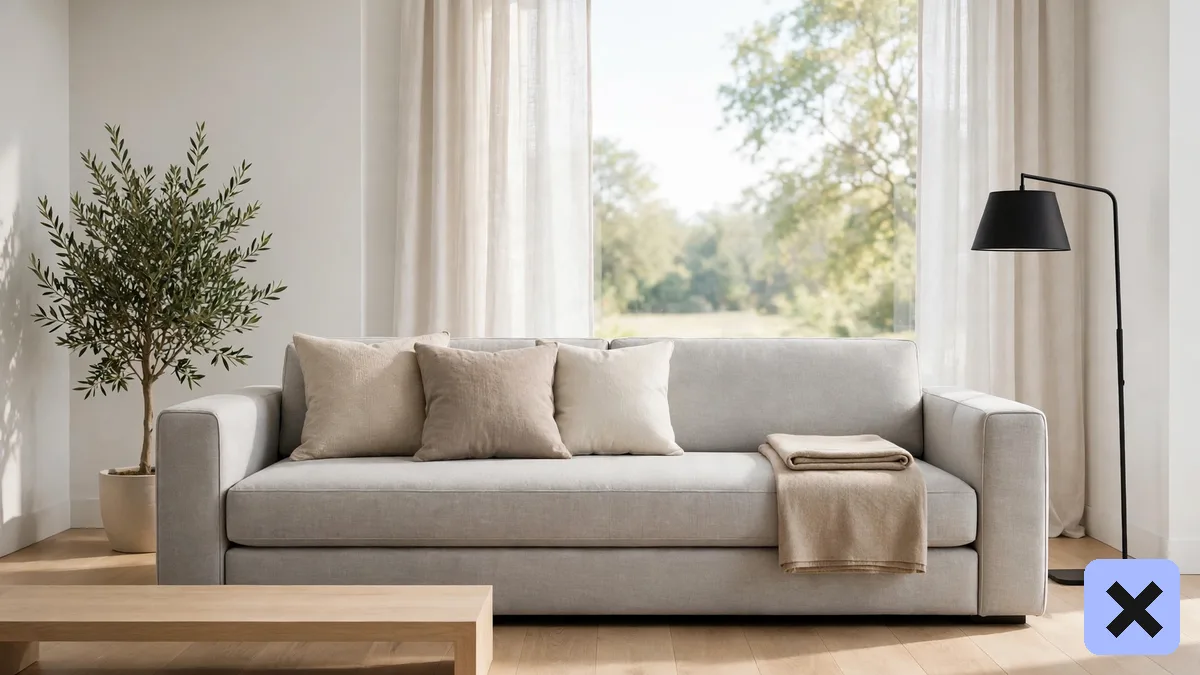
The best sleeper sofas in 2026 finally feel like a real sofa and a real bed at the same time. For years, shoppers had to accept a compromise: a comfortable couch hiding a lumpy mattress, or a decent bed folded into a stiff, boxy seat. That trade-off is gone. Better mechanisms, thicker mattresses, and smarter frames mean today’s sleeper sofas can anchor a living room every day and still give guests a good night’s sleep.
A sleeper sofa is one of the most practical pieces of furniture you can buy, especially if you live in a smaller home or host guests often. It earns its floor space twice over, working as your everyday seat and transforming into a bed in under a minute. The trick is knowing which models actually deliver on both jobs, because the difference between a great sleeper and a disappointing one hides in details you cannot see in a showroom photo.
This guide covers what matters: mechanisms, mattress options, sizes that fit real rooms, and build-quality signs that separate a ten-year sofa from a two-year regret.
Key Takeaways
- The best sleeper sofas in 2026 pair a supportive seat with a mattress at least 4 inches thick, so neither job feels like an afterthought.
- Pull-out mechanisms sleep the most comfortably, while click-clack and futon styles convert faster and suit tight budgets and tighter rooms.
- Measure your room twice: a queen sleeper needs roughly 90 inches of clear floor in front of it when fully open.
- Memory foam and hybrid mattresses beat thin innerspring ones for overnight comfort, and they fold more cleanly too.
- A solid hardwood or kiln-dried frame, a smooth mechanism, and a removable washable cover are the three quality signs worth paying for.
What Makes a Great Sleeper Sofa in 2026
A great sleeper sofa starts with honesty about how it will be used. If it will be your main sofa, seat comfort comes first. If it mostly hosts guests, the bed matters more. The best models refuse to choose, and they manage it by treating the sofa and the bed as two separate engineering problems solved inside one frame.
The seat should feel like a normal sofa, with even support and cushions that spring back instead of sagging. The bed should feel like a bed, not a camping cot: no metal bar in your back, no dip where the sections meet, and no mattress so thin you can feel the frame through it. In a store, lie on it for a minute, roll to your side, and sit on the edge. A good sleeper passes all three tests.
The Main Types of Sleeper Sofas Compared
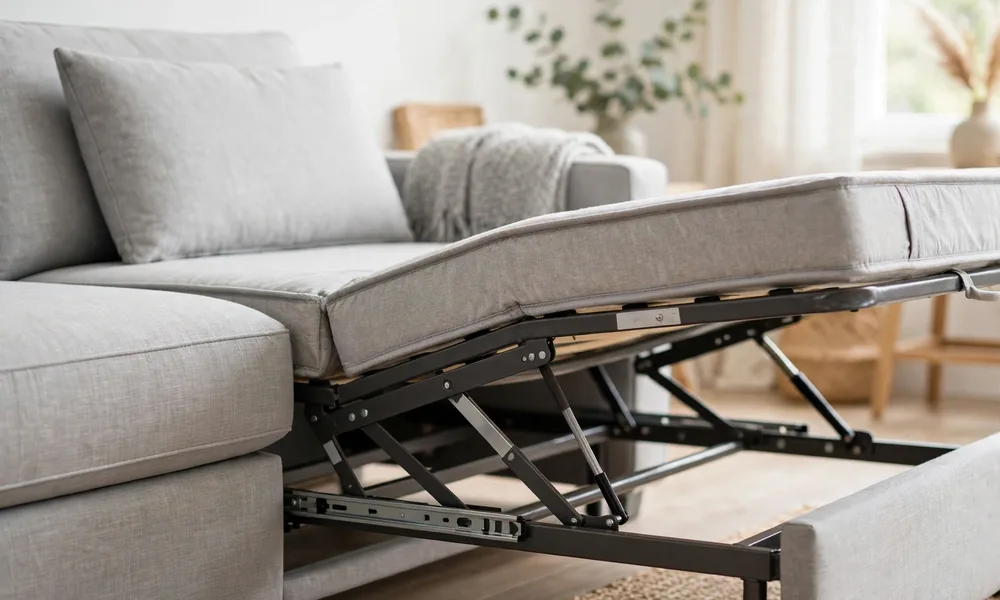
Sleeper sofas fall into a few clear families. Pull-out sleepers are the classic choice: the mattress folds away inside the base and pulls out on a metal frame. They sleep the best because they use a real mattress, and they come in twin, full, and queen sizes. Their downside is weight and depth: they are heavy and need a lot of clear floor space in front to open.
Click-clack sofas convert by lowering the backrest until it lies flat with the seat. They are light and quick to convert, which makes them popular in studios, though the sleeping surface is the seat cushions, so it is firmer than a real mattress. Futon-style sleepers work the same way and are the most affordable option. Sectional sleepers add a chaise or corner unit, often with storage, and suit larger rooms. Daybed-style sleepers look like a deep bench by day and take a twin mattress by night.
| Type | Bed Size | Comfort | Best For | Price Range |
|---|---|---|---|---|
| Pull-out sleeper | Twin to queen | Excellent | Regular overnight guests | Mid to high |
| Click-clack | Full to queen | Good | Studios and quick conversion | Low to mid |
| Futon style | Twin to full | Fair | Budget buyers, first apartments | Low |
| Sectional sleeper | Queen to king | Excellent | Large rooms, families | Mid to high |
| Daybed sleeper | Twin | Good | Offices and guest nooks | Low to mid |
How to Choose the Right Size
Size is where most sleeper-sofa mistakes happen, and they happen before the sofa even arrives. A sleeper that fits your wall perfectly as a sofa can still be impossible to open if the room is too shallow, and a bed that sleeps two comfortably can block the only path to the bathroom.
Start with the sofa dimensions, then add the open-bed dimensions, which the manufacturer should list separately. A queen pull-out typically extends about 85 to 90 inches out from the wall when open, so you need that much floor plus walking room. Mark the footprint on your floor with painter’s tape before you order. If you have to climb over the bed to reach a door, the size is wrong.
Think about who will sleep on it. A twin suits one guest and fits narrow rooms. A full works for one adult comfortably or two people who do not mind closeness. A queen is the sweet spot for couples. Also check the delivery path: sleeper sofas are heavy and often arrive in one piece, so measure every doorway and hallway turn against the packaged dimensions.
Comfort: A Sofa by Day, a Bed by Night
Comfort is two separate questions, and a good sleeper answers both. By day, the seat should be deep enough to sit in properly, with a height that lets your feet rest flat on the floor; a seat depth of 22 to 24 inches suits most adults. High-density foam holds its shape and supports weight evenly, while foam wrapped in fibre or down gives a softer sit.
By night, the mattress is the whole story. A thin innerspring mattress, the kind that gave sleeper sofas their bad reputation, transmits every bar and joint in the frame. A 4- to 5-inch memory foam mattress changes the experience completely: it spreads weight evenly, hides the mechanism underneath, and folds without damage. Gel-infused foam sleeps cooler, which matters for guests who run warm. Whatever the material, lie on it before you buy.
Bedding makes a bigger difference than most buyers expect. A fitted sheet, a real pillow rather than a sofa cushion, and a light blanket turn a fold-out into a proper guest bed. Keep a set stored nearby, so hosting takes minutes. Throw pillows made for small sofas add comfort without bulk by day and extra back support by night, while a smart TV chosen for a living room turns the same space into a movie-night spot and a guest lounge.
Mattress Options Explained
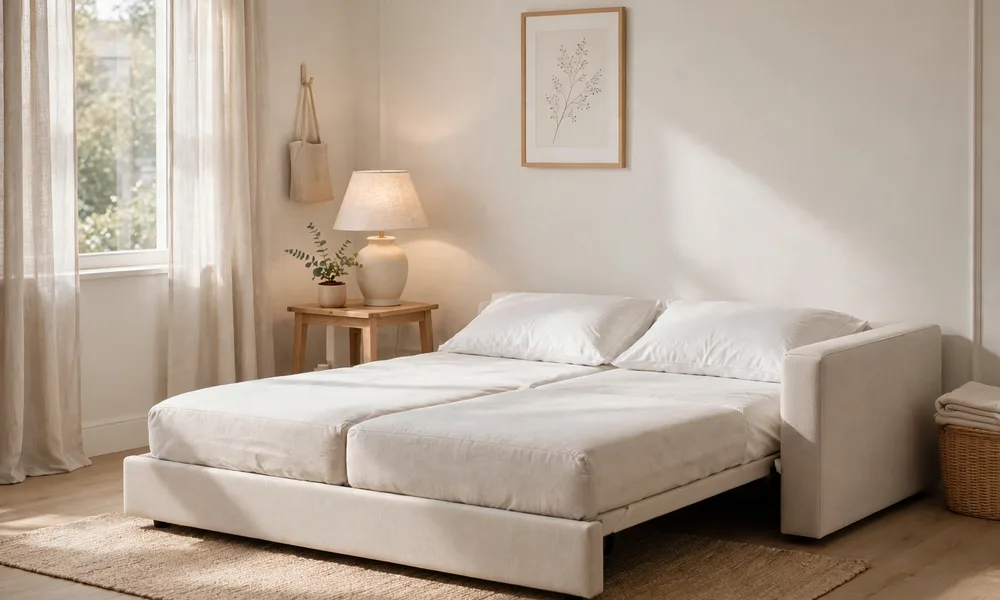
The mattress is the part of a sleeper sofa you cannot judge from a photo, so it deserves its own careful look. Three materials dominate the market, and each has a clear personality.
Memory Foam
Memory foam is the most popular choice in 2026. It contours to the sleeper, eliminates pressure points, and folds neatly without creasing. Its weakness is heat, so look for gel-infused or open-cell versions if your guest room runs hot. A 4-inch mattress is the minimum for regular use; 5 inches is noticeably better.
Innerspring
Innerspring mattresses are the old standard. They are bouncy, breathable, and cheap, but thin ones, usually 3 to 4 inches, are the reason sleeper sofas got a reputation for back pain. If you choose innerspring, insist on a thicker model with a decent coil count, and test it lying down, not just sitting on the edge.
Hybrid
Hybrid mattresses combine a coil base with a foam top layer. They sleep cooler than pure foam and feel more supportive than pure innerspring, which makes them the most balanced option for guests of different sizes. They are also the heaviest, so the mechanism needs to be sturdy enough to lift them. Check whether the mattress is replaceable: a sofa with a replaceable mattress is a better long-term buy.
Best Sleeper Sofas for Small Spaces
Small rooms are where sleeper sofas earn their keep, but they punish sloppy measuring. Look for apartment-sized models, usually 68 to 76 inches wide, with a twin or full bed. Armless or narrow-arm designs save precious inches, and a low back keeps the room feeling open. A loveseat sleeper is often the smartest pick for a studio: it seats two and sleeps one adult comfortably.
Storage is a bonus worth seeking in a small space: some sleepers hide a compartment under the chaise or seat for bedding. Think about the room as a whole: a coffee table sized for a small living room that slides aside when the bed opens, a floor lamp instead of a table lamp, and a rug that defines the seating zone. When the bed opens, the room should still work, not turn into an obstacle course.

Durability and Build Quality
A sleeper sofa works harder than any other seat in the house, because every open and close flexes its frame and mechanism. That is why build quality matters more here than with a regular sofa.
The frame should be kiln-dried hardwood, joined with corner blocks and screws rather than staples alone. The mechanism should be steel, with a support deck of mesh, slats, or a solid platform rather than bare bars. Open and close it several times in the store: it should glide, lock firmly, and never wobble. Look for a fabric with a high rub count and removable cushion covers you can wash. Check the warranty too: a good sleeper carries a multi-year warranty on the frame and at least a year or two on the mechanism and mattress.
Checklist: Before You Buy a Sleeper Sofa
- Measure the sofa footprint, the open-bed footprint, and every doorway on the delivery path.
- Lie on the open bed for a full minute, roll to your side, and sit on the edge to check support.
- Open and close the mechanism yourself, several times, and check that it locks firmly.
- Confirm the mattress is at least 4 inches thick, and ask whether a replacement is available.
- Check the frame material, the fabric rub count, and whether cushion covers are removable.
- Read the warranty: frame, mechanism, and mattress coverage, and for how long.
Frequently Asked Questions
Are sleeper sofas comfortable to sleep on every night?
A good one can be. Pull-out models with a 5-inch memory foam or hybrid mattress sleep well for most people. Cheaper futon and click-clack models suit occasional guests better than everyday sleeping.
What size sleeper sofa should I buy?
For one guest, a twin is enough. For a couple, a queen is the comfortable choice. A full sits in between. Match the size to your room first: the bed needs clear floor space to open fully.
How long do sleeper sofas last?
A well-built sleeper sofa lasts 7 to 10 years with regular use. The mattress usually wears first, typically after 5 to 7 years, which is why a replaceable mattress is such a valuable feature.
Can I replace the mattress in a sleeper sofa?
Often, yes. Many manufacturers use standard sleeper sizes and sell replacements. Measure the folded mattress carefully before ordering, and check that the replacement is designed to fold with the mechanism.
Do sleeper sofas need special sheets?
They use standard bed sizes, so ordinary sheets fit, but sleeper mattresses are thinner than regular ones, so deep-pocket sheets can bunch. Standard-depth fitted sheets fit better, and a thin mattress protector keeps the mattress fresh.
What is the difference between a sleeper sofa and a futon?
A sleeper sofa hides a separate mattress inside its frame and pulls out into a bed, while a futon folds its own seat and back down to form the sleeping surface. Sleepers generally sleep better; futons are lighter, cheaper, and quicker to convert.
The Bottom Line
The best sleeper sofas in 2026 refuse to compromise: a supportive seat you would happily sit on every evening, a mattress your guests would happily sleep on every night, and a mechanism that opens without a struggle. Measure your room, test the bed in person, and buy the best frame and mattress your budget allows.


