
The best sleeping bags for couples turn a cramped night in a tent into something you actually look forward to. A good double bag gives two people room to roll over and keeps the cold out on both sides.
Couples sleep differently from solo campers. You share body heat, you move at different times, and one of you almost certainly sleeps colder than the other. Width matters more than ultralight weight, two zippers matter more than a fancy hood, and a rating that looks fine for one person can leave the colder sleeper shivering by 3 a.m.
This guide compares the best sleeping bags for couples in 2026, explains true doubles versus two singles zipped together, and covers what to check first.
Key Takeaways
- A true double bag is wider than two singles zipped together and far more comfortable for restless sleepers.
- Rectangular bags suit couples better than mummy bags, leaving room for two people to shift position.
- Buy for the colder sleeper: choose a bag rated at least 10 degrees lower than the coldest night you expect.
- Two zippers, one on each side, are essential so neither person has to climb over the other to get out at night.
- Pair your bag with wide sleeping pads and a roomy tent, or even the best bag will feel cramped.
What Makes a Sleeping Bag Great for Two People
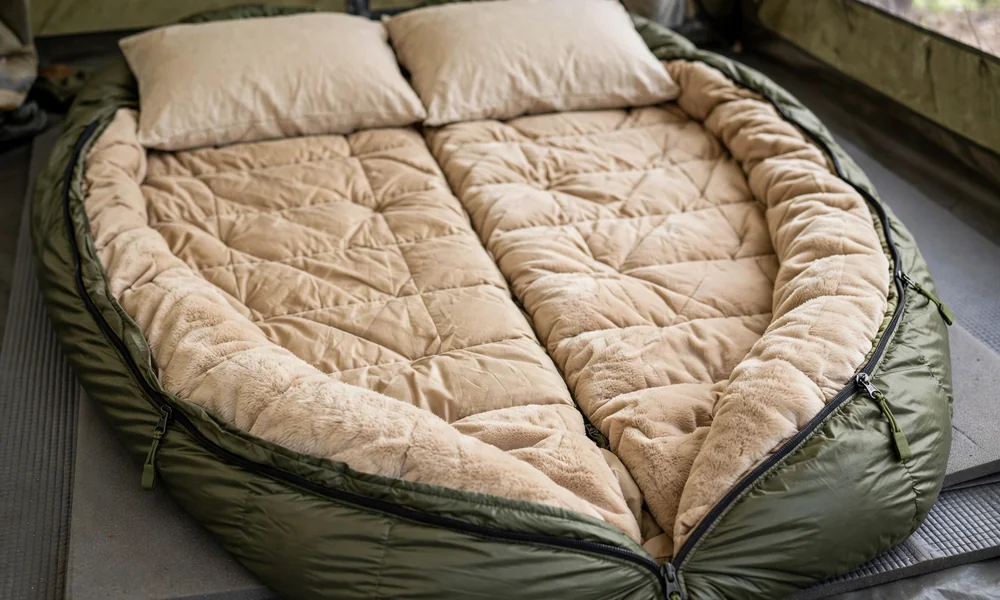
A couples sleeping bag is not just a bigger solo bag. It has to handle two bodies moving at different times and two different comfort temperatures.
True Double Bags vs Two Singles Zipped Together
There are two ways to sleep as a couple outdoors: a true double bag, built as one wide unit, or two single bags zipped together, which works only if both have compatible zippers on opposite sides. True doubles are more comfortable, because there is no cold gap down the middle and no ridge of zipper teeth pressing into someone’s back.
Zipped singles have one advantage: flexibility. Each person can use their own bag on solo trips, and you can unzip on a warm night. If you already own two compatible singles, trying them costs nothing. But if you are buying fresh, a dedicated double is the better investment. If you are still weighing solo options, our guide to the best sleeping bags for camping covers the strongest models and explains temperature ratings.
Size and Shape: Rectangular Beats Mummy for Couples
Mummy bags hug one body, so two people in a mummy-shaped double feel like sardines. Rectangular bags, with straight sides and a squared-off footbox, give each person room to bend their knees and roll onto their side. That extra space is worth more than the few degrees a tapered shape saves.
A comfortable double is at least 60 inches wide at the shoulders, and 64 inches is better if either of you is broad-shouldered. Look for at least 78 inches of length if either of you is over six feet tall, so your feet do not press against the footbox.
Temperature Ratings and the Cold Sleeper Problem
Almost every couple has a cold sleeper and a warm sleeper. The fix is simple: buy for the colder person. Choose a bag rated at least 10 degrees lower than the coldest temperature you expect, and add a lightweight liner for shoulder-season trips.
Ratings are also less generous than they look. Most mark a survival temperature, not a comfort temperature, and the comfort limit is usually 10 to 15 degrees higher than the headline number. A bag rated to 20 degrees is realistically comfortable down to about 30 to 35 degrees. Treat the rating as a starting point, and remember that a good pad matters as much as the bag.
The Best Sleeping Bags for Couples in 2026
The five bags below cover couples camping from budget car-camping doubles to lightweight three-season bags for backpacking pairs.
| Sleeping Bag | Temperature Rating | Weight | Size | Best For |
|---|---|---|---|---|
| Kelty Tru.Comfort 20 Double | 20°F | About 7 lb 8 oz | 64 x 82 in | Best overall for couples |
| Big Agnes Dream Island 15 Double | 15°F | About 6 lb 5 oz | 60 x 78 in | Three-season backpacking pairs |
| REI Co-op Camp Dreamer Double 20 | 20°F | About 8 lb 4 oz | 62 x 84 in | Roomiest car-camping double |
| Teton Sports Mammoth Queen | 0°F | About 12 lb | 94 x 78 in | Cold-weather and family camping |
| Nemo Jazz 30 Double | 30°F | About 6 lb 11 oz | 60 x 80 in | Warm-weather trips and festivals |
Best Overall: Kelty Tru.Comfort 20 Double
The Kelty Tru.Comfort 20 Double is the bag most couples should buy first. At 64 inches wide it is one of the roomiest doubles available, with two zippers so each person can vent or exit independently. The 20-degree rating covers three-season camping, the synthetic insulation keeps working when damp, and pillow pockets hold camp pillows in place.
Best for Backpacking: Big Agnes Dream Island 15 Double
The Big Agnes Dream Island 15 Double is the pick for couples who carry their gear. The lightest bag here for its warmth, it has a 15-degree rating for cold mountain nights and packs down far smaller than any rectangular double. Pad sleeves hold two pads in place overnight. The trade-off is price and a narrower 60-inch width.
Roomiest Pick: REI Co-op Camp Dreamer Double 20
The REI Co-op Camp Dreamer Double 20 is the most spacious bag here, with an 84-inch length for taller couples and a soft brushed lining that feels like bedding. It has two zippers, a centre draft tube, and a foot vent. It is the heaviest three-season option here, so it belongs in a car-camping kit.
Best for Cold Weather: Teton Sports Mammoth Queen
The Teton Sports Mammoth Queen is enormous, warm, and cheap for what it is. Rated to zero degrees and sized like a queen bed at 94 inches wide, it fits two adults plus a child or a dog at your feet. At around 12 pounds it is strictly a car-camping bag, but for winter camping it is unbeatable value.
Best for Warm Weather: Nemo Jazz 30 Double
The Nemo Jazz 30 Double is the bag for summer trips and anyone who runs hot at night. Its 30-degree rating suits warm weather, and the full-length zippers let it open flat as a blanket on hot nights. Not for shoulder-season mountains, but ideal from June through September.

How to Choose the Right Couples Sleeping Bag
The final choice comes down to how and where you camp.
Match the Temperature Rating to Your Trips
Start with the coldest night you expect, then add a 10-degree margin for the colder sleeper. If your coldest trip is a 40-degree autumn night, buy a 30-degree bag. If you camp year-round, buy for the coldest season and vent the bag on warm nights. A liner adds about 10 degrees of warmth.
Insulation: Down vs Synthetic
Down is lighter, packs smaller, and lasts longer, but it loses warmth when wet and costs far more. Synthetic is heavier and bulkier, but it keeps insulating when damp, dries faster, and is much cheaper. For car camping, synthetic is the sensible default; for backpacking, treated down is worth the premium.
Zippers, Draft Tubes and Hoods
Two full-length zippers are non-negotiable. A draft tube along each zipper stops cold air leaking in, and a two-way zipper lets you vent the footbox without opening the whole bag. Test the zippers before buying: snag-free zippers with anti-catch tape are worth paying for, because a stuck zipper at 2 a.m. is miserable.
Packed Size and Weight
Double bags are bulky. A 12-pound queen-size bag needs a large stuff sack and a big chunk of your boot, while a six-pound backpacking double compresses to roughly the size of a beach ball. Check packed dimensions, not just weight, and split the load: one carries the bag, the other the tent.
Sleeping Comfort: Pads, Pillows and Tent Space
A sleeping bag is only one part of a good night outdoors. The pad underneath matters just as much, because compressed insulation does almost nothing and the ground pulls heat away all night. Two wide pads side by side, or one double pad, keep you level and stop the gap between two narrow pads. Our guide to the best sleeping pads for camping compares the best options by thickness and insulation.
Tent space is the other half of the equation. A double bag needs a tent floor at least as wide as the bag, plus room for pads and gear. Most couples are happier in a three-person tent, which gives the bag room to breathe instead of pressing it against the walls, where condensation collects. Our guide to the best camping tents for couples explains floor dimensions and two-door layouts.
Couples Sleeping Bag Checklist
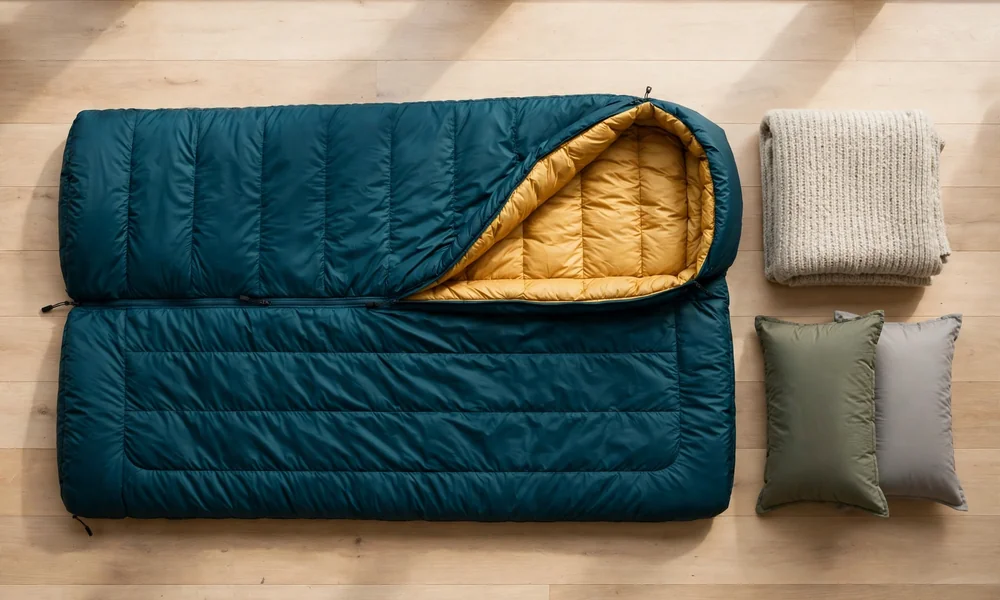
Run through this checklist before you buy and before you pack. It takes five minutes and prevents most first-night problems.
- Measure your pads and tent floor, and confirm the bag fits both with room to spare.
- Check the rating against the coldest night you expect, then add a 10-degree margin for the colder sleeper.
- Confirm there are two full-length zippers, one on each side, with draft tubes along both.
- Test the bag lying down with your partner, on your sides and on your backs, before the trip.
- Pack a liner for extra warmth and a dry bag to keep the insulation dry.
- Air the bag out after every trip and store it loose, never compressed in its stuff sack.
Common Mistakes Couples Make
The most common mistake is buying a bag that is too small: a 55-inch width sounds generous until two adults and two pillows need at least 60 inches. The second is buying for the warm sleeper, which guarantees one cold, grumpy person by morning. The third is ignoring the pad, since a great bag on a thin pad still leaves you cold from below. Finally, never store the bag compressed: insulation loses loft when squeezed in a stuff sack for months.
Frequently Asked Questions
Can two single sleeping bags be zipped together?
Yes, if they are the same model with opposite-side zippers. Most brands make left-zip and right-zip versions of the same bag for this purpose. Zipped singles work, but they have a cold seam down the middle, so a true double is more comfortable.
What size sleeping bag do two people need?
Look for at least 60 inches of width and 78 inches of length, which fits two standard pads side by side. Taller couples should look for 82 to 84 inches of length.
What temperature rating is best for couples camping?
A 20-degree bag covers three-season camping for most couples. Buy for the colder sleeper and add a 10-degree margin below the coldest night you expect. Summer-only campers can choose a 30-degree bag.
Are double sleeping bags warm enough in winter?
Yes, provided the rating matches the conditions and you pair the bag with insulated pads. Shared body heat helps, because two people warm the air inside a double bag faster.
How do you wash a double sleeping bag?
Use a front-loading machine on a gentle cycle with a technical wash made for sleeping bags, then dry on low heat with clean tennis balls to restore loft. Never use a top-loader with an agitator, which can tear the baffles.
Is a double sleeping bag good for backpacking?
It can be, with a lightweight model such as the Big Agnes Dream Island 15 Double. Split the weight between two packs, one carrying the bag and the other the tent. Heavy rectangular doubles are not suitable for backpacking.
The Bottom Line
The best sleeping bags for couples fit the way two people actually sleep: wide enough to roll over, warm enough for the colder partner, and easy to get in and out of without waking each other. For most couples, the Kelty Tru.Comfort 20 Double is the right starting point, with the Big Agnes Dream Island 15 Double for backpackers and the Teton Sports Mammoth Queen for cold weather.


