
A good night of sleep can make or break a camping trip, and the best sleeping pads for camping in 2026 are the most important piece of gear standing between you and a miserable morning. A quality pad cushions your body against hard, uneven ground, and insulates you from the cold earth below, which steals body heat far faster than the night air.
Modern air pads pack down to the size of a water bottle while offering several inches of cushioning, insulated models keep campers warm well below freezing, and closed-cell foam pads remain the nearly indestructible budget option that never leaks. Picking the right pad comes down to matching its weight, warmth, and comfort to the way you actually camp.
This guide compares the best sleeping pads for camping in 2026 for every style and budget. We explain R-values in plain language, break down air, self-inflating, and foam designs, and show you what to look for before you buy.
Key takeaways
- Choose a pad with an R-value of at least 3 for three-season camping, and 5 or higher for cold-weather trips.
- Air pads are the lightest and most comfortable, self-inflating pads balance comfort and simplicity, and foam pads are the cheapest and most durable.
- A pad that is too short or too narrow will cost you more sleep than any other mistake, so check the dimensions before you buy.
- Always test your pad at home first, inflating it fully and lying on it for at least ten minutes.
- Pair your pad with the right sleeping bag, since insulation works as a system.
How to Choose the Best Sleeping Pad for Camping
Choosing a sleeping pad is simpler than it looks once you understand the four factors that matter most: warmth, comfort, weight, and durability. Every pad trades among these four, and the best choice is the one whose trade-offs match your trips.
Understanding R-Value and Warmth
R-value measures how well a pad resists heat loss to the ground, and it is the single most useful number when comparing pads. A higher R-value means more insulation. For summer camping, an R-value around 2 is enough. For spring and autumn, aim for 3 to 4. For winter camping, look for 5 or above.
Many campers underestimate how much warmth they lose to the ground. Even on a mild night, bare earth draws heat away from your body all night, leaving you shivering in a sleeping bag rated for much colder conditions. If you wake up cold, the pad is often the culprit, not the bag.
Air Pads, Self-Inflating Pads, and Foam Pads
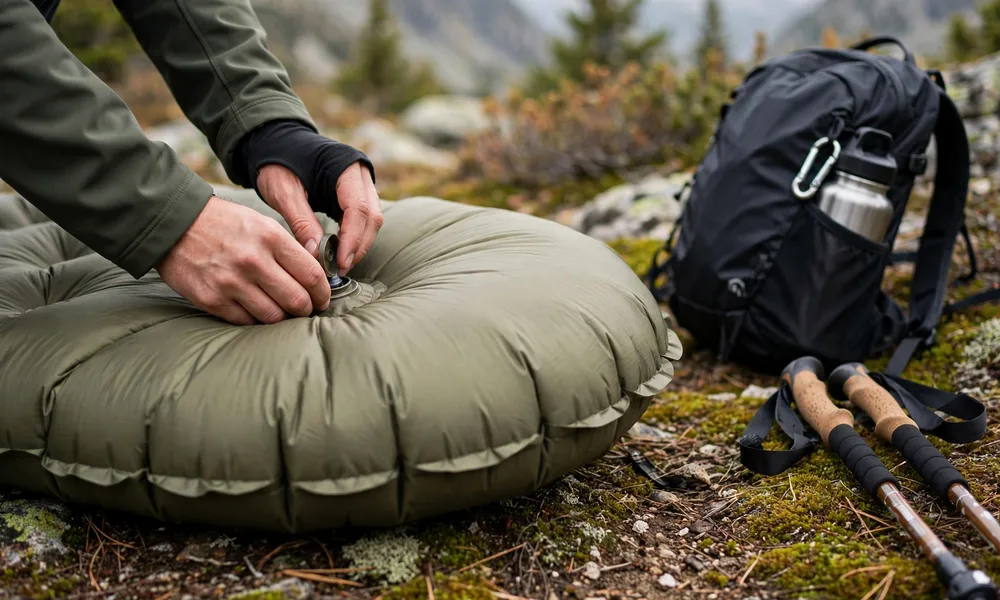
Air pads use baffled chambers that you inflate by mouth or with a pump sack, and they deliver the most comfort per gram of any design. The best models are several inches thick, which keeps hips and shoulders off the ground even for side sleepers. Their weakness is punctures, so carry a repair kit on longer trips.
Self-inflating pads combine open-cell foam with an air valve, so they expand on their own when you open the valve. They are heavier than pure air pads but simpler to use, since the foam inside still insulates even if the pad loses some air.
Closed-cell foam pads are the simplest option of all: a slab of dense foam that cannot leak, cannot pop, and costs very little. They are bulkier and thinner than air pads, so they suit car camping, short hikes, and use as a backup layer under an air pad in winter.
Weight, Packed Size, and Comfort
Weight matters most when you carry everything on your back. Ultralight air pads weigh under 400 grams and pack down smaller than a one-litre bottle. Car campers can ignore weight almost entirely and choose the thickest, most luxurious pad they can find.
Comfort is personal. Side sleepers need thicker pads, usually at least 7 centimetres, so hips and shoulders do not bottom out. Width matters too: a standard pad is about 51 centimetres wide, while wide versions run 64 centimetres or more and make a real difference for restless sleepers.
Best Sleeping Pads for Camping 2026 Compared
The table below compares the leading sleeping pads for camping in 2026 at a glance. Each one suits a different style of trip.
| Pad | Type | R-Value | Weight | Thickness | Best For |
|---|---|---|---|---|---|
| TrailRest Ultra Air | Air | 4.2 | 480 g | 8 cm | Backpacking |
| SummitSleep Insulated Pro | Air | 5.7 | 620 g | 9 cm | Cold weather |
| CampComfort Self-Inflating XL | Self-inflating | 4.8 | 1,150 g | 10 cm | Car camping |
| FeatherLite Air Lite | Air | 2.3 | 340 g | 6 cm | Ultralight trips |
| EverRest Foam Classic | Foam | 2.0 | 410 g | 2 cm | Budget and backup |
| CloudRest Double Wide | Air | 3.9 | 1,400 g | 12 cm | Couples |
| AlpineGuard Winter Max | Air | 6.5 | 780 g | 10 cm | Winter camping |
Best Overall: TrailRest Ultra Air
The TrailRest Ultra Air is our top pick for most campers because it balances warmth, comfort, and weight better than anything else in its class. At 480 grams with an R-value of 4.2, it handles three-season conditions with ease, and its 8-centimetre thickness is enough for side sleepers.
Best for Cold Weather: SummitSleep Insulated Pro
When temperatures drop, the SummitSleep Insulated Pro earns its place in your pack. Its reflective internal film and insulated baffles deliver an R-value of 5.7, which keeps you warm on frozen ground. It is only slightly heavier than the TrailRest, so it works for shoulder-season backpacking as well as winter trips. Pair it with one of the best sleeping bags for camping for a sleep system that handles genuine cold.
Best for Car Camping: CampComfort Self-Inflating XL
Car campers should look at the CampComfort Self-Inflating XL, a thick, wide pad that feels closer to a real mattress than any backpacking pad can. Open the valve, let the foam expand, add a few breaths, and you are done. At 10 centimetres thick with an R-value of 4.8, it is warm and comfortable.
Best Ultralight: FeatherLite Air Lite
The FeatherLite Air Lite weighs just 340 grams, making it the pick for fast-and-light hikers. Its R-value of 2.3 suits summer trips and warm climates, and its 6-centimetre thickness is comfortable for back sleepers. It is not the pad for cold nights, but for summer mountain trips it is hard to beat.
Best Budget: EverRest Foam Classic
The EverRest Foam Classic costs a fraction of the price of an air pad and will never let you down with a leak. It is a simple folding foam pad with an R-value of 2.0, and it doubles as a sit pad around camp and emergency insulation under an air pad.
Best for Couples: CloudRest Double Wide
Couples who camp together should consider the CloudRest Double Wide, a two-person pad that eliminates the gap between two single pads and the nightly slide into the middle. At 12 centimetres thick, it is one of the most comfortable pads here, and its R-value of 3.9 covers three-season use.
Best for Winter: AlpineGuard Winter Max
Serious winter campers need the AlpineGuard Winter Max, with its R-value of 6.5 and dual-layer insulation. It is the warmest pad in this guide and the one to trust on snow. Its 780-gram weight is remarkably light for its warmth.

How to Sleep Better on a Camping Pad
Even the best sleeping pad needs good technique. Start by clearing your tent floor of sticks, stones, and pine cones before you lay the pad down, since anything sharp underneath will press through and disturb your sleep.
Inflate your pad firmly, then lie on it and let out a little air until your hips just barely sink in without touching the ground. Most people over-inflate their pads, which makes them feel hard and bouncy. A slightly softer pad conforms to your body and sleeps far better.
Place the pad on the flattest part of your tent, with your head slightly uphill if the ground slopes. A small camping pillow, or a stuff sack filled with soft clothes, makes a surprising difference to how rested you feel.
Sleeping Pad Care and Repair
A little care goes a long way: store air pads unrolled with the valve open at home, which lets the internal foam relax and extends the pad’s life. Never store a pad compressed in its stuff sack for months, and keep pads out of direct sunlight.
Always carry a repair kit on multi-day trips. A leak that takes two minutes to fix in camp can ruin a trip without one. To find a slow leak, inflate the pad, submerge it section by section, and watch for bubbles. Clean your pad after each trip with mild soap and water, and let it dry fully before storage.
What to Check Before You Buy
The right pad lasts for years and the wrong one costs you sleep on every trip. Run through the checklist below before you spend your money.
- Check the R-value first: match it to the coldest night you expect, not the average night.
- Measure your tent: make sure the pad fits your tent floor with room to spare.
- Lie on it before you buy: if you can test a pad in a shop, lie on your side and check whether your hip touches the ground.
- Check the packed size: confirm the packed pad fits your backpack; foam pads strap outside the pack.
- Look at the valve: a good one-way valve makes inflation easy and deflation fast.
- Confirm the warranty: the best brands offer solid warranties and repair support.

Frequently Asked Questions
What R-value do I need for a sleeping pad?
For summer camping, an R-value of 2 is usually enough. For three-season camping, choose an R-value between 3 and 5. For winter camping, look for 5 or higher, and consider pairing an air pad with a foam pad underneath.
Are expensive sleeping pads worth it?
Yes, for most campers. A good pad lasts for many years and directly affects how well you sleep. Expensive pads are lighter, warmer, and more comfortable, and they usually come with better warranties. That said, a budget foam pad is fine for occasional car camping.
How do I stop sliding off my sleeping pad?
Choose a pad with a grippy, textured surface, and place it inside your sleeping bag’s pad sleeve if your bag has one. You can also put a thin foam pad underneath the air pad for grip.
Can I use a sleeping pad without a tent?
Yes, sleeping pads work well for cowboy camping under the stars, in bivvy bags, and under tarps. Just be careful about punctures from thorns and sharp ground. A foam pad is the safest choice for sleeping directly on the ground, since it cannot puncture.
How long do camping sleeping pads last?
A well-cared-for air pad typically lasts five to ten years, and a foam pad can last even longer. The most common failure is a valve problem or a puncture, both usually repairable. Store your pad unrolled with the valve open at home, keep it clean and dry, and it will serve you for many seasons.
Do I need a sleeping pad if I have a thick sleeping bag?
Yes. A sleeping bag’s insulation compresses under your body weight, which removes almost all of its insulating power underneath you. The pad provides the insulation between you and the cold ground, so even the warmest sleeping bag will leave you cold without a decent pad. Your sleep system needs both, just as it needs a good shelter like one of the best camping tents for families for a comfortable night outdoors.
The Bottom Line
The best sleeping pad for camping in 2026 is the one that matches your trips: a light, insulated air pad for backpacking, a thick self-inflating pad for car camping, or a simple foam pad for budget trips and backup duty. Check the R-value, test the comfort, and buy the warmest pad you can afford. And once your sleep system is sorted, complete your camp kitchen with one of the best camping stoves for families so every part of your trip is covered.


