Finding the best smart doorbells for small homes in 2026 is not like shopping for a large house. A cottage, compact townhouse or one-bedroom flat has a shorter entryway, a narrower frame and far less wall space, so a bulky doorbell with a wide mount and tangled wiring is the wrong fit.
The right model is slim, mounts without drilling, and watches a small porch without alerting you at every passer-by. Battery beats wired with no existing wiring, a tall narrow view matters more than a wide one on a shallow porch, and local storage beats a monthly bill.
We compared the leading models for size, mounting, video quality, motion detection and running costs, and ranked them for compact living. Below are the five best smart doorbells for small homes in 2026, a comparison table, a checklist and owners’ most-asked questions.
Key takeaways
- Battery doorbells suit most small homes best: no wiring, mounted with adhesive or small screws.
- Choose a slim body under 5 inches tall and a tall, narrow view, so it sees faces and parcels, not the whole street.
- Local storage or a free plan keeps running costs at zero for a single door.
- Renters should pick a no-drill mount that removes cleanly, and check rules for shared entrances first.
- The Ring Video Doorbell (Battery) is our top pick overall; the Eufy S220 is best with no subscription.

Why Small Homes Need a Different Doorbell
A doorbell for a large house assumes things a small home lacks: a wide porch, a deep garden, existing wiring and plenty of free wall. On a cottage or a flat, the mount overhangs a narrow frame, the camera watches the pavement, and the sensor fires at every passer-by.
Small homes sit closer to the street, shared hallways and neighbours, so there is more foot traffic in the detection zone and more false alerts. Adjustable motion zones and person-only alerts matter more here than extra features.
Power is the other dividing line. Many older cottages and flats were never wired for a doorbell, and new cable through solid walls is expensive and messy. Battery models sidestep the problem, lasting two to six months per charge. That is why the strongest smart doorbells made for full-size homes are not always the best choices here: they assume wired power and wide coverage a small entrance does not need.
What to Look For in a Doorbell for a Small Home
Four things decide whether a doorbell works in a compact space: size, power, field of view and running costs.
Size and mounting
Measure the flat surface beside your door first. Many small homes have under two inches of clear trim, so a doorbell under 5 inches tall and 2 inches wide fits easily. Check for a wedge mount and a no-drill adhesive mount if you rent.
Power: battery beats wired
Battery doorbells are the default choice for small homes. They install in fifteen minutes, work during a power cut, and move with you. Expect to recharge every two to six months, more often in a busy spot. Wired models suit owners with existing wiring, but cost more to fit.
Field of view
For a small porch, a tall view beats a wide one. A 3:4 portrait-style camera shows the visitor head to toe and the parcel at their feet, while a very wide 180-degree lens mostly shows your neighbours’ doors. Look for a vertical view of at least 100 degrees and clear two-way talk.
Storage and subscriptions
Every smart doorbell records video somewhere, and that is where the hidden cost lives. Some brands keep clips on the device or a base station for free; others need a monthly plan to save anything. Check what you get with no plan first. Our roundup of the best smart doorbells overall explains subscriptions, but the rule is simple: the cheaper the running cost, the better the fit for a small home.

The Best Smart Doorbells for Small Homes at a Glance
| Doorbell | Power | Video | Field of view | Storage | Best for |
|---|---|---|---|---|---|
| Ring Video Doorbell (Battery) | Battery | 1080p HD | 150° | Cloud plan | Best overall |
| Google Nest Doorbell (Battery) | Battery | 1080p HDR | 145° | Free 3 hours | Best tall view |
| Eufy Video Doorbell S220 | Battery | 2K | 160° | Local, no fee | Best without subscription |
| Blink Video Doorbell | AA batteries | 1080p HD | 135° | Cloud or local | Best budget |
| Arlo Video Doorbell 2K | Battery or wired | 2K HDR | 180° | Cloud plan | Best video quality |
The Best Smart Doorbells for Small Homes in 2026
Each pick was judged on fit for a small entrance first and specification second. All five are compact, install without an electrician, and suit a single front door.
1. Ring Video Doorbell (Battery) — Best Overall
The battery-powered Ring is the safest all-round choice for a small home. Slim enough for a narrow frame, it runs for months on a removable battery, and the quick-release mount lets you charge it without tools. Video is crisp 1080p HD with a 150-degree view, covering a small porch and its path without pulling in the street.
Ring earns its place at the top with its app. Motion alerts arrive fast, person detection is reliable, and motion zones are easy to draw tightly around a small entrance. It also pairs with a Ring Chime or Echo speaker. The drawback is the subscription: without a Ring Protect plan there are no recorded clips, only live view and alerts.
2. Google Nest Doorbell (Battery) — Best Tall View
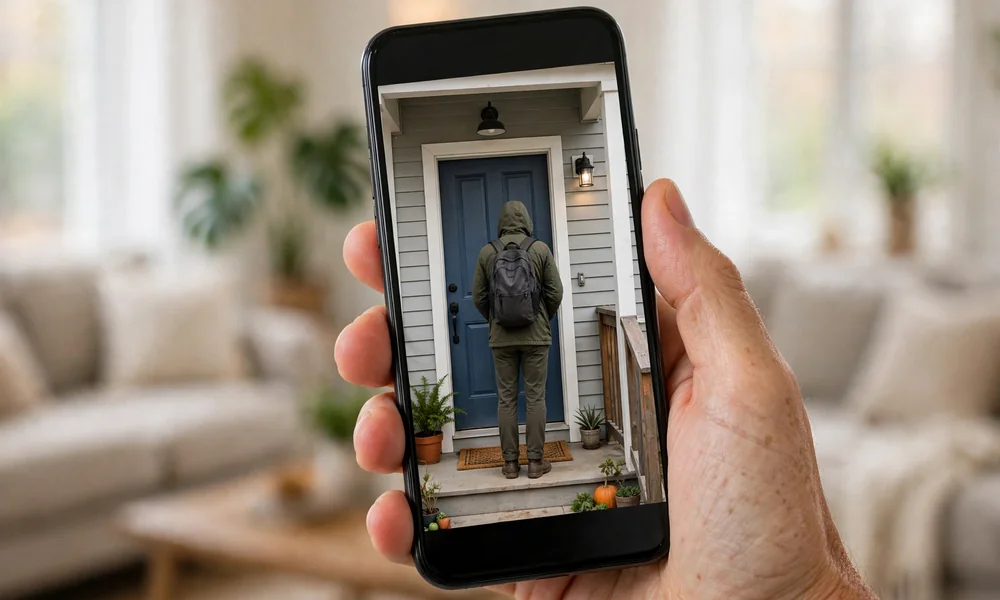
The Nest Doorbell (Battery) is the cleverest pick for a tight porch: its 3:4 portrait video shows the visitor’s face, the parcel at their feet and the step below. Most doorbells shoot wide video that wastes half the frame on fences and walls; the Nest points it where it counts. Video is strong 1080p HDR, and the camera handles backlight well, which helps on a sun-facing porch.
Google includes three hours of free event history with no plan, plus smart alerts that tell people, animals and vehicles apart. It works best with Google Home, and its clean rounded design suits a modern flat. Battery life is one to three months in a busy spot, so flats on a shared stairwell charge it more often.
3. Eufy Video Doorbell S220 — Best Without a Subscription
If you never want a monthly fee, the Eufy S220 is the pick. It records sharp 2K video to a home base station with local storage: no cloud bill, no footage leaving your home. Compact, with a six-month battery and minutes-long setup.
Video beats the 1080p models, with good night detail and a 160-degree view. The Eufy app is fast and alerts are dependable, though smart detection trails Ring and Google slightly. For the best picture with zero running costs, that is an easy trade.
4. Blink Video Doorbell — Best Budget
The Blink Video Doorbell is the cheapest way to put a smart camera on a small home, and one of the smallest. It runs on two AA batteries lasting up to two years in light use, is barely wider than a matchbox, and mounts with screws or adhesive. For a rented flat or a first smart doorbell, that combination is hard to beat.
The compromise is video: 1080p HD with a narrower 135-degree view and simpler motion detection. It still covers a small porch, and works with a Blink Sync Module for local storage or a low-cost cloud plan. If your budget is tight and your entrance is small, this makes the most sense.
5. Arlo Video Doorbell 2K (2nd Gen) — Best Video Quality
The Arlo Video Doorbell 2K is the pick for the sharpest picture. Its 2K HDR video picks out faces and parcel labels clearly at night, and the 180-degree diagonal view covers a wide porch and both sides of the door. It runs on battery or wired power.
Arlo’s app is polished, with fast alerts and useful smart detection, and the doorbell connects directly to Wi-Fi without a hub. As with Ring, the catch is the subscription: full history needs an Arlo Secure plan. If image quality is your priority, this is the best-looking feed for a small home.
Installing a Smart Doorbell in a Small Space
Installation is the easy part; most owners finish in under half an hour. Hold the doorbell where you plan to mount it and check the live view before fixing anything. The camera should sit about 48 inches up, angled toward the path, with the visitor’s face in the top half.
For renters, a no-drill adhesive mount is the answer. Clean the surface, press the mount firmly for a minute, and leave it a day before hanging the doorbell. Owners can use the two small screws in the box; the holes are tiny and easy to fill. If the frame is too narrow, a wedge bracket angles the camera from the wall beside it.
Wi-Fi is the last thing to check. Small homes usually have the router close to the door, but thick stone walls in older cottages can weaken the signal. If the live view stutters, move the router closer or add a small extender in the hallway. A strong signal matters most: a doorbell that cannot reach your phone misses visitors.
Small-Home Doorbell Checklist
Run through this list before you buy.
- Measure the mounting surface and confirm the doorbell fits, wedge included.
- Choose battery power unless you have working wiring, and check battery life for busy spots.
- Pick a tall view that shows faces and parcels at your feet, not a wide lens that films the street.
- Check the free plan and the true yearly cost with any subscription.
- Confirm the mount suits your home: adhesive for renters, screws for owners, a wedge for narrow frames.
- Test Wi-Fi at the front door and make sure alerts reach your phone fast.
Frequently Asked Questions
Do I need existing doorbell wiring?
No. Battery models work with no wiring at all, which is why they suit small homes and rented flats. You charge the battery every few months, and the doorbell rings through your phone or an optional plug-in chime.
What is the best smart doorbell for a rented flat?
A compact battery model with a no-drill adhesive mount, such as the Ring Video Doorbell (Battery) or the Blink Video Doorbell. Both remove cleanly at the end of a tenancy. Check your lease and building rules first. Our guide to doorbells built for apartments covers renter-friendly options.
How long does a battery doorbell last?
It depends on how busy your entrance is. In a quiet cottage, most last three to six months. On a shared stairwell or street-facing flat, expect one to three months. Shorter motion zones and person-only alerts stretch battery life.
Can a smart doorbell see parcels at my door?
Yes, if the view is tall enough. Portrait-style models, such as the Google Nest Doorbell, show the ground where parcels sit. Wide-angle models can miss them, so check the vertical angle before you buy.
Do I have to pay a monthly subscription?
Not always. Eufy records locally with no fee, and Google gives three hours of free event history. Ring, Arlo and Blink keep full history behind a plan, though live view and alerts still work without one. Decide how much history you need.
Will a smart doorbell work with weak Wi-Fi?
It may struggle. Video doorbells need a steady connection, and thick walls in older small homes can block it. Test Wi-Fi at the front door first, and move the router closer or add an extender if the signal is weak.
The Bottom Line
The best smart doorbells for small homes in 2026 are slim, battery-powered and cheap to run. The Ring Video Doorbell (Battery) is the best all-round choice, the Google Nest Doorbell (Battery) is best for a tight porch thanks to its tall view, and the Eufy S220 is best if you refuse a subscription. Measure your frame, check the free plan and test your Wi-Fi first.