The best smart thermostats for apartments in 2026 do more than change the temperature from the sofa. They learn your routine, cut wasted heating and cooling in small spaces, and give renters real control over comfort without rewiring the whole flat. For apartment dwellers, the right thermostat installs in minutes, works with the heating system you already have, and comes off cleanly when you move out.
Apartments are not small houses. A single room can swing from stuffy to chilly in an hour, radiators and window units behave differently from central heating, and many renters cannot drill or rewire without permission. That changes which features matter most. A thermostat built for a detached house may be overkill, while a renter-friendly model with room sensors and a simple app can transform a one-bedroom flat.
This guide compares the strongest options for apartment living in 2026, explains what to check before you buy, and shows how to pick a model that saves money without annoying your landlord. Every pick below works well in small spaces, and each one earns its place for a different kind of apartment and a different kind of renter.
Key Takeaways
- The best smart thermostat for most apartments is a simple, renter-friendly model with strong app control and scheduling.
- Check your wiring first: many apartments lack a C-wire, so a model that works without one saves a costly workaround.
- Room sensors matter more in apartments than in houses, because one thermostat on a hallway wall cannot feel the bedroom.
- Radiators, electric baseboards, and window units need different thermostat types, so match the model to your heating system.
- A smart thermostat typically pays for itself through lower energy bills within the first year or two of use.
Why Apartments Need a Different Kind of Smart Thermostat
Apartment heating and cooling has quirks that a house never faces. Shared walls pass heat between neighbours, a sunny window can bake a living room while the bedroom stays cold, and a single thermostat often sits in the worst possible spot. A smart thermostat senses real conditions, learns your schedule, and adjusts in small steps.
Small Spaces Heat and Cool Unevenly
A one-bedroom apartment can have a five-degree difference between rooms. The living room warms up from cooking and sunlight, the bedroom stays cold near an outside wall, and the hallway where the thermostat lives feels like neither. A standard thermostat reads one spot and guesses the rest.
Smart thermostats with room sensors fix this by measuring the rooms you actually use. Place a sensor in the bedroom and the thermostat heats based on that room at night, then switches to the living room during the day.
Renters Face Different Rules
Most renters cannot make permanent changes to heating equipment, and many leases require written permission before swapping a thermostat. Most smart thermostats install with two or three wires and a screwdriver, and the original can go back on the wall in ten minutes when you move out. Keep the old unit and its screws in a labelled bag.
Always ask your landlord before installing. Many landlords welcome the upgrade because it protects their heating system and can lower energy costs. If permission is refused, smart radiator valves can still give you room-by-room control without touching the wiring. For more ideas on automating a rental without permanent changes, see our guide to the best smart plugs for home automation.
The Best Smart Thermostats for Apartments in 2026
We judged every model below on apartment-specific criteria: easy installation, C-wire flexibility, room sensors, app quality, heating-system compatibility, and value for money.
Google Nest Thermostat: Best Overall for Renters
The Google Nest Thermostat is the easiest recommendation for most apartment dwellers. It is slim, affordable, and simple to install, with a guided setup in the Google Home app that walks through each wire. It learns your schedule over the first week and lets you control everything from your phone. The main limitation is the lack of room sensor support, so if your bedroom runs cold, you may want a model with sensors instead.
Ecobee Smart Thermostat Premium: Best for Room Sensors
If your apartment has rooms that never feel the same temperature, the Ecobee Smart Thermostat Premium is the strongest choice. It ships with a SmartSensor that measures temperature and occupancy in a second room, and you can add more sensors for the bedroom or home office. The thermostat then averages the rooms you care about, or follows the room you are in. It also has a sharp touchscreen, air quality monitoring, and voice control.
Amazon Smart Thermostat: Best Budget Pick
The Amazon Smart Thermostat is the cheapest way into smart heating, and it is a surprisingly capable device for the price. It is compact and unobtrusive, controlled through the Alexa app, where you can set schedules, create routines, and adjust the temperature by voice. The trade-off is fewer advanced features: no learning schedule like the Nest, no room sensors, and a minimal display. But if your apartment is small and your heating system is standard, it delivers the essentials at a fraction of the cost of premium models.
Honeywell Home T9: Best for Multi-Room Comfort
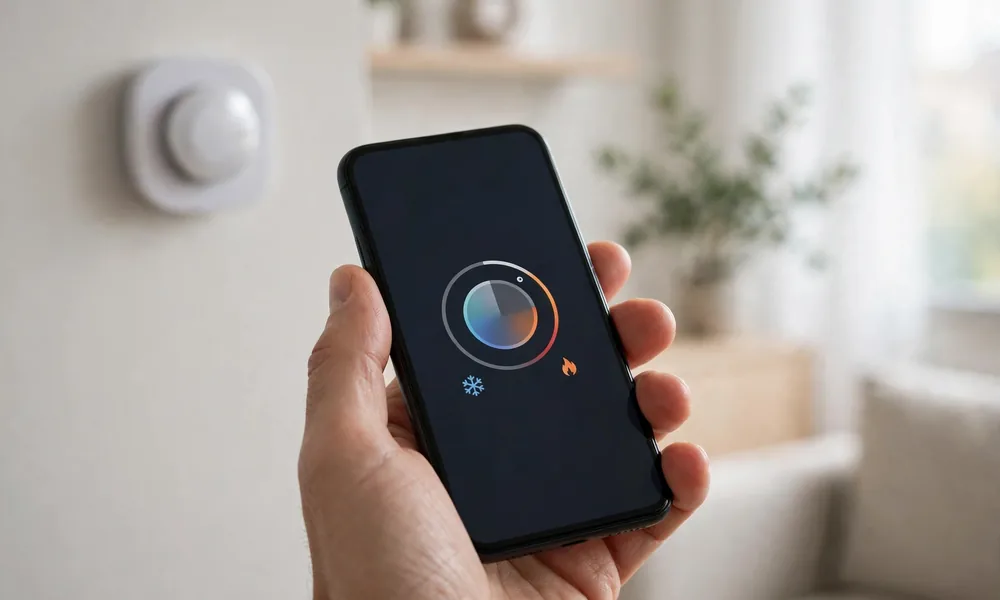
The Honeywell Home T9 is built around room sensors, and it does multi-room comfort better than almost anything at its price. It comes with one sensor in the box and supports up to twenty, so you can give every room in the apartment a voice in the temperature. You can schedule different rooms for different times of day, which is exactly what apartment living needs. The T9 also has a strong reputation for reliability and wide system compatibility, including many older heating systems found in apartment buildings.
Emerson Sensi Touch 2: Best Simple Setup
The Emerson Sensi Touch 2 is the best choice for renters who want a traditional thermostat feel with smart features underneath. It has a large, bright touchscreen that is easy to read and tap, and a setup process that is notably forgiving about wiring. Many apartments without a C-wire can run it with an adapter or a common-wire kit. Sensi also stands out for privacy: it needs no subscription, works with all major voice assistants, and stores your schedule on the device.
Smart Thermostats for Apartments Compared
The table below sums up the five picks side by side. Use it to narrow your choice, then read the detailed reviews above before deciding.
| Thermostat | Best For | Room Sensors | C-Wire Needed | Price Range |
|---|---|---|---|---|
| Google Nest Thermostat | Most renters | No | Usually yes | Budget to mid-range |
| Ecobee Smart Thermostat Premium | Uneven temperatures | Yes, included | Usually yes | Premium |
| Amazon Smart Thermostat | Budget buyers | No | Yes | Budget |
| Honeywell Home T9 | Multi-room comfort | Yes, included | Usually yes | Mid-range |
| Emerson Sensi Touch 2 | Simple setup | Yes, optional | Often no | Mid-range |
Prices vary by retailer and season, and many energy suppliers offer rebates that cut the cost further. Check with your local utility before buying, because a rebate can turn a premium thermostat into a mid-range one.
What to Check Before You Buy
A smart thermostat is only smart if it works with your apartment. Five minutes of checking before you order saves an afternoon of frustration and a return parcel.
C-Wire Compatibility
The C-wire supplies continuous power to a smart thermostat. Many apartments, especially older ones, do not have one. Before buying, remove your current thermostat cover and count the wires. If you see a wire labelled C, most models will work. If not, choose a model designed to run without one, or buy the matching power extender kit.
Landlord Permission
Ask your landlord in writing before you install. A short message explaining that the new thermostat is reversible, that you will keep the original, and that you will restore it when you leave is usually enough. Keep the reply with your lease paperwork.
Heating System Type
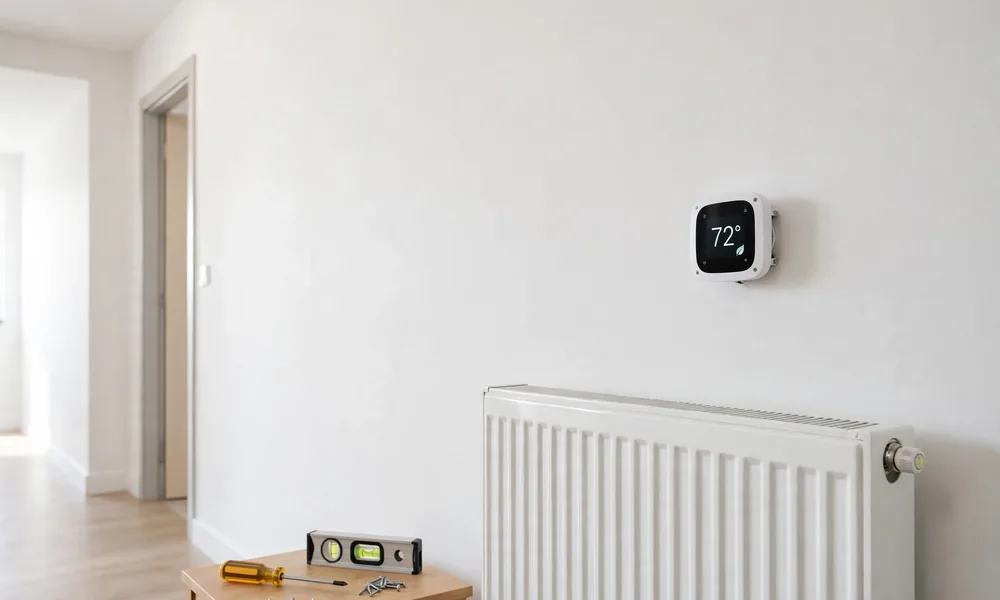
Not every thermostat works with every heating system. Forced-air systems and heat pumps are the easiest match. Radiators controlled by a central boiler may need a thermostat that supports millivolt or line-voltage systems, or a smart radiator valve instead. Electric baseboard heaters usually need a dedicated line-voltage smart thermostat.
Wi-Fi Strength
Smart thermostats need steady Wi-Fi for remote control and learning features. If your router sits far from the thermostat, or thick apartment walls weaken the signal, the thermostat may drop offline. A small Wi-Fi extender near the hallway usually solves this.
How Smart Thermostats Save Money in Apartments
The savings come from small, automatic decisions. A smart thermostat lowers the temperature while you sleep, eases off while you are at work, and warms the flat just before you return. It also learns how long your apartment takes to heat up, so it starts at the right moment instead of wasting energy.
In apartments, the effect is amplified because the space is small. A thermostat that avoids heating an empty flat for eight hours a day makes a real dent in the bill, and energy reports in the app show where the savings come from. Many users find the device pays for itself within a year. The same technology scales to larger spaces, as our round-up of the best smart thermostats for homes shows.

Apartment Thermostat Checklist
Run through this checklist before you buy and again on installation day.
- Confirm your heating system type and take a photo of the existing wiring before touching anything.
- Check for a C-wire, and buy the right power adapter or a no-C-wire model if you do not have one.
- Get written landlord permission and keep the original thermostat safe for move-out day.
- Place room sensors in the rooms you sleep and relax in, not in hallways or near windows.
- Set a schedule for sleep, work, and home hours, then let the thermostat learn and refine it.
- Turn on geofencing and energy reports so the thermostat saves energy automatically and shows you the results.
Frequently Asked Questions
Can renters install a smart thermostat?
Yes, in most cases, with the landlord’s permission. Installation usually takes under thirty minutes, uses the existing wires, and is fully reversible. Keep the original thermostat so you can restore it when you move out.
Do smart thermostats work without a C-wire?
Some do, and others work with a power extender kit. The Emerson Sensi Touch 2 is the most forgiving model in this guide, while the Nest and Ecobee usually need a C-wire or an adapter.
Will a smart thermostat work with radiators?
It depends on how the radiators are controlled. If a wall thermostat controls a central boiler, a standard smart thermostat usually works. If each radiator has its own manual valve, smart radiator valves are a better fit.
How much can a smart thermostat save in an apartment?
Savings vary with climate and habits, but many households save around eight to ten percent on heating and cooling. In a small apartment, that often means the device pays for itself within one to two years, and faster with a utility rebate.
Do I need room sensors in a small apartment?
Not always, but they help more than most people expect. Even a one-bedroom flat can have a cold bedroom and a warm living room, and one sensor in the bedroom usually fixes it.
What happens to my smart thermostat when I move out?
You can take it with you, or leave it for the landlord if you agreed that in advance. Either way, restore the original thermostat and reset the smart one. Small-space living rewards the same kind of smart, compact choices elsewhere too, from the best robot vacuums for small apartments to the lighting you choose.
The Bottom Line
For most apartments in 2026, the Google Nest Thermostat is the best all-round choice: simple to install, easy to live with, and fairly priced. If your rooms heat unevenly, spend more on the Ecobee Smart Thermostat Premium or the Honeywell Home T9 and let their room sensors do the work. If your budget is tight, the Amazon Smart Thermostat covers the essentials for very little money.