How to Choose Speaker Mounts That Hold Without Damaging Walls in 2026
Wall-mounted speakers sound better and free up every surface, but most people put the job off for fear of damaging the wall. The best speaker mounts of 2026 solve that worry: light bookshelf and satellite speakers need far less fixing than a television, and several mount types hold firmly with small holes, adhesive plates, or no drilling at all. This guide explains how to choose speaker mounts that hold without damaging walls in 2026, from matching the mount to your speaker and wall to fitting it cleanly.
Speaker mounts are a different product from the other ways of holding speakers. Our guide to speaker stands covers floor stands, which lift bookshelf speakers to ear level but take up floor space. TV mounts are a different job: our guide to TV mounts covers heavy screens on VESA bolts into studs, while a speaker mount holds a few kilos. If you have not chosen the speakers yet, start with our guide to the best speakers of 2026.
Key Takeaways
- Weigh your speaker first: most bookshelf speakers weigh two to five kilos, and the mount must be rated for at least one and a half times that weight.
- Match the fixing to the wall: screws into a stud or solid brick hold best, good plasterboard fixings hold light speakers well, and adhesive suits only the lightest speakers on smooth, clean walls.
- Check how your speaker attaches: a keyhole slot, a threaded insert, or a clamp-on shelf each need a different mount.
- A mount that tilts and swivels is worth paying for, because it aims the sound at your ears.
- Renters should favour small-hole fixings and removable adhesive mounts, and always test the mount with a firm pull before trusting it overnight.
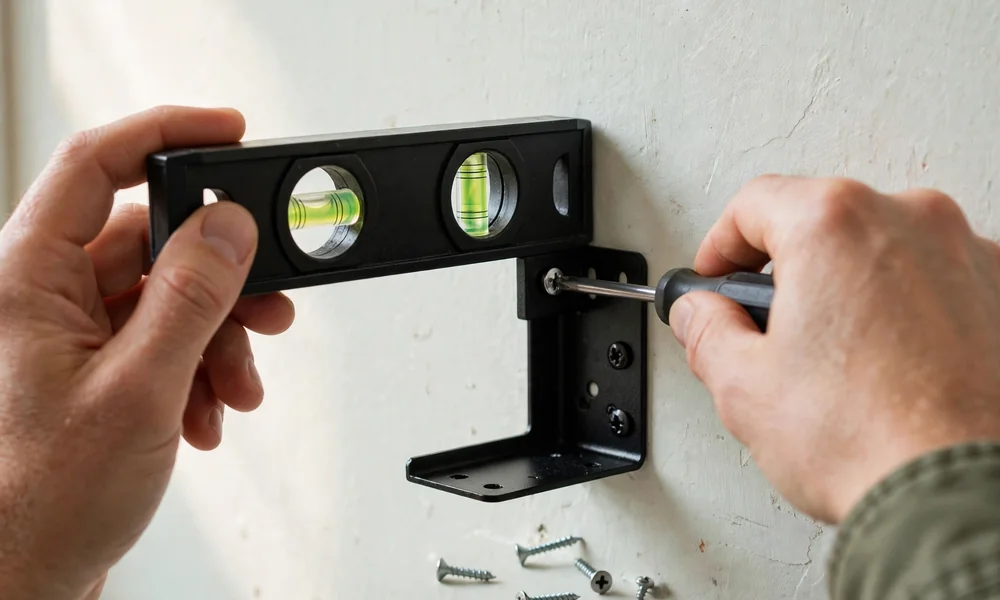
Why Mount Speakers at All
Speakers on a shelf or a sideboard rarely sit where they sound best. They end up too low or too close to the wall, and the sound suffers. A wall mount puts each speaker at ear level, angled toward the listener: voices get clearer, the stereo image steadies, and the bass stops booming.
Mounting also frees the room. A pair of bookshelf speakers takes up two shelf spaces or a whole sideboard, while the same pair on the wall leaves every surface clear. A good fixing leaves two small holes that filler hides in minutes.
The Main Types of Speaker Mount
Keyhole Wall Brackets
A keyhole bracket is a small metal plate screwed to the wall, with a screw head that slots into a keyhole-shaped hole on the back of the speaker. It is the simplest mount there is: two small screws, no moving parts, and the speaker sits close to the wall. It suits light satellite speakers and leaves the smallest holes of any screwed mount. The trade-off is no adjustment.
Threaded-Insert Arm Mounts
An arm mount bolts into a threaded insert on the back of the speaker and holds it on a short arm with tilt and swivel joints. It is the most flexible type: you can aim the speaker down toward a sofa or across a room, and adjust it again whenever the furniture moves. It needs a solid fixing, because the arm puts more leverage on the wall than a flat bracket.
Clamp and Shelf Mounts
A clamp or shelf mount grips the speaker from below, with side clamps or a small platform the speaker sits on, and needs no fixing on the speaker itself. It suits speakers with no keyhole or threaded insert. Check the platform size against the speaker footprint, and prefer a mount with a lip or strap that stops the speaker sliding off.
Ceiling Mounts
A ceiling mount hangs the speaker from above on a short pole or bracket, for rooms with no suitable wall or for surround speakers that belong high in the corners. It needs a solid ceiling joist, and it is the hardest type to fit well, so it suits a confident DIYer or a professional.
Adhesive and No-Drill Mounts
Adhesive mounts use high-strength removable strips to hold a light speaker with no holes at all. They are the renter-friendly option, and they work for small satellite speakers under about one kilo on smooth, clean, painted walls. They do not suit heavy speakers, textured walls, or steamy rooms.
Best Overall: A Threaded-Insert Arm Mount
The best all-round speaker mount in 2026 is a short arm mount that bolts into the speaker’s threaded insert and screws to the wall with two solid fixings. It holds bookshelf speakers up to about five kilos, tilts and swivels so you can aim the sound at your seat, The arm should lock firmly at each joint rather than relying on friction alone, because a joint that creeps will let the speaker droop within weeks.
What makes this type win is the combination of hold and adjustment. A keyhole bracket holds well but cannot aim the speaker, a shelf mount holds any speaker but takes up more wall, and an adhesive mount holds only the lightest speakers. Check the thread size before you order.
Best for Renters: A No-Drill Adhesive Mount
Renters need a mount that comes down cleanly, and the best no-drill mounts in 2026 do exactly that for light satellite and surround speakers. The mount uses removable adhesive strips rated for the speaker’s weight, pressed onto a clean, smooth wall and left to cure for a day before the speaker goes on. When you move out, the strips pull away without taking paint with them, and the wall looks untouched.
Be honest about the limits. Adhesive holds only light speakers, only on smooth walls, and only if the surface is clean and dry when you fit it. Test it with a firm pull, and never use it over the rated weight or on textured wallpaper. If your speakers are heavier than a kilo each, a keyhole bracket with two small screw holes is the better renter choice: the holes are tiny, and filler hides them completely when you leave.

Match the Mount to Your Wall
The wall decides the fixing, and the fixing decides whether the mount stays up. Solid brick and concrete are the best: drill, plug, and bolt. Stud walls are also fine, but only if the mount is screwed into the wooden stud itself, not into the plasterboard between studs. A stud finder is the most useful tool in this job; without it you are guessing.
Plasterboard alone can hold a light speaker with the right fixings. Specialist plasterboard anchors spread the load across the board and hold a speaker of two or three kilos safely, but check the rating on the packet and use the right number of fixings. Metal stud walls need specialist fixings. Drill a small pilot hole first.
How to Choose the Right Speaker Mount
Start with the weight. Weigh your speaker on a kitchen scale, then buy a mount rated for at least one and a half times that weight. A mount rated for two kilos will not hold a four-kilo speaker.
Next, check how the speaker attaches. Look at the back for a keyhole slot, a threaded insert, or nothing at all. A keyhole needs a keyhole bracket, a threaded insert needs an arm mount with the matching thread, and a speaker with neither needs a clamp or shelf mount. Measure the footprint too, since a shelf mount needs a platform at least as deep as the speaker.
Then think about the aim. A speaker that fires straight ahead from high on the wall sounds distant and thin, because the treble beams in a narrow cone and your ears sit below it. A mount that tilts down and swivels toward the seat fixes that. Finally, plan the cables first, with slack so the speaker can tilt without pulling the connection.
Speaker Mounts Compared
| Mount type | Weight limit | Wall damage | Aim adjustment | Best for |
|---|---|---|---|---|
| Keyhole bracket | Up to 3 kg | Two small holes | None | Light satellite speakers |
| Threaded-insert arm | Up to 5 kg | Two screw holes | Tilt and swivel | Bookshelf speakers |
| Clamp or shelf mount | Up to 5 kg | Two screw holes | Limited tilt | Speakers with no fixing point |
| Ceiling mount | Up to 5 kg | Joist fixing | Tilt and swivel | Surround speakers, no wall |
| Adhesive no-drill | Up to 1 kg | None | None | Renters, light speakers |
No mount wins on every measure.
What to Avoid
The worst mount failures share a few causes. The first is a mount rated below the speaker’s weight: it may hold for a week, then creep, sag, or drop the speaker in the night. The second is fixing into plasterboard with ordinary screws and no anchor, which pull out under a steady load. The third is a joint that relies on friction alone: it holds on day one and droops within a month, leaving the speaker pointing at the floor.
Also be wary of mounts with no cable plan. A speaker that cannot tilt because the cable is too short, or that dangles its cable down the wall, is a job half done. Skip mounts much cheaper than the rest: thin metal and weak joints.

Checklist: Before You Mount a Speaker
- Weigh the speaker and buy a mount rated for at least one and a half times that weight.
- Check the back of the speaker for a keyhole slot, a threaded insert, or neither, and match the mount to it.
- Find what the wall is made of and where the studs are; never hang a heavy speaker from bare plasterboard.
- Mark the height first: the tweeter at ear level from your usual seat, about 36 to 40 inches from the floor.
- Plan the cable route before you drill, with enough slack for the speaker to tilt.
- Test the mount with a firm pull before you trust it, and check it again after a week.
Frequently Asked Questions
Can I mount speakers on plasterboard?
Yes, for light speakers, with proper plasterboard anchors rated for the weight, or screws into the studs behind the board. Ordinary screws into bare plasterboard pull out.
Will speaker mounts damage the wall?
A screwed mount leaves two small holes, which filler and paint hide completely. An adhesive mount leaves no holes at all. The damage people fear comes from the wrong fixing, not from mounting itself.
How high should wall-mounted speakers be?
The tweeter should sit at ear level from your usual seat, usually about 36 to 40 inches from the floor for a sofa. Surround speakers can sit a little higher, around 48 inches, angled down. Higher than that, the sound passes over your head.
Can I mount speakers without drilling?
Yes, with adhesive mounts, but only for light speakers under about one kilo on smooth, clean walls. Clean the surface, press the strips on firmly, and leave them to cure for a day before hanging the speaker. For anything heavier, use a keyhole bracket with two small screw holes instead.
Do I need a mount if I already have stands?
Not always. Stands suit speakers that move between rooms; mounts suit tight floor space, homes with small children or pets, and home cinema speakers that belong high on the wall.
What if my speaker has no keyhole or threaded insert?
Use a clamp or shelf mount, which grips the speaker from below and needs no fixing on the speaker itself. Check the platform size against the speaker footprint, and choose a mount with a lip or a strap so the speaker cannot slide off.
The Bottom Line
The best speaker mount of 2026 is the one rated well above your speaker’s weight, matched to the fixing on its back, and fitted to a wall that can actually hold it. For most people that is a threaded-insert arm mount, or an adhesive mount for light speakers in a rented home. Weigh the speaker, check the wall, and test the mount before you trust it.