
The best stand mixers for small kitchens in 2026 prove you do not need a sprawling countertop to bake well. Compact models pack serious power into bodies that slide under standard cabinets and tuck into corners. If your counter space is measured in inches rather than feet, the right mixer changes how often you bake.
A full-size mixer can dominate a small kitchen, crowding out the chopping board, the kettle, and the coffee maker. The models in this guide earn their place: each is short enough to live on the counter, light enough to lift into a cupboard, and strong enough to knead dough, whip cream, and mix thick batter.
We compared footprint, height, bowl capacity, motor strength, and ease of use to find the mixers that genuinely suit tight spaces. Whether you bake bread every weekend or make a cake once a month, there is a compact mixer here for your kitchen and budget.
Key takeaways
- Measure cabinet clearance first: most compact mixers need 35 to 40 centimetres of height, and tilt-head models need room to open.
- A 3.5 to 4.5 litre bowl is the sweet spot for small kitchens.
- Tilt-head mixers are easier to use in tight spaces than bowl-lift models.
- Look for at least 300 watts if you plan to knead bread dough regularly.
- Weight matters: a mixer under 8 kilograms is far easier to lift in and out of a cupboard.

Why Size Matters More Than Power in a Small Kitchen
In a large kitchen, a stand mixer is a permanent fixture. In a small one, it is a negotiation: every centimetre matters, and a mixer that is too tall or too heavy becomes an appliance you dread using. The best compact mixers shrink the footprint without shrinking what the machine can do.
Height is usually the first problem: standard cabinets sit about 45 to 50 centimetres above the worktop, and many full-size mixers stand 40 centimetres tall before you tilt the head back. A compact mixer of 33 to 36 centimetres can stay on the counter permanently, so you will actually use it. Weight is the second problem: a 12 kilogram mixer is a two-handed lift, while compact models of 6 to 8 kilograms move with one hand. Power still matters, but the gap has closed, and a good 4 litre machine can knead a kilogram of dough.
What to Look For Before You Buy
Shopping for a compact stand mixer means checking different numbers than for a full-size machine. Bowl capacity and wattage still matter, but dimensions, weight, and storage matter just as much.
Footprint and Height
Measure the spot where the mixer will live, including the height to the underside of your cabinets. Leave at least 10 centimetres above a tilt-head mixer so the head can open fully.
Bowl Size and Weight
A bowl between 3.5 and 4.5 litres suits most small households, handling a standard cake, a batch of cookies, and a loaf of bread while staying light enough to wash by hand. Glass looks beautiful but adds weight and can chip, so stainless steel is usually smarter. Check for a bowl handle, because a full bowl of dough is awkward to lift without one.
Motor Power and Speeds
For light work such as whipping cream, 250 watts is enough. For bread dough, look for 300 watts or more, plus a slow speed that kneads without throwing flour across the room. Most bakers use only four speeds, and a planetary action, where the beater circles the bowl, mixes far more evenly than a fixed beater.
Attachments and Storage
A flat beater, a dough hook, and a wire whisk cover nearly every recipe, and extra attachments become clutter unless you will genuinely use them. If you already own a set of the best hand mixers for baking, a stand mixer with a whisk that reaches the bottom of the bowl will feel like a real upgrade rather than a duplicate.
The Best Stand Mixers for Small Kitchens 2026
These five mixers earned their places by balancing size, power, and price. Each fits comfortably in a small kitchen and handles the recipes most home bakers actually make. The table gives a quick overview, followed by a closer look at every pick.
| Mixer | Bowl | Height | Weight | Best for |
|---|---|---|---|---|
| Compact Classic 4.5L | 4.5 litres | 35 cm | 7.5 kg | Everyday baking |
| Mini Tilt-Head 3.5L | 3.5 litres | 33 cm | 6.2 kg | Smallest kitchens |
| City Baker Pro 4L | 4.0 litres | 36 cm | 8.0 kg | Bread dough |
| Quiet Whisk 4.2L | 4.2 litres | 34 cm | 7.1 kg | Open-plan living |
| Budget Compact 4L | 4.0 litres | 35 cm | 6.8 kg | First-time buyers |
Compact Classic 4.5L: The Best All-Rounder
The Compact Classic is the mixer most small kitchens should buy first. Its 4.5 litre steel bowl handles a double batch of cookies and a full loaf, while the 35 centimetre height slides under standard cabinets. The 350 watt motor kneads stiff dough without labouring, and the planetary action leaves no unmixed flour behind. The beater, hook, and whisk store inside the bowl, and at 7.5 kilograms the mixer lifts into a cupboard easily yet stays put while kneading, helped by suction feet.
Mini Tilt-Head 3.5L: The Best for the Smallest Kitchens
If your kitchen is genuinely tiny, the Mini Tilt-Head is the answer. At 33 centimetres tall and just 6.2 kilograms, it is the smallest serious mixer in this guide, fitting counters where nothing else will. The 3.5 litre bowl suits one or two people, handling a single cake, a batch of muffins, or a small loaf. The 300 watt motor manages cookie dough and light bread dough, and the whisk whips cream to stiff peaks in under three minutes. The trade-off is capacity: a double batch will overflow the bowl.
City Baker Pro 4L: The Best for Bread
Bread bakers need torque more than speed, and the City Baker Pro delivers it. Its 400 watt motor and metal gears knead dense wholemeal dough for ten minutes without heating up. The C-shaped hook pulls dough off the sides of the bowl instead of pushing it around. At 36 centimetres it is the tallest mixer here, so measure your cabinets first. The 4 litre bowl holds a kilogram of flour, and the splash guard keeps flour in the bowl. For a deeper look, our guide to the best stand mixers for bread compares the machines that handle heavy dough day after day.
Quiet Whisk 4.2L: The Best for Open-Plan Living
Stand mixers are noisy, and in a studio flat that noise travels. The Quiet Whisk runs noticeably softer than its rivals, thanks to a belt drive and dampened motor housing. You can hold a conversation while it whips cream, and an early morning bake will not wake the household. Quiet does not mean slow: the 320 watt motor creams butter and sugar smoothly, and the whisk makes glossy meringue in about four minutes. A soft-start brings the beater up gently, so icing sugar stays in the bowl.
Budget Compact 4L: The Best Value
The Budget Compact proves that a good small-kitchen mixer does not need a premium price. Its 4 litre bowl, 300 watt motor, and tilt-head design cover the essentials: cakes, cookies, and light dough without drama. The build feels solid where it counts, with metal gears and a sturdy base. There are compromises: six speeds rather than ten, and a motor that works harder on stiff dough than the City Baker Pro. None of these matter much for occasional bakers. Pair it with a compact setup, and the best electric kettles for small kitchens share the same thinking.
Tilt-Head vs Bowl-Lift: Which Fits a Small Kitchen?
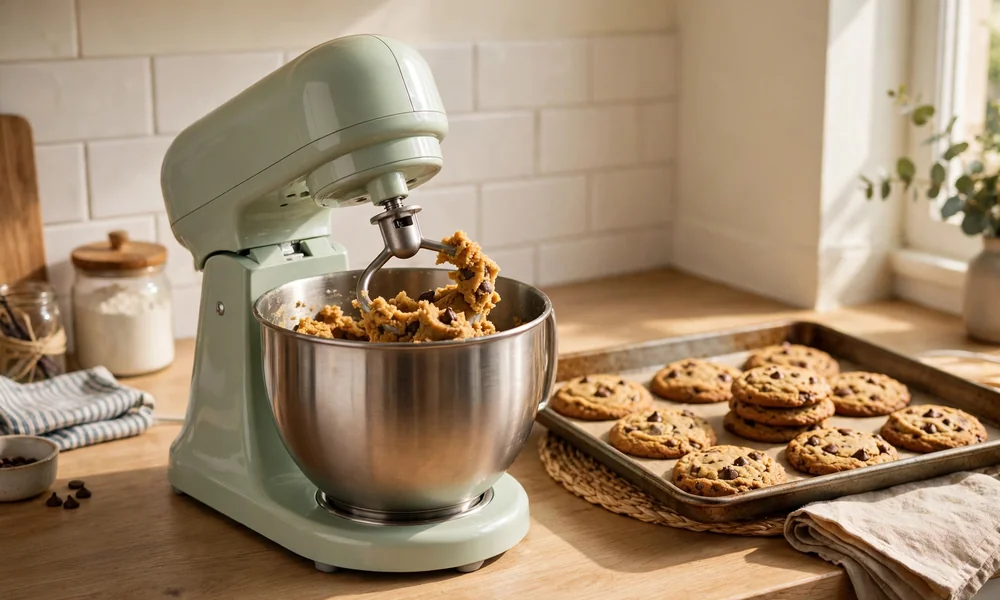
Most compact mixers use a tilt-head design, where the top hinges back so you can change the beater and scrape the bowl. Bowl-lift models raise the bowl on a crank instead. In a small kitchen, the tilt-head usually wins: it is shorter when closed and simpler to use, though it needs clearance above to open. A bowl-lift mixer is taller and needs room at the sides for the crank, making it harder to tuck into a corner. The exception is very low cabinets: below 38 centimetres of clearance, a bowl-lift model that never opens upward may suit you better.
How to Fit a Stand Mixer Into a Tiny Kitchen
Buying the right mixer is only half the job. The other half is giving it a home that does not steal your only stretch of free counter.
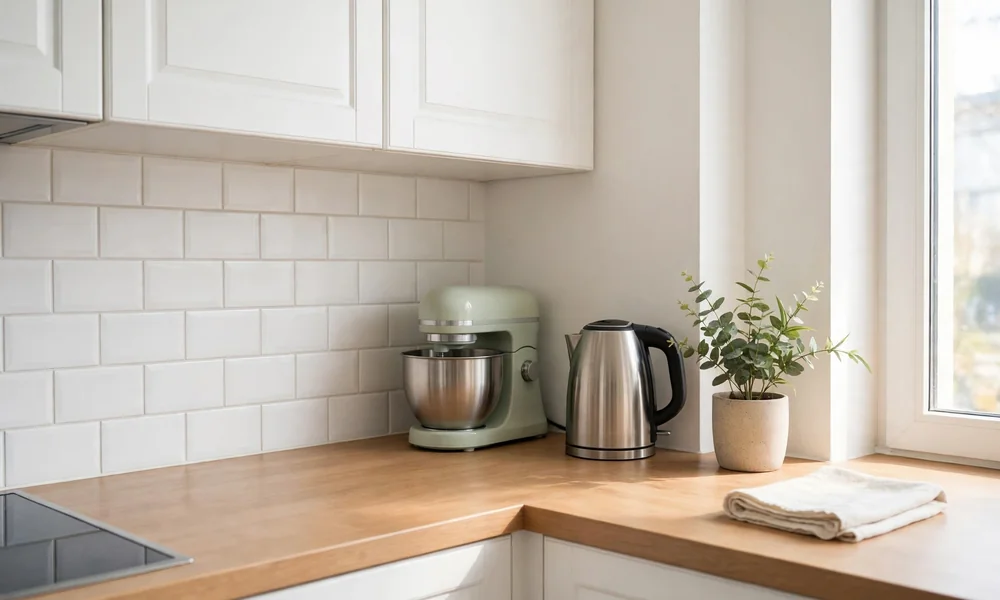
- Claim a corner: a corner spot uses dead space and keeps the mixer out of your main prep area.
- Use a sliding tray: a small tray lets you pull the mixer forward to use it and slide it back under the cabinet when you are done.
- Store attachments in the bowl: keeping the beater, hook, and whisk inside the bowl saves a drawer.
- Keep the cord short: wrap excess cord around the built-in hook so it does not sprawl across the worktop.
- Give it a permanent home: a mixer that lives on the counter gets used far more often than one in a cupboard.
- Clear the space above: move rarely used items off the shelf above the mixer so the head can tilt back freely.
Mistakes to Avoid When Buying a Compact Mixer
The most common mistake is buying on bowl size alone. A 5 litre bowl sounds generous, but on a compact machine it usually means a taller, heavier body that no longer fits the space. The second is ignoring the height of the tilt head: measure with the head raised, and leave a few centimetres to spare. The third is choosing the cheapest motor, since a mixer that stalls on dough will frustrate you and wear out faster. Finally, a 4 litre bowl of dough is heavy, so pick a mixer with a bowl handle.
Frequently Asked Questions
What size stand mixer is best for a small kitchen?
A bowl of 3.5 to 4.5 litres and a height of 33 to 36 centimetres suits most small kitchens, handling family recipes while fitting under standard cabinets.
Can a compact stand mixer knead bread dough?
Yes, if the motor is strong enough: look for at least 300 watts, metal gears, and a proper dough hook. Such mixers knead a kilogram of dough without overheating, though dense dough may need smaller batches.
Is a tilt-head or bowl-lift mixer better for small spaces?
A tilt-head mixer is usually better, because it is shorter when closed and simpler to use, though it needs clearance above to open. A bowl-lift mixer suits very low cabinets, since the head never moves, but it is taller.
How much counter space does a stand mixer need?
Allow roughly 35 by 22 centimetres for the mixer itself, plus a little room in front for the bowl and ingredients. A corner position works well, and a sliding tray makes it easy to pull out and push back.
Are compact stand mixers less powerful than full-size ones?
They can be, but the gap is smaller than it used to be. A good compact mixer with a 300 to 400 watt motor handles the same everyday recipes as a full-size machine. The real difference is capacity: a compact mixer makes one loaf where a full-size machine makes two.
Should I store my stand mixer in a cupboard?
You can, if the mixer is light enough to lift comfortably. Models under 8 kilograms are easy to move, while heavier ones are better left on the counter.
The Bottom Line
The best stand mixers for small kitchens in 2026 make baking possible where a full-size machine would not fit. Measure your counter and cabinets, choose a bowl that matches your household, and pick a motor strong enough for your recipes. The Compact Classic 4.5L is the best all-rounder, the Mini Tilt-Head 3.5L wins when space is tightest, and the City Baker Pro 4L is the pick for serious bread bakers. Whichever you choose, the right compact mixer earns its counter space every week.


