What Is a Tablet Holder? The Best Holders That Grip, Clamp and Stick in 2026
A tablet holder is a grip that holds your tablet where you can see it, without your hands and without a flat surface to spare. It clamps to the edge of a bedside table, sticks to the fridge, grips a bed frame on a bendable neck, or stands on the floor beside the sofa, and the tablet stays put while you watch, read, cook or call. The best tablet holders of 2026 keep a heavy screen steady at eye level, in the room where you actually use it.
Key Takeaways
- A tablet holder grips, clamps or sticks to something; a stand is a cradle on a flat surface and a mount fixes to one spot.
- Check the weight rating first: a tablet weighs three to five times as much as a phone, and a phone holder will sag or drop it.
- Clamp-on holders are the most useful type at home, because they grip an edge and leave the surface completely clear.
- A gooseneck holder is best for bed and sofa use, but a long arm wobbles under a heavy tablet, so shorter and stiffer holds better.
- Buy a holder that fits your tablet with its case on, and check that the charging port stays clear while the tablet is docked.
What Is a Tablet Holder?
A tablet holder is a device that grips the tablet itself and attaches it to something else: a table edge, a bed frame, a fridge door, a tiled wall or a floor base. The grip is usually a pair of spring-loaded jaws with rubber pads, a tray with a lip, or a magnetic plate, and the attachment is a clamp, a suction cup, a magnet or a weighted base.
A holder is not a stand. A stand is a cradle that sits on a flat surface and works by weight and balance: a heavy base keeps the tablet upright and the tablet rests in a fixed slot. Our guide to the best tablet stands covers those, A holder is for rooms where the flat surfaces are already full, or where there is no surface at all.
A holder is not a mount either. A mount is a holder with a permanent fixing: screws into a wall, a bracket bolted to a desk, an arm that lives in one place. Our guide to the best tablet mounts covers those fixed options, A holder is portable: you clamp it on, use it, and move it to another room tomorrow. If the tablet moves with you, buy a holder. If the tablet lives in one spot, buy a mount. The same holder logic works for phones, and our guide to the best phone holders covers the smaller versions, but a phone weighs 170 to 220 grams against a tablet’s 400 grams to more than a kilogram, so a phone holder’s jaws slip, its neck sags and its suction cup peels off.
The Six Types of Tablet Holder
Almost every tablet holder sold for home use in 2026 falls into one of six types, and the type decides what the holder is good at more than the brand does. Buy the type first and the model second.
Clamp-On Edge Holders: Best for Bedside and Desk Edges
Clamp-on holders grip the edge of a table, a headboard or a shelf with a screw clamp, and hold the tablet on a short arm or a ball joint. Check the clamp jaw opens wide enough for your table, usually 20 to 60 millimetres.
Gooseneck Holders: Best for Bed, Sofa and Hands-Free Watching
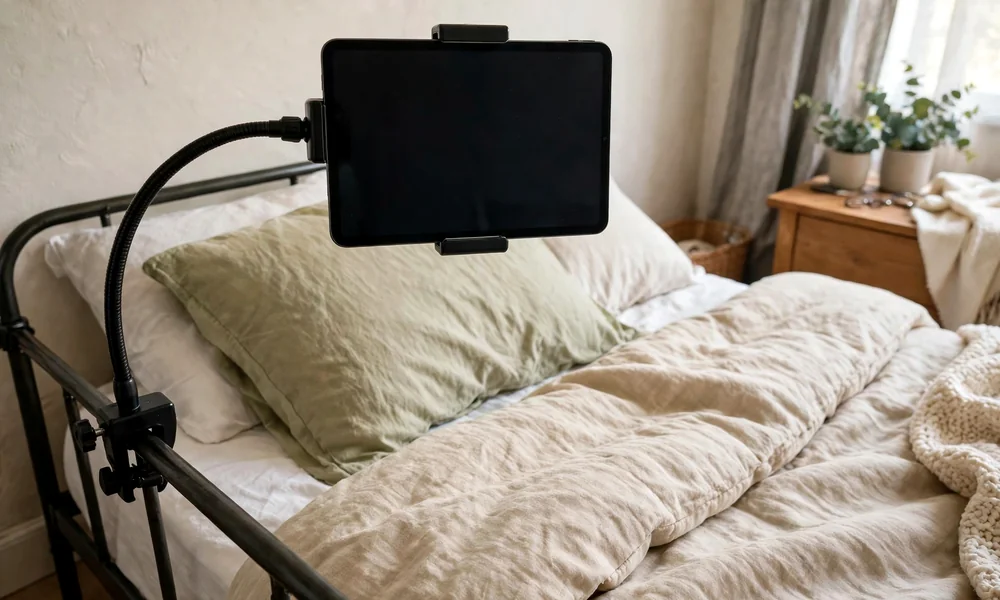
Gooseneck holders hold the tablet at the end of a long bendable neck, clamped to a bed frame, a table or a floor base, so the tablet can be bent into any position and held there.
Magnetic Holders: Best for the Kitchen and Quick Docking
Magnetic holders hold the tablet with a magnet instead of a clamp, which makes docking a one-handed flick and undocking just as fast. The catch is the hold: it only carries full weight with a strong magnet and a fitted plate, and a thick folio case will slide down a vertical fridge door.
Suction Holders: Best for Bathroom Tiles and Smooth Surfaces
Suction holders stick to a smooth surface with a suction cup, and they are the only holder type that works on a bathroom mirror, a tiled wall or a glass shower screen. They fail on textured tiles, painted plaster and anything dusty or greasy, so clean the surface first and press the cup firmly until the air is out.
Floor-Standing Holders: Best for the Living Room
Floor-standing holders are a weighted base on the floor with a tall pole and a gooseneck or an adjustable arm at the top. The base is everything: a light base tips over when the tablet is pushed to the edge of its reach, so look for a base of at least two or three kilograms with rubber feet.
Foldable and Travel Holders: Best for Moving Between Rooms
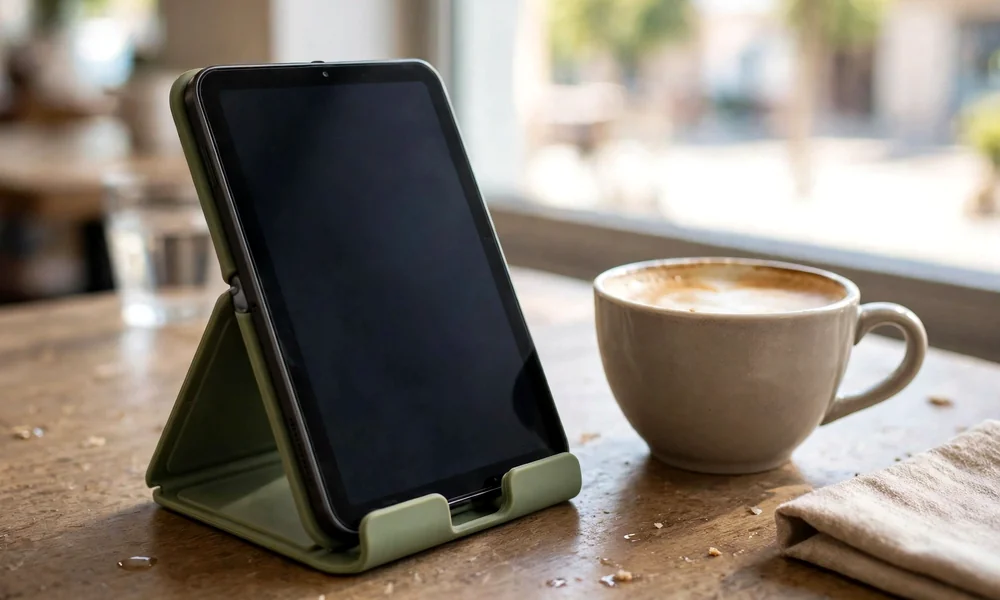
Foldable holders fold flat when they are not in use, slip into a bag or a drawer, and unfold in a second. The trade-off is stability: a folding holder is rarely as solid as a clamp-on or floor-standing one, so the build quality matters more.
Tablet Holders Compared
| Holder type | Best room | How it attaches | Watch out for |
|---|---|---|---|
| Clamp-on edge | Bedside, desk | Screw clamp on an edge | Jaw too narrow for thick tables |
| Gooseneck | Bed, sofa | Clamp plus bendable neck | Sagging under a heavy tablet |
| Magnetic | Kitchen | Magnet plus metal plate | Weak hold with a thick case |
| Suction | Bathroom | Suction cup on smooth tile | Fails on textured tiles |
| Floor-standing | Living room | Weighted floor base | Light base tips over |
| Foldable | Any room, travel | Folds flat, sits anywhere | Plastic hinges wear out |

The Best Tablet Holders by Room
The room decides the holder more than the catalogue does.
Bedside and Bedroom: The Clamp-On Holder Wins
The bedroom is the hardest room for a tablet holder, because the tablet is used in the dark, half asleep, and the holder must work without being looked at. A clamp-on holder on the edge of the bedside table is the best answer: the tablet sits at eye level when you are lying down, the screen is readable as a clock and an alarm without picking the tablet up, and the charging cable runs down the side of the table out of the way.
Kitchen: Magnetic and Suction Holders Earn Their Keep
The kitchen is the room where a holder earns its money, because a tablet on the counter is a tablet in danger. Flour, water, hot pans and sharp knives all share the same surface, and a recipe on a tablet lying flat is unreadable from a standing position. A magnetic holder on the fridge keeps the recipe at eye level and off the worktop, and the tablet comes off in one hand when the timer goes off.
Living Room: The Floor-Standing Holder Wins
The living room is where a floor-standing holder earns its place, because sofas rarely come with a table at the right height. A floor holder puts the tablet at face height beside the sofa, which is kinder to your neck than a tablet propped on a cushion, For video calls it is the best option in the house: the camera sits at eye level instead of looking up your nose, and the tablet does not slide every time someone shifts on the sofa.
What to Check Before You Buy
Run through these checks before you order, and you will avoid the commonest disappointment: a holder that fits the photograph but not your tablet.
Check the weight rating first. The rating should cover your tablet with its case on, with a margin to spare. Check the grip width as well: the jaws must open wide enough for the tablet plus its case, and the rubber pads must reach the tablet without squeezing the buttons.
Check the charging port next. The grip should leave the port clear while the tablet is docked, or the holder should have a cut-out for the cable. A holder that blocks the port means taking the tablet out every time the battery runs low, which defeats the point of a holder.
Finally, check the joints: a joint that creeps under the tablet’s weight will droop within days, and a ball joint that cannot be tightened is a holder with a short life. A clamp also needs an edge of the right thickness, a suction cup needs a smooth clean surface, and a magnetic holder needs a metal plate fitted to the tablet or its case.
Buying Checklist
- Check the weight rating covers your tablet with its case on, with a margin to spare.
- Check the grip width fits the tablet plus its case without pressing the side buttons.
- Check the clamp jaw fits your table edge, or the suction cup fits a smooth, clean surface.
- Check the charging port stays clear while the tablet is docked, or the cable has a cut-out.
- Check every joint locks, and the gooseneck is short and stiff rather than long and floppy.
- Check the holder turns from portrait to landscape, and folds or moves easily between rooms.
Frequently Asked Questions
What is a tablet holder?
A tablet holder is a grip that holds your tablet in place without your hands: it clamps to a table edge, sticks to a fridge or a tiled wall, or stands on the floor beside a sofa. It is different from a stand, which is a cradle that sits on a flat surface, and from a mount, which is fixed to one spot with screws.
Can I use a phone holder for a tablet?
Usually not. A tablet weighs three to five times as much as a phone and its screen is much wider, so a phone holder’s jaws slip, its neck sags and its suction cup peels off.
Which tablet holder is best for watching films in bed?
A gooseneck holder clamped to the bed frame or bedside table is the best choice for films in bed, because it floats the tablet over the mattress at eye level. Choose a short, stiff neck rather than a long, floppy one, because a long neck sags under a heavy tablet.
Will a tablet holder work with a case on?
Yes, if you buy for the cased size. Measure the tablet with its case on, including the thickness, and check the holder’s grip width and weight rating against those numbers.
Are suction tablet holders safe in the bathroom?
They are safe if you use them sensibly. Stick the cup to a smooth, clean tile or mirror, press out the air, and never hang the tablet over a hard floor or a sink without a lip or a safety tether.
What is the difference between a tablet holder and a tablet mount?
A holder grips the tablet and attaches to something temporarily, so you can move it between rooms. A mount is a holder with a permanent fixing, screwed to a wall or bolted to a desk, for a tablet that stays in one place.
The Bottom Line
The best tablet holders of 2026 are the ones that match the room and the weight: a clamp-on holder for the bedside, a magnetic or suction holder for the kitchen and bathroom, a floor-standing holder for the living room, and a foldable holder for travel. Check the weight rating with the case on, make sure the charging port stays clear, and buy joints that lock rather than joints that creep. Get those right, and the tablet will be where you want it.