Best Tent Lights for a Warm Glow Inside Your Tent in 2026
Getting the light right inside a tent changes the whole evening: the best tent lights of 2026 turn a dark fabric box into a place where you can read, cook, play cards and find your shoes without blinding each other. Tent lights are the fixed lights that live inside the tent: string lights clipped along the ceiling, small puck lights on the gear loft, and magnetic strips stuck to the poles. They differ from the lanterns and headlamps you carry around camp, and choosing the right kind comes down to brightness, warmth, battery life and how it hangs. This guide compares the main types, explains the numbers, and shows you how to light a tent properly.
Key Takeaways
- Tent lights are fixed interior lights, such as string lights and clip-on pucks, while lanterns are portable and headlamps are worn on your head.
- Warm white light around 2700K is the kindest inside a tent, easy on tired eyes and less attractive to insects than cool white.
- For most tents, 100 to 300 lumens spread across the ceiling is plenty; more than that just creates glare.
- USB-C rechargeable lights are easiest to live with, but a model that also takes standard batteries is safer on long trips.
- Hang lights high and spread them out for an even glow, and keep a dim red mode for late nights.
What Tent Lights Are, and What They Are Not
A tent light is any light designed to be fixed inside a tent and left there: string lights that clip to the ceiling seams, puck lights on the gear loft, and flexible strips with magnets that snap onto the poles. What they share is position: they stay put, light the whole interior at once, and switch on with a button or a remote rather than being picked up. They turn the tent into a room.
That fixed position separates them from the other lights in your kit. A lantern is a portable light you carry around camp and set on a table, covered in full in our guide to the best camping lanterns, from featherweight backpacking models to bright family lanterns. Hung inside a tent, a lantern works as a stopgap, but it throws light in every direction, including straight into your eyes, and it swings when you move. A headlamp, covered in our guide to the best headlamps, lights only what you look at: perfect for walking to the toilet block, useless for reading in bed. Tent lights fill the gap: hands-free, even, and always where you left them.
The Main Types of Tent Lights Compared
Every tent light trades brightness, weight, battery life and ease of hanging.
| Type | Brightness | Weight | Power | Best For |
|---|---|---|---|---|
| String lights | 100 to 200 lumens | 80 to 150 g | USB or battery | Even glow |
| Clip-on puck light | 100 to 300 lumens | 50 to 100 g | USB or battery | Reading |
| Magnetic strip light | 150 to 400 lumens | 100 to 200 g | USB-C | Family tents |
| Gear-loft light | 50 to 150 lumens | 40 to 80 g | Battery | Backpackers |
| Hanging lantern light | 200 to 500 lumens | 200 to 400 g | USB-C | Groups |
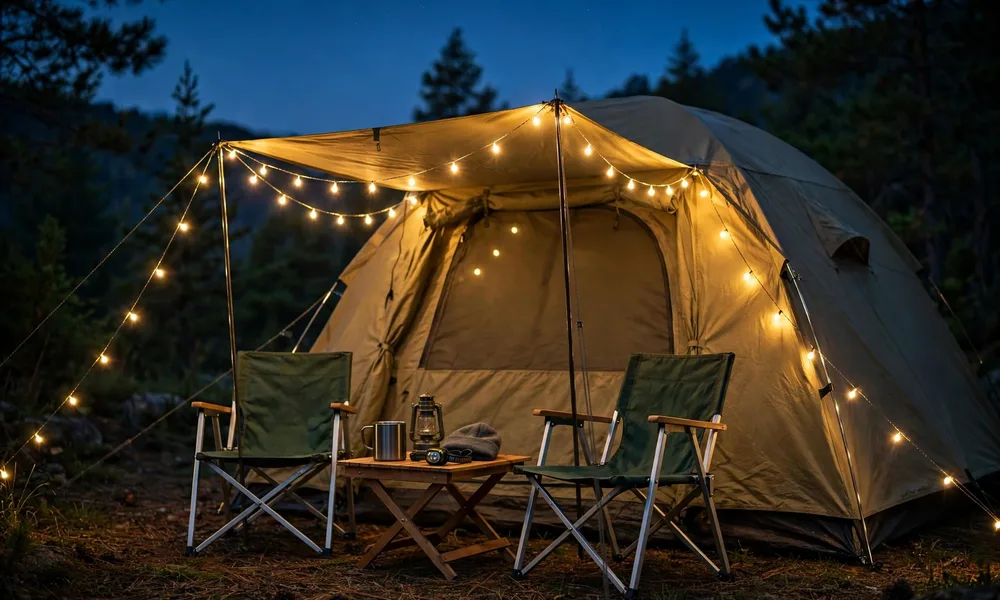
String lights are the most popular choice. One string clipped along the ceiling seams spreads dozens of small warm points of light across the whole tent, and the eye reads that scattered glow as warmth rather than glare. They pack down to nothing and most run for a whole weekend on one charge. Clip-on puck lights are the practical choice: one bright disc on the gear loft lights the sleeping area well enough to read by, and you can unclip it for a trip to the toilet block. Magnetic strips suit big family tents, where one puck is not enough, and snap onto steel poles in seconds. Gear-loft lights are the lightest option for backpackers, while hanging lantern lights are the brightest, best for groups who cook and eat inside a large tent.
Brightness and Colour: What the Numbers Mean
Lumens measure how much light a lamp gives out, and inside a tent the right number is lower than most people expect. A small two-person tent needs only 100 to 200 lumens spread across the ceiling, while a large family tent might need 300 to 400. More than that bounces off pale tent fabric and creates a harsh glare. Look for several brightness levels, so you can run it low for winding down and turn it up to find something in a bag.
Colour temperature matters just as much. Warm white light, around 2200K to 3000K, feels like candlelight: soft, relaxing and kind to tired eyes. Cool white, above 4000K, feels like a hospital corridor and attracts far more insects through the mesh door. Most good tent lights offer a warm setting as standard, and the best let you switch between warm and cool, or dim smoothly to a faint glow. A red-light mode is worth having too: it preserves your night vision, so you can step outside and still see the stars, and it does not wake a sleeping tent-mate.
Power and Runtime
Most tent lights now charge by USB-C, so the same cable charges your phone and your power bank. A string light on low can run for 20 hours or more, while a bright puck on high might manage six to eight. Manufacturers usually quote runtime on the lowest setting, which can mislead, so check the runtime on medium, the setting you will actually use.
Battery-powered lights still have a place. A light that takes three AAA batteries is easy to feed from a spares bag on a long trip, and never leaves you waiting for a charge. The smartest setup is a rechargeable light plus a small power bank, which covers a weekend easily and a week with care. Solar-charged string lights suit car campers who leave them draped over the tent all day, but they are unreliable on cloudy trips and in wooded pitches, so do not rely on them as your only light.

Hanging and Mounting a Tent Light
How a light hangs matters more than most buyers realise. The best come with clips, hooks or magnets that attach to the ceiling seams, gear loft or poles without damaging the fabric. String lights usually clip to the seams with small plastic hooks, and you can run them in a loop around the ceiling for even light on both sides. Puck lights clip to the gear loft mesh or hang from a short cord, and the highest point spreads furthest.
Before you buy, check how your tent is built. A gear loft gives you an obvious mounting point in the middle of the ceiling, while tents without one need clips on the seams or magnets on the poles. Avoid lights that need adhesive pads: they peel off in damp weather and leave sticky marks on the fabric. Do not drape a string light over a hot stove or a candle, and keep every light away from the tent walls, where condensation can drip onto the electronics. If you are still choosing the tent itself, our guide to the best camping tents explains which designs have the best lofts and ceiling loops for hanging lights.
Weather, Durability and Safety
Tent lights live in a damp, dusty environment, so build quality matters. Look for an IPX4 rating or better, which means the light survives splashes and rain dripping through the door; a light that cannot cope with condensation will fail on the second night of a wet trip. Check the housing too: a dropped light should survive, so a rubberised case or a flexible string beats a rigid plastic shell.
Safety is straightforward. Never leave a light charging inside a tent unattended, and never use a mains-powered light inside a tent: a damaged cable and a wet floor are a bad combination. Keep lights away from sleeping bags when they run hot, although most LEDs run cool enough to touch. A light left on all night drains its battery and attracts insects to the mesh door, so switch off when you sleep, even if the glow is pretty.
Mistakes That Spoil Tent Lighting
The most common mistake is buying a light that is too bright: a 500-lumen lamp inside a small tent is like a floodlight in a bathroom, and everyone ends up shielding their eyes. The second is choosing cool white light, which looks stark, attracts bugs and makes the tent feel cold. Warm white is almost always the better choice.
The third mistake is hanging one light in one corner. A single point of light throws hard shadows, so the far side stays dark while the near side glares; spread the light out, even if that means two smaller lights instead of one big one. The fourth mistake is forgetting a backup: a light that dies on night two of a four-night trip leaves you fumbling in the dark, so carry a spare puck or a headlamp. Finally, do not buy a light that needs a phone app. Apps fail, phones die, and a light with a simple button will always switch on when you need it.
Tent Lights Checklist
- Choose warm white light around 2700K, with a dimmer and a red mode.
- Match brightness to tent size: 100 to 200 lumens for two people, up to 400 for a family tent.
- Check the mounting: clips, hooks or magnets that suit your ceiling and gear loft.
- Pick USB-C rechargeable with a battery option, and pack a small power bank.
- Spread lights across the ceiling instead of hanging one in a corner.
- Carry a spare light, and check the IPX4 rating before a wet-weather trip.
Frequently Asked Questions
Are tent lights the same as camping lanterns?
No. Tent lights are fixed inside the tent, such as string lights and clip-on pucks, and stay where you put them. Lanterns are portable lights you carry around camp and set down on a table. A lantern can hang inside a tent as a stopgap, but it swings, glares and lights only one spot.
How many lumens do I need inside a tent?
For a two-person tent, 100 to 200 lumens spread across the ceiling is plenty. A four-person family tent needs 200 to 400. More than that creates glare on pale fabric, so a dimmable light beats a brighter one.
What colour light is best in a tent?
Warm white, around 2200K to 3000K, is the kindest choice. It feels relaxing, is easy on tired eyes, and attracts fewer insects than cool white. A red mode is useful late at night because it preserves your night vision.
How long do tent lights last on one charge?
It depends on brightness. A string light on low can run for 20 hours or more, while a bright puck on high might manage six to eight. Check the runtime on medium, the setting you will use most, and carry a power bank for longer trips.
Can I leave tent lights on all night?
You can, but there is little reason to. Lights left on all night drain the battery, attract insects to the mesh door, and disturb anyone trying to sleep. Use a dim red mode for a night light, and switch everything else off.
Do tent lights work in the rain?
Good ones do, as long as they stay inside the tent. Look for an IPX4 rating or better, which means the light survives splashes and condensation. Never use a mains-powered light in a tent, and never charge one inside a wet tent unattended.
The Bottom Line
The best tent lights are the ones you forget about until you need them: warm, even, dimmable, and fixed where you hung them. Start with a string light for glow and a clip-on puck for reading, and carry a spare. Get the light right and the tent stops feeling like a dark bag and starts feeling like a room.