
Best Thermostats Without Wi-Fi for Simple, Reliable Heating in 2026
Thermostats have quietly become complicated. Most of the thermostats on sale in 2026 want your Wi-Fi password, an app on your phone, and a cloud account before they will do the one job they exist for: switching the heating on and off at the right temperature. This guide is about the other kind. The best thermostats without Wi-Fi do that one job with a dial, a button, or a simple weekly schedule, and nothing else. There is no app, no account, no subscription, and nothing to stop working when the internet goes down.
That is a deliberate choice, not a compromise. A non-smart thermostat suits a rented flat, a holiday cottage with no broadband, an elderly relative who wants a dial they can turn, and any home where the boiler is old and simple. If you do want learning schedules and phone control, our guide to the best smart thermostats in 2026 covers that side, and the best versus worst thermostats comparison covers the whole market. This guide stays firmly on the simple side.
Key Takeaways
- A non-smart thermostat controls the heating with a dial or a simple schedule, and it keeps working when the Wi-Fi drops.
- Match the thermostat to the heating system first: low-voltage for boilers, line-voltage for electric heaters, millivolt for gas fires.
- Accuracy matters more than features: a good simple thermostat holds the room within a degree.
- Most non-smart thermostats run on batteries and need no C-wire, so they swap onto the old two wires.
- Buy for the people using it: a big clear dial suits a hallway, a lockable model suits a rental, a frost setting protects an empty house.
What a Non-Smart Thermostat Actually Is
A thermostat is a temperature sensor with a switch attached. It reads the temperature of the room, compares it with the temperature you asked for, and tells the boiler or heater to start or stop. A non-smart thermostat does exactly that and nothing more. It has no radio, no screen full of menus, and no connection to anything outside the wall it sits on.
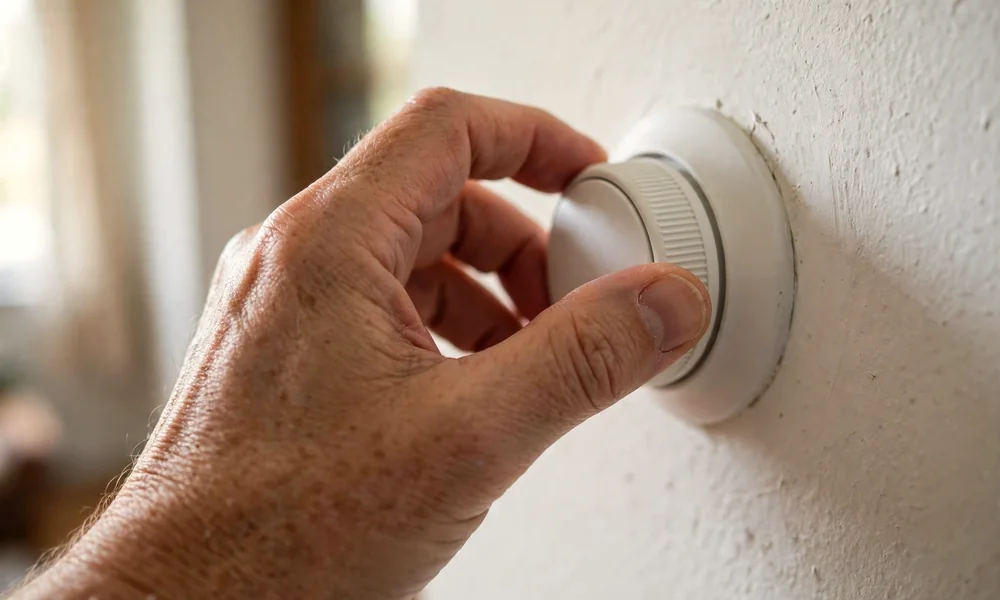
There are two main kinds. A mechanical thermostat uses a bimetal strip that bends as the room warms and cools, physically opening and closing the switch. It has no battery, no screen, and nothing to program: the round dial most people picture when they think of a thermostat. A programmable thermostat adds a small screen and a clock, so it can turn the heating down at night and up before you wake, on a seven-day schedule set with a few buttons. The schedule lives inside the device, so it survives a power cut.
The Types of Non-Smart Thermostat Compared
Buying the wrong type is the most common expensive mistake with simple thermostats. A thermostat built for a gas boiler will not work on an electric baseboard heater, and one built for a gas fire will not work on either.
| Type | Heating system | How it works | Best for |
|---|---|---|---|
| Mechanical dial | Gas boiler, furnace, heat pump | Bimetal strip switches the heating on and off | Simple homes, rentals, elderly users |
| Programmable (non-connected) | Gas boiler, furnace, heat pump | Seven-day schedule set on the device | Regular routines, saving energy overnight |
| Line-voltage | Electric baseboard and wall heaters | Switches mains power directly | Rooms heated by electric heaters |
| Millivolt | Gas fires, gas wall heaters | Runs on the tiny voltage the pilot light makes | Gas fires with no mains power nearby |
| Underfloor | Electric or water underfloor heating | Floor sensor plus air sensor | Bathrooms and kitchens with warm floors |
If you are unsure which system you have, look at the heater itself. A boiler with radiators almost always takes a low-voltage thermostat. A wall-mounted electric heater with a dial on its side almost always needs a line-voltage model. A gas fire with a pilot light takes a millivolt model. When in doubt, photograph the old wiring before you touch it.
The Best Thermostats Without Wi-Fi in 2026
We judged every thermostat on the things that matter when there is no app to hide behind: how steadily it holds the set temperature, how easy it is to set and read, how well it is built, and how honestly it is priced.
Best Overall: Honeywell Home T87N Round Mechanical Thermostat
The round Honeywell has sat on hallway walls for decades, and it is still the best mechanical thermostat you can buy. The dial turns with a smooth, weighted feel, the markings are large and clear, and the bimetal element holds the room within about a degree of the setting. There is no battery to change and no screen to go dark. It suits a gas boiler or furnace and fits the standard two-wire mounting. Its only real limitation is that it holds one temperature all day unless someone turns the dial.
Best Programmable: Honeywell Home RTH221B Basic Programmable Thermostat
The RTH221B is the best programmable thermostat for people who want a schedule without a smartphone. It holds four periods a day across a seven-day week, set with three buttons and a backlit screen readable from across the room. It runs for about a year on two AA batteries, needs no C-wire, and keeps its program through a power cut. Its swing is tighter than a mechanical dial, usually within a degree.
Best for Electric Heaters: Honeywell TL7235A Line-Voltage Thermostat
Electric baseboard and wall heaters need a line-voltage thermostat, and the TL7235A is the strongest of them. It switches mains power directly, so it must never be fitted in place of a low-voltage boiler thermostat, but for an electric heater it is exactly right. It offers a seven-day program, a large display, and a frost-protection mode.
Best for Gas Fires: Honeywell TH1100DV Millivolt Thermostat
A gas fire with a standing pilot light makes its own tiny voltage, and a millivolt thermostat runs on it. The TH1100DV needs no battery and no mains power at all, which makes it the only thermostat that keeps working through a power cut in a home heated by a gas fire. Check that your fire has a millivolt gas valve before buying: most modern fires do, but some need a mains-powered control instead.
Best Budget: Emerson 1E78-140 Mechanical Thermostat
The Emerson 1E78-140 is the cheapest thermostat in this guide that is still worth fitting. It is a plain mechanical dial with a clear temperature scale, a simple heat-off switch, and a mercury-free bimetal element. It switches reliably, costs very little, and is the sensible pick for a landlord, a workshop, or a room that only needs the chill taken off.
Accuracy and Temperature Swing
The number that matters most on a simple thermostat is one the box rarely prints clearly: temperature swing, also called differential or hysteresis. It is the gap between the temperature at which the heating switches on and the temperature at which it switches off. A thermostat with a wide swing lets the room drift two or three degrees either side of the setting, so you feel cold, then too warm, then cold again. A good one holds the room within about a degree, and the heating feels steady rather than lurching.
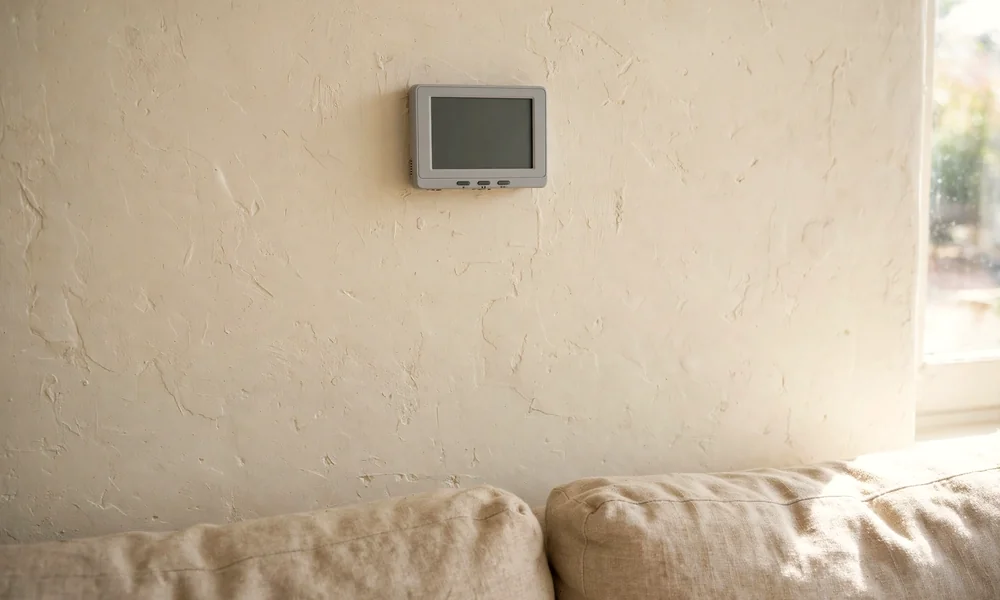
Mechanical dials swing widest, typically around two degrees; electronic programmable models usually stay within a degree. Placement matters as much as the device: a thermostat on a cold outside wall, above a radiator, or in direct sun will read the wrong temperature no matter how good it is. The right spot is an inside wall, about chest height, in the room you actually live in. A room thermometer left beside the sofa for a week is the honest way to check whether the thermostat is telling the truth.
Fitting One Yourself
Swapping a non-smart thermostat for another non-smart thermostat is one of the simplest home jobs, because the wiring is almost always just two low-voltage wires. Switch the heating off at the fused spur or breaker first, photograph the old wiring, and label the wires before you remove anything. Three rules keep the job safe. First, never fit a line-voltage thermostat on a low-voltage boiler circuit, or the other way round: the two are not interchangeable, and mixing them up can damage the boiler controls. Second, if the old thermostat has more than two wires, or the wires are thick mains cable rather than thin bell wire, stop and get a heating engineer. Third, test it before you screw the cover back on: turn it up and listen for the boiler firing, then turn it down and listen for it stopping.

Choosing the Right One for Your Home
Start with the household, not the product. A retired couple who are home all day need a clear dial they can turn without glasses and without a manual. A working family needs a seven-day program that drops the temperature overnight and brings it back before the alarm. A landlord needs a model with a lockable cover or a limited temperature range, so a tenant cannot run the boiler at full heat all winter. A holiday cottage needs a frost setting for empty winter weeks. Then check the practical details: a display readable from the doorway and buttons big enough for cold hands.
Checklist: Before You Buy a Non-Smart Thermostat
- Confirm your heating type: low-voltage boiler, line-voltage electric heater, millivolt gas fire, or underfloor.
- Check the temperature swing: aim for a model that holds the room within about a degree.
- Decide dial or programmable: a dial suits someone home all day; a program suits a regular routine.
- Make sure it needs no C-wire and no Wi-Fi, so it fits the existing two wires.
- Read the display from the doorway and try the buttons before you commit.
- Check for a frost setting if the house ever stands empty in winter.
Frequently Asked Questions
Do non-smart thermostats save energy?
Yes, if they are set well. A programmable model that drops the temperature overnight and while the house is empty saves roughly as much as a smart thermostat on the same schedule. What it cannot do is notice you have gone out early and turn the heating down by itself.
Can I replace a smart thermostat with a simple one?
Usually, yes. Most smart thermostats sit on the same two low-voltage wires as a simple model, so a mechanical dial or a basic programmable unit fits the same back box.
Why does my mechanical thermostat overshoot?
Mechanical thermostats have a wider temperature swing than electronic ones, so the room drifts a degree or two past the setting before the switch opens. If the overshoot is more than three degrees, the thermostat is probably on the wrong wall or near a heat source.
Do I need a C-wire for a non-smart thermostat?
No. Mechanical thermostats need no power at all, and most basic programmable models run on AA batteries for a year or more. The C-wire is only needed by thermostats that draw power from the heating circuit.
What temperature should I set in winter?
Most homes are comfortable at 18 to 21 degrees during the day, with bedrooms a degree or two cooler at night. Dropping the setting by a single degree typically cuts heating use by around seven percent.
How long does a simple thermostat last?
A mechanical dial commonly lasts twenty years or more, because it has almost nothing to fail. A programmable model lasts ten to fifteen years, with the screen and buttons usually giving up before the electronics.
Bottom Line
The best thermostat without Wi-Fi is the one that matches your heating system, holds a steady temperature, and can be used by everyone in the house without a manual. For most homes, that is the Honeywell Home T87N if you want a dial, or the Honeywell Home RTH221B if you want a schedule. Both cost a fraction of a smart thermostat, both will still be working when the smart models have been replaced twice, and neither will ever ask you for a password.


