
There is a small, specific pleasure in stepping out of a hot shower and reaching for a towel that is already warm. The best towel warmers of 2026 deliver exactly that feeling, turning an ordinary bathroom routine into something closer to a spa visit. A well-chosen towel warmer dries towels faster, keeps a bathroom smelling fresher, and adds gentle background warmth to a room that is often the coldest in the house.
A towel warmer is a heated rack, bar or bucket that warms towels before and after use. Some models mount on the wall like a ladder, others stand on the floor, and a few are bucket-shaped warmers that heat a single towel in minutes. Most run on electricity, either plugged into a standard outlet or hardwired into the wall, and many include a timer.
Choosing the right one is mostly about matching the warmer to your bathroom and your habits. A large family needs more bars and more capacity than a single person in a small flat. A rented home needs a plug-in model that leaves no holes, while a renovation is the perfect moment to install a hardwired rack. This guide explains the types, the features that matter, and the mistakes to avoid, so you can buy once and enjoy warm towels every single day.
Key takeaways
- Wall-mounted ladder racks warm the most towels at once and double as a bathroom heater, but they need wall space and a nearby power point.
- Freestanding racks and bucket warmers need no installation, making them the best choice for renters and small bathrooms.
- Look for a built-in timer and an automatic shut-off, which save electricity and remove any worry about leaving the warmer on.
- Stainless steel and brass finishes resist rust and last longest in a humid bathroom.
- A towel warmer dries towels between uses, which helps stop the damp, musty smell that grows on towels left bunched on a hook.
What Is a Towel Warmer?
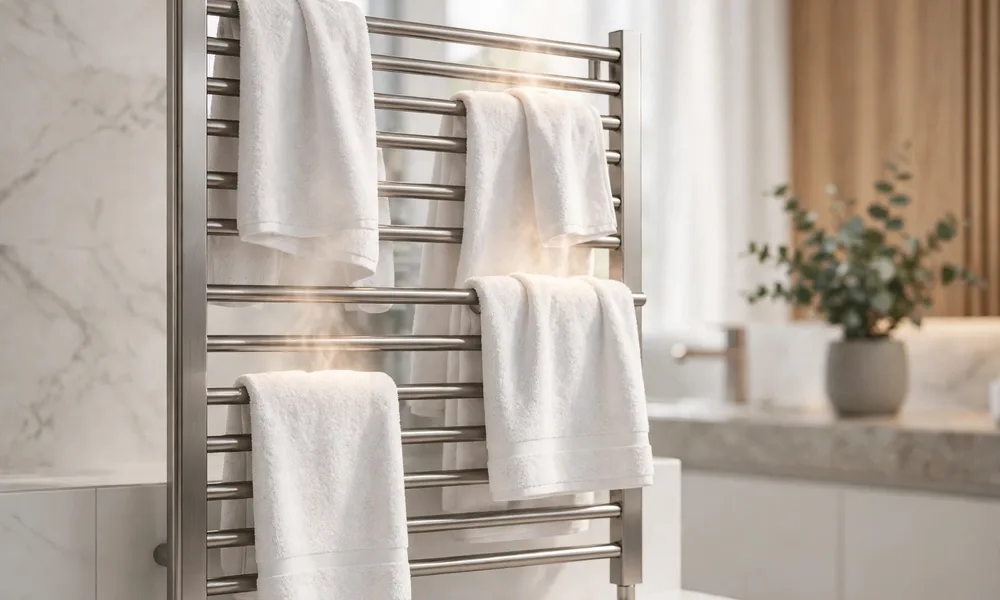
A towel warmer is an electrically heated frame that holds towels against warm metal bars. The bars are heated by an internal element to a cosy warmth. Towels draped over them absorb that heat, so they are warm when you reach for them and dry much faster afterwards.
A towel warmer will not dry a soaking wet towel in minutes. What it does brilliantly is keep a damp towel warm and dry it steadily over an hour or two, which stops mildew from growing and means you are not wrapping yourself in a cold, clammy towel the next morning. For the best results, pair a good warmer with the best bath towels, which absorb water quickly and release it easily when hung on warm bars.
The Main Types of Towel Warmers
Every towel warmer on the market in 2026 falls into one of a few clear designs, each suiting a different bathroom, household and budget.
Wall-Mounted Ladder Racks
The ladder rack is the classic towel warmer and the most popular choice for family bathrooms. It bolts to the wall in a tall, ladder-like frame of horizontal bars, and it can hold two to four full-size towels at once. Because it is fixed in place, it frees up floor space, and its large heated surface also warms the room slightly.
Ladder racks come in two power options. Plug-in models connect to a standard outlet and can be fitted without an electrician, though the cable is visible. Hardwired models connect directly to the mains and look neater, but they need professional installation. If you are renovating, hardwired is the better long-term choice; if you are upgrading an existing bathroom, plug-in is simpler and cheaper.
Freestanding Racks
A freestanding towel warmer stands on the floor and can be moved from room to room. It is the best option for renters, for bathrooms with no free wall, and for anyone who wants warm towels without drilling a single hole. Most hold one or two towels and fold flat for storage.
The trade-off is capacity and stability. A freestanding rack holds fewer towels than a wall-mounted ladder, and a tall one can wobble if knocked. Look for a model with a wide, stable base and a low centre of gravity, especially if children or pets use the bathroom.
Towel Warmer Buckets
The bucket warmer is the newest and most compact type. It is a cylindrical, lidded container, usually made of stainless steel, that heats a single folded towel inside it in about ten to fifteen minutes. Buckets are small enough to sit on a vanity or a shelf, and they are the warmest option of all, because the towel is enclosed and the heat has nowhere to escape.
Bucket warmers suit single people, couples and guest bathrooms perfectly. They are less useful for a large family, because only one person gets a warm towel at a time. They are also the most affordable type, and they use very little electricity, since they only run for a short burst before each shower.
Best Towel Warmers 2026: Comparison
The table below compares the main types side by side.
| Type | Best for | Towels at once | Installation | Price range |
|---|---|---|---|---|
| Wall-mounted ladder rack | Family bathrooms | 2–4 | Plug-in or hardwired | Mid to high |
| Freestanding rack | Renters and small homes | 1–2 | None, plug in and go | Low to mid |
| Towel warmer bucket | Singles, couples, guests | 1–2 | None, plug in and go | Low |
How to Choose the Best Towel Warmer for Your Bathroom
Start by measuring. A ladder rack needs a clear stretch of wall at least 50 centimetres wide and 120 centimetres tall, with a power point nearby. A freestanding rack needs floor space of roughly 60 by 40 centimetres, and a bucket needs only a flat surface near an outlet. Measure before you shop.
Next, count the towels. A household of four needs a ladder rack with at least ten bars, or two smaller warmers, so that everyone gets a warm towel. A single person or a couple can manage happily with a bucket or a single rail. Remember that towels need space between them to dry.
Finally, think about heat and control. The best towel warmers in 2026 offer adjustable temperature settings, a timer and an automatic shut-off. A timer is the single most useful feature, because it lets the warmer switch on half an hour before your usual shower and switch off again afterwards, giving you warm towels without wasting electricity all day.

Materials, Finishes and Durability
A towel warmer lives in a humid room, so the material matters. Stainless steel is the safest choice: it resists rust, holds heat evenly and suits almost every bathroom style. Brass warmers look warmer and more traditional, and they are equally durable, though they cost more. Cheaper chrome can pit or flake after a few years of steam.
Check the warranty before you buy. A good manufacturer stands behind a towel warmer for at least two years, and the better brands offer five. A long warranty is a useful sign of quality, because it tells you the maker expects the heating element and the finish to last.
Installation and Safety Basics
Plug-in towel warmers are genuinely simple to install: mount the brackets, hang the rack, and plug it in. Wall-mounted models need solid fixings, so check whether your wall is brick, plasterboard or tile, and use the right fixings for it. Keep the plug and cable away from direct splashes, and never run a cable across a wet floor.
Hardwired models must be installed by a qualified electrician, because they connect directly to the mains and often sit in a bathroom zone where electrical rules are strict. Budget for the installation cost as well as the warmer itself, and ask the electrician to fit a timer switch at the same time if the model does not include one.
Safety is straightforward but worth stating. A towel warmer should never be covered with plastic, and nothing flammable should be draped over it. Most modern models have overheat protection that cuts the power if the temperature climbs too high. Choose a model with that feature, keep the warmer clear of the shower spray, and switch it off when you go on holiday.
Towel Warmer Buying Checklist
Run through this checklist before you spend any money.
- Measure your wall or floor space and confirm the warmer fits with room to spare.
- Count how many towels your household needs warm at the same time.
- Choose plug-in for a rental or an existing bathroom, and hardwired for a renovation.
- Pick a timer and automatic shut-off so the warmer runs only when you need it.
- Check the finish: stainless steel or brass lasts longest in a steamy bathroom.
- Confirm the warranty is at least two years and that spare parts are available.
Frequently Asked Questions
Do towel warmers use a lot of electricity?
No. Most towel warmers draw between 60 and 150 watts, roughly the same as a light bulb or two. Running one for two hours a day costs only a few pounds or dollars a month, and a timer cuts that further.
Can a towel warmer dry a wet towel completely?
A towel warmer dries a damp towel well over one to two hours, but it is not a substitute for a tumble dryer for a soaking wet towel. For the best results, wring the towel out, spread it flat across the bars with space around it, and leave the warmer on for an hour. Good airflow and a quality towel make a real difference, which is why choosing a quality, quick-drying towel matters as much as the warmer itself.
Is a towel warmer safe to leave on overnight?
Modern towel warmers with overheat protection and a timer are designed to be left on. Even so, a timer is the better choice: set it to switch off after a couple of hours, so the towels dry and the warmer rests. Never leave a warmer on when you go away for days.
Can I install a towel warmer in a rented home?
Yes, if you choose a freestanding rack or a bucket warmer, which need no drilling at all. Plug-in wall-mounted models need only a few small screw holes, which most landlords accept, but ask first. Hardwired models are not suitable for a rental.
Will a towel warmer heat my bathroom?
A large ladder rack adds gentle background warmth and takes the edge off a cold bathroom, but it is not a replacement for a radiator or underfloor heating. Treat the comfort of warm towels, rather than room heating, as the main benefit.
What size towel warmer do I need?
Allow one bar for every towel fold, and aim for at least 50 centimetres of width for a single towel and 80 centimetres or more for two. A family of four should look for a ladder rack at least 120 centimetres tall with ten or more bars. When in doubt, go slightly larger: a warmer with spare bars dries towels faster than one packed to its limit, and it leaves room for a guest towel too. Finish the room with matching details, from bath mats for guest bathrooms to shower heads for small bathrooms, and the whole space feels considered.
The Bottom Line
The best towel warmer of 2026 is the one that fits your bathroom, your household and your routine. A wall-mounted ladder rack suits a family that wants warm towels for everyone, a freestanding rack or bucket suits a renter or a small home, and a slim heated rail suits an en-suite where space is tight. Buy for capacity first, insist on a timer and automatic shut-off, and choose stainless steel or brass so the warmer lasts. Do that, and every shower ends with a warm, dry towel waiting for you.


