The best travel organizers for cables in 2026 turn a tangled mess of chargers, cords, and adapters into a tidy kit you can grab in seconds. If you have ever dug through a backpack at an airport gate hunting for a phone charger, or untangled a knot of USB cables in a hotel room, you already know the problem. A good cable organizer solves it quietly on every trip, by giving every cord a fixed home.
Modern travel makes the problem worse. A single weekend trip can now involve a phone charger, a laptop charger, earbuds, a smartwatch cable, a power bank, and a travel adapter. Without a system, those cables end up loose in a bag, wrapped around other gear, or forgotten in a hotel drawer. The best travel organizers for cables keep everything visible, protected, and ready to use.
This guide compares the strongest options for 2026, from slim pouches that slip into a jacket pocket to structured cases built for a full tech kit. We looked at capacity, protection, pocket layout, and materials. The result is a short list of organizers worth your money, plus a simple method for packing them well.
Key Takeaways
- A dedicated cable organizer saves time at security, at the gate, and in the hotel room, because every cord has a fixed place.
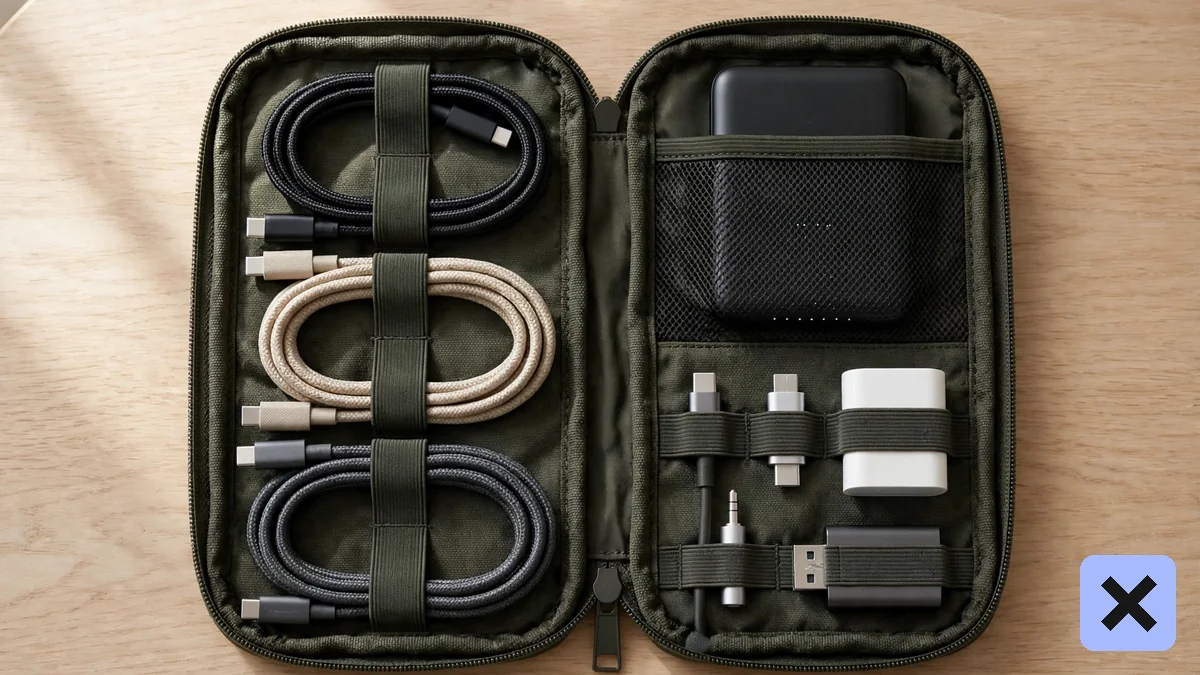
- Elastic loops suit short cables and adapters, while mesh pockets work better for bulkier chargers and power banks.
- A slim pouch is best for light packers, while a structured double-layer case suits travellers carrying a full tech kit.
- Water-resistant fabric and a sturdy zip protect cables from rain, spills, and the crush of an overstuffed bag.
- Pack by frequency of use, with the phone charger and earbuds easiest to reach and spares tucked deeper inside.
Why a Cable Organizer Matters More in 2026
Travel tech keeps multiplying. Phones, laptops, earbuds, and watches each bring their own charger, and many travellers now carry a power bank as well. The average carry-on tech kit has quietly grown from two cables to six or more, and six loose cables tangle far faster than two.
Tangled cables are not just annoying. Repeated bending and pulling at the connectors shortens a cable’s life, and a frayed charging cable can fail at the worst moment, such as on a long flight. A cable organizer protects the connectors, keeps bends gentle, and stops cables from snagging on zips. It also speeds up security, because a flat pouch slides out of a bag in one motion.
The Best Travel Organizers for Cables in 2026
The organizers below cover the full range of travel styles. All share the same basics: sensible pocket layout, durable fabric, and a zip that does not jam. Even the cheapest good organizer costs less than replacing one premium braided cable.
1. The Everyday Slim Pouch
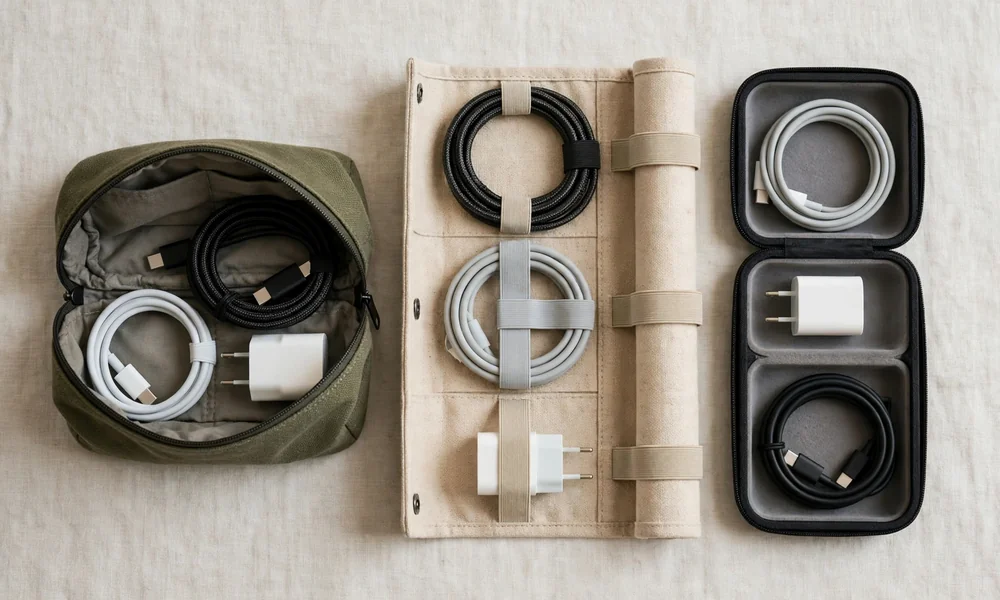
The everyday slim pouch is the best starting point for most travellers. This single-layer zippered pouch, roughly the size of a paperback, has elastic loops on one side and a mesh pocket on the other. It holds two or three cables, a compact charger, and earbuds, covering a phone, a watch, and a power bank for a short trip. The trade-off is capacity: it cannot hold a laptop charger and three spares at once.
2. The Double-Layer Tech Case
The double-layer tech case is the workhorse of this list. It opens like a book, with two panels of elastic loops, mesh pockets, and slots for memory cards and SIM tools. It swallows a laptop charger, two phone cables, a watch charger, earbuds, a power bank, and a travel adapter. The best ones have loops sized for different cable thicknesses and pockets deep enough for a chunky GaN charger.
3. The Roll-Up Wrap
The roll-up wrap is a flat fabric panel with elastic loops and small pockets that rolls into a compact cylinder and fastens with a strap. Unrolled, it lays flat on a desk or hotel bed, so you can see every cable at a glance, which suits travellers who work at a desk on arrival. The weakness is protection: a wrap offers little padding for a power bank or hard drive.
4. The Hard-Shell Case
The hard-shell case is built for travellers who check bags or want maximum protection. Its rigid shell shrugs off crushing, drops, and the weight of other luggage piled on top, while a moulded tray or elastic straps hold cables in place inside. The cost is bulk and weight: a hard shell cannot be squeezed into a gap in your bag the way a soft pouch can.
5. The Cable Pouch with Power Bank Slot
Some organizers are designed around a power bank, with a dedicated padded slot and a cable channel that lets you charge a phone while the bank stays inside the pouch. That small detail makes a real difference on travel days, when you often need to top up a phone while walking through an airport. The snug slot stops the heavy bank sliding around and pressing on delicate connectors.
6. The Minimal Cable Strap Set
Not every traveller wants a case. A set of reusable cable straps is the lightest possible system: each cable gets its own strap, coiled neatly and clipped, and the coiled cables drop into any pocket of your bag. Strap sets suit minimalists who carry one or two cables and like to use the pockets their bag already has. The limit is obvious: straps do not protect connectors or keep cables together as a kit.
7. The Full Travel Tech Organizer
At the top end sits the full travel tech organizer, a larger case that holds cables plus a tablet, a small keyboard, a mouse, memory cards, and a notebook. It is really a portable desk drawer, designed for people who set up a workspace wherever they land. It makes sense for remote workers on long trips, because everything for a working day lives in one case.
Comparison Table: The Best Travel Organizers for Cables at a Glance
| Organizer type | Best for | Typical capacity | Protection | Size |
|---|---|---|---|---|
| Slim pouch | Weekend trips, light packers | 2–3 cables, 1 charger | Basic | Pocket-sized |
| Double-layer case | Full tech kits, remote work | 5–7 cables, 2 chargers | Good | Tablet-sized |
| Roll-up wrap | Desk use, odd shapes | 3–5 cables, 1 charger | Light | Rolls flat |
| Hard-shell case | Checked bags, fragile gear | 4–6 cables, 1–2 chargers | Excellent | Compact brick |
| Power bank pouch | Daily charging on the move | 2–3 cables, 1 power bank | Good | Mid-sized |
| Cable strap set | Minimalists, spares | 1–2 cables | Minimal | Negligible |
| Full tech organizer | Long working trips | 7+ cables, full accessories | Very good | Large |
How to Choose the Right Cable Organizer
Start by counting your kit. Lay out every cable, charger, and adapter you actually take on a trip, not the ones you think you might need. Choose an organizer with room for that kit plus one spare cable. An organizer that is exactly full is hard to zip and hard to use; one with a little spare room stays pleasant.
Next, think about how you travel. If you fly carry-on only, size and weight matter most. If you check a bag, protection matters more, and a hard-shell case is worth the extra weight. Look for water-resistant fabric, a smooth lining that will not snag cable braiding, and a zip that runs freely when the case is full.
What Size Do You Really Need?
Most travellers overestimate. A three-day trip with a phone, earbuds, and a watch needs a slim pouch, not a full tech case. A two-week working trip with a laptop and camera gear needs the double-layer case or the full organizer. Remember the organizer must fit your bag, not just your cables. Our guide to the best carry-on bags for weekend trips can help you think about the bag and the organizer as one system.
Loops, Pockets, or Both?
Elastic loops suit cables you use often, because you can pull a cable out and slide it back in one-handed. Mesh pockets suit chargers, adapters, and power banks, which are too bulky for loops. The best organizers combine both. Watch out for loops that are all the same size: a loop sized for a thick laptop cable will not grip a thin watch cable.

How to Pack a Cable Organizer Properly
Coil each cable loosely, secure it, and place it by how often you will need it. A tight coil stresses the cable, while a loose coil with a strap or loop keeps it relaxed and ready. Start with the cables you use least: spares and a camera charger go at the bottom or in the deepest pockets. Then add the daily items, the phone charger and earbuds, and finish with the travel adapter, which you will need the moment you arrive.
Keep power banks and heavy chargers low and centred, so the case balances in your hand, and keep connectors pointing inward, protected by the lining, rather than outward toward the zip. Remember your adapter is as important as your cables. Our guide to the best travel adapters for Europe will help you pick one that fits neatly into your organizer. The same one-place logic works for the rest of your kit: our round-up of the best travel toiletry bags follows the same principle, one bag, one place, everything findable.
Cable Organizer Packing Checklist
- Count every cable, charger, and adapter before you pack, and leave one spare slot for a cable you might buy on the trip.
- Coil each cable loosely and secure it with a strap or elastic loop, with connectors pointing inward and protected.
- Place daily items like the phone charger and earbuds on top, and spares and rarely used adapters underneath.
- Keep the power bank in your carry-on, charged and easy to reach, never in checked luggage.
- Test the zip with the case fully loaded at home, and check that no connector catches on the zip teeth.
- Do a final check before leaving the hotel: open every pocket, count your cables, and confirm nothing is left in a wall socket.

Frequently Asked Questions
Do I really need a travel cable organizer?
If you travel with more than two cables, yes. An organizer protects connectors, stops tangling, and saves time at security and in the hotel room. It costs less than replacing a single premium cable, and it lasts for years.
What size cable organizer should I buy?
Count your cables and chargers, then add one spare slot. A slim pouch suits two to three cables, a double-layer case suits five to seven, and a full tech organizer suits seven or more. When in doubt, choose the smaller size that fits.
Are hard-shell cable organizers better than soft ones?
Hard-shell cases protect better against crushing and drops, making them ideal for checked luggage and fragile gear. Soft cases are lighter and easier to squeeze into a full bag. For carry-on travel, a good soft case is usually the better choice.
How do I stop cables tangling inside an organizer?
Coil each cable loosely, secure it with its own elastic loop or strap, and give every cable a fixed place. Do not throw loose cables into a single pocket, because they will tangle there just as they do in a bag.
Can I put a power bank in a cable organizer?
Yes, and a pouch with a dedicated power bank slot is ideal. Keep the bank in your carry-on, never in checked luggage, as airlines require. Make sure it sits snugly so it cannot slide around and press on cable connectors.
How do I clean a travel cable organizer?
Empty it completely, shake out dust, and wipe the lining with a damp cloth. Fabric organizers can usually be hand-washed with mild soap and air-dried, while hard-shell cases wipe clean. Let it dry fully before repacking.
The Bottom Line
The best travel organizers for cables in 2026 are the ones that match your real kit: a slim pouch for light trips, a double-layer case for a full tech load, and a hard shell when protection matters most. Count your cables, pick the size that fits with one spare slot, and pack by frequency of use. Do that, and your cables will be charged, protected, and exactly where you expect them, on every trip you take.


