Vanity lights decide whether your makeup looks right in daylight or only in your bathroom. A bad one flatters you with warm, dim light, hides the mistakes, and sends you out with foundation that looked perfect at home and uneven everywhere else. A good one shows your face the way other people see it: bright, even, and coming from the front.
This guide compares the best vanity lights of 2026 on the things that actually matter: colour temperature, colour rendering, brightness, dimming, and whether the fixture fits your mirror and your room. It is about lights only, for people who already have a mirror or want to add light to one. If you are starting from scratch, our guide to vanity mirrors covers the mirror itself, including its built-in lighting.
A vanity light is a fixture whose only job is to light one face at close range, evenly and truthfully, while you do your makeup, shave, or check your skin. The best vanity light is bright, even, and coming from the front, from above the mirror or from both sides of it, so it falls evenly across the face with no shadows under the eyes, nose and chin.
Light from the front, at face height, is the only arrangement that shows your face the way other people see it. Overhead light casts shadows downwards, and side light from a window creates a bright side and a shadow side. A vanity light fixes both problems by putting a large, even source of light directly in front of you.
Key Takeaways
- Light matters more than brightness: even, front-facing light at face height is what makes makeup look right.
- Look for LEDs around 4000K to 5000K with a CRI of 90 or above, so colours render truly in daylight.
- Size the light to the mirror: a bar should span most of the mirror width, and sconces should sit at eye level.
- Dimmable is worth paying for: full brightness for detail work, lower brightness for checking the overall look.
- Plug-in suits renters; hardwired suits a settled bathroom, but only with the right bathroom safety rating.
What Vanity Lights Actually Do
A vanity light is a fixture whose only job is to light one face at close range, evenly and truthfully, while you do your makeup, shave, or check your skin. The best vanity light is bright, even, and coming from the front, from above the mirror or from both sides of it, so it falls evenly across the face with no shadows under the eyes, nose and chin.
Vanity lights are not ring lights. A ring light wraps your face in a circle of diffused light for a camera, and our guide to ring lights covers video calls and content, where the camera is the audience. A vanity light is for your own eyes, at arm’s length, in a bathroom or bedroom, and it is judged on colour truth rather than on how it looks on camera.
How We Chose the Best Vanity Lights of 2026
We judged every light on colour truth first. Two numbers decide whether the light is honest: colour temperature, measured in Kelvin, and the colour rendering index, or CRI. Warm light around 2700K to 3000K flatters the skin but hides redness and mistakes, while cool daylight around 5000K to 6500K is honest but harsh. The sweet spot is around 4000K to 5000K, and for CRI look for 90 or above; below 80, colours shift.
Evenness came next: the best lights spread their output across the whole face, rather than throwing a bright spot in the middle and shadows at the edges. We favoured fixtures with diffusers or multiple bulbs spread across the width of the mirror, and we looked at brightness, dimming, fit and whether the fixture suits a bathroom, where steam and splashes are part of daily life.
Vanity Lights Compared
The table below puts the six main types side by side. No single type wins for every room, so match the strengths to your mirror, your wiring and whether you rent or own.
| Type | Best For | Light Quality | Drawbacks |
|---|---|---|---|
| Vanity bar | Most bathrooms, above a mirror | Even, wide spread | Usually hardwired |
| Wall sconce pair | Flattering side light, dressing rooms | Excellent, from both sides | Needs two fixings, more wiring |
| LED strip | Renters, around a mirror | Even, soft, dimmable | Can look cheap if poorly stuck |
| Hollywood bulb strip | Full-face work, dressing tables | Very even, glamorous | Bulky, bulbs need replacing |
| Back-lit panel | Modern bathrooms, soft glow | Soft, shadow-free halo | Less direct light on the face |
| Plug-in clip-on | Renters, travel, small mirrors | Good at close range | Weaker, cord on show |
Vanity Bars: The Best Starting Point
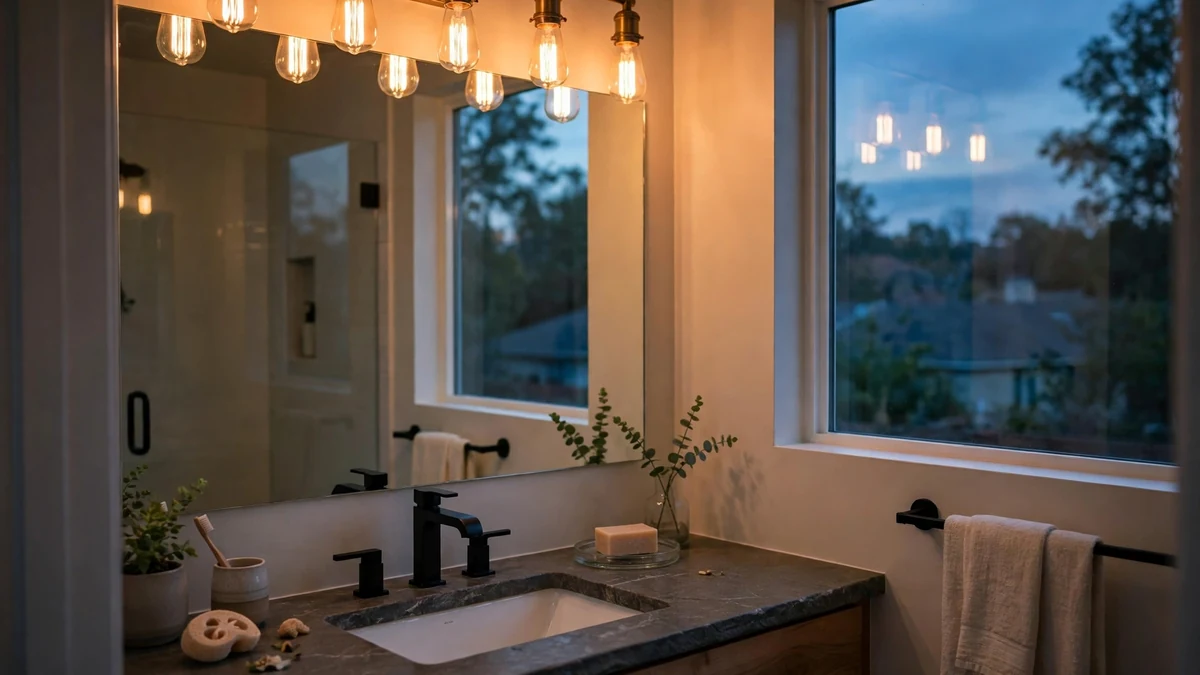
For most bathrooms, a vanity bar mounted above the mirror is the best starting point. It is a horizontal fixture with two, three or four lights spread across its length, throwing even light down across the face from above. The best bars use frosted glass shades or diffusers, so the light is soft rather than glaring, and they offer dimming for detail work and for a final check.
Size the bar to the mirror. As a rule, the bar should span about two-thirds to three-quarters of the mirror width: too short and the edges of your face fall into shadow, too long and it overhangs the mirror and looks wrong. The bar should sit about 15 to 20 centimetres above the top of the mirror, or at about 190 centimetres from the floor in a bathroom where you stand.
Most vanity bars are hardwired, which suits a settled bathroom but not a rental. If you rent, look for a plug-in bar that mounts with screws or strong adhesive and plugs into a nearby socket. A bar with replaceable bulbs is better value than one with sealed LEDs, because a single failed bulb should not mean replacing the whole fixture.

Wall Sconces: The Most Flattering Light
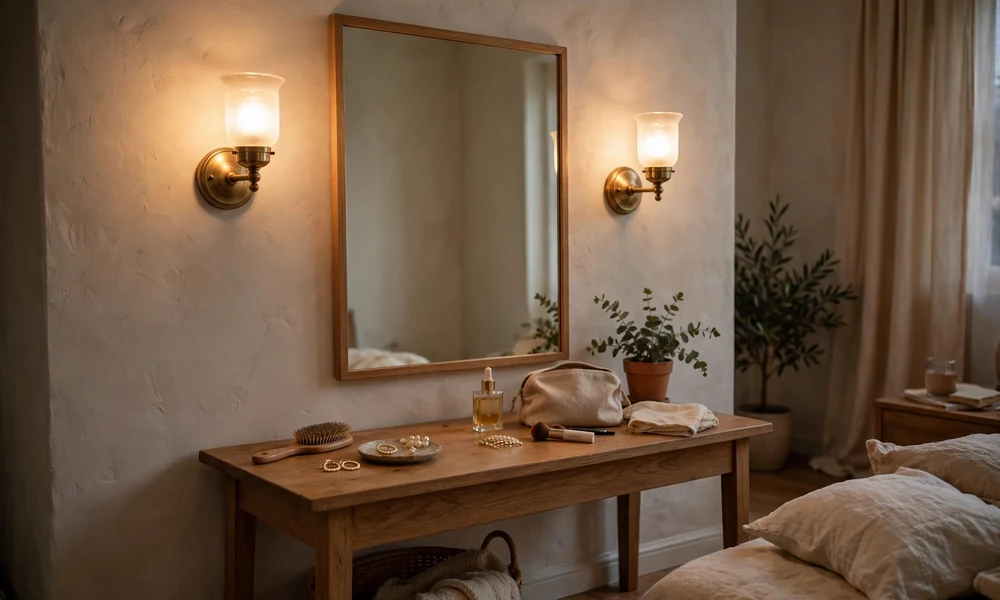
A pair of wall sconces, one on each side of the mirror at eye level, gives the most flattering vanity light of all, because the light comes from both sides at once and fills in every shadow before it forms. Each sconce should sit at about eye level when you are seated or standing at the mirror, and about 60 to 70 centimetres apart, so the light crosses the face evenly.
Sconces suit bedrooms and dressing areas as well as bathrooms, because they look like ordinary wall lights when switched off. The trade-off is wiring: two sconces need two fixings and, in a bathroom, proper safety-rated wiring, so they cost more to install than a single bar.
LED Strips and Back-Lit Panels
LED strips are the renter’s best friend. A self-adhesive strip stuck around the back or the edge of a mirror gives even, soft light for very little money, and it peels off when you move out. The best strips are dimmable, offer adjustable colour temperature, and come with a diffuser channel, so the individual LEDs do not show as hard dots.
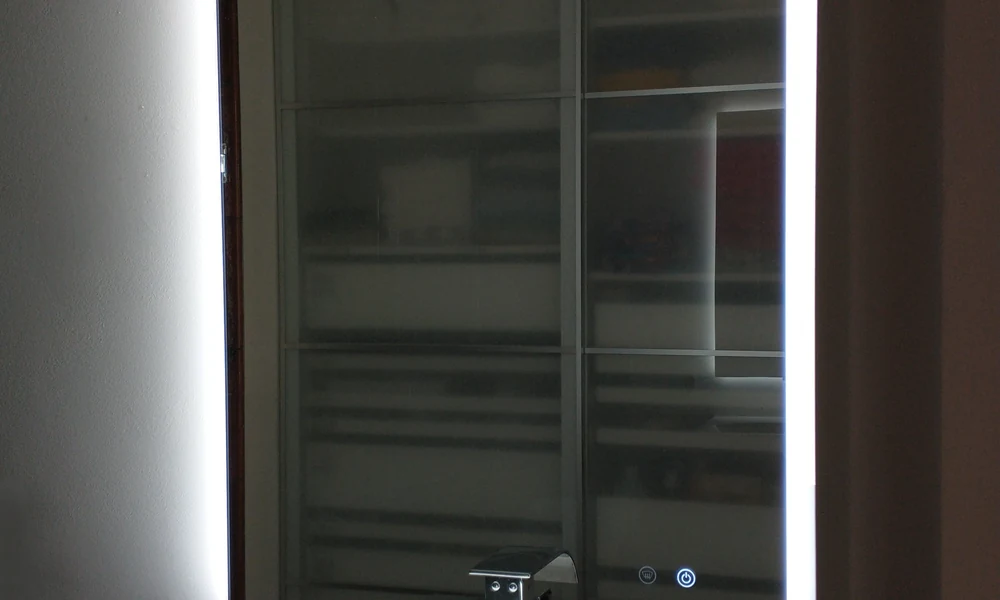
Back-lit panels take the same idea further: the light sits behind the mirror and glows around its edges, giving a soft halo. They look modern and flattering, but give less direct light on the face than a bar or a sconce pair, so they are not the best choice for detailed makeup every day.
Hollywood Bulb Strips and Plug-In Lights
A Hollywood bulb strip is a row of exposed bulbs around a mirror frame, giving the most even front light available, because the bulbs surround the face on all sides. It is the most glamorous option, but also the largest and most expensive, and it suits a dedicated dressing area where the mirror is wide.
Colour Temperature and CRI in Practice
Two numbers decide whether the light is honest. Colour temperature, measured in Kelvin, decides whether the light is warm or cool: warm light around 2700K to 3000K flatters the skin but hides redness, cool daylight around 5000K to 6500K is honest but harsh, and the sweet spot for makeup is in the middle, around 4000K to 5000K.
The colour rendering index, or CRI, decides whether colours look true under the light. Look for a CRI of 90 or above; below 80, colours shift, foundation stops matching your skin, and lipstick looks different at home from how it looks outside. Cheap lights often hide their CRI, and a light with no stated CRI should be treated as low.
Common Mistakes to Avoid
The first mistake is buying the brightest light instead of the most even one. A single very bright bulb throws hard shadows and glare, while a spread of moderate bulbs gives soft, even light that shows your face truly. The second is buying warm light for makeup: it feels cosy and it flatters, but it hides the redness and unevenness you need to see.
The third mistake is sizing the light wrong: a bar that is too short leaves the edges of your face in shadow, and sconces mounted too high light the top of your head instead of your face. The fourth is ignoring dimming, and the fifth is fitting a bathroom light without checking its safety rating, which is a mistake that can cost far more than the light itself.
The sixth mistake is forgetting the room around the mirror. A vanity light works best in a tidy space, where the tools you reach for every morning are within arm’s reach and nothing blocks the light. Our guide to makeup organizers covers the storage that pairs well with vanity lights, and a clear dressing table makes the light work harder, because nothing casts a shadow across your face while you work.
Vanity Lights Buying Checklist
- Choose LEDs around 4000K to 5000K with a CRI of 90 or above, dimmable if you can get it.
- Size the light to the mirror: a bar spanning two-thirds of the width, sconces at eye level either side.
- Check the mounting: screws for a settled room, plug-in or adhesive only where the maker states it is safe.
- Check the bathroom rating: the right ingress protection for the zone, fitted by an electrician if hardwired.
- Test the light with your own makeup on, in the room where it will live, before you commit to keeping it.
- Keep the cord plan tidy: routed down the side of the mirror, clear of water and out of the way.
Frequently Asked Questions
What colour temperature is best for vanity lights?
Around 4000K to 5000K, close to natural daylight, so colours render truly. Warm light around 2700K flatters the skin but hides redness and mistakes.
How bright should vanity lights be?
Bright enough for detail work at arm’s length, and dimmable for a final check. Choose even light across the whole face without glare, and choose dimmable every time you can.
Are LED strips good enough for a vanity?
Yes, if they are dimmable, adjustable in colour temperature, and fitted in a diffuser channel so the individual LEDs do not show as dots.
Should vanity lights go above or beside the mirror?
Above suits most bathrooms and is the simplest fit, while a pair beside the mirror at eye level gives the most flattering, shadow-free light.
Can I use vanity lights in a bathroom?
Yes, as long as the fitting has the right ingress protection rating for its position and any hardwired fitting is installed by a qualified electrician.
Do I need a new mirror as well as new lights?
Not necessarily. If your mirror is flat, true and the right size, adding lights to it is cheaper and often better than replacing it.
The Bottom Line
The best vanity lights in 2026 are the lights that show your face truly: LEDs around 4000K to 5000K with a CRI of 90 or above, even light from the front at face height, dimmable for detail work and for a final check, sized to your mirror and safe for your room. Get the light and the size right, and the rest is taste.