The Best Vanity Mirrors for Flawless Makeup in 2026
The best vanity mirrors for flawless makeup in 2026 do far more than show your reflection. A well-chosen vanity mirror gives you the right light, the right magnification and the right distance to do your makeup properly, so your makeup blends and the face in the mirror is the face everyone else sees in daylight. A bad one flatters you with warm, dim light, hides the mistakes, and sends you out with makeup that looked perfect at home and uneven everywhere else. Choosing well comes down to magnification, light, and fit.
This guide explains what makes a mirror a vanity mirror rather than a decoration, how magnification and lighting really work, and how to choose between tabletop, wall-mounted and Hollywood styles. It covers size, storage and the extras worth paying for.
Key takeaways
- A vanity mirror is a working tool, not a decoration: its job is true light and useful magnification at the distance you actually sit from it.
- For most people, 5x magnification is the sweet spot for detail work, with a normal 1x side for the overall look — higher magnification is harder to use than it sounds.
- Light matters more than the mirror itself: look for LEDs around 4000K to 5000K with a high colour rendering index, so your makeup looks the same indoors and out.
- Measure before you buy. A mirror that is too small, too low or too far away is useless however good its light is.
- Storage is the feature people undervalue most: a mirror with a tray, drawer or base storage keeps brushes and everyday products where your hands already are.
What makes a mirror a vanity mirror
A vanity mirror is built around one person sitting close to it and doing detailed work on their own face. That is what separates it from every other mirror in the house. A decorative mirror is judged on how it looks on the wall and how much light it bounces around the room. A vanity mirror is judged on whether you can see your own face clearly, evenly and truthfully while you work on it. The glass should be flat, the light should come from the front at face height, and the mirror should sit at your seated eye level.
That is why the mirrors made for small rooms and dark hallways are a different purchase altogether. A good mirror for a small room is chosen for size, shape and position on the wall, and it earns its place by borrowing light and space. A vanity mirror is chosen for what it shows you at arm’s length, and it earns its place by telling the truth. Buy the mirror for the job it has to do.
Magnification: how much do you actually need?
Magnification is the feature buyers overestimate most, because bigger numbers sound better. In practice, magnification is a trade-off: the more you magnify, the smaller the area you can see and the closer you have to hold your face to the glass. A 10x mirror shows every pore and every stray hair in extraordinary detail, but it shows so little of your face at once that blending foundation or checking that both eyes match becomes almost impossible.
For most people, the right answer is a dual-sided mirror: one side at 1x, showing your whole face at a natural distance, and one side at 5x for detail work — brows, eyeliner, lipstick, and checking that concealer has actually blended. Five times magnification is close enough to see what you are doing and far enough away to keep both eyes in view. Seven times suits very precise work; ten times is a specialist tool. Whatever you choose, check the mirror in person if you can: cheap magnifying mirrors distort at the edges, so the centre is true and the rim bends your face. A good magnifying mirror is true edge to edge.

Lighting: the part that matters most
Light is the single most important feature of a vanity mirror, and the one most buyers get wrong, because they judge the mirror by how it looks switched off. What matters is what the light does to your face when it is switched on. The best vanity light is bright, even, and coming from the front — from around the mirror or from both sides of it — so it falls evenly across the face with no shadows under the eyes, nose and chin. Light from the front, at face height, is the only arrangement that shows your face the way other people see it.
Two numbers decide whether the light is honest. The first is colour temperature, measured in Kelvin. Warm light around 2700K to 3000K is flattering — it makes skin look golden and hides redness — which is exactly why it is bad for doing makeup: it hides the things you need to see. Cool daylight around 5000K to 6500K is honest but can look harsh. The sweet spot is in the middle, around 4000K to 5000K, close to natural daylight. The second number is the colour rendering index, or CRI. Look for a CRI of 90 or above; below 80, colours shift.
LEDs have made all of this affordable, but not all LEDs are equal. Look for a mirror whose LEDs run around the whole frame or along both sides, rather than a single strip at the top, because even light matters more than bright light. Dimmable is worth having: full brightness for detail work, lower brightness for checking the overall look. A bathroom mirror lights a whole steamy room; a vanity mirror lights one face at close range.
The main types, compared
Vanity mirrors come in a handful of shapes, and the shape decides where the mirror lives and how you use it. A tabletop mirror sits on a dressing table or desk, usually on a stand or a base, and it is the most flexible choice: you can move it, tilt it, and put it away. A wall-mounted mirror never wobbles but cannot move with you. A Hollywood mirror — the wide, rectangular mirror ringed with bulbs — is the most glamorous and the most even-lit, but it is also the largest, the most expensive, and the hardest to fit into a small room. A tri-fold gives three angles at once, but the side panels can distort.
| Type | Best for | Light | Watch out for |
|---|---|---|---|
| Tabletop, single-sided | Everyday makeup at a dressing table | Ring or edge LED | Can wobble if the base is light |
| Tabletop, dual-sided | Detail work plus the overall look | Edge LED, often dimmable | Flipping can loosen the hinge over time |
| Wall-mounted | A dedicated dressing area | Backlit or front-lit LED | Fixed height and position |
| Hollywood style | Even, front light for full-face work | Bulbs around the frame | Large, heavy and expensive |
| Tri-fold | Checking hair and makeup from the sides | Often unlit or edge-lit | Side panels can distort |
| With storage | Small rooms and tidy dressing tables | Varies | Drawers add weight |
Travel and handheld mirrors are useful seconds, not substitutes: their light is weak and holding one while doing makeup is a compromise.
Size, height and where it goes
A vanity mirror that is the wrong size is worse than no mirror at all, because it forces you to lean in, crane your neck and guess at the parts of your face you cannot see. The rule is simple: the mirror should show your whole face and a little of your shoulders at the distance you sit from it, which for most people is an arm’s length — about 30 to 45 centimetres. For a tabletop mirror, that usually means at least 20 centimetres across. Sit in the chair you will actually use, and the centre of the mirror should be at your eye level. Mark the height with tape and check it seated before you drill. Face it into the room, away from a window, so daylight falls on your face.

Storage and extras worth paying for
Storage is the feature people undervalue when they buy and miss most afterwards. A mirror with nowhere to put things means a cluttered table and a morning spent hunting for the brush you just put down. A mirror with a built-in tray, a drawer in its base, or a matching organiser keeps the everyday tools where your hands already are. One deep drawer is usually more useful than several shallow ones. Dimmable light and adjustable temperature are worth paying for; speakers, chargers and clocks are not — spend the money on better glass, light and a heavier base.
Tabletop or wall-mounted: which suits your room?
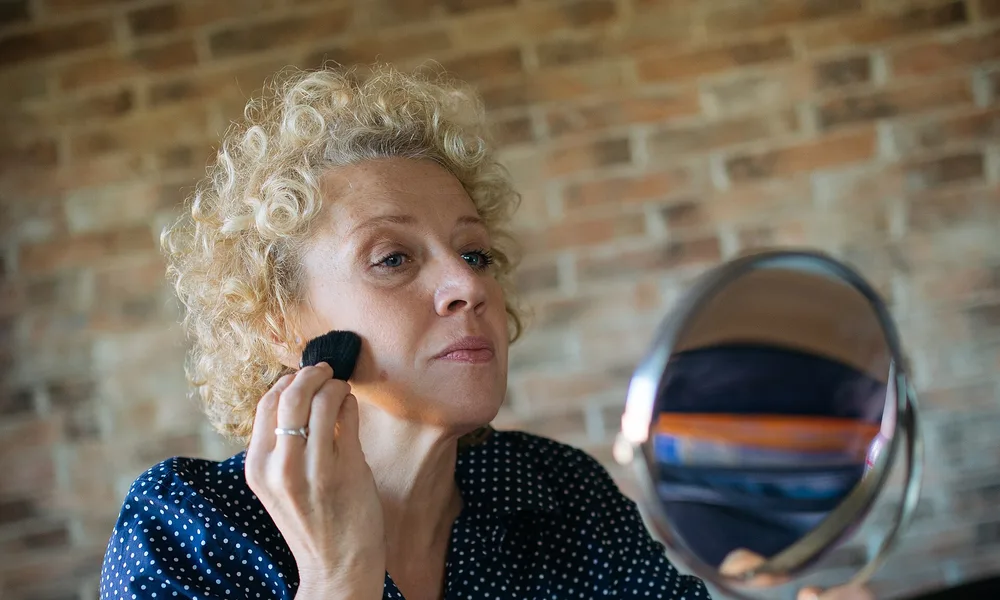
The choice comes down to how settled your space is. A tabletop mirror suits almost everyone: it moves with you, it works in a rented flat, it can be packed away, and it costs less. It takes up table space and a light base will wobble. A wall-mounted mirror suits a dedicated dressing area that will not move: it frees the table entirely and never wobbles, but it is fixed and needs proper fixings. A mirror on a stand with a heavy base is a good middle option. Whichever you choose, keep the tools close: the makeup brushes you reach for every morning should live within arm’s reach of the mirror. Do not buy for how it looks switched off — judge its light, glass and stability, and try it with your own makeup on before you commit.
Choosing well: a quick checklist
- Choose dual-sided 1x and 5x magnification for most faces.
- Insist on LEDs around 4000K to 5000K with a CRI of 90 or above, dimmable.
- Measure the space and your seated eye level before buying, and make sure the mirror shows your whole face at arm’s length.
- Pick tabletop for flexibility and rented rooms, wall-mounted for a settled dressing area.
- Value storage and a heavy, stable base over speakers, clocks and other extras that add cost and break first.
- Test the light with your own makeup on, in the room where the mirror will live, before you commit to keeping it.
Frequently asked questions
What magnification is best for a vanity mirror?
For most people, 5x on one side and 1x on the other. The 5x side is for brows, eyeliner and detail work; the 1x side is for the overall look.
What colour temperature should a vanity mirror be?
Around 4000K to 5000K, close to natural daylight, so colours render truly. Warm light around 2700K flatters the skin but hides redness and mistakes.
Are Hollywood mirrors worth it?
For a dedicated dressing area, yes: the bulbs around the frame give the most even front light available. For a small room or a tight budget, no.
Should I choose a tabletop or wall-mounted vanity mirror?
Tabletop if you rent, move rooms, or want flexibility; wall-mounted if you have a settled dressing area and want the table free.
Do I need a vanity mirror with storage?
Not necessarily, but it helps more than most buyers expect. A tray or drawer in the base keeps the brushes and products you use every morning within reach.
How do I clean a vanity mirror without streaks?
Use a microfibre cloth, barely damp with water or a little glass cleaner, and wipe in one direction rather than circles. Keep cleaner away from the LED strip.
The bottom line
The best vanity mirror in 2026 is not the largest, the most expensive or the one with the most features. It is the mirror that shows your face truly: flat glass, honest light around 4000K to 5000K, 5x magnification for detail and 1x for the whole picture, at the right height for the chair you actually sit in. Get the light and size right, and the rest is taste. Get them wrong, and no glamour will save a mirror that lies to you every morning.