The best mirrors for small rooms and dark hallways in 2026 do far more than show your reflection. A well-placed mirror bounces daylight into corners that never see the sun, makes a narrow hallway feel twice as wide, and turns a plain wall into the most interesting feature of the room. A badly placed one does the opposite: it reflects a blank wall, glares in the evening light, or makes a small room feel cluttered and restless.
Choosing well comes down to three decisions: the size of the mirror relative to the wall, the shape that suits the room, and the position that catches the best light. Get those three right and even a modest mirror can change how a room feels.
Key Takeaways
- A mirror hung opposite or beside a window bounces daylight deeper into the room and can make a small room feel noticeably brighter.
- Choose a mirror about two-thirds the width of the furniture beneath it, and hang its centre at eye level, around 145 to 155 centimetres from the floor.
- Round mirrors soften a room and suit hallways and small bedrooms, while large rectangular mirrors make narrow rooms feel wider.
- Leaning floor mirrors add height and drama without drilling, but they need a secure fixing at the top in homes with children or pets.
- Check the glass quality before buying: a true, flat reflection with no ripples or green tint is the mark of a good mirror.
Why Mirrors Work in Small and Dark Spaces
A mirror does something no other decoration can do: it borrows light and space from elsewhere in the room and puts it where there is none. A mirror opposite a window reflects the sky and the garden, so the wall it hangs on feels like a second window. A mirror at the end of a dark hallway reflects the light from the room behind you, so the corridor no longer feels like a tunnel.
Mirror Types Compared
| Mirror Type | Best For | Light Effect | Typical Size | Price Range |
|---|---|---|---|---|
| Round wall mirror | Hallways, small bedrooms | Soft, even glow | 60 to 90 cm diameter | $40 to $200 |
| Large rectangular mirror | Small living rooms | Strong, doubles the room | 90 to 150 cm wide | $80 to $400 |
| Arched mirror | Hallways, bedrooms, bathrooms | Tall, elegant reflection | 60 to 120 cm tall | $70 to $350 |
| Leaning floor mirror | Bedrooms, dressing areas | Full-length light bounce | 150 to 180 cm tall | $100 to $500 |
| Mirror panels or tiles | Very small or awkward rooms | Wide, flexible coverage | Custom, any size | $50 to $300 |
| Antique or smoked mirror | Moody rooms, feature walls | Warm, dimmed glow | 60 to 120 cm | $90 to $450 |
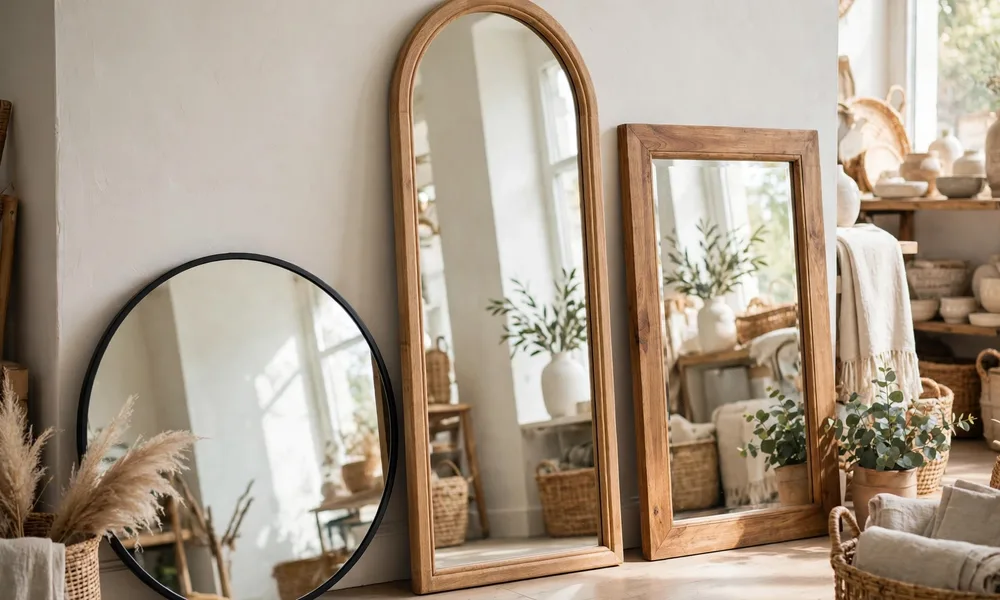
Round mirrors are the most forgiving choice. They have no corners to clash with the furniture, they soften a room full of straight lines, and they suit almost any style from modern to traditional. A round mirror above a console table in a hallway is the classic arrangement for a reason: it fills the wall without dominating it, and its reflection is easy to position well.
Arched mirrors sit between the two: their curved top adds height and softness, which suits hallways and bedrooms where a rectangular mirror can feel too sharp. A tall arched mirror in a narrow hallway draws the eye upward and makes the corridor feel less cramped. Leaning floor mirrors are the most dramatic option, and the most practical in a bedroom or dressing area, where a full-length reflection is genuinely useful.
Where to Hang a Mirror for the Most Light
Placement is the decision that matters most, and it is the one people get wrong most often. The rule is simple: a mirror should reflect something good.
The strongest position is opposite a window. A mirror there reflects the daylight straight back into the room, and on a bright day it can add as much light as a second window. The next best position is on a wall beside a window, at a right angle to it, where the mirror catches the light at an angle and spreads it across the room.

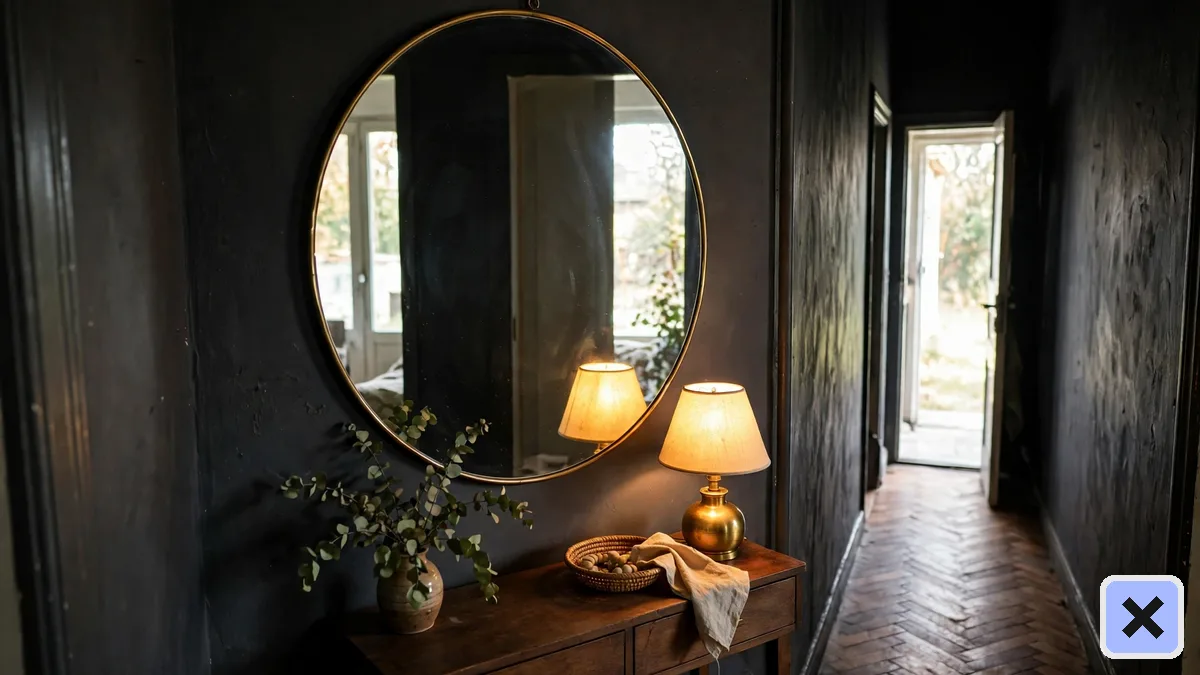
In a dark hallway, the best position is at the end of the corridor, where the mirror reflects the light from the room behind you, or on the wall opposite a door that opens onto a bright room. A round mirror above a console table, paired with a small lamp, is the classic hallway arrangement, because the lamp doubles in the mirror and the whole entrance feels warmer.
Sizing a Mirror for a Small Room
Size is where small rooms punish caution. A mirror that is too small does almost nothing: it reflects a patch of wall and adds neither light nor space. A mirror that is too large can overwhelm the wall and make the room feel like a dance studio. The right size is generous but not dominant, and it depends on the wall rather than the room.
One large mirror is almost always better than several small ones. If the wall is very large, a single mirror may not be enough on its own, and pairing it with a bookshelf or a picture can balance the wall better than a bigger mirror would. Our guide to bookshelves that make small rooms feel bigger in 2026 covers how to balance a wall with storage and reflection together.
Frames, Glass Quality, and Style
The frame is what makes a mirror look like it belongs in the room. A thin black metal frame suits a modern room, a brass frame suits a warm, classic room, and a wooden frame suits a traditional or country room. A frameless mirror looks clean and minimal, but it shows every fingerprint and every speck of dust on its edge, so it needs more cleaning. A thick, ornate frame can be beautiful in a large room, but in a small room it eats into the reflective area and makes the mirror look smaller than it is.
Glass quality is the part of a mirror that is hardest to judge in a shop and easiest to regret at home. Style should follow the room, not the trend, and the easiest way to achieve that is to match the frame to something else in the room: the lamp, the picture frames, or the handles on the furniture. A candle on the console table beneath a hallway mirror doubles its glow in the glass, and our guide to the best candles of 2026 covers which scents suit an entrance.
How to Hang a Mirror Safely
A mirror is heavy, and a falling mirror is dangerous, so hanging it properly is not optional. The first step is to know what the wall is made of. A plasterboard wall needs special fixings that spread the load, while a solid brick or block wall takes a standard wall plug and screw. A mirror under 5 kilograms can usually hang on a single good fixing, but anything heavier needs two fixings, spaced apart, so the weight is shared and the mirror cannot twist.

Use a spirit level, and check twice. A mirror that is a degree or two off level is surprisingly obvious, because the reflection of the room’s straight lines will tilt with it. Mark the fixing points with a pencil, drill carefully, and use fixings rated for at least twice the weight of the mirror. For a leaning floor mirror, fix the top to the wall with a small bracket or a picture-hanging wire, even if the mirror feels stable on its own, because a bump from a child or a pet can topple it.
Mirrors in Dark Hallways
Dark hallways are the hardest rooms to fix with decoration, because the problem is usually a lack of windows rather than a lack of furniture. A mirror is the most effective single change you can make, because it is the only decoration that adds light rather than absorbing it.
Colour matters in a hallway too. A dark hallway with dark walls and a dark-framed mirror will stay dark, however large the mirror is. Paint the hallway a light, warm colour, choose a mirror with a light or metallic frame, and keep the floor clear so the reflected light is not blocked by shoes and coats. A rug underfoot adds warmth without absorbing light, and our guide to what is the best area rug size for your living room in 2026 has sizing advice that works for hallways as well as living rooms.
Common Mistakes When Buying Mirrors
The first mistake is buying too small. A mirror that is too small for its wall does nothing for the room, and it is the most common reason people conclude that mirrors do not work. The second mistake is hanging the mirror where it reflects nothing worth seeing: a blank wall, a ceiling, or a cluttered corner. The third mistake is ignoring the glass quality, and discovering the ripple or the green tint only after the mirror is on the wall.
Mirror Buying Checklist
- Hold the mirror up before fixing it, and check that it reflects a window, a lamp, or a view worth seeing.
- Choose a mirror about two-thirds the width of the furniture beneath it, and hang its centre at eye level, around 145 to 155 centimetres.
- Pick one large mirror rather than several small ones, unless you are building a gallery wall.
- Check the glass for ripples and green tint by reflecting a straight edge, and look at it from an angle too.
- Match the frame to the room: thin black or brass for modern rooms, wood for traditional rooms, light frames for dark hallways.
- Use wall fixings rated for at least twice the mirror’s weight, and secure leaning mirrors at the top.
Frequently Asked Questions
Where is the best place to hang a mirror in a small room?
Opposite a window is the best place, because the mirror reflects daylight back into the room and makes the space feel larger and brighter. The next best place is on a wall beside a window, at a right angle to it.
What size mirror should I choose for a small room?
Choose a mirror about two-thirds the width of the furniture beneath it, such as the sofa or console table. Above a sofa, 90 to 120 centimetres wide usually works, and in a hallway, 60 to 90 centimetres across suits most console tables.
Do mirrors really make a room look bigger?
Yes, when they are placed well. A large mirror on one wall doubles the visible depth of that wall, and a mirror opposite a window adds light as well as apparent space.
Can a mirror make a dark hallway brighter?
Yes, and it is one of the most effective changes you can make in a hallway with no windows. Hang a mirror at the end of the hallway to reflect light from the brightest room, or above a console table with a lamp beside it so the glow doubles.
How high should I hang a mirror?
The centre of the mirror should sit at eye level, around 145 to 155 centimetres from the floor. Above furniture, leave 10 to 15 centimetres between the top of the furniture and the bottom of the mirror.
Is a leaning mirror safe?
Yes, if it is secured. A leaning floor mirror should be fixed to the wall at the top with a bracket or wire, even if it feels stable, because a bump can topple it.
The Bottom Line
The best mirrors for small rooms and dark hallways in 2026 are large enough to matter, placed where they reflect light and something worth seeing, and hung safely at eye level. A round mirror above a hallway console, a wide rectangular mirror above a small sofa, or a tall leaning mirror in a bedroom can each change how a room feels for far less than a renovation. Done well, a mirror gives a small room more light and a dark hallway a reason to linger.