The Best Box Fans for Summer Heat in 2026
The best box fans for summer heat in 2026 are the big, square workhorses of home cooling: a twenty-inch fan in a flat square frame that moves a serious amount of air for very little money and very little electricity. When the afternoon sun turns a living room stuffy, a box fan is the tool that changes the room. It pulls hot air out of a window, pushes cool evening air in, and keeps a breeze moving across a whole bedroom while you sleep.
This guide is only about box fans: a mains-powered, square-framed fan, usually about twenty inches across, with a large blade, a protective grille on both sides, and three speeds on a simple dial. It sits on the floor or in a window, and its job is to move air through a room rather than to blow on one face.
Key takeaways
- A box fan cools a room, not just one person, so judge it on airflow and room size first, and on noise second.
- A standard twenty-inch fan suits most living rooms and bedrooms; smaller fans suit small rooms, not open-plan spaces.
- Use a box fan in a window at night to pull cool air in or push hot air out, with other windows slightly open.
- Noise matters more than top speed, because a fan you switch off at midnight is no use at all.
- A tight grille, a stable base, and a long enough cord matter more than extra features you will never use.

What a box fan is, and what it is not
A box fan has a blade about twenty inches across, a frame only a few inches deep, and a carry handle on top. Most models have three speeds and feet that keep the frame steady. The grille on the front and back keeps fingers and curtains away from the blade.
What it is not matters too. A box fan is not an air conditioner: it does not lower the temperature of the air, it moves air across your skin so sweat evaporates and you feel cooler. On a truly hot day it cannot do the job alone. Our guide to the best air conditioners explains when a fan stops being enough. It is also not a desk fan: our guide to the best desk fans covers small fans that cool one person at a desk. And it is not a portable battery fan: our guide to the best portable fans covers fans you carry around the house, including a battery box fan for workshops.
The appeal of a box fan is value. It costs far less than an air conditioner, uses a fraction of the electricity, and can be moved to whichever room is hottest.
The main types of box fan compared
Most box fans fall into three groups, differing in where the fan sits and how it is powered. The table sets them out.
| Type | Best for | Airflow | Noise |
|---|---|---|---|
| Standard twenty-inch floor fan | Living rooms and bedrooms | High | Moderate |
| Window box fan | Night cooling and exhaust | High | Moderate |
| Compact eighteen-inch fan | Small rooms and flats | Medium | Lower |
| Battery box fan | Workshops and power cuts | Medium | Moderate |
| Quiet bedroom box fan | Light sleepers | Medium | Low |
The standard twenty-inch floor fan is the default choice, and for most homes it is the right one. It moves the most air for the money and pushes air across a whole room rather than in a narrow jet. If you buy one fan only, buy this size. The window box fan is the same idea shaped to sit in a window opening, often with a reversible direction so it can blow in or out. The compact eighteen-inch fan suits a small bedroom or study, but do not expect it to cool a large living room. Battery box fans belong in workshops and garages, and quiet bedroom models trade some airflow for a smoother, lower hum.
How to judge a box fan before you buy
Four things decide whether a box fan is good: airflow, noise, controls, and safety. Price comes after those four.
Airflow and size
Airflow is the headline number, usually given in cubic feet per minute, and for a twenty-inch fan a good figure is around two thousand or more on high. Compare box fans with each other, not with desk fans, because the measurements are not always taken the same way. A twenty-inch blade moves more air than an eighteen-inch blade at the same speed, and a twenty-inch fan suits a living room or large bedroom, while a small bedroom is happy with an eighteen-inch model.
Noise, and why the lowest speed matters
Noise is where cheap box fans give themselves away. On the highest speed every box fan is audible, but at night the lowest speed is the one that matters. A good fan hums steadily on low, a sound most people sleep through. A bad fan clicks or rattles on low, and that is the sound that keeps you awake. A stated decibel figure helps only if it says which speed it was measured at.
Controls and features worth paying for
The best control is a simple dial with three speeds and an off position, big enough to turn in the dark. A remote is rarely used after the first week. A timer is genuinely useful in a bedroom, letting the fan switch itself off when the room has cooled. Reversible airflow is worth having if the fan will live in a window. An ioniser or scented filter is not worth paying for, and tilt lets you aim the breeze at a bed or sofa instead of at the floor.
Safety in a real home
A box fan has a fast blade behind a grille, so the grille is a safety feature, not a decoration. Look for narrow gaps, firmly fixed, on both sides, because a fan in a window can be reached from either side. The base should be wide and stable, and the cord long enough to reach a socket without stretching across a walkway. Never run a fan with a damaged grille or a frayed cord, and never place a fan where a curtain can be pulled into the blade.

Using a box fan in a window
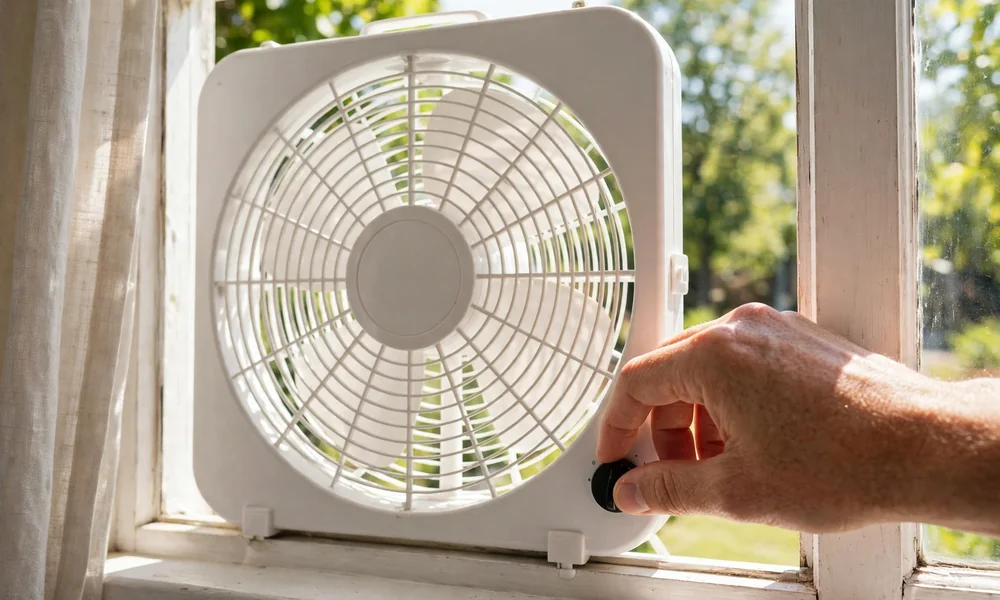
The most effective trick in this guide costs nothing and uses a box fan in a window. On a hot day, close the curtains on sunny windows and wait for the evening. When the air outside is cooler than the air inside, usually after sunset, place the box fan in a window facing outwards and switch it on. It will pull the hot air out, and cooler air will be drawn in through windows on the other side of the house. Open those other windows a little, just a few inches, so the air has a path through the building.
Direction matters. A fan blowing outwards is usually best at the start of the evening, because it clears the heat built up in the walls and furniture all day. Later, turn the fan around to blow cool night air in. Measure the window before you buy: a twenty-inch fan needs an opening at least that wide, and a fan wedged into a frame it does not fit will rattle and work half as well as it should.
Where to put a box fan, and where not to
Placement decides how much airflow you actually feel. A box fan on the floor blows air at knee height. Raise it on a sturdy low table and the breeze reaches the sofa or bed. Put it in a corner, angled across the room, and the air travels further. Never put a box fan behind furniture or a door, because the air has nowhere to go. In a bedroom, the best spot is at the foot of the bed, angled so the breeze crosses the bed rather than blowing straight into one person’s face all night.
Two places a box fan should never go: a bathroom, where water and mains electricity are a dangerous combination and steam corrodes the motor, and a window with no support, where a heavy fan can fall. A fan in a ground-floor window at night is an open invitation if the window is left wide open with no lock, so use a window lock or place the fan upstairs instead.
Keeping a box fan working well
Dust is the enemy of a box fan: it builds up on the blade and grille, unbalances the blade, and reduces airflow. Once a month in summer, unplug the fan and wipe the blade and grille with a damp cloth. If the grille does not come off, use a soft brush or a vacuum with a brush attachment, and never poke a cloth through the grille while the fan is plugged in. At the end of summer, clean the fan, wind the cord loosely, and store it upright in a dry place.
If a fan starts to rattle, the cause is usually a loose grille screw, a dusty blade, or a loose foot. Tighten the screws and clean the blade before you assume the motor has failed. If the fan hums but the blade does not turn, switch it off and unplug it at once.
Box fan buying checklist
- Twenty inches for a living room or large bedroom, eighteen inches for a small room, and no smaller for whole-room cooling.
- Airflow of around two thousand cubic feet per minute on high for a twenty-inch fan, compared like for like with other box fans.
- A low speed you can sleep through, checked by ear or by reviews that mention night use, not just the headline noise figure.
- A tight grille on both sides, a stable base, and a cord long enough to reach a socket without crossing a walkway.
- A window opening that fits the fan, measured before you buy, if the fan will be used for night cooling.
- A timer or thermostat if the fan will run in a bedroom, so it switches itself off when the room has cooled.
Frequently asked questions
Can a box fan cool a whole room?
A box fan cools the people in a room rather than the air itself, but a large one moves enough air to make a whole room feel cooler, especially in a window at night. It cannot replace air conditioning on the hottest days.
Is it safe to leave a box fan on all night?
Yes, if the fan is in good condition, the grille is intact, and the cord is undamaged. Use the lowest speed that keeps you comfortable and keep curtains clear of the fan.
Should a window fan blow in or out?
Blow out first, in the evening, to exhaust the hot air built up during the day. Once the room has cooled, turn the fan around to blow cool night air in.
How much electricity does a box fan use?
Very little compared with an air conditioner. A typical twenty-inch fan uses around seventy to one hundred watts on high, and far less on low speed.
Why is my box fan so noisy?
The most common causes are dust on the blade, a loose grille screw, or a wobbling base. Clean the blade, tighten the grille, and move the fan onto a flat surface.
Can I use a box fan in a window that is smaller than the fan?
No, not well. A fan larger than the opening will leak air and rattle. Measure first, and if the window is too small, use the fan on the floor in front of it instead.
The bottom line
The best box fan for summer heat in 2026 is a standard twenty-inch fan with strong airflow, a low speed you can sleep through, a tight grille, and a stable base. Use it in a window at night, place it where its breeze can cross the room, and keep it clean.