
A mop is the simplest cleaning tool in the house, and it decides whether your hard floors feel fresh underfoot or stay faintly sticky no matter how often you clean. A good mop lifts dried spills and muddy footprints in a single slow pass, wrings out properly so the floor dries in minutes, and leaves no streaks behind. A bad one pushes dirty water around, leaves grey trails across the tiles, and smells musty within a week.
The gap between the best and the worst mops in 2026 is wider than the price tags suggest. The best mops are the ones whose head, wringing system, and handle suit your floors and the way you clean. The worst look clever in the shop and fail at home, because their pads are thin, their buckets leak, or their heads cannot hold water properly. This comparison puts both sides head to head across every type of mop, so you can tell them apart before you spend a penny.
Key Takeaways
- The pad matters more than the handle, because a thick microfibre pad that stays in contact with the floor lifts grime a thin pad only smears.
- A flat mop is the best all-round choice for tiles and wood, while a spin mop wins for large tiled areas and a spray mop wins for quick daily cleans.
- Wringing decides the result: a mop that wrings nearly dry leaves floors clean in minutes, while a soggy mop leaves streaks and wet patches.
- Steam mops are the best option for sealed tiles and stone, but steam and unsealed wood, waxed floors, and laminate with open seams do not mix.
- Cheap string mops with thin cotton heads are the worst buy of all, because they hold dirty water, shed fibres, and start to smell within days.
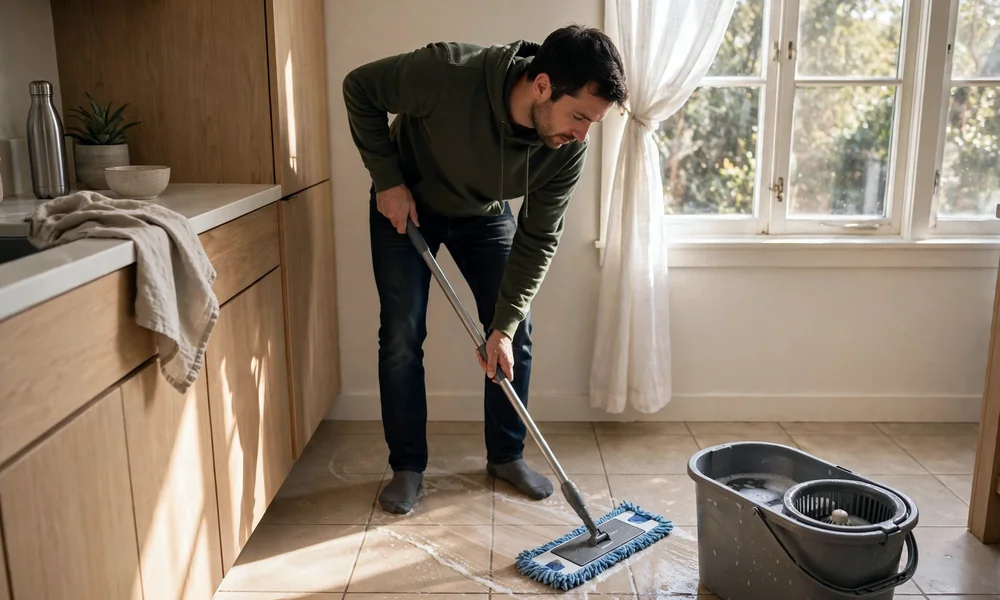
What Makes a Mop Good or Bad
The mop head is the first thing to check, because it does all the actual cleaning. A thick microfibre pad traps dust and grease in its fibres and holds it until you rinse it out, while a thin sponge or a loose cotton string mostly pushes dirty water from one spot to another. The head should stay flat against the floor through the whole stroke, reach into corners, and pick up without needing to be pressed down hard.
Wringing is the second thing, and it decides whether the floor dries clean or stays streaked. A mop that wrings nearly dry leaves a thin film of water that evaporates in minutes, while a mop that stays sodden leaves puddles in the grout and streaks across the tiles. Spin buckets, lever wringers, and spray mops all solve this in different ways, and the best system is the one you will actually use every time.
Weight, handle length, and the bucket decide whether you actually use the mop. A handle that is too short leaves you bent over and aching after one room, while a handle that adjusts to your height makes the whole job easier. The best mop is the one that fits your floors, your height, and your habits, not the one with the most gadgets attached.
The Best Mops of 2026
Flat mops for tiles and wood
For most homes, a flat mop is the best all-round choice. The wide rectangular head covers ground quickly, the microfibre pad lifts dust and dried spills without chemicals, and the pads are machine washable, so you always start with a clean one. The best flat mops of 2026 have a swivel head that reaches under low furniture and into corners, a handle that extends to your height, and pads thick enough to hold water without dripping. If you mop once or twice a week and want one mop that does everything, a flat mop is the best money you will spend.
Spin mops for large tiled areas
Spin mops are the best choice for large tiled floors, kitchens, and hallways that see a lot of foot traffic. The round microfibre head spins in the bucket to wring itself nearly dry, so your hands never touch the dirty water and the floor dries in minutes. A good spin mop covers a wide area with each pass, and the head reaches into corners better than a flat mop does. The bucket is the weak point: it is heavy when full and needs cleaning itself. For a home with lots of tiles, though, nothing beats a spin mop for speed and ease.
Spray mops for quick daily cleans
A spray mop is the best mop for quick daily cleaning and small homes. It carries its own water tank and sprays a fine mist ahead of the pad, so there is no bucket to fill, carry, or empty, and the floor is dry within minutes. The best spray mops of 2026 have a washable microfibre pad, a trigger that gives a light even spray, and a tank big enough for a whole flat. Used for daily maintenance between deeper cleans, a spray mop is the easiest mop to grab and the quickest to put away.
Steam mops for sealed tiles and stone
Steam mops are the best option for sealed tiles, stone, and vinyl that need a deep clean without chemicals. Hot steam loosens dried sauce, muddy footprints, and sticky patches that a cold mop only smears, and the floor dries in minutes with no chemical smell. Our guide on how to pick a steam mop that actually lifts grime in 2026 explains why steady heat and steam control matter more than raw power. The rule to remember is that steam suits sealed floors only: steam and unsealed wood, waxed floors, and laminate with open seams do not mix, and using one there can cause real damage.

The Worst Mops of 2026
Cheap string mops with thin cotton heads
The worst mop you can buy is the cheapest string mop on the shelf, and it fails in the same way every time. The cotton head is thin and loosely wound, so it holds dirty water instead of lifting it, sheds fibres across the floor, and starts to smell within days. The bucket has no wringer worth the name, so you are either wringing by hand or mopping with a sodden head that leaves puddles. A cheap string mop costs more in replacement heads and wasted time than a decent flat mop would have cost in the first place.
Sponge mops that fall apart
Sponge mops look clever and fail fast. The sponge head tears within weeks, especially on rough tiles or grout lines, and once it starts crumbling it leaves bits of sponge across the floor. The roller wringer squeezes the sponge unevenly, so one side stays wet while the other stays dry, and the floor ends up streaked. The sponge also holds smells: once it has picked up kitchen grease or pet mess, no amount of rinsing gets it fresh again.
Robot mops that drag dirty pads around
Cheap robot mops are among the most disappointing purchases in the whole category. Without proper navigation they wander in circles, miss whole rooms, and get stuck under the same chair every single day. The worst ones drag a dirty pad in circles, leave streaks across the hallway, and return to their dock still filthy. A robot mop only works when it applies real pressure to the floor and keeps its pads clean while it works, and those are the first things a cheap robot skimps on. Our comparison of the best vs worst robot mops of 2026 shows what proper scrubbing, clean pads, and good navigation are worth. If you mop mostly by hand, a robot is a luxury; if you buy one, buy one that actually scrubs.
Mops with flimsy handles and leaky buckets
Some of the worst mops in use today were once decent heads attached to handles and buckets that were never built to last. A handle that bends under pressure, a head that flops off its clip mid-stroke, and a bucket that leaks from a cracked seam turn a simple job into a mess. The lesson is to check the build before you buy: push the handle firmly, twist the head, and look at the bucket seams. A mop that falls apart in your hands is a bad mop, however good its pad looks on the shelf. If your floors are hardwood, our guide to the best robot mops for hardwood floors in 2026 covers which machines are gentle enough for wood and which ones to keep away from it.

Best vs Worst at a Glance
The best mops share four traits: a thick pad that stays in contact with the floor, a wringer that leaves the head nearly dry, a handle that fits your height, and a head you can wash or replace cheaply. The worst share the opposite: thin heads, soggy wringing, flimsy handles, and buckets that leak. Price is a rough guide but not a guarantee, because some mid-range mops outperform premium ones on real floors.
The clearest test is a simple one. Mop a dirty patch of tiles slowly, then look at the pad and the floor. A good mop leaves the pad visibly dirty and the floor clean and streak-free. A bad mop leaves the pad nearly clean, the floor streaked, and the dirt exactly where it was. Do that test in the first week, while you can still return the mop, and you will never be stuck with a bad mop again.
How to Choose the Right Mop for Your Home
Start with your floors, because they decide the type. Mostly tiles and a large area means a spin mop. Sealed wood and laminate mean a flat mop with a well-wrung pad. Small flats and daily cleans mean a spray mop. Sealed tiles that need a deep clean mean a steam mop. Pets mean a pad you can wash often and a wringer that keeps your hands out of dirty water. Allergies mean microfibre matters more than the mop shape, because a thick pad traps dust instead of spreading it.
Then check the running costs before you buy. Pads, heads, and filters are the hidden price of a mop, and a cheap mop with expensive replacement heads costs more over two years than a better mop with washable pads. Check the handle length against your height, the bucket weight against your strength, and the pad size against your floor area. Read the returns policy too, because a mop that looks good in the shop can only prove itself on your floors.
The Verdict
The best mops of 2026 are the ones that match your home: a flat mop for everyday cleaning, a spin mop for large tiled areas, a spray mop for quick daily cleans, and a steam mop for a deep clean on sealed floors. The worst are the cheap string mops with thin cotton heads, sponge mops that fall apart, and robot mops that drag dirty pads around. Spend your money on a thick pad, a wringer that leaves the head nearly dry, and a handle that fits your height. A good mop should make cleaning easier, and the right one will still be working well years after a bad one has been thrown away.


