
A tennis ball is the smallest thing you buy for the game, and it is the one that changes how every single shot feels. The best tennis balls of 2026 fly true off the strings, bounce at the height you expect, and still feel lively after an hour of hard rallies. The worst ones go soft within twenty minutes, wobble through the air, and turn a good game into a guessing game.
This comparison puts the best tennis balls of 2026 head to head against the worst, judged the way you would actually use them: in a weekly club game, in a coaching session with a basket of balls, on a hard court in summer, and on a damp court in winter. We look at bounce, felt, durability, how they behave on different surfaces, and whether they are still worth hitting with after the first set. The ball is only half the equipment story, and our comparison of the best and worst tennis rackets of 2026 covers the other half, because even the finest racket cannot rescue a dead ball.
Key Takeaways
- Judge a tennis ball by its bounce after an hour of play, not by how it feels when the can first opens.
- Pressurised balls feel livelier and faster, but they lose their bounce sooner than pressureless balls.
- The felt matters as much as the core: thick, tight felt grips the court and the strings, while thin felt goes bald fast.
- Match the ball to the court: extra-duty felt for hard courts, regular-duty felt for clay and indoor courts.
- A ball that has gone soft is not a bargain, however cheap it was, because it teaches you bad timing.
What Makes a Tennis Ball Good or Bad
A good tennis ball starts with its bounce. When a fresh ball drops from shoulder height onto a hard court, it should come back up to roughly waist height, time after time, with the same lively spring. The best balls of 2026 hold that bounce through a full set and well into the second, because their rubber core is even and their pressurised air escapes slowly. The worst balls start well and then fade: after twenty minutes of rallies the bounce drops, your timing goes early, and every shot feels as though it arrives a fraction sooner than you expected.
The second thing that separates good from bad is the felt. A good ball has thick, tightly woven felt that stays fluffy without shedding, and it gives the strings something to grip so you can put spin on the ball. The best balls keep their nap through a long session, and the seam stays smooth and even. A bad ball has thin, loose felt that pills within a few games, goes bald on one side, and then skids instead of gripping. Once the felt has gone, the ball flies faster and lower than it should, and your topspin stops biting.
Consistency is the third test, and it is the one that matters most in a match. Open a can of good balls and all three should feel the same in your hand: the same weight, the same firmness, the same bounce. The best balls are made to tight tolerances, so the third ball in the can plays like the first. The worst balls vary wildly from one to the next, and sometimes from one can to the next. One ball bounces high, the next one barely bounces at all, and you spend the match adjusting to the ball instead of playing your opponent.
The Best Tennis Balls of 2026
The best tennis balls of 2026 are the ones that disappear into the game. You stop thinking about them after the first few rallies, because every bounce is where you expect it to be, every serve comes off the strings cleanly, and the ball still feels firm when you pick it up for the second set. They are usually pressurised balls from makers who have been doing this for decades, with a dense rubber core and a heavy felt that holds up on hard courts.

What the best balls share is a feeling of liveliness without wildness. They come off the racket with a clean pop, they sit up nicely for a groundstroke, and they do not fly long when you hit with topspin. On clay they pick up a little dust and slow down just enough to reward a patient rally, and on a hard court they keep their pace without skidding. Their felt wears evenly, so the ball stays round and true instead of going lopsided after an hour.
The Worst Tennis Balls of 2026
The worst tennis balls of 2026 are not always the cheapest, and that is what makes them so annoying. Some arrive in a smart-looking can and feel fine for the first ten minutes, then the bounce falls away and the felt starts to shed. Others are rock hard out of the can, so hard that they jar your arm on every serve and fly off the strings like a stone.
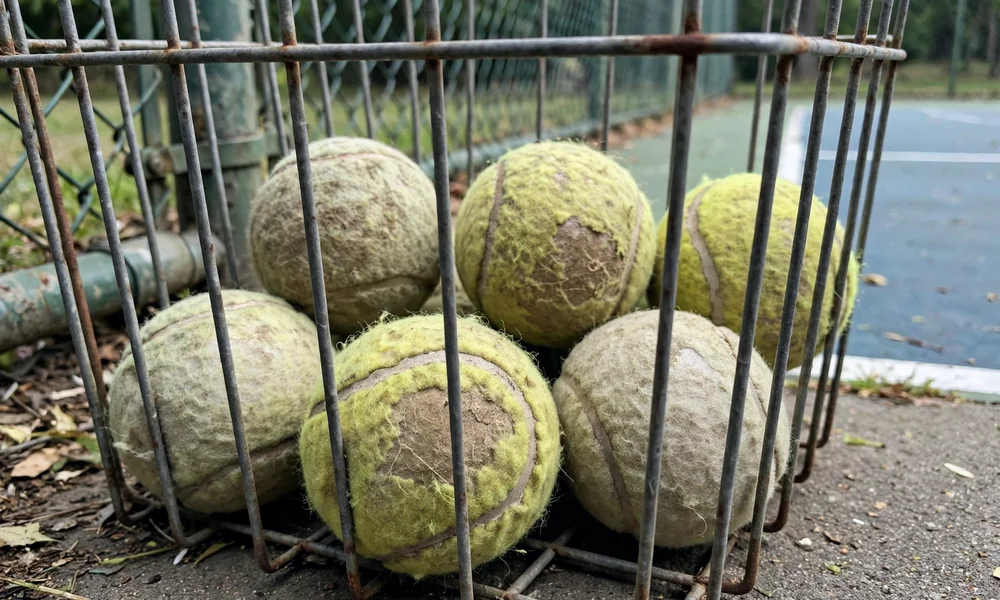
Softness is the most common failure. A ball that has lost its pressure feels dead in the hand, and on court it drops short, sits up for your opponent, and refuses to carry to the baseline. You end up swinging harder to make up for it, your timing slips, and your arm does the work the ball should be doing. Balls kept too long in an opened can, or bought in bulk and stored for months, are the usual culprits.
Then there is the felt. The worst balls have felt so thin that it wears through to the rubber within a single session, leaving a shiny bald patch that makes the ball skid and swerve. Others have felt that comes away in clumps, leaving fluff all over the court and your clothes. A ball that has lost its felt is not just ugly, it is unpredictable, and unpredictable is the last thing you want when you are trying to groove a stroke.
Hard Court, Clay, or Grass: Which Ball Wins
Hard courts are the toughest test of a tennis ball, because the rough surface grinds the felt away faster than any other. Extra-duty felt is made for this: it is thicker and tougher, and it survives the abrasion of a hard court far longer than regular-duty felt. The best extra-duty balls of 2026 still look respectable after a long session on a hard court, while a regular-duty ball on the same surface can look tired within an hour.
Clay and indoor courts are kinder to felt, and regular-duty balls come into their own there. Their thinner felt picks up less clay dust, so the ball stays lighter and livelier, and it grips the strings well for spin. On grass, a ball needs to stay firm and fast, and a good pressurised ball with a tight felt is the right choice. Whatever the surface, the rule is simple: a ball built for your court will last longer and play truer than one built for a different one. Your feet matter on court too, and our guide to the best tennis shoes of 2026 shows how much difference the right shoes make to your movement.
Pressurised or Pressureless: The Honest Comparison
| Type | Bounce | Feel | Durability | Best for |
|---|---|---|---|---|
| Pressurised | Lively and high when fresh | Soft and responsive | Fades after a few sets | Matches and competition |
| Pressureless | Steadier and slightly lower | Firmer and heavier | Lasts for weeks of practice | Coaching and practice |
| Cheap pressurised | Good for twenty minutes | Soft, then dead | Goes flat fast | Nothing, honestly |
| Old or stored balls | Low and unpredictable | Dead in the hand | Already finished | The practice basket only |
Pressurised balls are the match ball, and they are at their best in the first hour after the can opens. That hiss when you crack the seal is the sound of fresh pressure, and it is also a warning: from that moment the air is escaping, slowly but surely. A pressurised ball that has been open for a week will never play like a fresh one, however good it was to start with.
Pressureless balls work differently. They have no sealed air inside, so their bounce comes from a thicker, stiffer rubber core, and they never go flat in the same way. They feel firmer and a little heavier, and they are not as lively as a fresh pressurised ball, but they keep the same bounce for weeks. For coaching, for a ball machine, and for a practice basket, they are the sensible choice, and the best ones feel far better than their reputation suggests.
How to Buy Tennis Balls Without Regret
The single most useful thing you can do before buying tennis balls is to check the date and the seal. A can that has been sitting on a shelf for a year has already lost pressure through the seal, and it will play like a ball that has been open for a week. Buy from a shop that turns its stock over quickly, check that the seal is intact, and listen for the hiss when you open it. No hiss means no pressure, and no pressure means a dead ball.

Buy for the way you actually play, not the way you imagine playing. If you play once a week at a club, a can of good pressurised balls opened fresh for each session is the right buy. If you practise three times a week, a bucket of pressureless balls will save you money and frustration. And if you coach, keep the two separate: fresh balls for matches, practice balls for drills, and never mix them up. Small kit makes a difference too, and our guide to athletic socks that stop blisters before they start covers the cheapest comfort upgrade in tennis.
Finally, know when a ball is finished. Squeeze it: if it gives too easily, it is dead. Look at the felt: if it is bald on one side, it is finished. Drop it next to a fresh ball: if it bounces noticeably lower, it is done. Retire dead balls to the practice basket or the dog, and open a fresh can. A tennis ball costs very little, and a fresh one makes every shot in the game feel better.
The Verdict
The best tennis balls of 2026 are the ones you forget about during the game. They bounce the same in the first game and the tenth, their felt grips the strings and the court, and they still feel firm when the match is on the line. They cost a little more than the cheapest balls, and they are worth every penny of it.
The worst tennis balls of 2026 are the ones that make you think about the ball instead of the game: the ones that go soft halfway through a set, shed their felt, or bounce differently from one to the next. A cheap ball that dies in twenty minutes is not a bargain, it is a false economy that costs you timing, rhythm, and enjoyment.
So buy fresh, buy for your court, and retire balls when they are done. Open a new can for a match, keep pressureless balls for practice, and never let a dead ball spoil a good game.


