
A travel pillow is the smallest piece of luggage you carry and the one that decides whether a long flight feels like rest or like an endurance test. A good one holds your head steady, supports your neck, and lets you drift off without sliding forward or waking with a stiff neck. A bad one flops, flattens, pushes your chin into your chest, and leaves you more tired than if you had slept without it. The difference between the best and the worst travel pillows in 2026 is not about softness or price. It is about support, shape, fit, and a filling that keeps its form for hours, not minutes.
This head-to-head comparison puts the two sides against each other properly, rather than listing good pillows on one page and bad ones on another. On one side, the pillows that cradle your head, stay cool, and pack down neatly when the journey ends. On the other, the ones that deflate, overheat, and slide off your shoulder before the plane has even levelled out. By the end, you will know which kind belongs in your carry-on and which kind should never have been bought.
Key Takeaways
- A good pillow holds your head in a neutral position, because support that stops your head falling forward is what prevents a sore neck.
- Memory foam gives the most reliable support for sleeping upright, while inflatable pillows pack smallest but support least.
- Fit matters more than brand: the pillow should fill the gap between head and shoulder without pushing your chin forward.
- Cheap pillows flatten within an hour, trap heat, and slide around, and their thin covers are the first parts to wear out.
- Try the pillow in a seat before you travel, because a pillow that feels fine standing up can fail completely when you sit and lean.
What Makes a Great Travel Pillow
A great travel pillow is judged by three things: how well it supports your head, how comfortable it stays over hours, and how easily it travels. Support comes first, because a pillow that cannot hold your head up is not a pillow at all, it is a very soft scarf. A good pillow is firm enough to keep its shape under your head, soft enough against your cheek, and shaped for the way people really sleep sitting up.
Comfort over hours is the test most buyers overlook. A pillow that feels lovely for five minutes in a shop can become hot, sweaty, and irritating by the second hour of a flight. The best pillows breathe, with a cover that wicks moisture and a filling that does not trap heat, and they stay comfortable whether you lean left, right, or forward. That is why the cover matters as much as the filling. A removable, washable cover is essential for any pillow you will press your face against again and again.
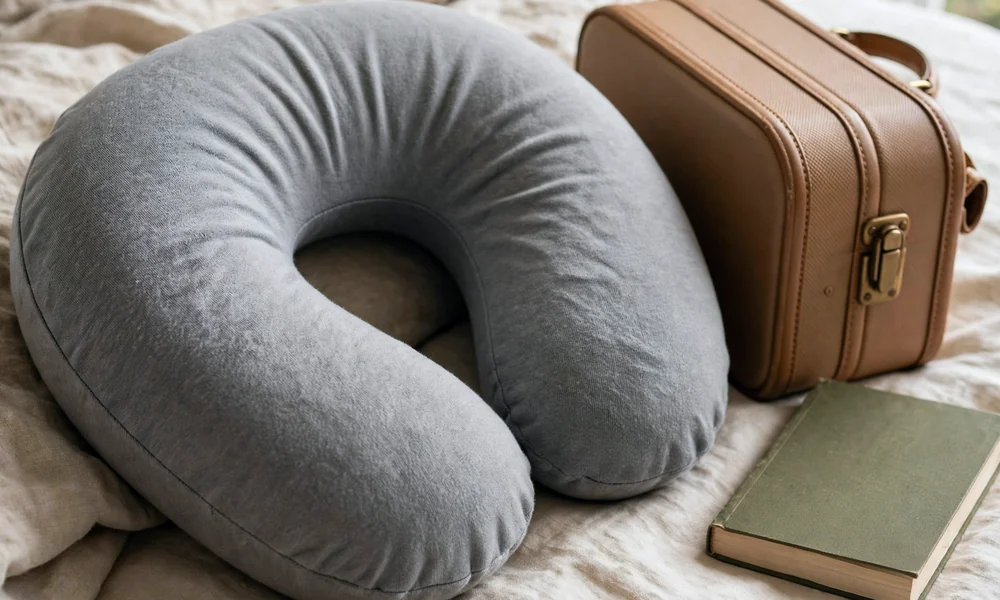
The Best Side: Pillows That Earn Their Place
Firm Memory-Foam U-Shaped Pillows
A firm memory-foam U-shaped pillow is the best choice for most travellers, and the easiest upgrade you can make to a long flight. The best of them hold your head steady from both sides, stop the dreaded forward flop, and keep their shape for the whole journey, not just the first hour. Dense foam springs back slowly, stays cool, and fills the gap between head and shoulder without pushing your chin down. Look for a pillow with a high front or a chin support, rather than a simple ring that leaves your head free to fall forward.
Wrap and Scarf-Style Pillows
Not every good travel pillow is a foam ring, and the best wrap styles understand that some travellers want something softer and more discreet. A good wrap pillow coils gently around your neck, supports your head from the side, and feels more like a scarf than a piece of equipment, which makes it easy to wear through an airport without looking like you are already asleep. It usually has a soft, breathable cover, a filling that holds a little shape without feeling stiff, and a design that packs flat in a bag. Some have a simple fastening, which is all you need; a pillow with a dozen straps and clips is solving a problem nobody has.

Cool Covers, Washable Fabrics, and Smart Packing
The small details of a pillow decide whether using it feels easy or annoying every journey. The best pillows have a removable cover you can wash after every trip, a fabric that stays cool and does not make your skin itch, and a shape that compresses into a small pouch or clips to the outside of your bag. They have a strap or a snap that keeps the pillow rolled up, rather than a loose bundle that unrolls inside your luggage. And they dry quickly, so a washed cover is ready for the next flight, not still damp when you need to pack.
The Worst Side: Pillows That Fight You Every Flight
The worst travel pillows of 2026 are not always the cheapest ones, but they share the same unhappy talent: they make a perfectly good journey harder to sleep through. They deflate, they flatten, they overheat, and they slide off your shoulder just as you start to drift off. Most of their faults are visible before you buy, if you know what to look for: a thin filling that compresses to nothing, a shiny cover that traps heat, a shape with no chin support at all, and a valve or seam that looks like it will fail on the first trip.
Thin, Floppy, and Flat Within an Hour
A pillow that flattens under the weight of your head is the classic bad travel pillow, and it fails in the most tiring way possible. You settle in, lean back, and for a few minutes it feels fine, until the filling compresses, your head starts to slide, and you wake with your chin on your chest and your neck aching. Cheap foam and thin inflatable chambers make it worse, because they offer no real resistance at all, just a soft shape that gives way the moment you trust it. That matters, because most of us now fly overnight or take long train journeys, and a pillow that fails in the first hour costs you the only sleep you were going to get.
Hot, Sweaty, and Always Sliding Off
A pillow that will not stay put is a pillow that cannot do its job, and the slippery, shiny cover is the usual culprit. Smooth synthetic fabrics slide against skin and seat fabric alike, so the pillow creeps around your neck, bunches up behind your ear, and ends up on the floor or wedged against the window. Hot, non-breathable fillings make it worse, because you wake damp and uncomfortable, peel the pillow off, and spend the rest of the flight awake. It is a small annoyance the first hour and a miserable journey by the time you land.

Head to Head: Best vs Worst at a Glance
Put the two sides next to each other and the choice becomes straightforward. The best pillows are firm, shaped to stop your head falling forward, cool to sleep against, and easy to wash and pack. The worst are soft to the touch and flat within an hour, hot and slippery, and impossible to keep in place. The best cost a little more on the day you buy them and far less over a year, because you are not replacing them every few trips or paying for the sore neck they cause. The worst cost almost nothing and then keep costing you in lost sleep and wasted journeys.
If you are choosing between the two sides in a shop, use your hands and your neck. Squeeze the pillow and hold it compressed: a good one springs back slowly and keeps its shape. Put it on, lean forward and to the side: your head should stay supported, not flop. Feel the cover: it should be soft and breathable, not shiny and slippery. And check that the cover comes off for washing.
The Verdict
The verdict is clear: buy a firm memory-foam U-shaped pillow with chin support, a breathable, removable, washable cover, and a shape that fits the gap between your head and your shoulder, in a size that packs neatly into your carry-on. It will hold your head steady, keep you cool through a long flight, and still support you properly a year from now. It costs more than the cheapest pillow on the shelf, and it is worth every penny of the difference, because it is the only kind you buy once and then forget about.
The worst pillows are not a mystery. Thin fillings that flatten, shiny covers that slide, no chin support, and valves that leak are all easy to spot and easy to avoid. If your current pillow does any of those things, replace it. Your journeys will feel calmer and your neck will thank you.
Who Each Side Is For
The best side is for anyone who sleeps sitting up for more than an hour at a time. It suits frequent flyers, overnight train travellers, and long-distance coach passengers, because the support is steady, the pillow stays cool, and the cover can be washed between trips, in the same way that good travel pillows should serve the person wearing them rather than the shelf they came from. It also suits anyone with a sensitive neck, because a well-shaped pillow keeps the head neutral instead of letting it hang.
The worst side, if it can be said to be for anyone, is for a journey that is hardly slept on: a short hop, a daytime bus ride, or a pillow bought as a novelty rather than for sleep. Even then, a cheap pillow with a proper shape is usually the smarter buy. For a flight you plan to sleep on, the best side wins on comfort, on cost over time, and on the simple pleasure of arriving rested. A good sleep mask and a pair of reliable earplugs will finish the job the pillow starts.
How to Choose and Care for Yours
Choosing well takes five minutes. Measure the gap between your head and your shoulder, then try the pillow on and lean in every direction, so it supports you where you actually fall asleep. Check that the foam is firm and springs back, that the cover is breathable and removable, and that the pillow packs down small enough for your bag. Place the pillow high enough that it cradles your jaw, not low around your shoulders where it does nothing.
Caring for it is just as simple. Wash the cover after every trip, because a pillow pressed against your face collects sweat and germs faster than you would expect. Air the filling out between journeys and do not store it compressed for months, which is how most foam starts to lose its spring. If the pillow is inflatable, check the valve before you pack it, and carry a spare in case it leaks mid-flight. A pillow looked after this way will last for years, and the journey will stay a place you actually sleep on, with support that helps you rest instead of fighting you.


