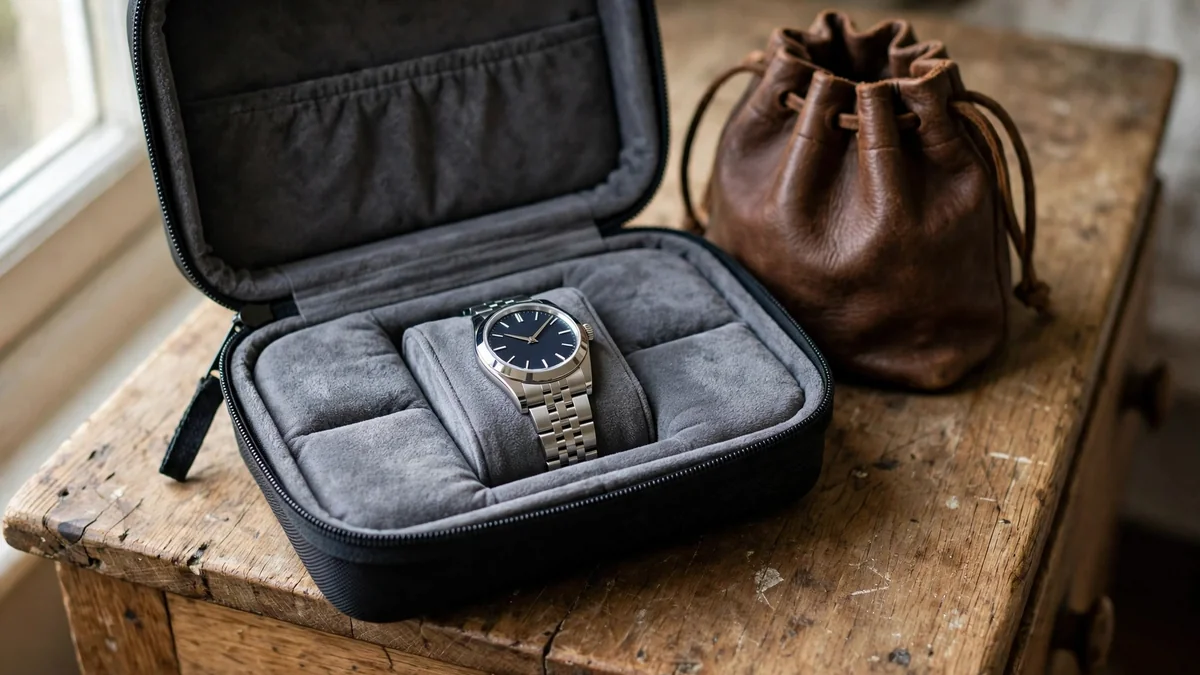
Why Watch Cases Protect Your Favourite Watch Better Than a Drawer in 2026
Watch cases are the simplest way to protect the one watch you actually wear: a padded, close-fitting case that holds a single watch still, keeps dust and knocks away from the dial, and travels with you instead of sitting in a drawer. The best watch cases of 2026 do that job without fuss — a firm cushion, a shell that resists crushing, and a closure you can open with one hand. A drawer does none of it: watches slide, clasps scratch cases, and a loose watch rolls into whatever else lives there.
Most watch owners do not need a bigger box. They need one good case for the watch on their wrist today, and maybe a second for weekends. This guide compares the watch cases worth buying in 2026 — zippered hard cases, leather rolls, single-watch display cases and soft pouches — and shows how to choose between them and fit a watch to its cushion.
Key Takeaways
- A watch case holds one watch; a watch box holds a collection — buy the case for the one watch you wear daily.
- The cushion matters more than the outside: it must grip the strap without stretching it and hold the case upright.
- A hard shell beats soft leather for travel, because a case in a bag gets crushed and dropped.
- Measure your watch first: a 44 mm diver on a steel bracelet needs a wider, deeper case than a 36 mm dress watch.
- Keep the case out of direct sunlight and away from radiators, because heat and UV fade dials and dry out leather straps.
What a Watch Case Is — and What It Is Not
A watch case is a protective case made for a single watch, with a padded cushion the watch wraps around and a shell that closes over it. It is usually zippered or latched, small enough to slip into a bag or a jacket pocket, and its cushion holds the watch still so the case cannot knock against anything. The right one is the case your watch fits without forcing the strap.
A watch case is not a watch box, and the difference matters. A box holds six or twelve watches on a dresser, each in its own slot, and it stays at home. A case holds one watch and goes where you go. Our guide to watch boxes covers the dresser boxes in full; this guide stays narrow: the single case that protects the watch you wear most.
A watch case is also not a watch winder. A winder turns an automatic watch to keep it running while you are not wearing it; a case keeps a watch safe but cannot wind anything. Our guide to watch winders covers the turning machines in full. If you own two or more automatics and hate resetting the date, a winder earns its place beside the case, not instead of it.
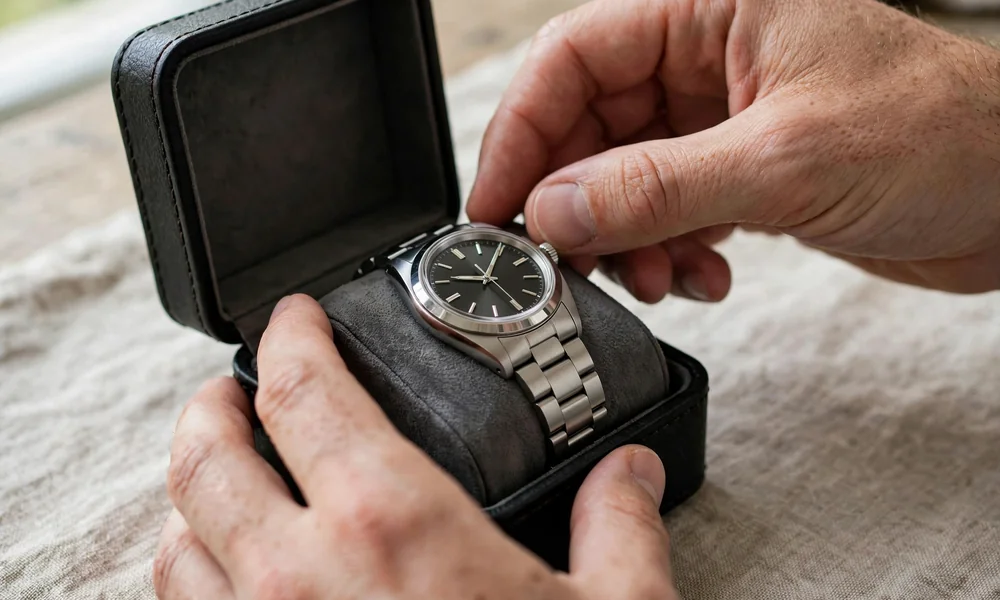
The Main Types of Watch Case
Most watch cases fall into four designs.
Zippered hard cases
A zippered hard case is a small rigid shell, usually with a padded lining and a single cushion inside, closed by a zip that runs around three sides. It is the best all-rounder for travel: the shell resists crushing in a packed bag, the zip keeps dust out, and the case opens flat so the watch lifts out easily. Look for a zip that runs smoothly without catching the lining, and a shell that springs back when you press it rather than denting. It is bulkier than a roll, so it suits a bag better than a jacket pocket.
Leather watch rolls
A leather watch roll is a strip of leather with one to three padded slots that rolls up and fastens with a strap or a snap. It is the most elegant way to carry a watch, and the slimmest: a single-watch roll is barely thicker than the watch itself. The leather ages well, but it protects less than a hard shell — a roll will not save a watch from a heavy bag dropped on it. Choose a roll for hand luggage you carry yourself, not checked luggage.
Single-watch display cases
A single-watch display case is a small box with a glass lid, made to sit on a bedside table or a desk and show off one prized watch. It is the case you buy for the watch you love looking at: the glass keeps dust off the dial while letting you see it, and the cushion holds the watch upright. Buy one for a gift watch or a retirement watch, and keep it out of direct sunlight, because a glass lid focuses light onto the dial. It is not a travel case — glass lids chip, and the case is too bulky for a bag.
Soft pouches and sleeves
A soft pouch is a padded sleeve, usually in leather, suede or microfibre, that a watch slides into with its strap wrapped around a small cushion or left loose. It is the cheapest and lightest option, and it beats a bare pocket every time: the padding stops keys and coins scratching the case, and the drawstring keeps the watch from sliding out. The weakness is shape: a pouch does not hold the watch still, so a heavy watch can shift and knock against the zip. Use a pouch for a beater watch on a short trip, and a hard case for anything you would mind scratching.
Watch Cases at a Glance
| Case type | Best for | Protection | Size | Price |
|---|---|---|---|---|
| Zippered hard case | Travel | High, crush-resistant | One watch | Mid-range |
| Leather watch roll | Jacket pocket, hand luggage | Medium, scratch-proof | One to three watches | Premium |
| Single-watch display case | Bedside, gifts | Medium, dust-proof | One watch | Mid-range |
| Soft pouch or sleeve | Short trips | Low, scratch-only | One watch | Budget |
What to Look For Before You Buy
The cushion
The cushion is the part that touches your watch, so it deserves the most attention. A good cushion is firm, evenly stuffed and sized to the case: the watch should slide on without forcing the strap, and stay upright. Cushions that are too soft let a heavy watch sink until its case touches the shell; cushions that are too hard stretch a leather strap and leave a crease. Removable cushions are worth paying for, because you can swap in a wider one for a chunky diver or a slimmer one for a dress watch.
The shell
The shell is what stands between your watch and the rest of your bag. A hard shell should resist a firm squeeze without flexing onto the watch inside, and its corners should be reinforced. Leather shells look better but need a rigid insert — thin leather alone sags. Check the stitching where shell meets lining: loose threads mean the case will split within a year.
The closure
A case that opens by accident is worse than no case at all. A zip should run the full length of the case and close with a smooth pull, without snagging the lining. A snap or strap should fasten with a firm click and stay fastened when the case is shaken upside down. Test it before you travel: if the closure gives way, send the case back.
Size and fit
Measure your watch before you buy, not after. A 44 mm diver on a steel bracelet is wider, thicker and heavier than a 36 mm dress watch on leather, and a case made for the second will crush the first. Check the internal length against your watch’s lug-to-lug measurement, and the depth against the watch plus its cushion. A slightly roomy case beats a snug one: a watch forced into a tight case presses its crown against the shell.
Lining and care
The lining is what your watch actually rests against, so it must be soft enough not to mark a polished case. Velvet and microsuede cradle a watch; rough or thin linings leave fine marks over months of use. A removable, washable lining is a bonus, because dust and skin oils build up inside any case used daily. Brush it every few months, and air the case out after a trip rather than zipping it straight into a drawer.

Using a Watch Case on the Road
A watch case earns its keep on trips, but only if you pack it properly. Put the case in the middle of your bag, surrounded by soft clothes, never at the bottom under everything else. If you carry two watches, take two single cases rather than one roll, which lets them knock together. At airport security, take the case out of the bag so the scanner sees it clearly, and zip it shut before it goes back in.
At home, the case is for the watch you are not wearing today. Keep it on the bedside table, not in a bathroom drawer, because steam and humidity fog crystals and stiffen leather straps. If you rotate watches, keep one case per watch: the cushion takes the shape of one strap, and a different strap stretches it out of shape. For the rest of a collection, a proper box is the better home — our guide to jewelry boxes covers the same build quality in boxes made for rings, necklaces and bracelets.
Watch Case Checklist
- Measure your watch lug to lug against the case’s internal size.
- Test the cushion: firm, evenly stuffed, and removable if possible.
- Squeeze the shell hard and check it does not flex onto the watch.
- Close the case and turn it upside down to test the zip or snap.
- Check the lining is soft velvet or microsuede, not rough or thin fabric.
- Keep the case out of sunlight and away from radiators and bathrooms.
Frequently Asked Questions
Is a watch case better than a watch box?
It depends how many watches you own. A case protects one watch and travels with you; a box stores a collection at home. If you own one or two watches, a case is the better buy. If you own five or more, a box is the better home, with a case for travelling.
Will a watch case fit a large diver’s watch?
Only if you buy a case made for it. A 44 mm diver on a steel bracelet needs a wider and deeper case than a dress watch, so check the internal measurements against your watch before ordering.
Can I put an automatic watch in a case for months?
You can, but it will stop — an automatic winds from your wrist, and a case cannot wind it. For a few weeks that is fine; you reset the time when you wear it again. For longer, a winder keeps it running.
Do leather watch rolls protect as well as hard cases?
No. A roll stops scratches and looks elegant, but it will not resist crushing in a packed bag. Use a roll for hand luggage you carry yourself, and a hard case for checked luggage.
How do I clean a watch case?
Brush the lining with a soft brush every few months, wipe leather with a dry cloth, and air the case out after trips. Never soak a case, and never use a wet wipe on suede or velvet.
Is a single-watch display case worth it?
For a prized watch or a gift, yes. It keeps dust off the dial, shows the watch properly, and turns a bedside table into a small display. For everyday use, a hard case is more practical.

Bottom Line
A watch case is a small purchase that protects a large one. Buy a zippered hard case for travel, a leather roll for the jacket pocket, or a glass display case for the watch you love looking at — and in every case, check the cushion, the shell and the closure first. The watch you wear most deserves better than a drawer.


