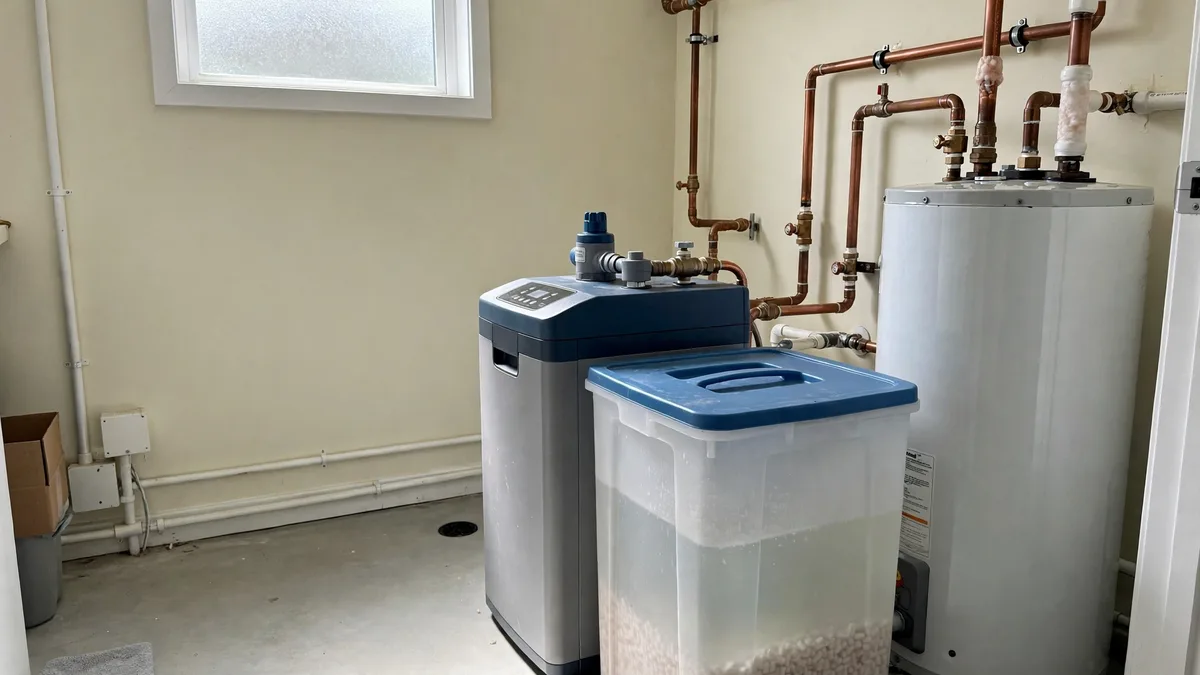
A water softener quietly changes almost everything water touches in a hard water home: the taste of a glass of water, the feel of a shower, the life of a kettle, and the softness of laundry. If you live with hard water, you know the signs: white crust around taps, soap that never quite lathers, glasses that come out of the dishwasher cloudy, and a kettle that furs up within weeks. A water softener removes the minerals that cause all of that.
This guide explains how water softeners work, how to tell whether your home needs one, which type suits your house, and how to size it correctly.
Key Takeaways
- Hard water is rich in calcium and magnesium; a softener removes those minerals, which stops limescale, improves lather, and protects pipes.
- Salt-based ion exchange is the only method that truly softens water; salt-free conditioners change how minerals behave but leave the hardness in the water.
- Test your water first: hardness in grains per gallon decides the size of softener you need, so never buy blind.
- Size by grain capacity and flow rate, not by the size of the box; an undersized softener regenerates too often and wastes salt and water.
- Budget for salt and water as well as the unit itself, because regeneration is a running cost for the life of the softener.
What Hard Water Does to a Home
Hard water is not dirty water. It is ordinary tap water that has passed through chalk and limestone, picking up dissolved calcium and magnesium on the way. Those minerals are harmless to drink, but they cause a long list of problems. When hard water is heated, the minerals come out of solution and form limescale, the hard white crust that coats kettles, shower heads, and heating elements. A coated heating element has to work harder, which wastes energy and shortens its life. Soap and detergent also react with calcium and magnesium instead of cleaning, so you need more soap to get a lather, and the result is a filmy residue on skin, hair, and laundry. Towels feel stiff, whites turn grey, and glasses come out spotted. If your shower head is already clogged, softening will stop new scale forming but will not clear the old deposits, so clean or replace it when the softener goes in. Our guide to the best shower heads in 2026 covers high-flow and low-pressure options for a newly softened supply.
How hard your water is depends on where you live. In chalk and limestone regions, hardness can be very high, and a softener pays for itself in longer appliance life and lower soap and energy use. The only way to know is to test: a simple test strip gives a rough reading in minutes, while a water company report gives an exact figure. Above about 7 grains per gallon, most households will notice a real benefit.
How a Water Softener Works
A salt-based water softener works by ion exchange, a swap inside a tank full of tiny resin beads. Hard water flows through the resin, and the beads hold on to the calcium and magnesium ions while releasing sodium ions in their place. The water that leaves the tank is soft. When the beads fill up, the softener regenerates, flushing them with a salty brine that washes the hardness away. The cycle runs automatically, usually at night.
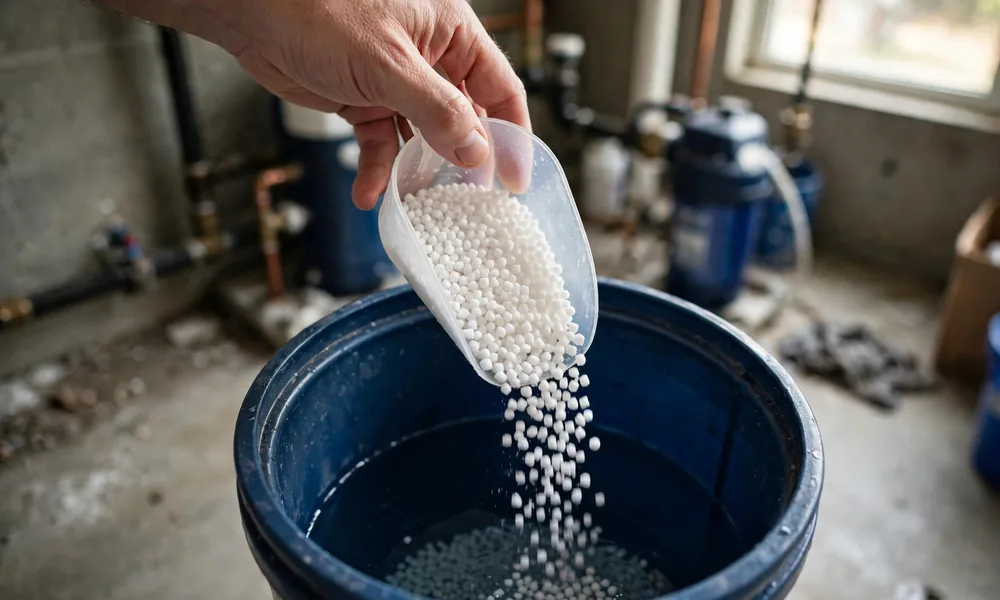
The brine comes from a separate tank, the brine tank, which holds salt pellets and water. A household typically uses a bag or two of salt a month. A modern metered softener only regenerates when it needs to, while an older timer-based softener regenerates on a fixed schedule.
Salt-free systems work differently, and the difference matters. A salt-free conditioner, often using template assisted crystallisation, changes the structure of the calcium crystals so they are less likely to stick to surfaces and form scale. The water feels the same and the hardness reading does not change, because the minerals are still there. That can help protect a boiler, but it does not soften the water.
Water Softener vs Water Filter: Not the Same Job
Softeners and filters are often confused, and some shops sell them as if they were interchangeable. They are not. A filter removes things from water: chlorine taste, sediment, lead, and other contaminants, depending on the filter type. A softener removes hardness minerals and nothing else. A softened home can still have chlorine taste, and a filtered home can still have hard water. Buying one when you need the other is an expensive mistake. Our guide to the best water filters in 2026 compares pitchers, countertop, under-sink, and whole-house filters. A faucet filter is not a substitute for a softener, but it can be a useful companion: our guide to the best faucet filters in 2026 explains which models improve taste at a single tap.
The Best Water Softeners of 2026
1. Best Overall: Fleck 5600SXT 48,000 Grain
The Fleck 5600SXT is the workhorse of home water softening, and the 48,000 grain version is the best overall choice for a typical family home. Its metered digital control head regenerates only when needed, which keeps salt and water use low, and the Fleck valve is known for reliability.
2. Best for Large Homes: GE 40,000 Grain Water Softener
The GE 40,000 grain softener is the best choice for a larger home with high water use. It combines a generous grain capacity with a straightforward digital controller. It regenerates on demand, has a clear display showing salt level and water use, and keeps the resin tank and brine tank in one tidy cabinet unit. It uses a little more salt than the Fleck in very hard water.
3. Best Compact: Whirlpool WHES30E 30,000 Grain
The Whirlpool WHES30E is the best compact softener for a smaller home or a flat with limited space. At 30,000 grains it suits one or two people, or a small family with moderately hard water, and its single-cabinet design takes up less floor space than a two-tank system. Its limits are capacity and flow: in a larger household it will regenerate often.
4. Best Salt-Free Conditioner: Aquasana SimplySoft
The Aquasana SimplySoft is the best salt-free conditioner for a home that wants scale protection without salt, electricity, or wastewater. It uses template assisted crystallisation to keep calcium in suspension, so it is less likely to form hard scale on heating elements and shower heads. It needs no drain, no power, and no salt top-ups. Be clear: it does not soften water or improve lather.
5. Best for Very Hard Water: Pentair WS48-56SXT10
The Pentair WS48-56SXT10 is the best choice for very hard water, the kind that furs a kettle in a week and leaves thick crust on every tap. Its 48,000 grain capacity and high flow rate handle hardness that would overwhelm a smaller unit.
6. Best Budget Pick: Tier1 Essential Series 32,000 Grain
The Tier1 Essential Series 32,000 grain softener is the best budget pick for a household that wants real salt-based softening without paying for a premium brand. It uses a simple digital metered controller and softens effectively at moderate hardness levels.
Water Softeners 2026 Comparison Table
| Softener | Type | Capacity | Best for | Salt | Price |
|---|---|---|---|---|---|
| Fleck 5600SXT | Salt-based | 48,000 grain | Family homes | Yes | Medium |
| GE 40,000 Grain | Salt-based | 40,000 grain | Large homes | Yes | Medium |
| Whirlpool WHES30E | Salt-based | 30,000 grain | Small homes, flats | Yes | Low |
| Aquasana SimplySoft | Salt-free conditioner | Not rated | Scale protection only | No | Medium |
| Pentair WS48-56SXT10 | Salt-based | 48,000 grain | Very hard water | Yes | High |
| Tier1 Essential Series | Salt-based | 32,000 grain | Budget buyers | Yes | Low |
How to Size a Water Softener
Sizing a softener is a simple calculation. Multiply the number of people in the house by the average daily water use per person, roughly 75 gallons a day. Multiply that by your water hardness in grains per gallon, and then by seven to cover a week between regenerations.
Flow rate matters just as much as capacity. A softener must deliver soft water as fast as the house uses it, and a house with two bathrooms, a washing machine, and a dishwasher running at once can demand a high flow. Check the service flow rate of any softener you buy, and match it to your home.
If the calculation feels uncertain, a plumber or water treatment specialist can test your water and size the system for you. A softener that is too small is a constant frustration.
Installation, Salt, and Maintenance
Most whole-house softeners are installed where the water enters the home, after the main stopcock and before the water splits to the kitchen, bathrooms, and appliances. The softener needs a drain, a power socket, and space for the brine tank. A competent plumber can usually fit a standard unit in a few hours.
One point to settle at installation is whether the kitchen drinking tap should be softened. Softened water contains a small amount of extra sodium, and many households prefer to keep one unsoftened cold tap for drinking and cooking.
Maintenance is simple but regular. Check the salt level in the brine tank every month, and top it up before it runs out, because a softener without salt cannot regenerate. Use the salt type your softener recommends, usually pellets or crystals.
Running costs are modest but real. Salt is the main cost, typically a bag or two a month, and regeneration uses water, which adds a small amount to the water bill. Against that, a softener saves money on soap and detergent and extends the life of boilers, washing machines, and dishwashers.
Water Softener Buying Checklist
- Test your water first: the hardness in grains per gallon decides the size you need.
- Size by grain capacity and flow rate, not by the size of the box.
- Choose salt-based ion exchange for truly soft water, and salt-free conditioning only for scale protection.
- Check installation needs: a drain, a power socket, and space for the brine tank.
- Decide whether the kitchen drinking tap stays on hard water, and ask a plumber to pipe it that way if you prefer.
- Budget for salt, water, and annual maintenance, and check the salt level every month.
Frequently Asked Questions
Is softened water safe to drink?
Yes, for most people. Softening adds a small amount of sodium, and the water remains safe to drink. Anyone on a strict low-sodium diet should ask a doctor first.
Do water softeners remove chlorine?
No. A standard salt-based softener removes calcium and magnesium only. Chlorine taste and other contaminants need a filter, which is a separate unit.
How often does a water softener regenerate?
A metered softener regenerates when it needs to, usually every few days to once a week, depending on water use and hardness. It typically regenerates at night.
How much salt does a water softener use?
A typical family home uses one to two bags of salt a month, depending on water hardness and use. Very hard water and a large household will use more.
Can I install a water softener myself?
A confident DIYer can install a softener, but most households are better off hiring a plumber. The work involves cutting into the main water supply and fitting a drain.
Will a water softener fix my limescale?
It will stop new limescale forming, because the hardness minerals are removed before the water reaches your taps and appliances. It will not dissolve existing scale, so kettles and taps that are already furred up will need cleaning or replacing.
The Bottom Line
A water softener is one of the few home improvements that pays you back every single day. Test your water, size the system to your household, and buy a salt-based metered softener from a reliable brand. Keep the salt topped up and check it monthly.