
The best wine fridges in 2026 are not about chilling a bottle for tonight. They are about keeping a collection safe for months and years, so every bottle opens as the winemaker intended. A bottle stored badly loses its freshness and its cork dries out. A bottle stored well simply waits, quietly improving, until you open it.
Choosing the best wine fridge is a different decision from choosing a wine chiller. A chiller brings a bottle to serving temperature quickly so you can pour it this evening. A wine fridge is built for ageing and storage: steady temperature, controlled humidity, low vibration, and protection from light.
Key Takeaways
- A wine fridge is for long-term storage and ageing, not just chilling a bottle.
- Dual-zone fridges suit red and white collectors; single-zone models are simpler and cheaper for one style.
- Compressor cooling suits warm rooms and large collections; thermoelectric runs quieter in small spaces.
- Capacity is measured in standard 750 ml bottles, so buy 20 to 30 percent more space than you need today.
- Built-in models need front ventilation and exact measurements; freestanding models need airflow around the sides.
What a Wine Fridge Actually Does
A wine fridge is a storage cabinet designed around the four enemies of wine: heat, light, vibration and dry air. A kitchen fridge fights none of them well. It keeps food at 3 to 5 degrees, far too cold for wine, and every time the door opens the temperature swings. Wine stored there for a year comes out tired and flat.
A good wine fridge holds a steady temperature between 5 and 18 degrees, within a degree or two, day and night. It keeps humidity around 50 to 70 percent so corks stay sealed, its shelves cradle bottles on their sides, and its tinted glass blocks the light that breaks down aroma. That combination turns a box into a cellar.
Wine Fridge vs Wine Chiller vs Wine Cellar
The three options solve different problems. A wine chiller is a serving appliance: it cools a bottle to drinking temperature in minutes or hours, and most hold just one or two bottles. It is brilliant for a dinner party and useless for a collection. For the quick-chill options, see our guide to the best wine chillers for home.
A wine cellar is the gold standard for storage: naturally cool, dark, humid and still. But a real cellar needs the right room and a budget in the thousands, and very few homes have one. A wine fridge gives you roughly 90 percent of a cellar’s benefit at a fraction of the cost. It is a storage appliance first: set one zone to 7 degrees for whites and another to 16 degrees for reds, and both stay exactly there.
The Main Types of Wine Fridges in 2026
Small models hold 6 to 18 bottles and suit a flat or first collection. Mid-size cabinets hold 24 to 50 bottles and suit households that buy by the case. Large cabinets hold 100 bottles and more for serious collectors.

Single-Zone Wine Fridges
A single-zone fridge holds one temperature throughout, usually adjustable between 5 and 18 degrees. It is the simplest and cheapest option, ideal if you mostly drink one style of wine or buy wine to age. It suits a dedicated red-wine collection, because reds age best at a steady 15 to 17 degrees.
Dual-Zone Wine Fridges
A dual-zone fridge splits the cabinet into two compartments, so you can store reds at 16 degrees in one zone and whites at 7 degrees in the other. It is the most popular type in 2026, because most households drink both. Check each zone’s capacity rather than the total: a 46-bottle fridge might hold 28 reds and 18 whites.
Compressor vs Thermoelectric Cooling
Compressor fridges cool quickly and hold temperature even in a warm kitchen. They suit large collections and built-in installations, cost more to run, and hum gently at 35 to 42 decibels. Thermoelectric fridges use a solid-state system with no compressor and almost no moving parts. They are silent and vibration-free, and suit bedrooms and small flats, but they struggle above 25 degrees and rarely hold more than 18 bottles.
How Much Capacity Do You Really Need?
Capacity is the number most buyers get wrong, because they buy for the collection they have today, not the one they will have in a year. Buy 20 to 30 percent more than you need today. A 12 to 18-bottle fridge suits a first collection, 28 to 46 bottles suits regular buyers, 50 to 80 bottles suits enthusiasts who buy by the case, and 100 bottles or more suits serious collectors. Capacity is measured in standard 750 ml Bordeaux bottles, and wider Burgundy and champagne bottles fit fewer to a shelf.
Best Wine Fridges 2026 Compared
The fridges below cover the sizes and budgets that matter most in 2026.
| Wine Fridge | Capacity | Zones | Cooling | Best For |
|---|---|---|---|---|
| Ivation 18-Bottle Thermoelectric | 18 bottles | Single | Thermoelectric | Quiet flats, first collections |
| NewAir 24-Bottle Dual-Zone | 24 bottles | Dual | Compressor | Mixed red and white drinkers |
| Kalamera 24-Inch Built-In 46-Bottle | 46 bottles | Dual | Compressor | Built-in kitchens |
| EdgeStar 34-Bottle Single-Zone | 34 bottles | Single | Compressor | Red-wine ageing |
| Wine Enthusiast 32-Bottle Classic | 32 bottles | Single | Compressor | Value for money |
| Lanbo 52-Bottle Dual-Zone | 52 bottles | Dual | Compressor | Growing collections |
Ivation 18-Bottle Thermoelectric
The best wine fridge for a first collection. Its thermoelectric system is almost silent and vibration-free, so it works in a bedroom or a home office, holding a steady 7 to 18 degrees. It holds 18 bottles and struggles above 25 degrees.
NewAir 24-Bottle Dual-Zone
The best dual-zone fridge for most households. It gives you two temperatures in a cabinet that fits under a counter: reds age at 16 degrees below while whites chill at 7 degrees above, and the compressor holds both steady in a warm room.
Kalamera 24-Inch Built-In 46-Bottle
The best built-in wine fridge for a kitchen renovation. It slides into a standard 24-inch gap with front ventilation, so the door opens flush with your cabinets. Its dual zones hold 46 bottles, and its compressor is quiet enough for an open-plan kitchen.
EdgeStar 34-Bottle Single-Zone
The best single-zone fridge for ageing red wine. It holds one steady temperature across the whole cabinet and does not waste space on a second zone. Its compressor is strong enough for a garage or a warm utility room.
Wine Enthusiast 32-Bottle Classic
The best value wine fridge in 2026. It gives you compressor cooling, a solid build and a fair price without luxury extras. It holds 32 bottles in a single zone and runs reliably for years.
Lanbo 52-Bottle Dual-Zone
The best wine fridge for a growing collection. Fifty-two bottles gives you room to buy by the case without running out of space in six months. Its dual zones keep reds and whites at their own temperatures.
Built-In vs Freestanding Wine Fridges
Built-in wine fridges fit under a counter or inside kitchen cabinetry, with ventilation at the front so they sit flush against the walls. They look superb, but they cost more, need exact measurements, and are harder to move. A 24-inch model needs a gap of 24 inches plus a few millimetres of clearance.
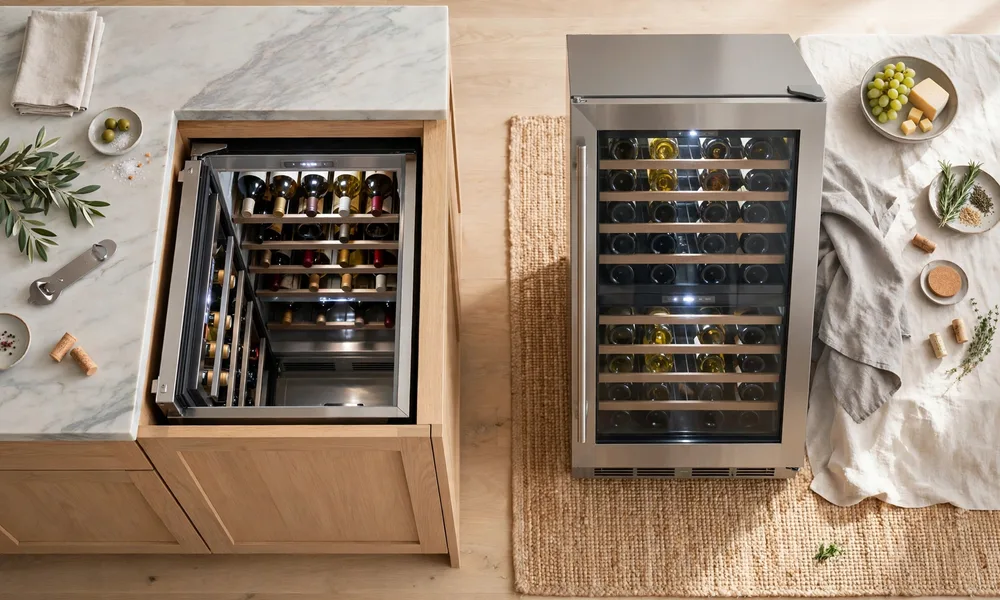
Freestanding fridges vent from the sides and back, so they need 5 to 10 centimetres of airflow on every side. They cost less, they move with you, and they come in far more sizes, from 6-bottle countertop models to 200-bottle cabinets. If you rent, buy freestanding; if you are renovating a kitchen to keep, built-in is worth the extra cost.
Placement, Humidity, Vibration and Light
Where you put a wine fridge matters almost as much as which one you buy. Keep it out of direct sunlight, away from radiators and ovens, and in a room that stays between 10 and 25 degrees. A garage can work if it is insulated, but an uninsulated garage that drops below freezing in winter will strain the compressor.
Humidity is the quiet detail that separates a good wine fridge from a bad one. Corks dry out when the air is too dry, letting oxygen spoil the wine, so aim for 50 to 70 percent humidity. Vibration disturbs the sediment in older bottles, which is why good fridges mount compressors on dampers and use wooden shelves. Light is the easiest enemy to beat: keep the fridge out of sunlight and choose UV-protected glass or a solid door.

Running Costs and Noise
A wine fridge runs all day, every day. A small thermoelectric model uses around 60 to 100 kilowatt-hours a year, roughly £15 to £25. A mid-size compressor model uses 100 to 180 kilowatt-hours, roughly £25 to £45, and a large 100-bottle cabinet can use 200 to 300, roughly £50 to £75 a year. One spoiled case of good red costs more than a decade of electricity.
Noise matters if the fridge lives in a living room or a bedroom. Thermoelectric models are effectively silent, while compressor models hum at 35 to 42 decibels, about the level of a quiet library. Once your bottles are stored properly, the rest is serving them well. A good decanter lets a young red breathe, and our guide to the best wine decanters for home covers the shapes that suit different wines. If you are building out the whole drinks corner, our roundup of the best home bar essentials lists the tools and storage that turn a fridge into a proper bar.
Wine Fridge Buying Checklist
- Count your bottles, then buy 20 to 30 percent more capacity than you need.
- Choose dual-zone for red and white wine, single-zone if you mostly drink one style.
- Measure the space twice, including door swing and the ventilation gap.
- Pick compressor cooling for warm rooms and large collections, thermoelectric for quiet spaces.
- Check the shelves fit your widest bottles, including champagne and Burgundy shapes.
- Look for UV-protected glass, 50 to 70 percent humidity, noise under 42 decibels.
Frequently Asked Questions
What temperature should a wine fridge be?
For storage, set a single-zone fridge to 12 to 14 degrees. In a dual-zone fridge, set reds to 15 to 17 degrees and whites to 7 to 10 degrees. Stability matters more than the exact number.
Is a wine fridge better than a normal fridge?
Yes, by a wide margin. A normal fridge is too cold, too dry, too bright and too shaky, and it swings in temperature every time the door opens. A wine fridge holds a steady temperature, keeps humidity up and blocks UV light.
How long can wine be stored in one?
Most wines keep well for one to five years, and age-worthy reds such as Bordeaux, Barolo and Rioja can improve for ten to twenty years. Everyday whites and rosés are best drunk within two years.
Do wine fridges use a lot of electricity?
No. A small model costs roughly £15 to £25 a year, a mid-size model £25 to £45, and a large cabinet £50 to £75. That is far less than replacing one case spoiled by bad storage.
Can I put a wine fridge in a garage?
You can, if the garage is insulated and stays above freezing in winter and below 30 degrees in summer. An uninsulated garage will strain the compressor, so a spare room is safer.
Should I choose a glass door or a solid door?
A solid door protects wine best, because it blocks all light. A glass door is fine as long as the glass is UV-protected and the fridge sits out of direct sunlight. In a sunny room, choose solid.
The Bottom Line
The best wine fridges in 2026 match your collection, not the biggest or most expensive ones. A quiet 18-bottle thermoelectric model suits a first collection in a flat. A dual-zone 46-bottle cabinet is the sweet spot for a household that drinks both red and white. A large compressor cabinet suits a serious collector buying by the case. Buy a little more capacity than you need, measure twice, and keep the temperature steady.


