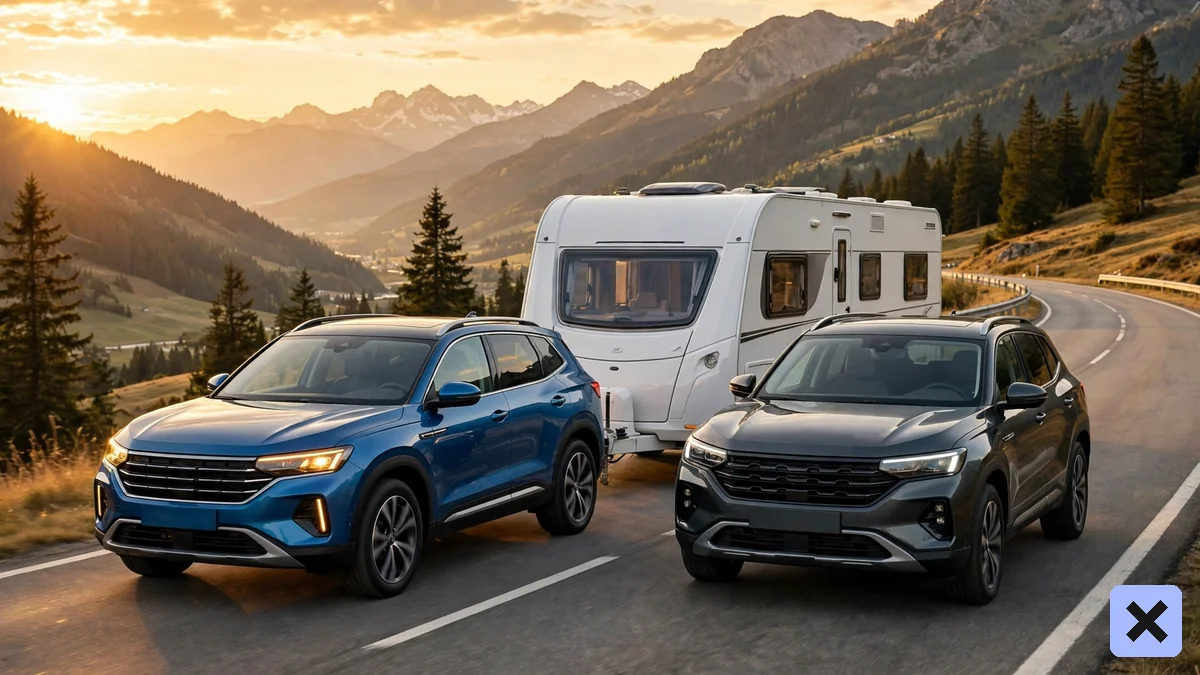
Choosing between petrol vs diesel SUVs towing a caravan, horsebox or boat trailer shapes every towing trip. The wrong engine affects how confidently your SUV pulls away on a hill, how stable it feels at motorway speed, and how much strain the drivetrain endures over thousands of towing miles.
The heart of the petrol vs diesel SUVs towing debate is torque. Diesel engines produce pulling power low in the rev range, exactly where a towing driver needs it, while petrol engines must be worked harder for the same effort. That difference shapes fuel economy on a long tow and how relaxed the driver feels on a gradient.
Yet the gap has narrowed. Modern turbo petrol SUVs offer far more torque than the thirsty petrol engines of a decade ago, while diesel faces higher prices, stricter emissions rules and rising servicing costs. This guide compares the two fuels across towing capacity, torque, fuel economy, running costs, driving feel and reliability, so you can pick the right SUV for your trailer.
Key takeaways
- Diesel SUVs tow better because they deliver strong torque at low revs, making hill starts and overtaking with a trailer feel effortless.
- Petrol SUVs are cheaper to buy and service, and modern turbo petrol engines tow light to medium trailers capably.
- Diesel typically uses 20 to 30 percent less fuel than an equivalent petrol SUV while towing.
- For occasional towing under 1,500 kg, a turbo petrol SUV is the smarter, cheaper choice.
- For heavy trailers over 2,000 kg or regular long-distance towing, diesel remains the best option.

Towing Capacity: What the Numbers Really Mean
Every SUV has a maximum braked towing capacity set by its manufacturer, and that is the first number to check. A large diesel SUV is commonly rated at 2,500 to 3,500 kg, while an equivalent petrol model may be rated 500 to 1,000 kg lower, a gap driven by cooling, gearing and drivetrain durability rather than raw power.
Capacity figures can mislead, though. A petrol SUV rated to tow 2,000 kg will work much harder at that limit than a diesel rated for 3,000 kg towing the same trailer. Keep your trailer at or below 85 percent of the tow car’s kerb weight for a stable, relaxed tow.
Payload matters too. A family of four, a roof box and a full boot can add 400 kg or more before the trailer is even hitched. Diesel SUVs tend to carry higher gross train weights, the combined limit for car, passengers, luggage and trailer, so check that figure on the vehicle’s weight plate, not just the brochure’s headline towing number.
How to Match Your Trailer to the Right SUV
Start with the trailer’s maximum laden mass, the figure on its own plate, rather than its unladen weight. Many caravans gain 200 to 300 kg once loaded with water, gas, food and gear. Above 2,000 kg loaded, diesel is the sensible default; below 1,500 kg, a strong turbo petrol SUV will tow happily and cost less.
Torque and Power Delivery: Where Diesel Wins
Torque is the twisting force that gets a heavy trailer moving, and it is the biggest reason diesel SUVs dominate towing. A typical 2.0-litre diesel produces around 400 Nm from as low as 1,750 rpm, while a comparable turbo petrol reaches similar peak torque only higher up the rev range, so pulling away on a slope with two tonnes behind you feels effortless in the diesel and strained in the petrol.
Petrol engines are not helpless. A modern turbo petrol SUV can tow a medium caravan with confidence, especially with an eight-speed automatic, though the gearbox shifts more often and the engine revs higher on gradients. For a deeper look at how the two fuels compare away from the tow bar, our guide to diesel versus petrol cars for long-distance driving covers the same torque and economy trade-offs in everyday use.
Gearbox choice amplifies the difference. Diesels are usually paired with torque-converter automatics tuned for low-speed pulling, while some petrol SUVs use continuously variable transmissions that feel strained under a heavy trailer. If you tow regularly, prioritise a conventional automatic with a towing mode or manual gear selection.
Fuel Economy While Towing
Towing hurts fuel economy for both fuels, but diesel loses less. A diesel returning 40 mpg solo might manage 26 to 28 mpg towing a 1,500 kg caravan, while an equivalent petrol could fall from 32 mpg to 19 to 21 mpg. Over 5,000 towing miles a year, the petrol SUV can burn several hundred litres more fuel.
Diesel fuel contains more energy per litre, and diesel engines run leaner at higher compression ratios under load. Petrol engines must enrich their mixture to protect the engine when working hard, which is why consumption climbs so steeply on gradients.
One caveat: modern diesels rely on particulate filters that need regular longer runs at operating temperature to regenerate. An SUV used mainly for short trips can suffer blocked filters and expensive repairs, wiping out the fuel savings. If your SUV rarely leaves town, petrol avoids that risk entirely.
Running Costs: Purchase Price, Servicing and Tax
Diesel SUVs usually cost more to buy: the premium over an equivalent petrol often runs to £1,500 to £3,000, rarely recovered unless you tow or drive long distances regularly. Servicing is dearer too, with pricier oil, fuel filters and emissions-system maintenance, and injector or turbo repairs can run into four figures.
Petrol SUVs flip the calculation. They are cheaper to buy, service and insure, and they avoid the particulate filter and AdBlue systems behind so many diesel headaches. For a driver towing a handful of times a year, petrol’s lower fixed costs usually outweigh its higher fuel consumption, and diesel’s break-even point can sit beyond 15,000 miles a year.
Depreciation matters too. Diesel values have softened as cities introduce low-emission zones, while petrol SUVs have held up better. Even so, a well-maintained diesel with a strong towing reputation still commands good money among caravanners and boat owners.
Driving Experience and Stability
A good tow is as much about the chassis as the engine. Diesel SUVs are often heavier than their petrol twins, and that extra weight improves the ratio between car and trailer, so a heavier tow car is less easily pushed around by a swaying caravan. Many of the most reassuring tow cars are large diesel SUVs with long wheelbases and self-levelling suspension.
Petrol SUVs can still tow well, particularly larger models with all-wheel drive and proper towing packages. What matters most is kerb weight, wheelbase, suspension tuning and trailer stability aids, and modern SUVs offer trailer sway control to calm a snaking trailer. If you are choosing between two similar models, the best family SUVs of 2026 shows which large SUVs combine space, weight and towing hardware most effectively.
Reliability and Longevity for Regular Towers
Diesel engines are built stronger to withstand higher compression, which is one reason high-mileage diesel SUVs are common. A well-serviced diesel can cover 200,000 miles or more, with a drivetrain designed for sustained high-load work. For a driver who tows every week, that durability is genuine peace of mind.
The weak point is the emissions equipment, not the engine block. Particulate filters, exhaust gas recirculation valves and AdBlue systems cause most expensive diesel faults, and short journeys stress them all, while regular long-distance towing keeps them healthier, since sustained motorway running helps the filter regenerate. Petrol engines have fewer emissions traps and cheaper failure modes, though turbo petrol engines still demand strict oil-change discipline when worked hard.
Petrol vs Diesel SUVs for Towing: Head-to-Head Comparison
| Factor | Petrol SUV | Diesel SUV |
|---|---|---|
| Maximum towing capacity | 1,500 to 2,500 kg | 2,500 to 3,500 kg |
| Torque delivery | Strong, higher in the rev range | Strong, available from low revs |
| Fuel economy while towing | 19 to 24 mpg with a caravan | 25 to 30 mpg with a caravan |
| Purchase price | Lower by £1,500 to £3,000 | Higher than petrol |
| Servicing and repairs | Cheaper and simpler | Dearer, with costly emissions parts |
| Best for | Occasional towing under 1,500 kg | Heavy or frequent towing |
| Weakness | Thirsty at the limit | Filter needs regular long runs |
Which Fuel Suits Your Trailer?
The right answer depends on honest arithmetic about your towing life: how many miles you tow each year, how heavy your loaded trailer really is, and how much of your driving is short urban trips. Towing a 1,200 kg trailer six times a year to nearby sites? A turbo petrol SUV will leave you happier and richer. Towing a 1,800 kg twin-axle caravan across the country every month? Buy diesel without hesitation.
Consider the rest of the car’s life too. If the SUV will spend 90 percent of its miles on the school run and the commute, petrol’s refinement, lower costs and freedom from filter worries may matter more than its towing compromise. If it is a dedicated tow car or a high-mileage motorway machine, diesel’s effortless pulling and fuel savings will repay the premium. Finally, test before you buy: hire the model for a weekend and tow your own caravan with it.
Towing Checklist Before Every Trip
A good pre-trip routine prevents most towing trouble, whichever fuel your SUV burns. Run through these checks every time you hitch up, and never skip them when you are in a hurry.
- Check the noseweight with a gauge and keep it within the tow bar and caravan limits, usually 50 to 100 kg.
- Confirm the trailer’s tyres, including the spare, are at the correct pressure with no cracks or bulges.
- Test all trailer lights, indicators and brakes, and check the breakaway cable is correctly attached.
- Load heavy items low and over the trailer axle, and secure everything so nothing shifts.
- Check the SUV’s oil, coolant and tyre pressures, and set the mirrors to see clearly past the trailer.
- Plan your route for fuel stops and gradients, and keep your speed steady.
Most towing incidents come from avoidable errors rather than engine choice, and the worst towing mistakes drivers make is a useful reminder of the habits behind swaying and snapped couplings.
Frequently Asked Questions
Can a petrol SUV tow a caravan?
Yes. A modern turbo petrol SUV can tow a caravan of up to around 1,500 kg comfortably, within the car’s rated capacity and the 85 percent kerb-weight guideline. It will use more fuel than a diesel, but for occasional towing it is perfectly capable.
Is diesel always better for towing?
For heavy trailers and frequent towing, yes, thanks to its low-down torque and superior fuel economy under load. For light, occasional towing, the advantage shrinks, and petrol’s lower costs can make it the better choice.
What towing capacity do I need for a caravan?
Check the caravan’s maximum laden mass on its plate, then choose an SUV whose braked towing capacity exceeds it with margin. Aim for the loaded caravan to weigh no more than 85 percent of the SUV’s kerb weight.
Does towing damage a petrol engine?
Towing within the manufacturer’s limits will not damage a healthy petrol engine, but it increases wear on the clutch, gearbox and brakes. Keep the oil fresh and let the turbo cool after hard climbs.
Why is my diesel SUV’s fuel economy poor when towing short distances?
Short trips stop the engine and particulate filter reaching full operating temperature, so the engine runs rich and the filter regenerates more often. Diesels are most economical on longer runs.
Should I choose all-wheel drive for towing?
All-wheel drive helps traction on wet grass, gravel pitches and slippery boat ramps, and improves stability in poor weather. It is not essential on dry tarmac, but it helps if you regularly pitch on grass or launch boats.
The Bottom Line
Diesel remains the best fuel for serious towing, thanks to its low-down torque, higher capacities and far better fuel economy under load. But petrol has closed the gap enough that occasional towers should think twice before paying the diesel premium. Match the engine to your trailer’s loaded weight and annual towing miles.