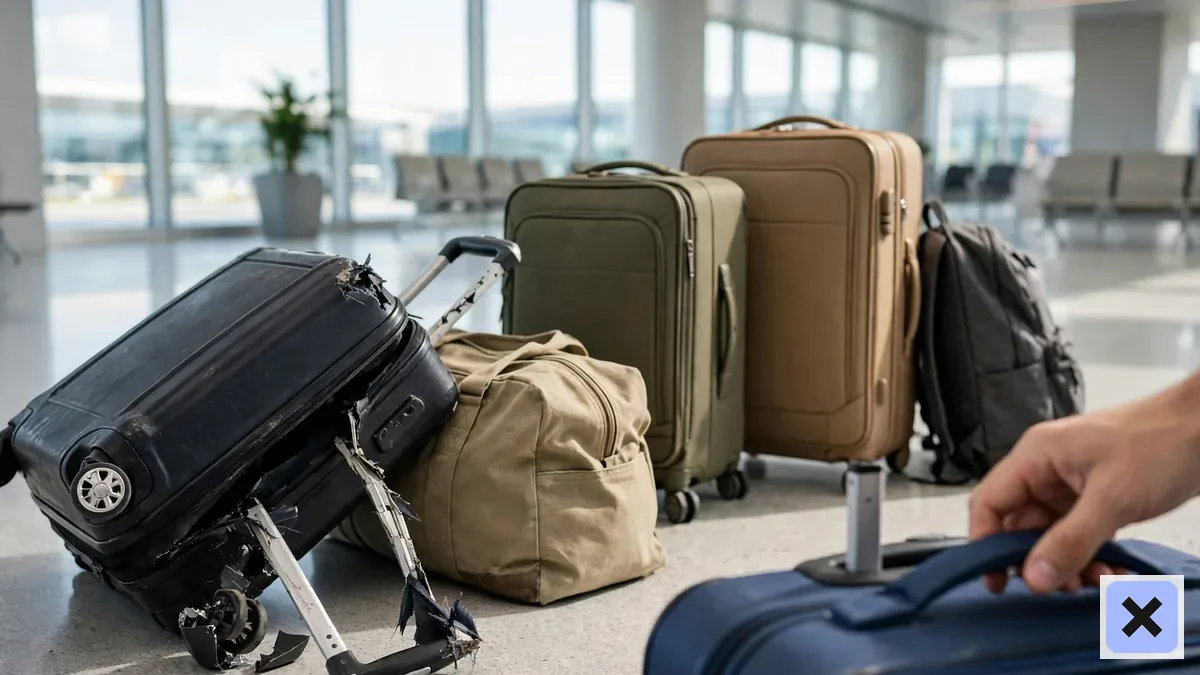
Frequent travellers learn quickly that luggage is not just something you carry. It is the difference between gliding through an airport and wrestling a broken suitcase across a terminal while your flight boards. The worst luggage choices for frequent travellers rarely look like mistakes in the shop. They look like bargains, like clever designs, like the bag everyone else seems to be buying. The problems show up later, when a wheel jams or a zip splits.
After dozens of flights a year, small flaws become daily annoyances. A sticking handle or a bag that tips over at every stop is no small thing when you have twenty minutes to make a connection. The wrong bag costs you time, money, and patience, and it often costs you again when you have to replace it far sooner than you expected. Choosing well is not about buying the most expensive case on the shelf. It is about avoiding the specific traps that punish people who travel often.
This guide looks at the luggage choices that cause the most trouble for frequent travellers, from oversized checked bags to flimsy bargain shells. Each one seems reasonable at first glance, and each one has a better alternative that costs little more and lasts far longer. If you fly every week or every month, the bag you choose is a tool you use more than almost anything else you own, so it deserves the same care you would give to any tool you rely on daily.
Key takeaways
- Oversized bags invite overweight fees and slow you down at every stage of the journey.
- Two wheels wear out your shoulder; four spinner wheels are the standard for a reason.
- Cheap hard shells crack and cheap zips fail, usually on the trip you can least afford it.
- A bag with no organisation wastes packing space and makes every hotel unpack a chore.
- Always check your airline’s real carry-on limits before you buy, not the manufacturer’s claim.
The Oversized Checked Bag That Fights You Everywhere
The biggest bag in the shop feels like the smartest buy. More space means more clothes, more shoes, more room for the things you bring home. For someone who travels once a year, that logic almost works. For a frequent traveller, an oversized bag is a slow punishment. It is heavy before you pack it, it tempts you to fill it past the weight limit, and it is awkward on trains, in taxis, and in hotel lifts that were never designed for a case the size of a small wardrobe.
Airlines make the problem worse. A bag that weighs twenty-three kilos when full is fine until the day you add a pair of boots and a thick coat, and suddenly you are paying an overweight fee at the desk while a queue forms behind you. Frequent travellers pay that fee again and again, and the total soon exceeds the price of a better, smaller bag.
Why Medium Beats Maximum
A medium checked bag, usually around sixty-five to seventy litres, holds enough for a week without encouraging you to pack for a month. It stays under weight limits with room to spare, it fits in a car boot beside another case, and you can lift it onto a hotel luggage rack without help. Frequent travellers who switch to a medium case almost never go back, because the smaller bag simply causes fewer problems on every single trip.
A medium bag is also quicker to pack, unpack, and wheel through a terminal, so you arrive less tired. If you genuinely need more space for a particular trip, a foldable duffel tucked inside your case gives you extra capacity only when you need it, without forcing you to drag a giant bag on every journey.
Two Wheels When Four Would Have Saved Your Shoulder
Two-wheeled rollaboards were the standard for years, and plenty of travellers still swear by them. The trouble is that every step pulls the full weight of the bag through one arm and one shoulder. On a short trip that is fine. On a year of weekly flights, it becomes a genuine strain, and many frequent travellers end up with a sore shoulder they blame on everything except their luggage.
Four-wheel spinner cases changed the maths completely. The bag stands upright beside you and rolls in any direction, so you push it rather than drag it, and your shoulder carries nothing at all. In a crowded airport, a spinner turns sideways through gaps that a tilted two-wheeler cannot manage, and at the gate you can slide it forward without lifting. The difference is most obvious on long walks through large airports, where a spinner feels almost weightless and a two-wheeler feels heavier with every gate you pass.
The Spinner Catch to Watch For
Not all spinner wheels are equal, and this is where frequent travellers get caught out. Small, hard plastic wheels rattle on rough floors, wear flat, and eventually seize up. Look for larger wheels, ideally with rubber tyres and proper bearings, and test the bag fully loaded if you can. A spinner with good wheels is one of the best purchases a frequent traveller can make, while a spinner with bad wheels is worse than a two-wheeler, because a seized wheel makes the bag almost impossible to steer.
Check that the wheels are replaceable, because a bag with unreplaceable wheels has a built-in expiry date.
The Soft-Sided Bag With No Structure
Soft-sided luggage has real advantages. It is light, it squeezes into tight overhead bins, and it forgives an extra jumper stuffed in at the last minute. But a soft bag with no internal frame and no structure is a different creature entirely. It slumps, it sags, and the moment you set it down it collapses into a shape that no longer fits anywhere neatly.
The worst versions are the ultra-light duffels and unstructured totes sold as cabin bags. They look spacious when empty, but once packed they bulge in odd places, and the bulge is exactly what makes them fail the airline’s sizing frame at the gate. These bags get rejected at boarding while a rigid case of the same size sails through.
What Good Soft-Sided Luggage Looks Like
A good soft-sided bag has a lightweight frame, a reinforced base, and compression straps that hold the contents in place. It stands upright on its own when empty, and it keeps its shape when full. The fabric matters too: ballistic nylon and heavy-duty polyester resist scuffs and rain, while thin nylon tears at the corners after a few trips through baggage handling. If you prefer soft-sided luggage, buy the structured kind, and treat anything that cannot stand up on its own as a weekend bag, not a travel companion.
The Bargain Hard Shell That Cracks on Trip Two
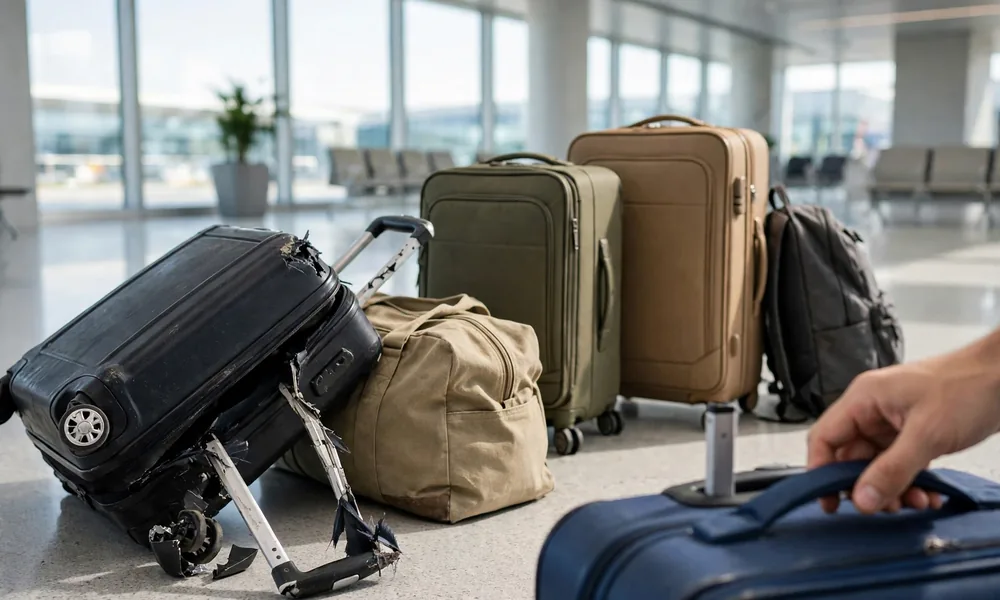
Hard-shell cases look indestructible in the shop, and the cheapest ones are tempting precisely because they look so much like the expensive ones. The difference is in the material. Cheap hard shells are often made from brittle ABS plastic that looks glossy and solid until the first hard knock, when it cracks along a seam or splits at a corner. Baggage handlers, conveyor belts, and tarmac drops are not gentle, and a case that cannot survive them is not a bargain at any price.
The crack often appears on the way home, leaving you to hold the case together with a strap for the rest of the journey. Frequent travellers who buy the cheapest shell often buy three of them in the time a good polycarbonate case would have lasted, and the total spend ends up higher than if they had bought well in the first place.
Spend on the Shell, Save on the Rest
Polycarbonate is the material to look for. It flexes under impact instead of cracking, and it keeps its shape after knocks that would destroy a cheaper shell. A polycarbonate case from a reputable brand, bought in a sale, is one of the best value purchases in travel. The travel hype that promises more than it delivers often surrounds bargain luggage, with glossy photos hiding thin materials and weak fittings that only reveal themselves after a few real journeys.
The Bag With No Organisation Inside
Some bags are just an empty box with a zip. Everything goes in together, clothes mix with chargers and toiletries, and finding one item means emptying the whole case onto the hotel bed. For a frequent traveller, that wasted time adds up, and it also wastes space, because unorganised packing always leaves gaps and creases. A good bag has a divided main compartment, a mesh pocket for small items, and compression straps that keep clothes flat. When you are choosing between two similar cases, pick the one with smarter pockets, because you will feel the difference on every trip, including mountain escapes where unpacking in a small room leaves no space for chaos.
The Carry-On That Is Not Really a Carry-On
Manufacturers measure their bags generously, and airlines measure them strictly. A case sold as cabin-sized may be two centimetres too deep once the wheels and handle are counted, and that is enough to get it gate-checked on a full flight. Frequent travellers learn their airlines’ real limits by heart, because a forced gate check costs time at both ends of the journey. Measure the bag yourself, wheels and handles included, and compare it with the smallest limit among the airlines you fly. A bag that fits everywhere is worth more than a slightly larger one that fits almost everywhere, and the same applies to hotel design traps that look spacious in photos and cramped in person.
At a Glance: Bad Choices and Better Alternatives
| Worst choice | Why it fails | Better alternative |
|---|---|---|
| Oversized checked bag | Overweight fees and awkward handling | Medium case plus a foldable duffel |
| Two wheels | Shoulder strain on long airport walks | Four-wheel spinner with rubber tyres |
| Cheap hard shell | Cracks under normal baggage handling | Polycarbonate shell from a trusted brand |
| Unstructured soft bag | Slumps, bulges, and fails size checks | Framed soft-sided case that stands upright |
Checklist: Choosing Luggage That Lasts
- Measure the bag yourself, including wheels and handles, against your airlines’ limits.
- Choose four spinner wheels with rubber tyres and check that spares are available.
- Pick polycarbonate for hard shells and heavy-duty fabric for soft-sided bags.
- Test the telescopic handle fully extended with a loaded bag before you buy.
- Look for a divided interior, compression straps, and a pocket for small essentials.
- Check the warranty and the brand’s repair service before you pay.
Frequently Asked Questions
How often should a frequent traveller replace luggage?
A good case should last several years of weekly travel. Replace it when wheels, zips, or handles fail repeatedly rather than on a fixed schedule.
Are expensive suitcases worth it for frequent travellers?
Usually, yes. Better materials, wheels, and warranties cost more upfront but survive far more trips than bargain cases.
Is a spinner or a two-wheeler better for frequent travel?
A spinner is better for most frequent travellers, because it removes the weight from your shoulder and moves easily through crowded terminals.
What size carry-on fits most airlines?
Around 55 by 40 by 20 centimetres is the safest common size, but always check your specific airline before you travel.
Should I choose hard or soft-sided luggage?
Hard shells protect better and keep their shape, while good structured soft bags are lighter and squeeze into tight spaces. Both work if well made.
What is the most common luggage mistake?
Buying the biggest or cheapest bag available. Oversized bags bring fees, and cheap bags fail early, so both end up costing more.
The Bottom Line
The worst luggage choices for frequent travellers all share one trait: they look fine until the travelling starts. Buy a medium, well-built case with four good wheels, a strong zip, and a sensibly organised interior, and it will quietly make every trip easier for years.