
Worst Minivans for City Driving 2026
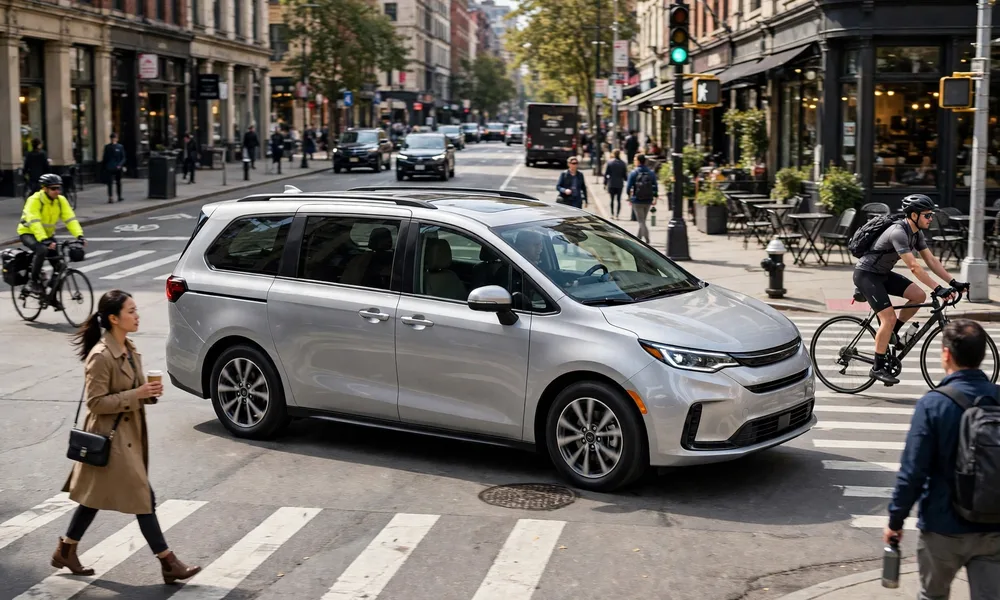
The worst minivans for city driving in 2026 are not bad vehicles — they are good family cars used in the wrong place. A minivan that feels effortless on a motorway, with seven seats, a quiet cabin, and room for a week’s luggage, can feel enormous in a city: too long for a standard parking bay, too wide for a narrow street, and too slow to turn in a tight junction. This guide names the minivans that struggle most in urban driving, explains exactly why, and shows what to buy instead if your daily life is school runs, supermarket car parks, and narrow residential streets. The daily drive is where a minivan earns its keep or fails it, so this guide judges each one on city streets, not motorways.
Key Takeaways
- The Chrysler Pacifica, Toyota Sienna, and Honda Odyssey are the worst minivans for city driving, mainly because of their length — over 5.1 metres — and turning circles above 11.5 metres.
- A minivan needs roughly 5.4 metres of kerb space to parallel park, while a typical city bay is only 4.8 metres long — that gap is the daily problem.
- Hybrid minivans cope better with stop-start traffic, but their size still makes parking and tight turns hard.
- Sliding doors help children get in and out, but they need wide clearance and can trap you in a tight multi-storey car park.
- If you drive mostly in a city, a compact hatchback or a small SUV is a better daily car — keep the minivan for weekends and holidays.
How We Ranked the Worst Minivans for City Driving
The Worst Minivans for City Driving in 2026
1. Chrysler Pacifica — Worst Overall for City Driving
The Chrysler Pacifica is the longest and widest minivan in this guide, at around 5.2 metres long and just over 2 metres wide, with a turning circle of about 12 metres. In a city that combination is punishing. Parallel parking needs a gap of roughly 5.5 metres, which is rare on a busy street, and multi-storey car parks with tight ramps and low ceilings turn every visit into a slow crawl. The Pacifica’s V6 engine is smooth on a motorway but thirsty in traffic, returning roughly 19 miles per gallon in stop-start driving, and its long bonnet makes judging the front corners hard at junctions.
2. Toyota Sienna — Worst for Parking and Tight Turns
The Toyota Sienna is the only hybrid minivan in this guide, and the hybrid system is genuinely good in traffic: it recovers energy when you brake, runs quietly at low speed, and returns roughly 36 miles per gallon in mixed driving, far better than any petrol rival. But the hybrid advantage does not fix the size problem. The Sienna is around 5.18 metres long with a turning circle of about 11.9 metres, and its wide body and long wheelbase make it one of the hardest minivans to park in a city.
3. Honda Odyssey — Worst for Visibility and Stop-Start Fuel Use
The Honda Odyssey is the best-driving minivan on the open road, with car-like handling, a calm ride, and a clever cabin. In the city, though, it struggles. At around 5.2 metres long with a turning circle of about 11.9 metres, it is as long as the Pacifica, and its thick windscreen pillars and small rear side windows make junctions and reversing harder than they should be. The petrol V6 returns roughly 19 miles per gallon in city traffic, which means a daily school run and shopping trip can cost noticeably more than in a smaller car.
The Odyssey’s sliding doors are practical for children, but they need clearance that a tight parking bay does not offer, and the van’s length means it overhangs most city bays. It is also one of the heavier minivans here, at over 2,000 kilograms, which shows in stop-start driving: the engine works hard from every traffic light, and the brakes wear faster. The Odyssey is a fine family car for suburban and motorway life, but as a daily city car it is one of the worst choices. Families who love the Odyssey’s space should read our guide to the best minivans for large families to see where it shines — on long trips with a full load, not on a city school run.
5. Chrysler Voyager — Worst Value in the City
The Chrysler Voyager is the budget version of the Pacifica, and in the city it inherits the Pacifica’s size problems without its best features. At around 5.2 metres long with a similar turning circle, it is just as hard to park, just as thirsty in traffic at roughly 19 miles per gallon, and just as awkward on narrow streets. But it lacks the Pacifica’s nicer cabin materials, its better sound insulation, and some of its parking aids, which makes the city experience worse rather than better.
6. Older Full-Size Minivans — The Hidden Worst
The sixth entry is not a single model but a category: older full-size minivans bought second-hand for city use. A ten-year-old Pacifica, Odyssey, or Sienna has the same length and turning circle as a new one, but without modern parking cameras, blind-spot monitoring, or automatic emergency braking. The result is a large, thirsty vehicle with poor visibility and no electronic help — the hardest combination in a city. Older minivans also return worse fuel economy in traffic, often below 18 miles per gallon, and their larger turning circles were designed for American suburbs, not European city streets.
If you are shopping used, be especially careful. Check the turning circle, the parking camera, and the blind-spot system before you buy, and test-park the van in a real city car park rather than an empty dealer forecourt. A used minivan can be a bargain for a family that drives mostly outside the city, but as a daily urban car it is often the worst choice of all. Our guide to the worst used SUVs to buy covers similar traps in the used market, where size and age combine to make a car far harder to live with than it first appears.
Comparison Table: Worst Minivans for City Driving 2026
| Minivan | Length | Turning Circle | City Fuel Economy | Main City Problem |
|---|---|---|---|---|
| Chrysler Pacifica | 5.20 m | 12.0 m | 19 mpg | Longest, hardest to park |
| Toyota Sienna | 5.18 m | 11.9 m | 36 mpg (hybrid) | Parking, tight turns |
| Honda Odyssey | 5.20 m | 11.9 m | 19 mpg | Visibility, fuel use |
| Chrysler Voyager | 5.20 m | 12.0 m | 19 mpg | Size without the aids |
| Older full-size minivans | 5.10–5.20 m | 12.0 m+ | Under 18 mpg | No parking aids, poor visibility |
Why Minivans Struggle in Cities
Parking Bays Are Too Small
Turning Circles Are Too Wide
Fuel Use in Stop-Start Traffic

What to Buy Instead for City Driving
If your daily life is mostly urban, the best replacement is a compact car with a small turning circle and a short body. A hatchback such as a Honda Civic or Toyota Corolla Hybrid is around 4.5 metres long with a turning circle under 10.5 metres, fits a standard bay with room to spare, and returns 40 to 50 miles per gallon in traffic. A small SUV such as a Honda HR-V or Toyota Corolla Cross offers a higher driving position and more space while staying under 4.4 metres long.
For families who genuinely need seven seats, the answer is not to give up on space but to choose it carefully. A compact three-row SUV is shorter and narrower than a minivan, turns more tightly, and fits city bays more easily, even if the third row is tighter. Or keep the minivan for weekends and holidays and buy a small, cheap city car for daily use: the combination often costs less to run than a single large minivan used in the city every day. The right comparison is our SUV vs minivan for family travel guide, which weighs space against everyday usability and shows where each body style actually wins.
When a Minivan Still Makes Sense
City Driving Checklist
- Measure your parking bay: if it is under 5.4 metres long, a full-size minivan will overhang it.
- Check the turning circle — anything above 11.5 metres means regular three-point turns in the city.
- Test-park the van in a real multi-storey car park, not an empty dealer forecourt.
- Open the sliding doors fully in a tight bay and check the clearance on both sides.
- Work out city fuel costs: a petrol minivan at 19 mpg costs roughly 500 to 700 dollars a year more than a small car over 10,000 miles.
- If you need seven seats in a city, test a compact three-row SUV first — it may fit your life better.
Frequently Asked Questions
What is the worst minivan for city driving?
The Chrysler Pacifica is the worst overall for city driving, at around 5.2 metres long with a 12-metre turning circle and roughly 19 miles per gallon in traffic. It is a fine motorway car, but its size makes parking and tight turns hard every day in a city.
Is the Toyota Sienna good for city driving?
The Sienna’s hybrid system is excellent in traffic, returning around 36 miles per gallon, but the van itself is too long and wide for easy city driving. Its 11.9-metre turning circle and 5.18-metre length make parking and tight turns difficult, so it is not a good city car despite the fuel economy.
Can a minivan fit in a standard parking bay?
Barely. A standard bay is about 4.8 metres long, while a full-size minivan is about 5.2 metres, so it overhangs by around 40 centimetres. The width is also tight, leaving only about 20 centimetres on each side for the doors.
What is the best alternative to a minivan for city driving?
A compact hatchback or a small SUV is the best daily city car: around 4.5 metres long, a turning circle under 10.5 metres, and 40 to 50 miles per gallon in traffic. For seven seats, a compact three-row SUV is shorter and easier to park than a minivan.
Do sliding doors help in the city?
Sliding doors help children get in and out without swinging a door into the next car, but they need a wide gap to open fully and can be awkward in a tight multi-storey bay. They are a benefit in a wide space and a limitation in a narrow one.
Should I buy a used minivan for city driving?
Be careful. Older minivans have the same size problems as new ones but lack modern parking cameras, blind-spot monitoring, and automatic braking, and they return worse fuel economy in traffic, often below 18 miles per gallon. Test-park one in a real city car park before you buy.
The Bottom Line
The worst minivans for city driving in 2026 are the Chrysler Pacifica, Toyota Sienna, Honda Odyssey, Kia Carnival, and Chrysler Voyager — not because they are bad cars, but because they are large cars in a small-car environment. At over 5.1 metres long with turning circles near 12 metres, they overhang standard parking bays, need three-point turns on ordinary streets, and — except for the hybrid Sienna — drink fuel in stop-start traffic. If your daily life is urban, buy smaller: a hatchback or a compact SUV will save you time, money, and stress every day. Keep the minivan for the life it was built for — long trips, large families, and open roads — and let the city belong to smaller cars.


