The Worst Pit Lanes to Avoid in 2026: Seven Lane Types That Turn a Stop Into a Mess
The worst pit lanes of 2026 are not the oldest lanes on the calendar or the slowest ones on the map. An old lane can still be honest, and a slow lane can still be safe. The worst pit lanes fail in a much more basic way: they hide their entry, squeeze their boxes, starve their exits or leave drivers guessing where to stop. A bad lane turns a stop measured in seconds into a gamble before the crew touches the car.
Key takeaways
- A pit lane is judged by flow first: a lane that hides its entry or chokes its exit wastes every second the crew saves.
- Space is safety: boxes that are too short or too narrow turn routine stops into collisions and penalties.
- Markings matter more than money: faded paint and missing signs cause more mistakes than any piece of equipment.
- Speed limits only work when the lane is built for them: a lane that forces hard braking and blind merges is a risk, not a rule.
- Walk the lane before you trust it, and avoid any lane where the entry, the boxes and the exit do not all make sense.
How the worst pit lanes were ranked
Every type below was scored on five measures. Entry comes first: can a driver see the entry, slow down safely and commit without guessing? Box space is second: does a car fit its box with room for the crew? Exit is third, because a lane that dumps cars into fast traffic without a proper merge is a crash waiting for a moment. Markings are fourth, and surface fifth.
First, no real circuit, venue or place is named as the worst: this guide ranks types and patterns, not individual tracks. Second, a bad lane is not the same as a bad crew: our guide to the worst pit crews shows how good lanes can still be wasted by crews that fumble the stop, and our guide to the worst race tracks shows the same logic in the venues themselves, where even a good lane cannot save a bad day out.
Comparison table: the worst pit lanes 2026
| Rank | Lane type | Main failure | Worst moment |
|---|---|---|---|
| 1 | The blind-entry lane | Entry hidden behind a wall or turn | Missing the entry, losing a lap |
| 2 | The single-file lane | Too narrow for any car to pass | Queuing behind a slow stop |
| 3 | The cramped-box lane | Boxes too short, too close together | Two crews colliding in one space |
| 4 | The slow-exit lane | Exit merges into fast traffic | Leaving the box into full-speed cars |
| 5 | The unmarked lane | Faded paint, missing signs | Stopping in the wrong box |
| 6 | The queue-prone lane | Too few boxes for the field | Waiting while the race goes on |
| 7 | The flooded lane | Water, dust, broken surface | Sliding through your own box |
The worst pit lanes of 2026
1. The blind-entry lane: the turn you cannot see coming
The blind-entry lane is the most feared type on this list, because it punishes the driver before the stop even begins. The entry sits behind a wall, around a bend or where the braking markers are hidden, and the driver must commit to slowing down before they can see where they are going. Get it wrong and the car sails past at full speed, losing a lap and the race.
The problem is the lane’s design, not the driver’s eyesight. A good entry gives a long, clear view and a braking zone that starts well before the turn-in. A blind entry gives none of that, so every stop starts with a guess.
2. The single-file lane: one slow stop ruins everyone
A pit lane is a road, and a road that only fits one car at a time is a queue with a speed limit. The single-file lane is too narrow for a car to pass another, so one slow stop, one stalled car or one crew that takes an extra ten seconds blocks every car behind it. The drivers behind cannot overtake, cannot help and cannot leave; they can only sit, watch the race go by and count the positions they are losing.
Narrow lanes are usually born of old venues where the pit building came first and the lane was squeezed into whatever space was left. A good lane is wide enough to pass safely at the limit.

3. The cramped-box lane: no room to work, no room to be wrong
The pit box is where the stop happens, and the cramped-box lane gives the crew almost nowhere to do it. The boxes are too short for the car, too narrow for the crew, and so close together that one team’s work spills into the next team’s space. A wheel gunner steps back and trips over the next car’s jack; a driver overshoots by half a metre and blocks two boxes instead of one.
Cramped boxes punish good crews as much as bad ones, because there is no margin for the small errors in every stop. A good box gives the crew room to move and to recover when something goes wrong. Space in the pit lane is the difference between a stop and a collision.
4. The slow-exit lane: the merge nobody survives cleanly
Leaving the pits should be the easiest part of the stop, and the slow-exit lane makes it the most dangerous. The exit dumps cars back onto the circuit with no proper merge, no clear line and no time to build speed, so a car leaving its box at the pit limit meets cars on the circuit at full racing speed. The driver leaving must guess when to go; the driver on the circuit must guess what the leaving car will do.
The worst exits join the racing line itself, or end in a blind corner where nobody can see the merge until they are in it. A proper exit gives the leaving car its own lane, a clear view and a merge point to plan around.
5. The unmarked lane: guess where your box is
Paint is the cheapest part of a pit lane and the most neglected. The unmarked lane has faded box lines, missing numbers, worn speed-limit paint and signs that have not been replaced in years, so drivers must guess where their box starts, where the limit begins and where the lane ends. In daylight that is a nuisance. At night or in the rain it is a disaster, because the driver is guessing at speed in a place full of people.
The mistakes are small and constant: a car half a box too far forward, a crew in the wrong place, a driver braking late because the limit line was invisible. The fix costs a weekend and a few tins of paint, yet venues ignore it most.
6. The queue-prone lane: too few boxes for too many cars
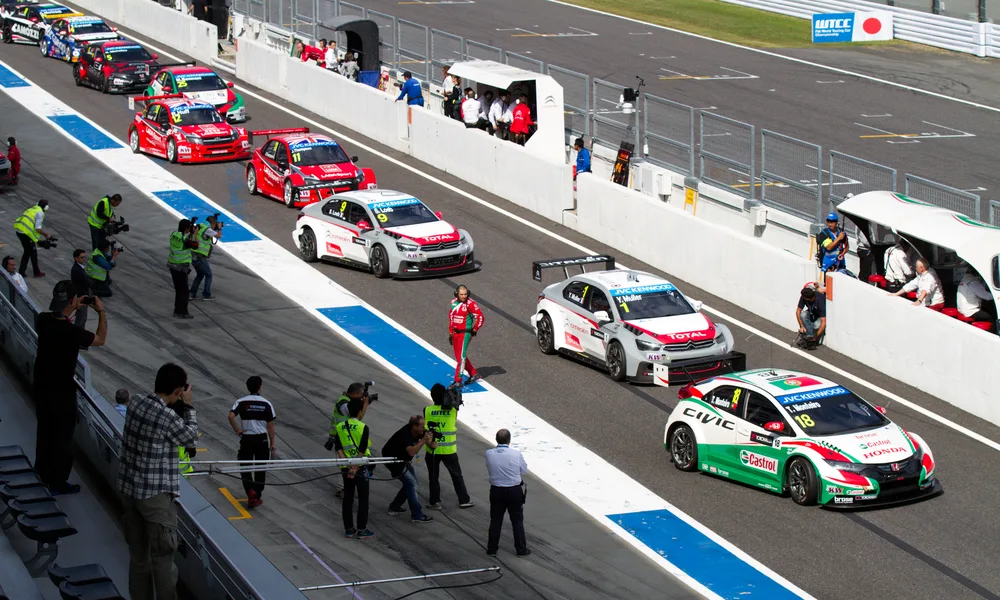
Some lanes are fine when the field is small and hopeless when it is full. The queue-prone lane has too few boxes, so when the stops come together after a safety period or a change in the weather, the lane fills up and the cars behind must wait in the fast lane. The drivers at the back lose more time standing still than staying out.
The queue is not the drivers’ fault; it is arithmetic. A lane with too few boxes cannot serve a full field at once, and no crew skill changes the numbers. A lane that cannot hold its own field has outgrown its pits.
7. The flooded lane: water, dust and broken tarmac
A pit lane is a working surface, and the flooded lane is one that has stopped working. Standing water, dust across the boxes and tarmac broken into patches all take grip away from the one place where cars must stop precisely. A driver brakes for a box and slides through it; a jack sinks into soft ground and the stop falls apart.
Surface failures are the clearest sign of a venue that has stopped caring about its pits: the track is smooth and freshly laid while the lane beside it cracks and floods. Water in the pit lane is neglect with a puddle on top.
What to avoid when judging a pit lane
The most common pit lane regret is a wrong expectation: a blind entry nobody walked first, a cramped box nobody measured, or an exit nobody checked for the merge. Walk the entry, stand in the box, and follow the exit to the merge before you trust a lane. Our guide to the worst motorsport makes the same point about formats that fall apart on the day.
Checklist: reading a pit lane before you race it
- Walk the entry on foot and check you can see it early, brake for it safely and commit without guessing.
- Measure the box against the car and the crew, and walk away from any box the car does not fit with room to spare.
- Follow the exit to the merge and confirm a car can join the circuit without meeting traffic at full speed.
- Check the paint, the numbers and the speed-limit signs, and flag any lane where the markings have faded away.
- Look at the surface for standing water, dust and broken tarmac, especially in the braking area before each box.
- Count the boxes against the field, and expect a queue on any day when too many cars need the lane at once.
Frequently asked questions
What makes a pit lane dangerous?
Bad flow makes a lane dangerous: a hidden entry, a narrow lane, a cramped box or an exit merging into fast traffic. The danger is the places where drivers and crew must guess.
Why do pit lanes have speed limits?
The limit keeps the lane safe for the crews working in it. A car at racing speed through a lane full of people would be lethal, so the limit trades seconds for safety.
How big should a pit box be?
Big enough for the car plus the crew, with room to spare on every side. If the car overhangs the box, or the crew must work in the next box’s space, the lane is too cramped.
What happens if a driver misses the pit entry?
The car must carry on and try again on the next lap. That costs a full lap, and often the race, which is why a clear entry matters more than almost anything else.
Can a pit lane be too narrow?
Yes. A lane that only fits one car at a time means no car can pass a slow stop, so one stalled car blocks everyone behind it. A good lane is wide enough for safe passing at the speed limit.
Why do some pit lanes flood when it rains?
Poor drainage and a surface cracked with age. Water collects where the lane dips, and grip disappears where cars must brake for their boxes. It is fixed by resurfacing and drainage.
Bottom line
The worst pit lanes of 2026 are the ones that fight the people using them: the entry you cannot see, the lane you cannot pass in, the box you cannot fit in, the exit you cannot merge from, the markings you cannot read, the queue you cannot escape and the surface you cannot trust. A good lane lets the racing decide the result.


