
Leave the Worst Race Tires of 2026 Behind: Seven Tire Types That Ruin Race Day
The worst race tires of 2026 are not the slowest tires on the grid. A slow tire can still be honest, holding its grip lap after lap. The worst race tires fail in a much more basic way: they give a driver three good laps and then fall apart, or they never warm up at all, or they turn a damp track into a skating rink. This guide ranks the worst types of race tire, by compound and condition, so you can spot a bad tire before it costs a race.
Key takeaways
- A race tire is judged by how it holds its grip over a full stint, not by how fast it feels on its first flying lap.
- Heat is the enemy: a tire that overheats loses grip, wears in patches and forces an early stop.
- A tire that never reaches its working temperature is just as bad as one that cooks, because it never grips at all.
- Wet weather punishes the wrong tire harder than any other condition, turning a small mistake into a spin.
- Check the compound, the wear, the age and the matching set before you trust any race tire.
How the worst race tires were ranked
Every type below was scored on five measures. Grip comes first: does the tire bite and hold the car through a corner, lap after lap? Wear life is second, judged on whether the tire lasts a full stint. Heat tolerance is third, because a tire that cooks fades exactly when the race matters most. Wet performance is fourth, and consistency is fifth, because a tire that changes its behaviour lap to lap cannot be trusted. Two notes before the list. First, no real tire maker or product is named here: this guide ranks types and patterns, not individual products. Second, a bad tire is not the same as a bad car, and our guide to the worst race cars shows how a good tire can still be wasted by a machine that is too heavy to turn or too fragile to finish.

Comparison table: the worst race tires 2026
| Rank | Tire type | Main failure | Worst moment |
|---|---|---|---|
| 1 | The one-lap wonder | Brilliant for three laps, gone after ten | Leading, then sliding backwards |
| 2 | The rock-hard endurance tire | Lasts forever, grips never | Sliding wide at every corner |
| 3 | The fair-weather tire in the rain | Cannot clear standing water | Aquaplaning on the straight |
| 4 | The fast-wearing shredder | Tears itself apart under load | Chunks of rubber flying off |
| 5 | The cold tire that never wakes up | Never reaches working temperature | Spinning on the first lap out |
| 6 | The mismatched set | Different ages and compounds on one car | One end grips, the other lets go |
| 7 | The bald hand-me-down | Worn past any useful life | A puncture at full speed |
The worst race tires of 2026
1. The one-lap wonder: brilliant for three laps, gone after ten
The one-lap wonder is the worst type of race tire, because it lies to you at the exact moment you need the truth. On its first flying laps it feels perfect: sharp turn-in, strong braking, a car that goes exactly where it is pointed. Then the heat builds, the surface grains, and the grip falls off a cliff. By lap ten the driver is fighting the car through every corner.
A tire that overheats forces the driver to slow down to save it, giving up positions to cars on steadier rubber, and it wears in patches, so the handling changes from corner to corner. The one-lap wonder wins the first five minutes and loses the next fifty.
2. The rock-hard endurance tire: lasts forever, grips never
The rock-hard endurance tire solves the wear problem by giving up on grip altogether. It will last a full race distance and still look usable at the end, which sounds like a bargain until the car tries to turn. The compound is so hard that it never bites into the surface properly, so the car slides wide at every corner, locks its brakes under pressure and spins its wheels out of every slow turn.
What makes this tire so frustrating is that it looks like the sensible choice, promising no extra stops and no drama, and it delivers on all three by being slow everywhere. Endurance is worth nothing if the tire cannot hold the car to the road.
3. The fair-weather tire in the rain: fast in the dry, hopeless in the wet
Some race tires are built for dry tarmac and nothing else, with a smooth surface that grips beautifully when the track is dry and turns into a ski the moment water appears. When the rain starts, these tires cannot clear standing water, so the car aquaplanes on the straights and the driver has to slow to a crawl just to stay on the track.
The worst part is the gamble it forces: a team that stays out on dry tires is betting the weather will clear, and when it does not, the race is over. A tire that only works in perfect conditions is not a race tire at all.

4. The fast-wearing shredder: tears itself apart under load
The shredder does not fade gently. It tears itself apart, with chunks of rubber coming off the surface and blisters forming where the heat has cooked the compound from the inside. The car starts to vibrate, the steering goes light and heavy in turns, and the driver can feel the tire coming apart through the seat. It is the most dramatic failure on this list, and one of the most dangerous.
This type usually appears when a soft compound meets a rough surface or a heavy car. The first few laps feel quick, which hides the failure, and then the wear accelerates until there is nothing left to race on.
5. The cold tire that never wakes up: no grip until it is too late
Every race tire needs heat to work, but the cold tire needs more heat than the race can give it. On a cool day, on a slow track, or after a long stop, it never reaches its working temperature, so it stays hard and slippery for the whole stint. The driver brakes early and still feels the car slide, because the tire is simply not awake.
The cruel thing is that it can look fine on a warm day and hopeless on a cool one, so the same set can win one weekend and ruin the next. A tire that only works in a narrow temperature window is a liability.
6. The mismatched set: one end grips, the other lets go
A mismatched set is not one bad tire but four tires that do not belong together: different ages, different compounds, different amounts of wear, all fitted to the same car. The front grips while the rear slides, or the left side bites while the right side lets go, and the car changes its mind about handling from one corner to the next.
This usually happens when a team is short of tires and mixes old and new stock, and it almost always costs more time than it saves. A mismatched set makes the car unpredictable in exactly the places where predictability matters most.
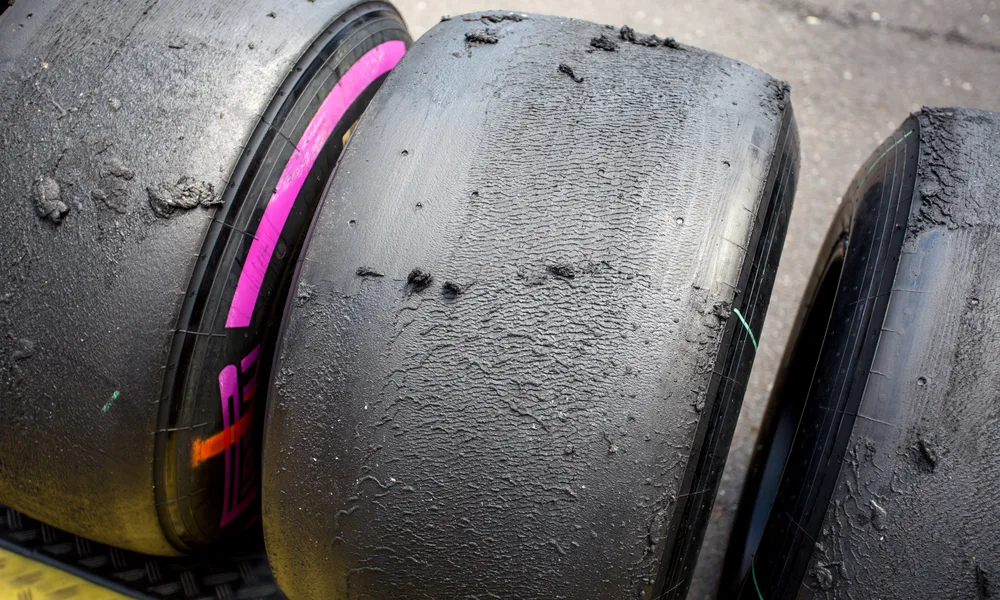
7. The bald hand-me-down: worn past any useful life
The bald hand-me-down is a tire that has already done its best work and been passed on anyway. The tread is gone, the surface is smooth and cracked, and the rubber is old and hard. It might hold air and it might look round, but it has nothing left to give a race car. It slides under braking, spins under power and can fail suddenly, because worn rubber is thin rubber, and thin rubber punctures.
Reusing tires is tempting when budgets are tight, but a race tire is a consumable, not an heirloom. Once it is worn past its useful life, every extra lap is a gamble. It sits at the bottom of this list only because the other six fail while still looking new.
What to avoid when choosing race tires
The most common tire regret is a wrong match: a soft tire chosen for a long race, a dry tire kept on in the rain, or a used set trusted for one more stint than it had left. Avoid the trap by checking four things before the car leaves the pits: the compound, the wear and age of every tire, the weather forecast, and whether all four tires match. The same checks apply to the rest of the race day, and our guide to the worst race tracks shows how a bad surface can punish even a good tire, because a rough or dirty track wears rubber faster than any driver can save it.
Checklist: spotting a bad race tire
- Check the compound first and match it to the race length, the surface and the weather, not to the fastest lap in practice.
- Look for graining, blistering and uneven wear across the surface, and walk away from any tire that already shows them.
- Feel the tire after a run: if it is too hot to touch in patches, it is overheating and will fade.
- Make sure all four tires match in compound, age and wear, and never mix old and new stock on the same car.
- Ask when the tire was made and how it was stored, because old rubber goes hard even if it has never been used.
- Have a wet-weather plan ready before the rain starts, and change tires early rather than gambling on the sky.
Frequently asked questions
What makes a race tire bad?
A race tire is bad when it cannot hold its grip for a full stint. The usual failures are overheating, fast wear, a compound that never warms up, and a surface that cannot cope with water.
How long should a race tire last?
It depends on the compound, the car and the track, but a good race tire holds its grip for the stint it was designed for. If lap times fall off a cliff halfway through, the tire was wrong for the job.
Why do race tires overheat?
They overheat when the compound is too soft for the car, the track or the temperature, or when the driver has to slide the car to make it turn. The surface grains and the grip falls away.
Can you use the same race tires in the wet?
No. A smooth dry tire cannot clear standing water and will aquaplane. Wet-weather tires have tread patterns that move water away from the surface.
Is it safe to reuse old race tires?
Only within their useful life. Rubber hardens with age, and worn rubber is thin and easy to puncture. A tire that is bald, cracked or past its age should not be raced.
How do I know if my tires are mismatched?
Check the compound, the date and the wear on all four tires. If any one of them is different, the car will handle differently at each end.
Bottom line
The worst race tires of 2026 promise speed and deliver trouble: the one-lap wonder that fades, the rock-hard tire that never grips, the fair-weather tire that drowns in the rain, the shredder that tears itself apart, the cold tire that never wakes up, the mismatched set that cannot agree, and the bald hand-me-down that should have been retired. Check the compound, the wear, the age and the match before the car leaves the pits. The same care applies to the whole sport, and our guide to the worst motorsport shows how a bad format can waste a good car, a good tire and a whole weekend in one go.


