
Some vehicles should never tow a heavy trailer, and the trouble is that many of them look like they should. A rugged off-roader, a big luxury SUV, a powerful-looking pickup: all three can be terrible towing vehicles. The wrong choice does not just mean slow progress up a hill. It means trailer sway, overheating, worn brakes, and a combination that is tiring at best and dangerous at worst.
This guide names the towing vehicles to avoid in 2026, and the setups that turn an otherwise good vehicle into a bad one. Most of them are excellent at what they were designed for. They are simply the wrong tool for pulling a heavy trailer.
Key takeaways
- Small crossovers are the worst towing vehicles of all: most are rated at 1,500 to 3,500 lb, far below a family caravan.
- A short wheelbase is the enemy of stability, which is why the Bronco and Wrangler struggle with tall trailers despite their rugged image.
- The base engine in a full-size truck can tow thousands of pounds less than the headline figure, so the cheapest truck is often the worst tower.
- A truck without the factory tow package is a bad buy for towing, however good the price looks.
- Payload runs out first: vehicles such as the Tundra and Sequoia have low payload figures that leave little room for tongue weight and passengers.
Small crossovers: the worst place to start
The single worst towing choice is a small crossover. The Toyota RAV4 is rated at up to 3,500 lb, but only in most all-wheel-drive models; the LE all-wheel-drive version is rated at just 1,750 lb. A family caravan typically weighs 3,500 to 6,000 lb loaded, which means even the best RAV4 is at its limit with a small caravan and hopelessly overloaded with a normal one. The same applies to most compact SUVs, which are built on car platforms with light-duty transmissions, small brakes and no separate chassis.
The problem is not only the rating. A light vehicle towing a heavy trailer is a tail wagging a dog: the trailer outweighs the tow vehicle, so in a crosswind or during emergency braking the trailer dictates what happens. If your trailer weighs more than your car, you have bought the wrong car.
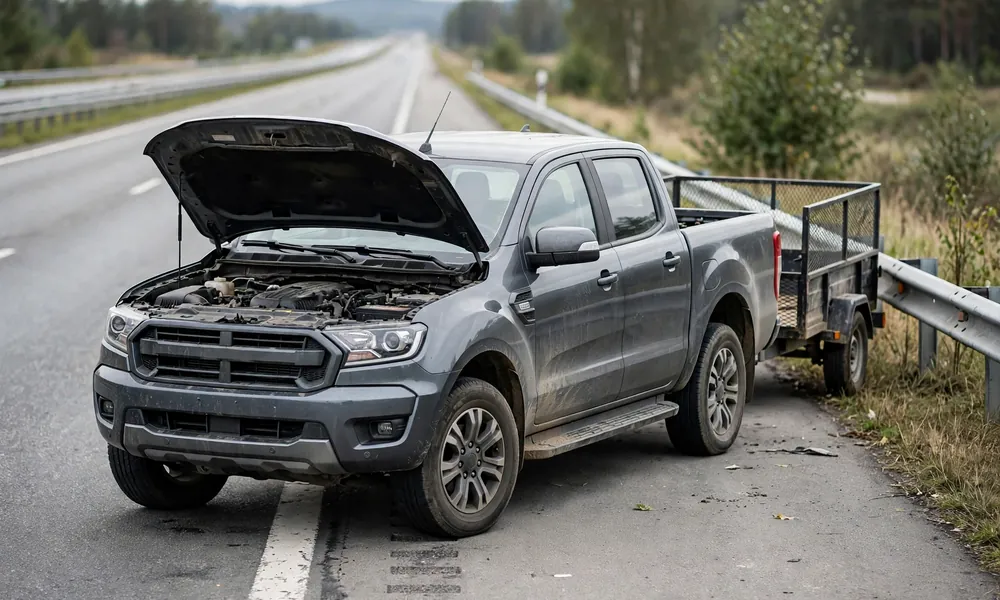
Short-wheelbase off-roaders: rugged looks, poor towing
The Ford Bronco and Jeep Wrangler are two of the most capable off-road vehicles on sale, and two of the worst towing vehicles. The Bronco is rated at up to 4,500 lb and the Wrangler at up to 5,000 lb, but the numbers hide the real problem. Both have short wheelbases, which means the trailer has a long lever arm on the vehicle. A gust of wind or a passing lorry can start a sway that a longer vehicle would shrug off.
Tall, flat-sided caravans make it worse: they catch the wind like a sail, and a short, light tow vehicle has little mass and little wheelbase to resist them. Both can tow a small camper or a jet ski trailer happily. Neither is sensible for a long caravan holiday, and a bigger engine does not fix the physics.
Performance trucks: the Raptor trap
The Ford F-150 Raptor is one of the most exciting trucks on sale, and one of the worst for towing. It is rated to tow just 8,200 lb, against 13,500 lb for a properly equipped standard F-150 with the 3.5-litre EcoBoost. The Raptor costs from about $79,005, more than twice the price of a base F-150, and tows thousands of pounds less.
The reason is the suspension. The Raptor is built for high-speed desert running, with long-travel, soft suspension that soaks up jumps and rough ground. That same softness is the opposite of what towing needs: a heavy trailer compresses the soft springs, the nose rises, and the steering goes light. Payload is only about 1,410 lb. Buy a Raptor for the desert, and a standard F-150 for the caravan.
Base-engine full-size trucks: the headline is not yours
The most common towing disappointment is not a bad vehicle at all. It is a good truck bought with the wrong engine. The 2026 Ford F-150 with the base 2.7-litre EcoBoost is rated to tow just 8,400 lb, against 13,500 lb for the 3.5-litre EcoBoost. The Ram 1500 with the base 3.6-litre Pentastar V6 manages 8,130 lb, against 11,610 lb for the Hurricane six. The Toyota Tundra SR is rated at 8,300 lb, against 12,000 lb for the best configuration.
Buyers who compare headline figures and then buy the cheapest version end up with a truck that tows 4,000 to 5,000 lb less than the number they remember from the brochure. If you tow regularly, the engine upgrade is not a luxury. It is the difference between the truck you thought you bought and the one you actually own.
Our comparison of pickup vs SUV for towing explains why the configuration matters more than the nameplate, and why the same model can be either an excellent or a poor tower.
Vehicles to avoid for towing in 2026
| Vehicle | Max towing | Why to avoid it |
|---|---|---|
| Toyota RAV4 (LE AWD) | 1,750 lb | Far below any family caravan |
| Toyota RAV4 (most AWD) | 3,500 lb | At its limit with a small caravan |
| Ford Maverick (base) | 2,000 lb | Too light for anything but small trailers |
| Ford Bronco | 4,500 lb | Short wheelbase, poor sway control |
| Jeep Wrangler | 5,000 lb | Short wheelbase, light for tall trailers |
| Ford F-150 Raptor | 8,200 lb | Soft suspension, low payload, high price |
| Ford F-150 (2.7-litre base) | 8,400 lb | 5,100 lb below the headline rating |
| Ram 1500 (Pentastar V6) | 8,130 lb | Weakest engine in the range |
| Toyota Tundra SR | 8,300 lb | Base trim, lowest rating in the range |
| Toyota Sequoia | 9,520 lb | Strong tow rating but only 1,400 lb payload |
Every figure above is a maximum for one properly equipped configuration. A vehicle on the lot may be rated lower still.
The missing tow package
A truck without the factory tow package is a towing vehicle to avoid, whatever the badge. The F-150’s 13,500 lb rating needs the Max Trailer Tow Package, and the Silverado 1500’s 13,300 lb rating needs the Max Trailering Package. Without the package, most Silverado configurations tow between 9,000 and 9,700 lb, and a similar drop applies across the class.
The package is not a single part: it typically adds a higher-capacity radiator, a transmission cooler, a trailer brake controller, an upgraded axle ratio and a higher-rated hitch. Retrofitting all of it is expensive and sometimes impossible, and a dealer-fitted tow bar alone does not restore the factory rating.

Low payload: the hidden deal-breaker
Payload is where several otherwise capable vehicles quietly fail. The Toyota Sequoia tows up to 9,520 lb, but its maximum payload is only about 1,400 lb, which a heavy trailer’s tongue weight can use up before a single passenger gets in. The Toyota Tundra has the same problem, with a maximum payload of about 1,850 lb, the lowest of its rivals.
The same trap catches luxury SUVs and high-trim trucks: every option adds weight, and every kilogram of it comes out of payload. Before you buy, read the payload sticker on the driver’s door jamb and do the arithmetic with your real passengers, luggage and tongue weight.
Fuel choice plays a part here too. Diesel engines are heavier than petrol engines, which can reduce payload slightly, but they repay the difference with low-rev torque on long tows. Our guide to petrol vs diesel SUVs for towing weighs the trade-off in detail.
Electric trucks and long tows
Electric trucks are not bad vehicles, but they are currently poor choices for long-distance towing. The Ford F-150 Lightning is rated to tow up to 10,000 lb with the extended-range battery and Max Tow Package, and the Chevrolet Silverado EV is rated at up to 12,500 lb. Both tow strongly and quietly, and both are fine for short, local trips with a trailer.
The problem is range. Towing can cut electric range by half or more, turning a 300-mile truck into a 150-mile truck, and charging with a trailer attached is still awkward at many sites. Until range and charging improve, an electric truck is a vehicle to avoid for long caravan holidays.

Used trucks with tired running gear
A used truck can be a smart buy, but a tired one is the worst towing vehicle of all. Cooling systems weaken with age, transmissions slip, brakes fade, and suspension sags, so a truck rated to tow 10,000 lb when new may not safely tow 7,000 lb after years of hard work.
Before buying any used tow vehicle, check the service history for transmission and cooling work, test the trailer brake controller, and have the suspension and brakes inspected. A vehicle with no tow package, no service history and worn tyres is a breakdown waiting for a hill.
For a sense of what the good end of the market looks like, see our guide to the best pickup trucks of 2026, and compare its ratings with any used truck you are considering.
Your avoid-list checklist
- Do not buy a crossover rated below your loaded trailer weight, however capable it looks: most are rated at 1,500 to 3,500 lb.
- Do not tow a tall caravan with a short-wheelbase vehicle such as the Bronco or Wrangler, because sway control matters more than engine power.
- Do not pay performance-truck money for towing: the Raptor tows 8,200 lb while a standard F-150 tows 13,500 lb for far less.
- Do not buy the base engine and expect the headline rating: check the tow figure for the exact engine, cab and axle you are buying.
- Do not accept a truck without the factory tow package, and do not assume a dealer tow bar restores the factory rating.
- Do not ignore the payload sticker: subtract tongue weight, passengers and luggage first, and walk away if the answer is negative.
Frequently asked questions
What is the worst vehicle for towing?
A small crossover such as the base Toyota RAV4, rated at just 1,750 lb. It is lighter than most family caravans and should not tow anything heavier than a small utility trailer.
Can a Jeep Wrangler tow a caravan?
It can tow a small camper, but it is a poor choice for a large caravan. The Wrangler is rated at up to 5,000 lb, yet its short wheelbase makes it prone to trailer sway with tall, flat-sided trailers in wind.
Why is the Ford F-150 Raptor bad for towing?
Because it is built for high-speed off-road driving, not towing. Its soft, long-travel suspension compresses under tongue weight, its payload is only about 1,410 lb, and it is rated at 8,200 lb against 13,500 lb for a standard F-150.
Is a base-engine truck bad for towing?
It can be. The base F-150 tows 8,400 lb against 13,500 lb for the 3.5-litre EcoBoost, and the base Ram 1500 tows 8,130 lb against 11,610 lb. Always check the rating for the exact engine you are buying.
Can I tow with an electric truck?
Yes, for short trips. The F-150 Lightning tows up to 10,000 lb and the Silverado EV up to 12,500 lb, but towing can halve electric range and charging with a trailer attached is still awkward at many sites.
What matters more: towing capacity or payload?
Both, but payload runs out first. Tongue weight, passengers and luggage all come out of payload, so a vehicle with a good tow rating and a low payload can still be overloaded.
Bottom line
The vehicles to avoid for towing in 2026 are not bad vehicles. Small crossovers, short-wheelbase off-roaders, performance trucks, base-engine pickups and tired used trucks are all fine at what they were designed for. They fail at towing because of physics no badge can fix: too little weight, too short a wheelbase, too little payload, or the wrong equipment. Buy the vehicle that matches your loaded trailer, with the right engine, the factory tow package and payload to spare.


