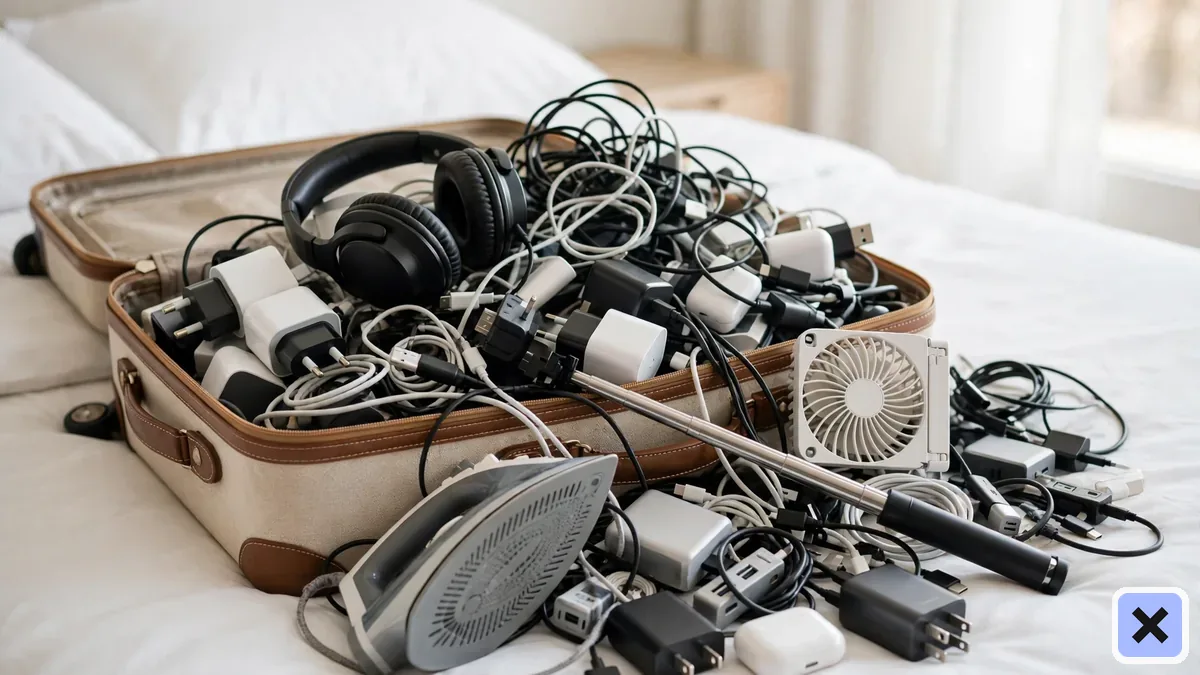
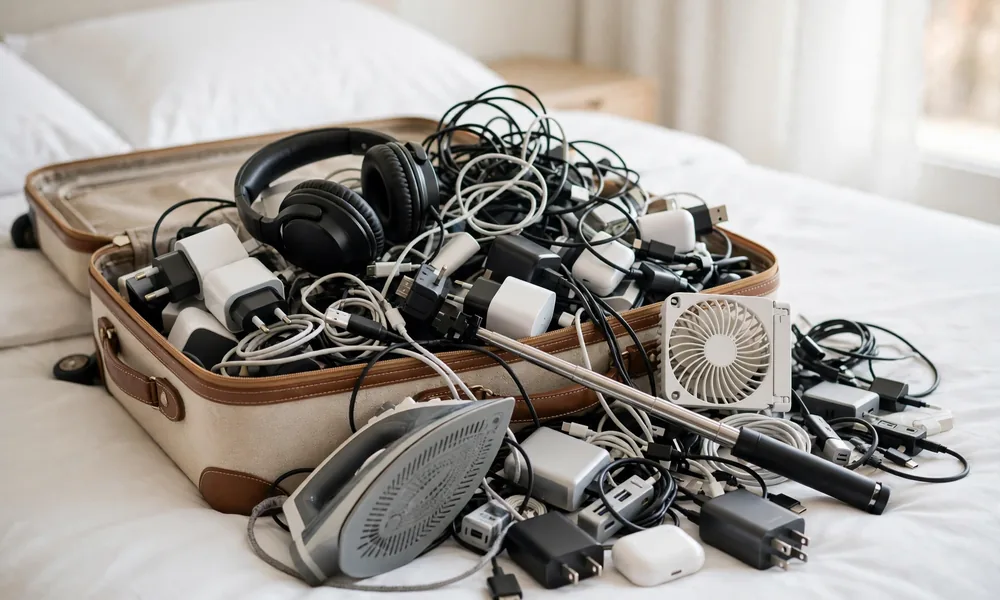
The worst travel gadgets are the ones that sound brilliant in a product video and turn into dead weight by the second day of a trip. They promise to save space, save time, or solve a problem you did not actually have, and they usually do the opposite. A suitcase full of clever devices is heavier, harder to organise, and more stressful to manage than a suitcase with a few well-chosen essentials.
Most of these gadgets fail for the same simple reasons. They need charging, they need a cable you forgot, or they solve a problem that a cheaper, lighter object already solves. The marketing shows the one perfect moment, never the airport security tray or the hotel room with one plug socket.
This guide looks at the travel gadgets that are not worth packing, explains why each one disappoints, and shows what to take instead. The goal is a lighter bag, a calmer trip, and money kept for the parts of travel that actually matter.
Key takeaways
- Most travel gadgets fail because they add weight, cables, and charging chores without solving a real problem.
- Single-use devices are the worst offenders: if it does one small job, leave it at home.
- A good phone, a good pair of headphones, and a reliable charger cover almost every real travel need.
- Check weight, power, and compatibility before buying any gadget, not after you have packed it.
- The best packing rule is simple: if you have not used it on your last two trips, you will not use it on this one.
Why Travel Gadgets Go Wrong
Travel is the hardest test any gadget can face. Everything gets carried, dropped, squeezed into a bag, and used in places with different plugs, different voltages, and different rules. A device that works perfectly on a desk at home can become useless on a plane, in a hostel, or on a mountain road.
The second problem is the packing trap. Every gadget comes with extras: a case, a cable, a charger, an adapter, or a stand. A gadget that weighs 200 grams can easily become 400 grams once its accessories are counted. Add five such gadgets and you have added a full kilogram of clutter to a bag that was already close to the airline limit.
The Promise Versus the Reality
Advertisements show a traveller gliding through an airport with one small device that does everything. Real travel is messier. Devices run out of battery at the wrong moment, apps demand updates on slow hotel Wi-Fi, and tiny parts get lost between seats. The gap between the promise and the reality is where most travel gadgets fail.
There is also a psychological trap. Buying a gadget feels like preparing, so it feels productive. But preparation is not usefulness, and a bag full of unused devices is just a heavier bag.
Weight, Space, and Battery Drain
Every item in a bag has to earn its place. A gadget earns it by being used often, by replacing something heavier, or by solving a problem that has no lighter answer. Most travel gadgets fail all three tests. They are used once, they duplicate something a phone already does, and they create a new problem in the form of charging.
Batteries are the hidden cost. A gadget with its own battery needs its own charging time and often its own cable, while the phone, watch, and headphones already need charging. A device that saves ten minutes of effort but costs an hour of charging has not saved anything.
The Worst Travel Gadgets That Are Not Worth Packing
The gadgets below are the repeat offenders: the ones travellers buy with high hopes, carry with growing annoyance, and eventually leave at home on the next trip. Each one has a cheaper, lighter, or simpler alternative that works better in real travel.
1. The Travel Iron and Steamer
A travel iron sounds sensible. Nobody wants to arrive looking creased, and a small iron seems like the answer. In practice, it is heavy, slow, and awkward. It needs a flat surface, a plug socket, and time, and most hotels already provide an iron or a steaming service on request.
2. The Portable Washing Machine
Small portable washers and ultrasonic washing gadgets promise clean clothes anywhere. The reality is a device that washes a few items badly, takes a long time, and still leaves clothes wet. Drying remains the real problem, and no small gadget solves it.
3. The Multi-Tool With Everything Built In
A travel multi-tool with a knife, scissors, bottle opener, screwdriver, and a dozen other attachments looks like the ultimate packing shortcut. On a plane, it is the ultimate packing problem. Blades and sharp tools are not allowed in cabin bags, and a confiscated multi-tool is an expensive lesson in airport security rules.
4. The Selfie Stick
The selfie stick had its moment, and that moment has passed. Modern phones have wide front cameras, timers, and voice commands that take a good self-portrait without a long pole. A selfie stick is awkward in crowds, banned in many museums and attractions, and it marks its user out as a tourist in the worst way.
5. The Travel Pillow With Speakers, Massagers, and Lights
A simple neck pillow can be genuinely useful on a long flight. A travel pillow loaded with speakers, vibration, heating, and lights is a different story. It is bulky, it needs charging, and its extra features are rarely used more than once.
6. The Gadget Organiser Full of Cables
A gadget organiser is not a gadget itself, but it is the clearest sign of a packing problem. If a trip needs a whole case of cables, adapters, and chargers, the trip has too many devices. The organiser adds weight and bulk, and it hides the real issue: too many gadgets, each with its own charging needs.
7. The Smart Luggage Tracker and Bag Scale
Luggage trackers and digital bag scales seem useful, but both solve problems that are smaller than they look. Most airlines now show bag tracking in their own apps, and a tracker cannot stop a bag from being delayed; it only tells you where the delay is. A bag scale is used once per trip, at most, and then carried for the rest of it.
A Quick Comparison
The table below sums up the worst offenders, why they fail, and what works better.
| Gadget | Main problem | Better alternative |
|---|---|---|
| Travel iron or steamer | Heavy, slow, needs power and water | Crease-resistant clothes, hotel iron |
| Portable washing machine | Washes badly, clothes stay wet | Local launderette |
| Multi-tool with blades | Banned in cabin bags | One small tool, if any |
| Selfie stick | Awkward, often banned | Phone timer, small tripod |
| Pillow with speakers | Bulky, weak features | Plain pillow, good headphones |
| Portable fan | Weak breeze, short battery | Shade, water, light clothing |
| Luggage tracker | Cannot speed up delivery | Airline app, cabin essentials |
What to Pack Instead
The best travel kit is small, and every item in it earns its place daily. A phone covers maps, tickets, translation, photos, and entertainment. A good pair of headphones makes flights and train journeys far more comfortable, and the headphones that actually matter for travel are the ones with strong noise cancelling and long battery life, not the ones with the most features.
A single multi-port charger and two cables will charge a phone, headphones, and a watch. A small power bank is worth carrying on long travel days, but only one, and only a model that charges quickly. A lightweight day bag, a water bottle, and a small first aid kit cover the rest of the realistic needs.
Clothes should be chosen for the trip, not for the gadget that irons them. Quick-drying fabrics, layers for changing weather, and comfortable shoes matter far more than any device.
How to Decide Before You Pack
Before any gadget goes into a bag, it should pass a simple test. Ask whether it solves a problem you have actually had on a trip, whether a lighter object solves the same problem, and whether you would carry it on a walk around a city all day. If the answer to any of those is no, the gadget stays home.
Travel rewards flexibility. A light bag lets you change plans, walk further, and take a bus instead of waiting for a large taxi. A heavy bag narrows every choice.
Packing Checklist
- Use the gadget at home for a week first: if it stays in a drawer, it stays home.
- Count its accessories: case, cable, charger, and adapter all count toward the weight.
- Check airline rules: anything with a blade or a large battery may not fly in the cabin.
- Check the plug: a gadget that needs its own adapter is already two items, not one.
- Ask what it replaces: if the answer is nothing, it is extra weight, not a replacement.
- Pack, then remove three items: the bag will still have everything that matters.
Frequently Asked Questions
Are travel gadgets ever worth buying?
Yes, a few are. A good power bank, a reliable multi-port charger, and noise-cancelling headphones are used on almost every trip. A useful gadget is used daily; a bad one is used once and then carried for the rest of the journey.
What is the single worst travel gadget?
The portable washing machine is a strong candidate, because it promises a real benefit and delivers almost none of it. It washes a small load slowly, leaves clothes wet, and still needs somewhere to dry them. A local laundry service is faster, cheaper, and far more reliable, which makes the gadget almost impossible to justify.
How many gadgets should I pack for a holiday?
For most trips, three or four electronic devices are enough: a phone, headphones, a charger, and a power bank. A camera or an e-reader can be added for a specific trip, such as a photography holiday or a long beach stay. Beyond that, each extra device adds cables, weight, and worry without adding much enjoyment.
Do I need a travel adapter?
A travel adapter is one of the few gadgets that earns its place. A small universal adapter that covers the countries on the trip is enough. Many modern chargers already handle different voltages, so the adapter is often the only extra piece needed.
Why do travel gadgets look so good in advertisements?
Advertisements show the one moment a gadget works perfectly, in ideal light, with no crowds and no queues. They never show the charging, the cables, the security tray, or the moment the battery dies. The hype around travel gear follows the same pattern as other overhyped products, and the worst travel hype to ignore before a trip is usually the promise that one more device will fix a trip that needs better planning, not more gear.
What should I do with gadgets I already own but never use?
Give them a final test on a short trip. If they stay unused, sell them or give them away. A gadget that is useful at home can still be a bad travel gadget, and the money can go toward a better bag, better shoes, or the trip itself.
The Bottom Line
The worst travel gadgets are not worth packing because they promise more than they deliver and cost more than they save: weight, space, charging time, and patience. A lighter bag, a good pair of headphones, a reliable charger, and clothes that suit the trip will beat a suitcase full of clever devices every time. The best journeys are rarely remembered for the gadgets that came along, and the best mountain escapes prove the point: what matters is where you go and how freely you move, not what you carried to get there.