Top Reusable Straws That Don’t Taste Like Metal in 2026
The best reusable straws in 2026 are the ones you forget are there. No metallic tang, no soggy collapse, no plastic taste on a hot day — just a clean sip from a straw that survives the dishwasher, the car cup holder, and a year of daily use. The trouble is that most reusable straws fail on exactly one of those points: steel straws can taste like a coin, glass straws feel fragile, silicone straws can hold on to flavours, and bamboo straws need more care than the packet admits. This guide sorts out which reusable straws actually taste of nothing, which ones suit smoothies and which suit iced coffee, and how to keep them clean without a second thought.
Key takeaways
- Glass and food-grade silicone are the only materials that add no taste at all; steel can taste metallic to sensitive sippers, especially in acidic drinks.
- Wide straws, around 12 millimetres, are the only honest choice for smoothies and bubble tea; standard 6 millimetre straws clog and frustrate.
- A cleaning brush is not optional — a straw you cannot scrub through will smell within a fortnight, whatever the material.
- Silicone is the safest pick for children and for hot drinks, because it never gets hot to the lips and cannot shatter or dent.
- Buy a set with a travel case and at least four straws, so a dirty one never forces you back to a single-use plastic straw.
Why some reusable straws taste like metal
The metallic taste that puts people off reusable straws is real, and it has a simple cause. Stainless steel is an alloy, and cheap or thin steel can leach a faint metallic flavour into acidic drinks such as lemonade, citrus water, and iced coffee. The effect is strongest in drinks that sit in the straw for a while, which is why a quick sip of water tastes fine and a slow glass of orange juice does not. Good quality 18/8 food-grade steel minimises the problem, but it does not remove it entirely for the most sensitive tasters — roughly one person in five notices it, and once you notice it, you cannot un-notice it. Temperature makes it worse: a steel straw in a hot drink conducts heat straight to your lips, and in an iced drink it can feel unpleasantly cold and sharp.
The four materials, compared
No single material wins on every measure, which is why most happy reusable-straw owners end up with two types: one for home and one for the bag. The table below is the honest version of the choice, with the weaknesses left in.
| Material | Taste | Durability | Cleaning | Best for |
|---|---|---|---|---|
| Silicone | None after first wash | Bends, never breaks | Easy; dishwasher safe | Children, hot drinks, travel |
| Glass | None, ever | Strong but can shatter | Easy; see-through | Home, iced coffee, taste purists |
| Stainless steel | Faint metallic for some | Nearly indestructible | Needs a brush | Smoothies, outdoors, long life |
| Bamboo | Faint woody note at first | Good; replace yearly | Hand wash and dry fully | Natural feel, cold drinks |
Silicone straws: the easy everyday pick
Silicone straws are the easiest reusable straws to live with, and the best starting point if you are switching from plastic. They bend without kinking, so they fit any cup, any lid, and any bag without snapping. They are safe in hot drinks because silicone does not conduct heat, and they are the only straw worth handing to a child, because there is nothing hard to bite or sharp to fall on. Most silicone straws are dishwasher safe and survive being stepped on, sat on, and chewed by toddlers.
Glass straws: the purest taste of all
If taste is your only criterion, glass wins and it is not close. A borosilicate glass straw adds nothing to the drink, looks good in the glass, and lets you see at a glance whether it is clean — a bigger advantage than it sounds, because a straw you can see through is a straw you will actually clean. Glass straws suit iced coffee, iced tea, lemonade, and water, and they handle hot drinks without passing heat to your lips the way steel does.
Stainless steel straws: the toughest, with one catch

Steel straws are the toughest reusable straws you can buy. They do not break, stain, or absorb flavours, and a good one will outlive the cup you drink from. For smoothies, milkshakes, and bubble tea, a wide steel straw is the most practical tool in this guide: it powers through thick drinks that defeat silicone and paper, and it rinses clean in seconds. For outdoor use, camping, and work lunches, steel is the obvious pick, because it survives the bottom of a bag without a case.
The catch is the one in the title. If you are sensitive to metallic taste, steel will disappoint you in acidic and hot drinks, and no amount of washing fixes it. The fix is a silicone tip, which covers the part your lips touch, or a powder-coated steel straw, which puts a layer between your mouth and the metal. Heat is the second catch: a steel straw in hot coffee becomes too hot to touch within a minute, so steel is a cold-drink straw unless it has a silicone tip. And because steel is opaque, you cannot see whether it is clean — the brush is essential, and a straw that has carried milk or a smoothie needs brushing the same day. If you want a deeper dive into the bottles these straws usually pair with, our guide to reusable water bottles that stay cold all day covers the insulation and lids that decide whether your drink is still cold by the afternoon.
Bamboo straws: natural, light, and honest about their limits
Bamboo straws are the lightest and most natural-feeling option, and they suit cold drinks beautifully. They are warm to the touch, quiet against the teeth, and they do not taste of metal or plastic. A bamboo straw in a glass of iced tea feels like part of the drink rather than an accessory, and they are the most sustainable choice in this guide, being made from a fast-growing plant rather than mined or manufactured material.
How to choose the right straw for your drink
Match the straw to the drink, not to the trend. For water and iced tea, any material works, so choose on taste and convenience: glass at home, silicone in the bag. For smoothies, milkshakes, and bubble tea, only a wide straw works — 12 millimetres for smoothies, wider still for bubble tea pearls — and steel or wide silicone are the practical picks. For hot coffee and tea, silicone is the safest and glass the purest; steel without a tip is the one to avoid.
Cleaning: the habit that decides whether you keep using them
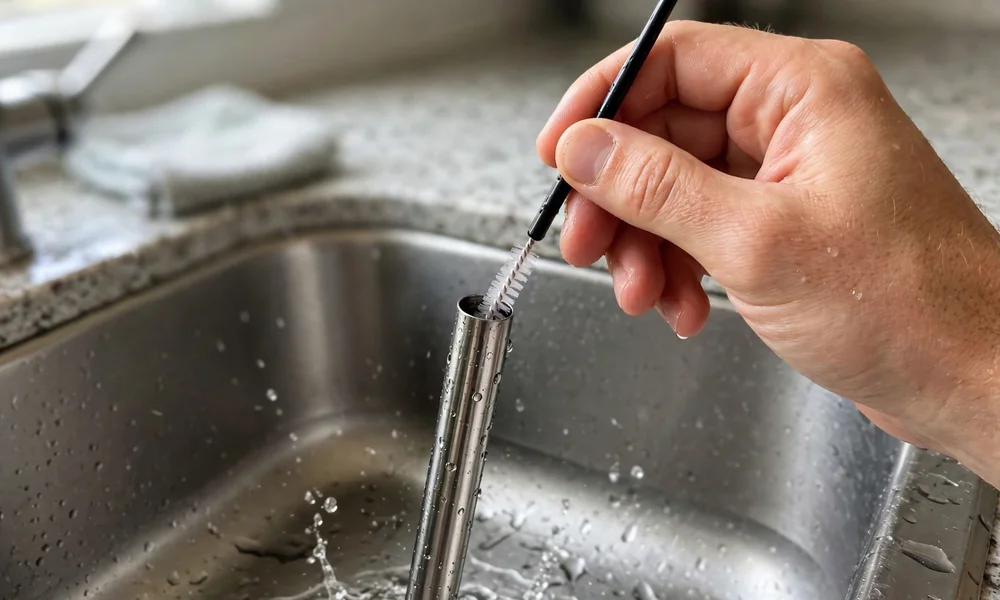
Once a week, give the set a deeper clean. Glass and silicone straws can go in the dishwasher; steel straws can too, but a brush pass first is still wise because the dishwasher cannot scrub the inside. For a straw that has gone cloudy or picked up a smell, soak it for half an hour in warm water with baking soda, then brush and rinse. The brush deserves a word of its own: the thin wire brush that comes with most sets is fine, but it wears out, so keep a spare, and check it is at least as long as your longest straw. If you want the full cleaning picture, our guide to the best bottle brushes covers the brush shapes that actually reach the inside of narrow bottles and straws.
Travel cases and taking straws out of the house
Keep a set in the car, a set at work, and a set at home, rather than carrying one set everywhere. A straw that lives in the car gets used at drive-throughs and cafes; a straw that lives at work gets used at lunch. Three cheap sets beat one expensive set that is always in the wrong place. For the rest of your on-the-go kit, the comparison in our best versus worst water bottles guide is worth a read before you buy a bottle to pair with your straws, because a bottle with a straw lid changes which straw length and diameter you need.
Before you buy checklist
- Pick the material for your main drink: glass or silicone for taste, steel for smoothies, bamboo for cold drinks.
- Check the diameter: 6 millimetres for water and iced coffee, 12 millimetres for smoothies, wider for bubble tea.
- Check the length against your tallest glass and your travel cup, and buy a set with two lengths if you can.
- Make sure the set includes a cleaning brush that is at least as long as the longest straw.
- Look for a hard travel case if the straw will leave the house, and a silicone tip if you choose steel.
- Confirm dishwasher safety for the material, and check the steel grade is 18/8 if you buy steel.
Frequently asked questions
Do stainless steel straws always taste like metal?
No, but they can. Good 18/8 food-grade steel tastes of nothing to most people, while cheap or thin steel tastes metallic, especially in acidic drinks such as lemonade and iced coffee. If you are sensitive to the taste, a silicone tip or a powder-coated straw removes most of it, or switch to glass or silicone, which never taste metallic.
Are glass straws safe to drink from?
Yes. Borosilicate glass straws are safe for everyday use: the glass is thick, heat-resistant, and free of coatings, and you can see inside to check it is clean. They can break if dropped on a hard floor or bitten hard, so they suit adults at home better than children or travel, and a protective case is worth having.
How often should bamboo straws be replaced?
Roughly once a year with daily use, or sooner if the straw darkens, smells after washing, or feels rough inside. Bamboo is porous, so it absorbs moisture and flavour over time. Wash it after every use, dry it fully standing upright, and never soak it or put it in the dishwasher.
Can reusable straws go in the dishwasher?
Silicone, glass, and stainless steel straws can all go in the dishwasher, ideally in the cutlery basket standing upright so water runs through. Bamboo straws cannot. Even dishwasher-safe straws benefit from a quick brush pass first, because the dishwasher rinses the inside but does not scrub it.
What size straw do I need for smoothies?
A wide straw of about 12 millimetres for smoothies and milkshakes, and wider still for bubble tea with pearls. A standard 6 millimetre straw will clog on anything thicker than juice. Mixed sets with two standard and two wide straws cover most drinks without buying two separate sets.
Do reusable straws really save money?
Yes, over time. A decent set costs about the same as a few months of buying drinks with disposable straws, and it lasts years. The saving is small per straw, but the real gain is never being caught without one — a set in the car and a set at work means the disposable straw never enters the picture.
The bottom line
The best reusable straws in 2026 are the ones that taste of nothing, clean in thirty seconds, and are actually with you when you need them. Glass wins on pure taste, silicone wins on everyday ease, steel wins on toughness, and bamboo wins on natural feel — and most households are happiest with two of those, a glass or silicone set at home and a steel or silicone set for the bag. Pick for your main drink, buy a set with a brush and a case, and the metallic taste that put you off reusable straws in the first place becomes a problem you solved rather than a reason to go back to plastic.