Best Beach Blankets That Actually Keep the Sand Off in 2026
The best beach blankets in 2026 solve one problem before anything else: sand. A good beach blanket keeps the sand underneath it, not on top of it, stays put in a sea breeze, dries before you pack up, and still has room for two people, a book, and a bag without anyone sitting on grit. This guide compares the blanket types that actually work on a beach, explains how sand-proof mesh, anchor pockets, and size really work, and helps you pick one that earns its place in the car boot.
Key takeaways
- Sand-proof mesh is the single most important feature: dual-layer woven mesh lets sand fall through and stops it coming back up, while fleece and cotton trap it.
- Size matters more than pattern: a blanket for two needs at least 180 by 140 centimetres, and a family blanket should be 240 by 200 centimetres or bigger.
- Anchor pockets you fill with sand beat stakes on most beaches, because stakes pull out of dry sand and are banned on some beaches.
- Quick-dry fabric decides whether the blanket goes back in the bag or gets draped over the car for the drive home.
- A blanket that packs to the size of a water bottle gets used ten times more than a bulky one that lives in the garage.
What makes a beach blanket different from a picnic blanket
A picnic blanket and a beach blanket look similar in a product photo and fail in opposite ways. A picnic blanket is built for grass: its job is to stop damp coming up from the ground, so it has a waterproof backing, soft fleece on top, and enough padding to smooth out sticks and stones. Take it to the beach and the fleece traps sand in every fibre, the waterproof backing stops sand falling through, and the whole thing becomes a gritty, heavy bundle that carries half the beach home with it.
A beach blanket is built for sand, and its priorities are reversed. The top surface needs to let sand through rather than catch it, the blanket needs to stay flat in wind rather than stay dry underneath, and it needs to dry fast after a swim rather than cushion rough ground. That is why the best beach blankets are thin, smooth, and often made from woven mesh or parachute nylon rather than fleece. If you want the full grass-side comparison, our guide to which picnic blanket is worth packing explains waterproof backing, padding, and ground comfort in detail — the beach blanket is a different tool for a different surface.
The main types, compared
Beach blankets split into four clear types, and the right one depends on your beach and your group. The table below keeps the weaknesses in, because every type trades something away.
| Type | Sand handling | Wind hold | Dries | Best for |
|---|---|---|---|---|
| Dual-layer mesh | Excellent; sand falls through | Good with anchor pockets | Very fast | Fine sand, families, all-day trips |
| Parachute nylon | Good; shakes clean | Good; light but anchored | Very fast | Travel, backpacking, light packers |
| Microfibre / Turkish | Fair; shakes off, some sticks | Fair; needs weights | Fast | Doubling as a towel, style |
| Quilted / padded | Poor; traps sand | Good; heavy | Slow | Pebble beaches, comfort first |
Dual-layer mesh is the standout for most people. Two layers of woven mesh, offset so sand falls through the top layer and out the bottom, keep the sitting surface nearly sand-free even after hours of use. Parachute nylon is the traveller’s pick: it folds to almost nothing, dries in minutes, and shakes clean with one flick, though it can feel slippery and needs anchoring in wind.
How sand-proof mesh actually works
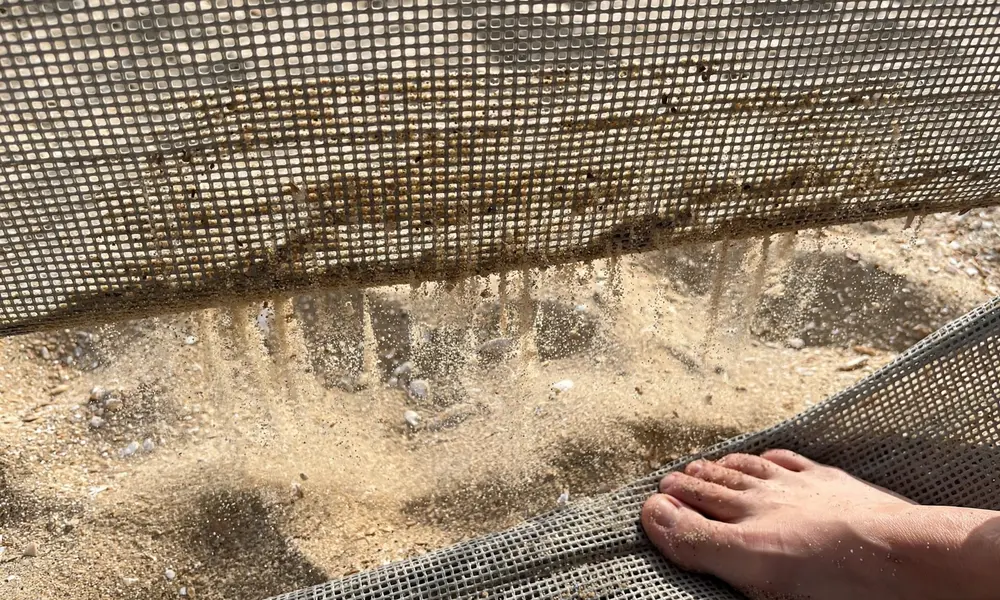
Sand-proof mesh works on a simple trick: the holes are big enough for a grain of sand and too small for anything else. A single layer of mesh lets sand through in both directions, which is no help at all — sand comes up through it as easily as it falls down. Dual-layer mesh fixes this by offsetting two layers, so sand falls through the top layer, lands on the second layer at an angle, and slides out the sides and bottom instead of bouncing back up. The result is a surface that stays clear while you sit on it, and a quick shake clears whatever is left.
Not all mesh is equal, and the difference shows up in the weave. A tight, even weave with small, regular holes sheds sand well and feels smooth; a loose or uneven weave catches sand in its gaps and feels rough on bare skin. Mesh has two honest limits: it offers no padding, so it suits fine sand and not shingle, and it offers no waterproofing, so a wet patch of sand will dampen it from below.
Staying put: anchor pockets, stakes, and wind
Wind is the great enemy of beach blankets, and it embarrasses more blankets than sand does. A light blanket on a breezy beach lifts at the corners, flaps, and ends up wrapped around a stranger’s legs. The fix is weight at the corners, and the best version of it is the anchor pocket: a sewn pocket at each corner that you fill with sand. Four pockets of sand weigh several kilos, hold the blanket flat in a strong breeze, and cost nothing — and when you leave, you tip the sand out and the blanket is light again.
Stakes are the alternative, and they work on grass and firm ground but poorly on dry sand, where they pull out at the first gust. Some beaches also ban stakes, because they are a hazard to bare feet. A blanket with both anchor pockets and stake loops is the most flexible, but if you must choose one, choose pockets. Test the blanket on a windy day near home before a holiday — a blanket that will not stay down is a blanket you will curse for a week.
Size: the decision people get wrong
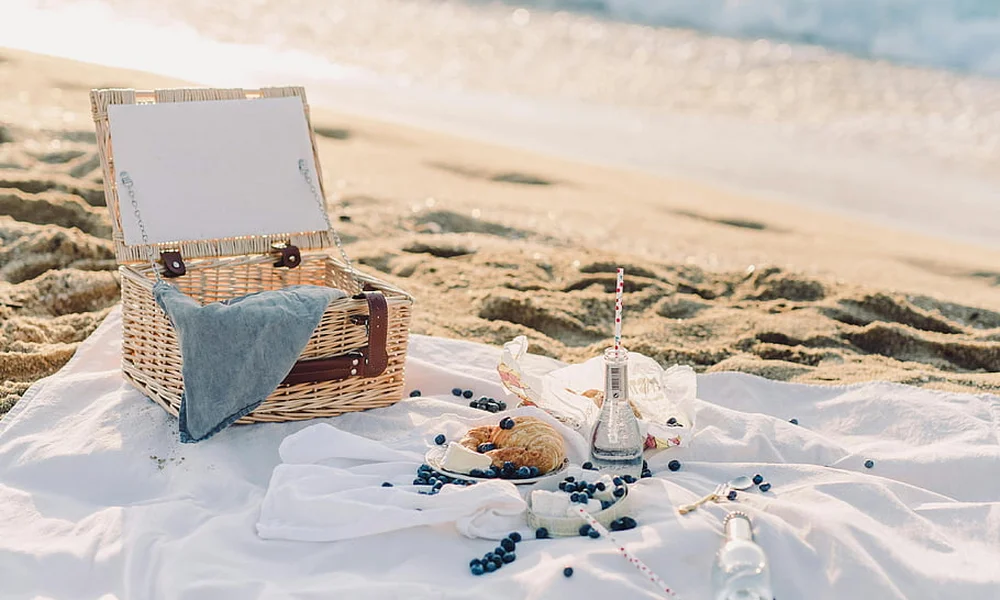
Beach blankets are almost always smaller than people expect. A blanket that looks generous in the shop feels cramped once two adults, a bag, a bottle, and a book are on it, and the moment someone’s legs hang off the edge they are lying on hot sand. For two people, about 180 by 140 centimetres is the minimum that works without elbows and belongings fighting for space. For a family of four, look for at least 240 by 200 centimetres, and bigger still with children, because children treat a blanket as a base camp rather than a seat.
Oversized blankets sound like the answer, and they are — up to a point. A very large blanket is harder to fold, heavier to carry, and catches more wind, so there is a real trade-off between space and portability. If you are choosing between two sizes, take the bigger one — nobody has ever complained that a beach blanket was too big. For the rest of your beach packing, our guide to beach holiday packing lists covers what else deserves space in the bag alongside the blanket.
Drying, packing, and looking after it
A beach blanket that stays wet is a blanket that smells by the next morning, so drying speed is a practical feature, not a luxury. Mesh and parachute nylon dry in minutes in sun and breeze; microfibre takes a little longer; quilted and cotton blankets can take hours and go home damp. If you swim repeatedly and pack up quickly, a fast-drying blanket will serve you far better than a comfortable one that stays soggy.
Packing is the other daily reality. A blanket that folds into its own pouch and clips to a bag gets used; a blanket that needs careful rolling and a separate bag gets left behind. Care is simple: shake the blanket out before folding, rinse off salt and sand at home, and dry it flat or hung up before storing it. If your beach days also involve drying off after a swim, our guide to the best beach towels covers the towel types that pair well with a mesh blanket, from fast-drying microfibre to soft Turkish cotton.
Before you buy checklist
- Check the weave in close-up photos: true dual-layer mesh with small, even holes, not solid fabric calling itself sand-proof.
- Measure for your group: at least 180 by 140 centimetres for two people, 240 by 200 centimetres or more for a family.
- Look for anchor pockets at all four corners, and stake loops as a bonus for firm ground.
- Check the packed size and weight: it should fold into its own pouch and carry with one hand.
- Confirm quick-dry fabric and machine washability, so salt and sunscreen do not build up over the season.
- Match the type to your beach: mesh for fine sand, padded or mesh-over-mat for pebbles, nylon for travel.
Frequently asked questions
Do sand-proof beach blankets really work?
Yes. Dual-layer mesh blankets genuinely keep sand off the sitting surface, because sand falls through the offset weave and cannot come back up. Single-layer mesh and solid fabrics do not work the same way, so check that the blanket is genuinely dual-layer mesh before you buy. A quick shake clears whatever is left.
What size beach blanket do I need for a family?
At least 240 by 200 centimetres for a family of four, and bigger with small children, who spread out more than adults. For two people, 180 by 140 centimetres is the minimum that works. Measure your group lying down rather than sitting up — a blanket that fits everyone sitting feels tiny once everyone lies down.
Are anchor pockets better than stakes?
On sand, yes. Anchor pockets filled with sand weigh several kilos, hold in a strong breeze, and are allowed on every beach. Stakes pull out of dry sand and are banned on some beaches as a hazard to bare feet. A blanket with both is the most flexible, but pockets alone are enough for most beaches.
Can I use a beach blanket as a picnic blanket?
You can, but it is a poor picnic blanket. Mesh lets crumbs and liquid through, offers no padding for hard ground, and has no waterproof backing, so damp grass will soak through from below. It works for a dry beach picnic, but for grass, a proper picnic blanket with a waterproof backing is the better tool.
How do I clean a sand-proof beach blanket?
Shake it out before folding, rinse off salt and sand with fresh water at home, and dry it flat or hung up. Most mesh and nylon blankets are machine washable on a gentle cycle a few times a season. Never store it damp and folded, or it will smell, and keep it out of prolonged direct sun when stored.
What is the best beach blanket for windy beaches?
A dual-layer mesh blanket with anchor pockets at all four corners, in a slightly heavier weave. The mesh lets wind pass through rather than catching it like a sail, and the sand-filled pockets hold it flat. Avoid very light nylon blankets on exposed coasts unless they have anchor pockets, and bring a beach bag and cooler to weigh down the corners as well.
The bottom line
The best beach blankets in 2026 are the ones that disappear into the day: sand falls through them, wind cannot lift them, they dry before you pack up, and there is room for everyone. Dual-layer mesh with anchor pockets is the pick for most beaches and most families, parachute nylon is the pick for travellers, and a padded blanket is the pick for pebbles.