Every traveler knows this frustration: late at night in a Paris hotel room, your phone is at four percent, and the charger in your hand does not fit the socket. The best travel adapters for Europe 2026 solve that problem before it starts.
Europe uses different plug shapes and voltage from North America, and the details vary by country. France and Germany look similar but are not identical, the United Kingdom and Ireland use something else entirely, and Switzerland has its own slim three-pin plug. A good adapter handles all of that, and the best add fast USB-C charging and a body that stays put in loose sockets.
This guide covers the plug types you will meet, the features that matter, and the five adapters that earned the top spots this year.
Key takeaways
- Most of continental Europe uses Type C and Type F plugs; France and Belgium use Type E, and the UK and Ireland use Type G.
- A universal adapter covers the continent, but a simple Europlug adapter is lighter and cheaper for one country.
- Look for at least 20W USB-C charging, two or more ports, and a grounded option for laptops.
- An adapter changes plug shape only, not voltage, so check your devices are dual-voltage first.
- Buy before you fly: airport and hotel adapters cost several times more and are often the worst.

Why Europe Needs a Different Adapter
Travelers from the United States, Canada, and much of Asia arrive with flat-blade plugs that cannot enter a European socket, which takes round pins. Without an adapter, your charger is useless.
The second difference is voltage: most of Europe runs on 220 to 240 volts, North America on 110 to 120. Modern phones, laptops, and cameras almost always accept both ranges, marked 100-240V. Hair dryers and curling irons often do not, and those burn out on the wrong voltage.
The right choice is not the cheapest airport-shop cube, but a well-made adapter that fits the sockets you will meet, charges quickly, and stays in the wall.
The Plug Types You Will Meet in Europe
Europe is not one plug but a small family that mostly overlaps.
Type C: The Europlug
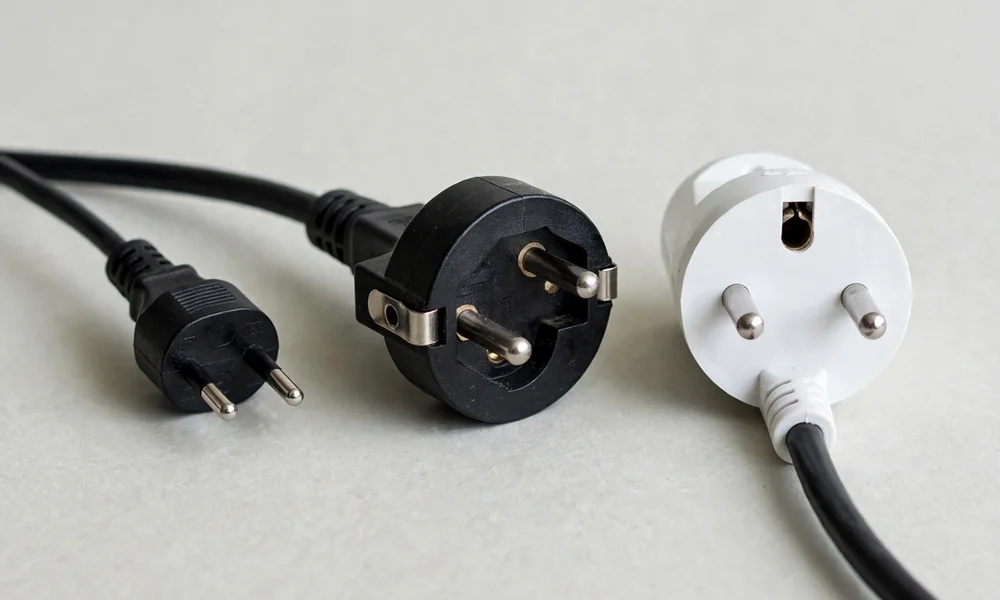
The Europlug is the slim two-pin plug seen everywhere in Europe, fitting Type C, E, and F sockets and covering most hotels and cafes across the continent. It is ungrounded, suiting phones, tablets, and cameras, and it is the safest single choice for mainland Europe.
Type F: The Schuko Plug
Germany, Austria, the Netherlands, Spain, and much of Eastern Europe use Schuko: two round pins with grounding clips on the sides. Schuko sockets accept Europlugs. Laptop travelers need one supporting grounded Schuko connections.
Type E: The French Plug
France, Belgium, Poland, and the Czech Republic use Type E sockets, which have a round grounding pin sticking out of the socket. A Europlug fits a Type E socket easily, but a Schuko plug does not, because it has no hole for the grounding pin.
Type G: The UK and Ireland Exception
The United Kingdom and Ireland use the large three-pin Type G plug, completely different from the rest of Europe. If your trip includes London or Dublin, you need an adapter covering Type G too, and this is where universal adapters earn their keep.
How We Chose the Best Travel Adapters for Europe 2026
We judged every adapter on what matters at the wall, not on the box. Fit came first: an adapter that wobbles, falls out, or blocks the next socket is a bad one. We favored a snug fit in Type C, E, and F sockets and a low profile that does not droop.
Charging speed came second. A modern adapter should offer one USB-C port with 20 watts or more, enough to fast-charge a phone, and ideally a second port. Gallium nitride (GaN) models earned extra credit for delivering more power from a smaller, cooler body. We also checked our roundup of the best travel adapters to make sure these Europe picks hold up against the best general-purpose models.
Finally, we weighed size, weight, and build quality. The best adapter disappears into a carry-on pocket and survives two weeks in a bag. Flimsy mechanisms, loose pins, and hollow plastic counted against a model, while safety certifications and surge protection were essentials.
The Best Travel Adapters for Europe 2026
The five adapters below are the strongest choices for European travel this year. The table is the quick comparison; the notes explain who each one suits.
| Adapter | Plug coverage | USB ports | Max power | Best for |
|---|---|---|---|---|
| EuroGo GaN 65W Universal | C, E, F, G | 2x USB-C, 1x USB-A | 65W | All-round travel |
| Continental Slim Duo | C, E, F | 1x USB-C, 1x USB-A | 30W | Light packers |
| Voyager Cube 45W | C, E, F, G | 2x USB-C | 45W | Families and couples |
| Alpine Ground Pro | F, E, C | 1x USB-C, 2x USB-A | 40W | Laptop travelers |
| Metro Mini Europlug | C | 1x USB-C | 20W | Budget single-country trips |
1. EuroGo GaN 65W Universal
The EuroGo is the adapter we would hand to almost any traveler. Its sliding pins cover Type C, E, F, and G sockets, so it works from Lisbon to London. Two USB-C ports and one USB-A port deliver 65 watts, charging a laptop and a phone together. GaN internals keep it compact, and the pins lock firmly. It is the priciest pick, but it replaces three adapters and a charger.
2. Continental Slim Duo
The Continental Slim Duo is barely thicker than a phone and slides into a jacket pocket. It covers the three mainland plug types with 30 watts through one USB-C port plus a USB-A port. It will not charge a laptop at full speed, but for a phone, earbuds, and a tablet it is enough. Its slim body never blocks the next socket.
3. Voyager Cube 45W
Families and couples should start with the Voyager Cube. It covers the full European range including the UK, with two USB-C ports sharing 45 watts so two phones fast-charge side by side. The cube sits flush, holds two cables without tipping, and has a fuse and surge protection.
4. Alpine Ground Pro
Laptop travelers need grounding, and the Alpine Ground Pro is the only pick built around a proper grounded Schuko connection, making it the safest choice for laptop chargers. It offers 40 watts across one USB-C and two USB-A ports, charging a laptop, phone, and watch from one outlet. It is larger than the slim picks, but the bulk buys safety.
5. Metro Mini Europlug
Sometimes the simplest answer is best. The Metro Mini is a tiny Europlug adapter with a single 20-watt USB-C port, costing less than an airport coffee. For one mainland country, one phone, and light travel, it is enough. It weighs almost nothing, but it does not cover the UK or charge a laptop.
Universal Adapters vs Single-Plug Adapters
Universal and single-plug adapters solve the same problem differently. A universal adapter has sliding pins that reshape for different countries, making it the right call for multi-country trips, UK visits, and anyone wanting one adapter for every holiday. The trade-off is size, weight, price, and more moving parts.
A single-plug adapter does one job well. A Europlug adapter is small, cheap, and nearly indestructible, fitting almost every socket on the mainland. It suits one- or two-country trips, minimal packers, and as a cheap backup. Many travelers carry both: a universal adapter as the main charger and a tiny Europlug as a spare.
What About Voltage and Power?
An adapter changes the plug shape and nothing else. It does not change voltage or turn 230 volts into 110 volts; that job belongs to a voltage converter, which most travelers do not need. Check each charger label before you travel. If it reads 100-240V, it is dual-voltage and safe in Europe with a simple adapter. If it reads 110V only, leave it at home.
Heating appliances are the danger zone: hair dryers, straighteners, and curling irons draw far more power than a phone charger, and a single-voltage model can overheat on European current. Many hotels provide a hair dryer; if you must bring your own, buy a dual-voltage travel model.
Power matters away from the wall too. A charged power bank covers trains, flights, and long sightseeing days, and the best portable chargers for travel pair with a compact adapter, since the same USB-C cable charges both. Keep the bank in your day bag and the adapter in your room.
Packing and Using Your Adapter Like a Pro
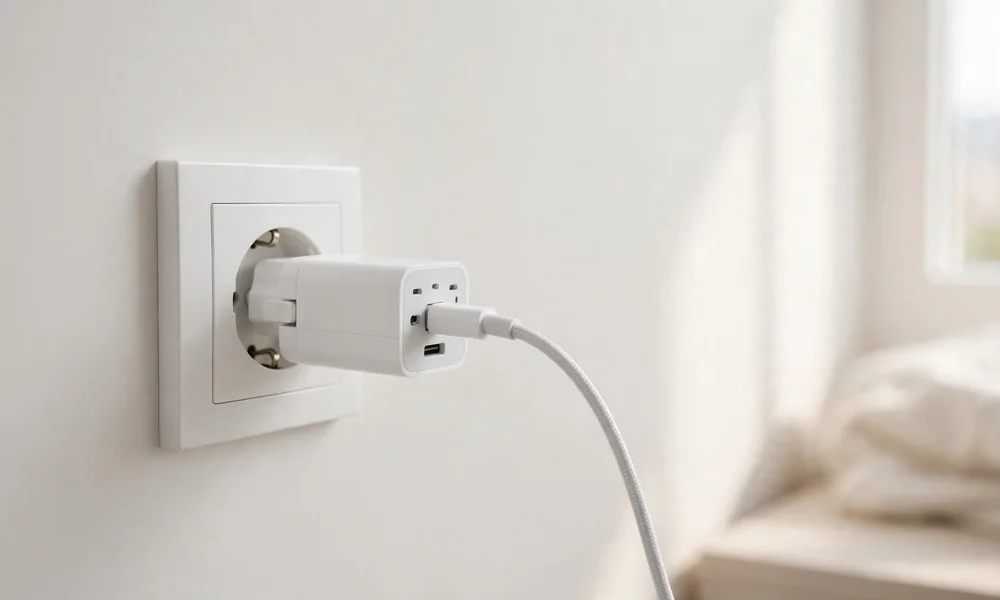
A good adapter only helps if it is in your bag and easy to reach. Pack it in your carry-on, not checked luggage, so a delayed bag never leaves you powerless on arrival. Keep it in the same pouch as your cables. If your room has one socket and three devices, charge the phone first and rotate.
Test your adapter before you fly: plug it in at home and charge your phone through it for ten minutes. The tidy approach that makes travel packing cubes so useful applies to your tech pouch, with each cable and adapter in its own place.

Pre-Trip Adapter Checklist
- Check every device label for 100-240V support.
- Confirm your adapter covers every country on your itinerary, including the UK.
- Pack the adapter and cables in your carry-on.
- Bring one USB-C cable per device, plus one spare.
- Test the adapter at home for ten minutes.
- Download offline maps and boarding passes.
Mistakes to Avoid
The most common mistake is buying at the airport. Airport shops charge three or four times the normal price for the flimsiest models. Buy before you fly, from a recognized brand.
The second mistake is assuming one adapter covers the UK. It usually does not. Travelers who add London to a Paris trip at the last minute end up hunting for one. Check your itinerary country by country, and if the UK is on it, bring a universal model or a separate Type G adapter.
The third mistake is forgetting the socket shortage. Many older European hotel rooms have a single outlet, often behind a bed or a wardrobe. A multi-port adapter solves this, and a compact power strip helps couples and families, as long as it is rated for 230 volts.
Frequently Asked Questions
Do I need a travel adapter for Europe?
Yes, if your plugs are not European round-pin plugs. Most of the world uses different shapes, so an adapter is essential for charging in European sockets.
What is the best travel adapter for Europe in 2026?
A universal GaN adapter with 45 to 65 watts and two USB-C ports: it covers the whole continent including the UK and charges a laptop and a phone together.
Does a travel adapter convert voltage?
No. An adapter only changes the plug shape, not the voltage. Your devices must be dual-voltage, marked 100-240V, or you need a converter.
Will my US hair dryer work in Europe with an adapter?
Probably not safely. Most US hair dryers are single-voltage and high wattage, so they can overheat on European current even with an adapter. Use the hotel dryer or a dual-voltage travel dryer.
Do I need a different adapter for the UK?
Yes. The UK and Ireland use the three-pin Type G plug, different from the rest of Europe, so bring a universal adapter with Type G or a separate UK adapter.
Can I buy a travel adapter when I arrive in Europe?
You can, but you will pay more for a worse product: airport and hotel shops sell adapters at a steep markup.
The Bottom Line
The best travel adapter for Europe in 2026 fits every socket on your itinerary, charges your devices fast, and stays in the wall without fuss. For most trips, that is a universal GaN adapter with two USB-C ports and 45 watts or more; for one mainland country, a slim Europlug adapter costs and weighs less. Buy before you fly, check your devices are dual-voltage, and pack it in your carry-on.