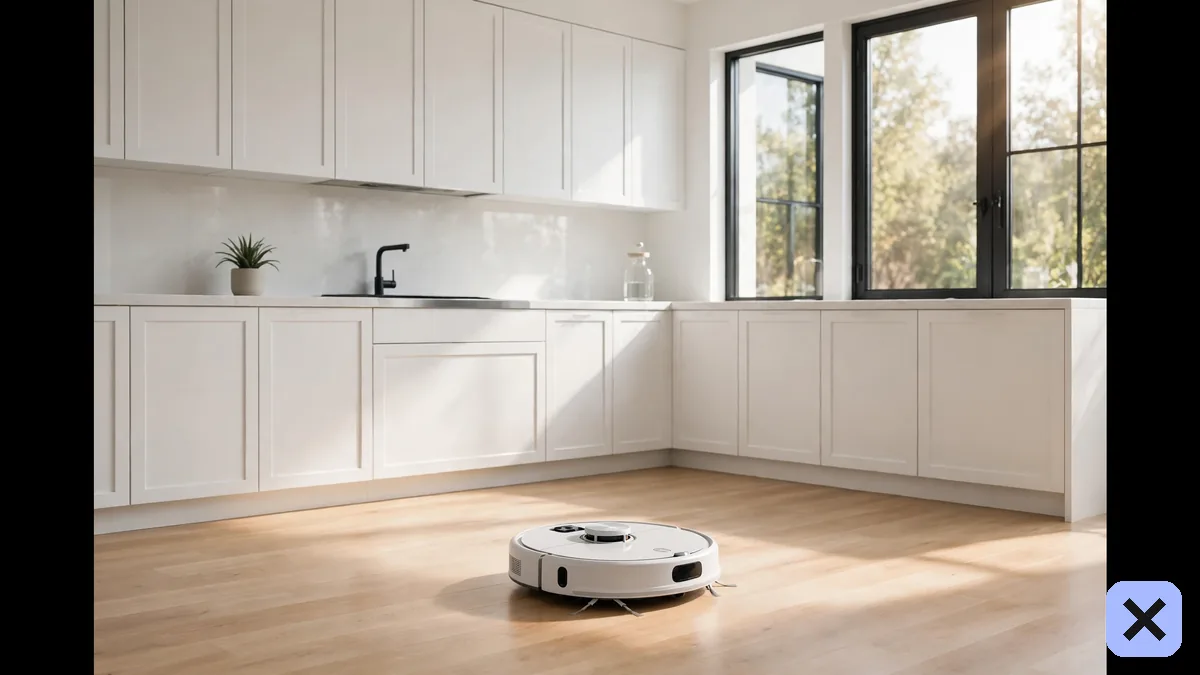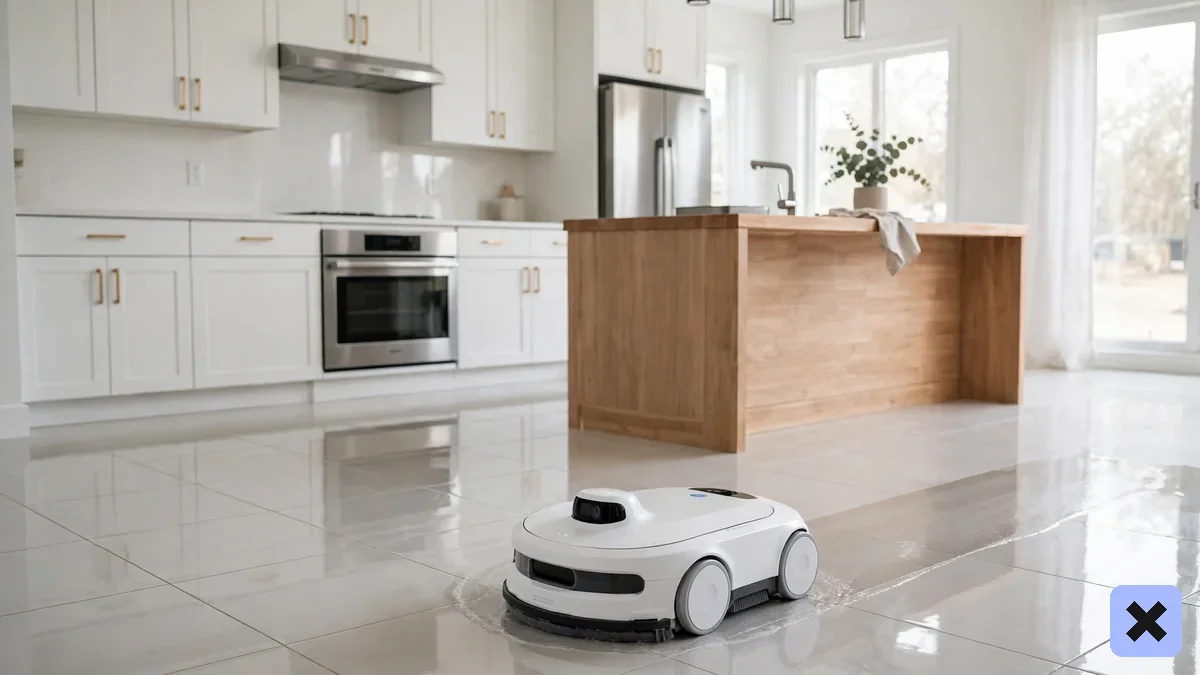
The best robot mops for kitchens do more than push a damp cloth around the floor. A kitchen floor takes more punishment in a single day than most rooms see in a week: cooking oil spatters near the stove, coffee drips by the machine, crumbs scatter under the table, and sticky juice dries into stubborn spots. The right robot mop handles all of it on a schedule, quietly, while you cook or relax, and leaves hard floors genuinely clean rather than just lightly wiped.
Choosing one is not as simple as picking the model with the highest suction number. Kitchens demand strong scrubbing power for dried-on spills, smart navigation that threads between chair legs and island stools, mop pads that lift clear of rugs and thresholds, and a dock that washes and dries the pads so the mop does not spread yesterday’s grease around today’s floor. A robot that excels in an empty living room can struggle badly in a busy kitchen.
This guide compares the strongest kitchen robot mops of 2026, explains which features matter on tile, hardwood, and vinyl, and gives you a checklist for matching a model to your kitchen.
Key takeaways
- Rotating mop pads or vibrating mop plates clean dried kitchen spills far better than a simple drag pad.
- A self-washing dock matters most in kitchens, because greasy pads spread grime instead of removing it.
- Look for mop lift of at least 10 mm and reliable carpet detection, so the mop never drags a wet pad across rugs.
- LiDAR navigation with obstacle avoidance is essential for kitchens crowded with chairs, stools, and cables.
- Run the mop after cooking: a quick daily pass stops grease and food residue bonding to the floor.
Why Kitchens Are the Hardest Room for a Robot Mop
No other room combines so many cleaning challenges in such a small space. A living room is mostly open floor with a few obstacles. A kitchen is a maze of cabinets, appliances, and furniture, and the dirt is stickier, greasier, and more likely to dry into a hard film.
Grease, crumbs, and sticky spills
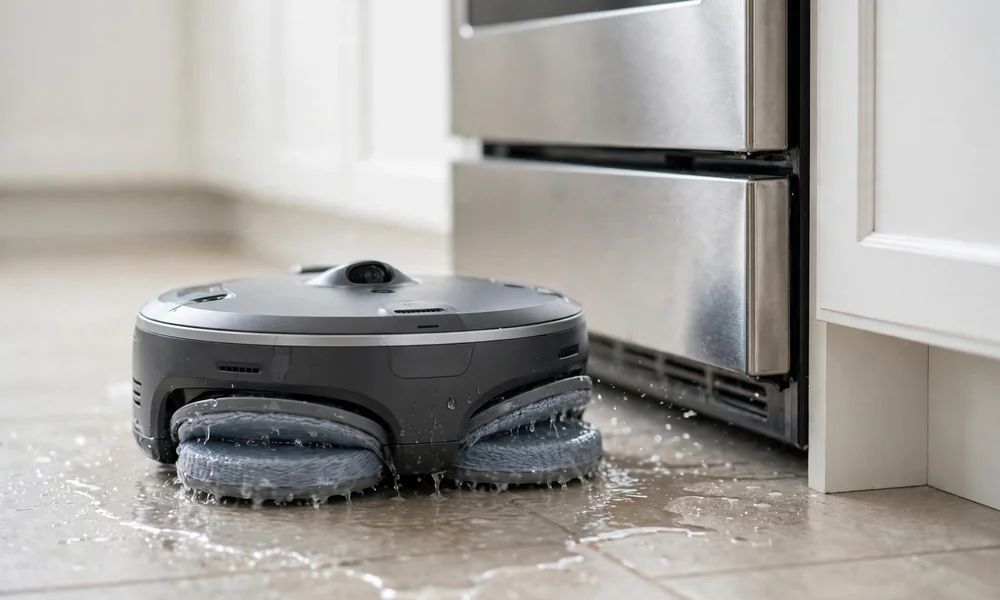
Cooking produces a film of airborne grease that settles on floors, especially near the stove. Add spilled sauces, coffee, juice, and flour, and the result is a surface a dry vacuum pass cannot fix and a light damp wipe barely improves. Effective kitchen mopping needs real downward pressure or rapid pad rotation, plus enough water flow to soften dried residue. Models that simply drag a damp cloth smear grease into streaks, which is why the strongest kitchen performers use spinning pads, vibrating plates, or roller mops that actively scrub.
Water temperature helps too: a few premium docks wash mop pads with warm water, which dissolves kitchen grease far more effectively than cold water.
Tight spaces and low clearance
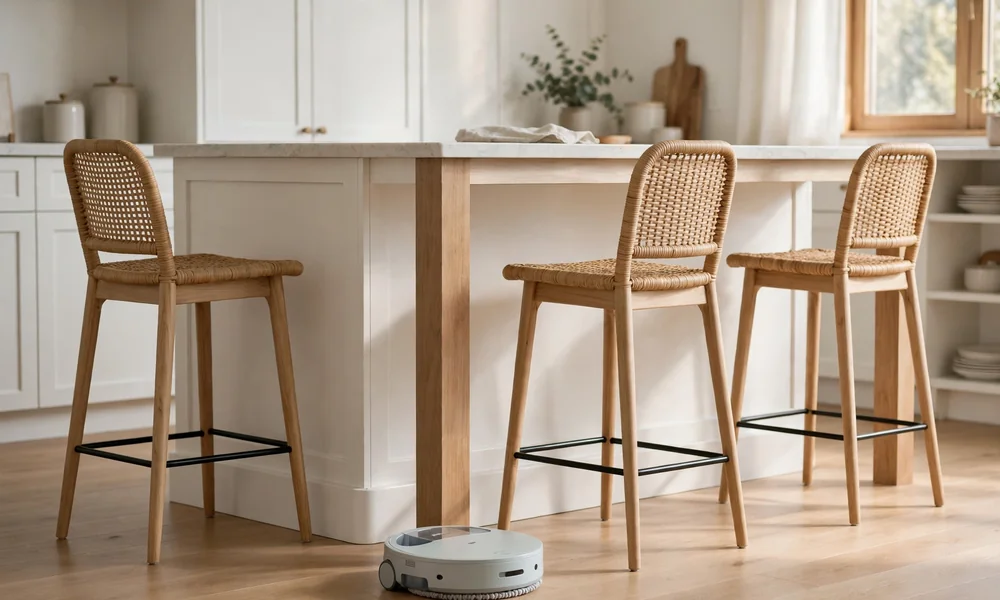
Kitchens are full of narrow gaps: between the fridge and the wall, under low cabinet toe-kicks, around table legs, and beneath bar stools. A robot that is too tall cannot reach under toe-kicks, and one with poor navigation wastes battery bumping around the same corner. The best kitchen models combine a low profile with precise LiDAR mapping, so they clean right up to cabinet edges.
Thresholds add another complication: many kitchens sit slightly higher or lower than the adjoining room, or have a rug in front of the sink. A robot that cannot climb a 15 to 20 mm threshold leaves part of the kitchen uncleaned, while one that drags wet pads over a rug soaks it. Mop lift and reliable carpet detection solve both problems at once.
The Best Robot Mops for Kitchens in 2026
The models below are the strongest kitchen performers of 2026, ranked for scrubbing power, navigation, and value. Prices are typical street prices and move with seasonal sales.
| Model | Best for | Mop system | Dock | Typical price |
|---|---|---|---|---|
| Roborock S8 MaxV Ultra | Overall kitchen performance | Vibrating plate, 10 mm lift | Hot-water wash, auto dry | $1,400–$1,800 |
| Dreame X40 Ultra | Edges and corners | Extendable spinning pads | Hot-water wash, auto dry | $1,300–$1,700 |
| Ecovacs Deebot X2 Omni | Large open kitchens | Rotating pads, 15 mm lift | Hot-water wash, auto dry | $1,200–$1,600 |
| iRobot Roomba Combo j9+ | Obstacle avoidance | Retractable pad, 2-stage clean | Auto-empty, pad wash | $1,000–$1,400 |
| Narwal Freo X Ultra | Quiet daily mopping | Triangular spinning pads | Hot-water wash, auto dry | $900–$1,300 |
Roborock S8 MaxV Ultra: the best all-rounder for kitchens
The S8 MaxV Ultra is the safest overall pick for kitchens because it does everything well. Its vibrating mop plate scrubs at high frequency, which is effective on dried sauce and coffee rings near the stove, and its obstacle avoidance steers around chair legs, pet bowls, and cables. The dock washes the mop pad with hot water and dries it, so the pad starts every run clean.
Dreame X40 Ultra: the best for edges and corners
Kitchen dirt collects along edges: where the floor meets the cabinets, around the base of the island, and in the corners behind the bin. The Dreame X40 Ultra tackles this with an extendable spinning mop pad that cleans right up to the wall, and its side brush extends the same way to sweep crumbs from the toe-kicks.
Ecovacs Deebot X2 Omni: the best for large open kitchens
Big open-plan kitchens need a robot with strong navigation and long battery life. The Deebot X2 Omni’s square body reaches into corners better than round robots, its rotating mop pads lift 15 mm clear of carpets, and its LiDAR maps large areas quickly.
iRobot Roomba Combo j9+: the best obstacle avoider
iRobot’s obstacle avoidance remains the most reliable in the business, and that matters in kitchens where a dropped grape, a charging cable, or a pet accident can turn a cleaning run into a disaster. The Combo j9+ avoids solid pet waste and cables, retracts its mop pad fully when it crosses rugs, and vacuums first in its two-stage cleaning mode, so crumbs are collected rather than smeared into wet streaks.
The trade-off is mopping intensity: a single retractable pad cannot scrub as hard as dual spinning pads, so stubborn dried spills may need a second pass. Its dock auto-empties the dustbin for up to 60 days. Households with shedding pets should also compare it with the robot mops built for pet owners, tuned for hair pickup and frequent pad washing.
Narwal Freo X Ultra: the best quiet daily kitchen mop
Not every kitchen needs a flagship. The Narwal Freo X Ultra is the value pick in this group, and it is especially good as a daily maintenance mop: quiet enough to run during breakfast, gentle on hardwood and vinyl, and equipped with triangular spinning pads that scrub well on tile. Its dock washes and dries pads with hot water, which is rare at this price.
Suction is weaker than the flagships, so it suits kitchens where dry debris is light, but for the price its mopping performance is outstanding. It also works well in smaller homes; if space is tight, see our guide to robot mops made for small apartments for compact alternatives.
How to Choose a Robot Mop for Your Kitchen
Matching a robot to your kitchen means weighing your floor type, your cooking habits, and the room’s layout. A model that is perfect for a large tiled kitchen can be a poor fit for a small hardwood galley kitchen.
Mop lift and carpet detection
This is the most important kitchen feature after scrubbing power. Your kitchen almost certainly borders a room with carpet, a rug, or a runner. A robot without reliable mop lift drags a wet, dirty pad across those textiles, leaving damp streaks and transferring grime onto fabric. Look for at least 10 mm of lift.
Dock features that matter
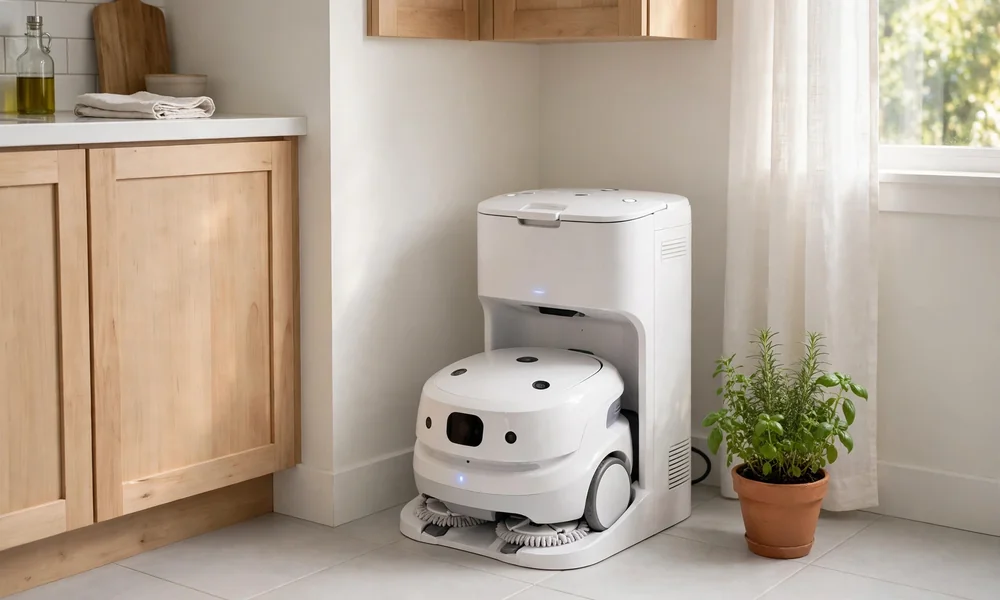
In a kitchen, the dock does more work than the robot. Hot-water pad washing dissolves grease that cold water leaves behind, warm-air drying prevents mildew on damp pads, and a large clean-water tank means the robot can mop a big kitchen without returning mid-run. Budget at least for a dock that washes and dries the pads.
Navigation and obstacle avoidance
Kitchens punish weak navigation. Chairs get pulled out at odd angles, stools move, and cables snake across worktops. LiDAR mapping is now standard on good models and is worth insisting on, because it lets the robot plan efficient routes and remember no-go zones around pet bowls or the bin. Camera-based obstacle avoidance recognizes cables, shoes, and solid pet waste and steers around them.
Kitchen Robot Mop Checklist
Use this checklist before you buy, and again at setup.
- Measure the gap under your cabinet toe-kicks and island overhang, and confirm the robot fits underneath.
- Check that the mop lifts at least 10 mm and that carpet detection works on your rugs and runners.
- Confirm the dock fits in its planned spot with clearance for the robot to enter and exit.
- Map the kitchen as its own room in the app, set higher water flow and scrub intensity, and schedule a run after dinner.
- Mark no-go zones around pet water bowls, the bin area, and any floor-level cables or power strips.
- Run a test pass while you are home the first week, then check the pads and dustbin to confirm the kitchen is actually getting clean.
Frequently Asked Questions
Can a robot mop really clean a greasy kitchen floor?
Yes, provided you choose a model with active scrubbing and a dock that washes pads with hot water. A robot that only drags a damp cloth will smear grease, so run it daily and residue never has time to bond.
Will a robot mop damage hardwood kitchen floors?
No, as long as you use the correct water flow setting for wood and avoid leaving standing water. Most good robots let you set water flow per room: low on hardwood, higher on tile. Never use harsh floor cleaners in the water tank unless the manufacturer approves them.
How often should a robot mop run in a kitchen?
Daily is ideal for a kitchen used for cooking. A five to ten minute run after dinner is usually enough for a small kitchen, while a large kitchen-diner may need a full clean every day. If daily feels excessive, aim for four runs per week.
Do I still need to vacuum if I have a robot mop?
Most modern robot mops are combination vacuum-mops, so they collect dry debris before or during mopping, covering daily crumbs, dust, and hair. You will still want a proper vacuum for deep cleaning and stairs, but for day-to-day kitchen floors a robot vacuum-mop is usually enough.
What is the best robot mop for a small kitchen?
Look for a compact model with strong navigation, a small dock, and good edge cleaning, since small kitchens have proportionally more corners and obstacles.
Are robot mops worth it for kitchens, or should I just mop by hand?
For most households, yes, because consistency beats intensity: a robot that mops lightly every day keeps a kitchen cleaner than a person who mops thoroughly once a week. The robot handles the routine work, and you only need to mop by hand occasionally for deep cleaning. The same logic applies beyond the home: the robot mops designed for offices handle larger, high-traffic kitchen floors with bigger bins and longer runtimes.
The Bottom Line
For most kitchens, the Roborock S8 MaxV Ultra is the best robot mop of 2026, balancing scrubbing power, obstacle avoidance, and a hot-water dock. If edge cleaning is your priority, the Dreame X40 Ultra is the better pick; if you want strong kitchen mopping for less money, the Narwal Freo X Ultra delivers most of the experience at a far lower price. Whichever model you choose, insist on active scrubbing, reliable mop lift, and a dock that washes and dries the pads, and run it daily after cooking.