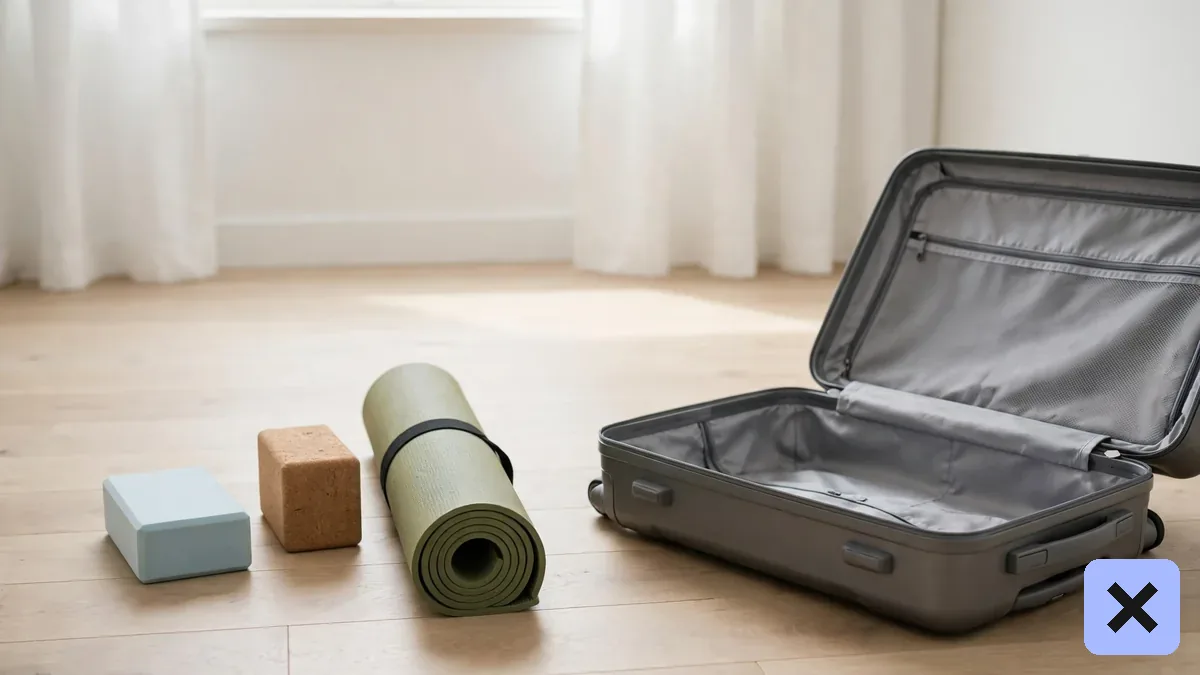
The best yoga blocks for travel are the ones you actually pack. A full-size studio block is a wonderful prop at home, but it is heavy, bulky, and almost always the first thing left behind when a suitcase has to close. Travel blocks are shorter, lighter, and shaped to fit beside a folded mat, yet still firm enough to hold your weight in a lunge or a seated twist.
Finding the best yoga blocks for travel in 2026 means weighing different priorities than for home practice. Weight matters more, because every gram competes with clothes, chargers, and toiletries. Size matters more too, because a block that does not fit in a carry-on stays home. And durability matters most, because a travel block gets dropped on hotel floors, squeezed into backpacks, and used on balconies, beaches, and park benches.
This guide compares the best travel yoga blocks of 2026, explains how cork, foam, and wood behave on the road, and shows you how to pack a block so it earns its place.
Key Takeaways
- The best travel blocks weigh under 400 grams and measure no more than 22 centimetres long, so they fit in a carry-on or daypack.
- High-density foam is lightest for air travel; cork grips best outdoors.
- A half-size block gives most of a full block’s support at roughly half the weight and volume.
- Rounded edges and a non-slip surface matter more on unfamiliar floors.
- Pair your block with a thin travel mat and a quick-dry towel for a complete kit that still fits in one bag.
What Makes a Yoga Block Good for Travel
Size and Weight
Most standard blocks measure about 23 by 15 by 10 centimetres and weigh 400 to 900 grams. The most useful travel size is roughly 22 by 11 by 7 centimetres, which slides into a backpack side pocket or lies flat at the bottom of a suitcase. Anything under 400 grams is easy to carry all day, while blocks above 600 grams feel like a real burden on a walking holiday.
Half blocks suit mainly seated poses and gentle support: half the thickness, so lighter and flat-packing, but only two usable heights instead of three. For standing poses and deeper stretches, a slim full-height block is usually better, even if it weighs a little more.
Density and Support
Density decides whether a block feels supportive or spongy. A block that compresses under your hand in a side plank can throw your alignment off. High-density EVA foam is the travel standard because it is light and holds its shape under body weight. Cork is denser still and barely compresses, making it the most supportive travel material, though heavier than foam.
When you test a block, press it firmly with both hands: a good one flexes only slightly and springs back at once. If your fingers sink in more than a few millimetres, the foam is too soft for anything beyond gentle seated work. Beginners often benefit from a firmer block, and our guide to yoga blocks for beginners explains how firmness and size affect your first months of practice.
Durability on the Road
Travel is hard on yoga props: blocks get scuffed by zips, dented by hard cases, and soaked by rain or sweat. Cork handles this well, resisting dents and moisture, and grips better when slightly damp. Cheap soft foam can dent permanently and crumble at the edges after a few trips. Wood is the most durable but also the heaviest, and it can crack if dropped. For most travellers, cork or dense foam is the sensible balance, and rounded edges resist chipping far better than sharp corners.
The Best Yoga Blocks for Travel in 2026
We compared travel blocks on weight, packed size, grip, durability, and price, testing each in the poses travellers use most: seated twists, lunges, supported bridge, and standing forward folds. The five below are the strongest all-round choices for 2026.
| Block | Material | Weight | Size (cm) | Best For |
|---|---|---|---|---|
| Travel Cork Slim | Natural cork | 380 g | 22 x 11 x 7 | Outdoor practice and grip |
| FeatherFoam Travel | High-density EVA | 190 g | 22 x 11 x 7 | Ultralight air travel |
| HalfMoon Mini | Recycled foam | 240 g | 22 x 15 x 5 | Packing flat in a suitcase |
| Bamboo Road Block | Bamboo | 520 g | 20 x 10 x 7 | Durability and stability |
| DualGrip Travel Duo | Cork and foam | 310 g | 22 x 11 x 7 | Two-height versatility |
1. Travel Cork Slim
The Travel Cork Slim is the best all-round yoga block for travel in 2026. At 380 grams it is light enough to carry comfortably, and its slim profile fits in a daypack beside a water bottle. Cork gives it outstanding grip, even with sweaty hands, and it stays stable on smooth hotel floors where foam blocks slide. It is firm without being harsh, supporting the hips in seated poses and holding steady in a revolved triangle. The only drawback is that cork can feel hard against bony areas such as the sacrum in supported bridge, so place a folded towel over it for restorative poses.
2. FeatherFoam Travel
At just 190 grams, the FeatherFoam Travel is the lightest serious block you can buy, and the obvious pick if you fly with hand luggage only. The high-density EVA foam is firmer than budget-block foam, so it holds its shape in standing poses, and its textured surface stops it sliding on polished floors. It packs flat against a laptop and is so light you forget it is there. The trade-off is grip in the heat: in a sweaty outdoor session, foam feels slippery next to cork, so keep a small towel nearby.
3. HalfMoon Mini
The HalfMoon Mini is a half-thickness block of recycled foam, and the best choice if packing space matters most. At five centimetres thick it slides into a suitcase like a book, and at 240 grams it adds almost nothing to your luggage weight. It suits seated poses, gentle backbends, and support under the knees in savasana. Being thinner, it offers only two useful heights and is not tall enough for a deep standing forward fold, so it suits a mostly gentle, restorative practice best.
4. Bamboo Road Block
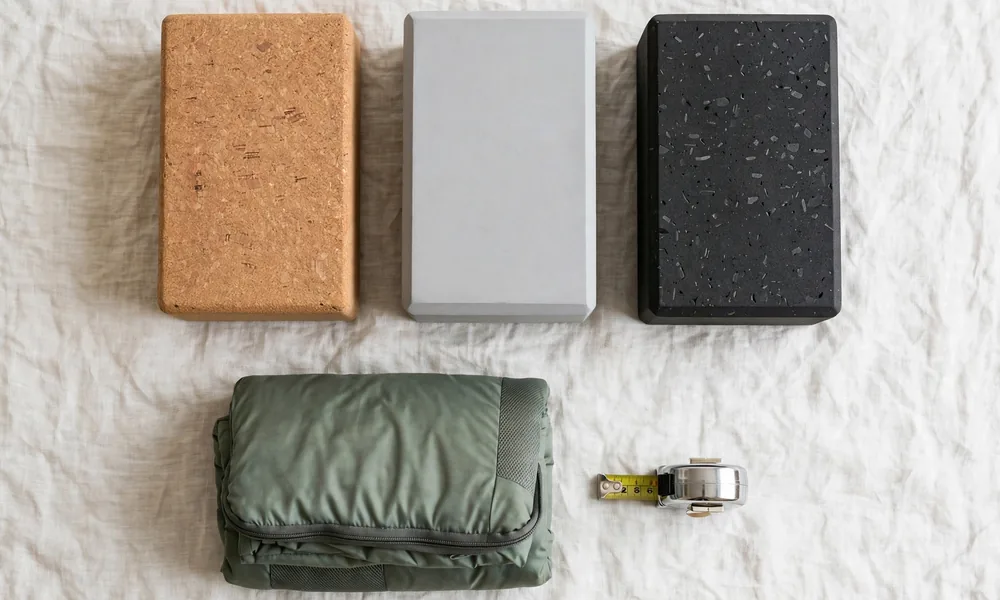
The Bamboo Road Block is the heaviest here at 520 grams, but also the most stable and longest lasting. Bamboo is harder than cork and does not compress at all, making it the best choice for heavier practitioners and for anyone who uses a block as a seat or step in strength-based yoga. Its sealed surface wipes clean in seconds and resists moisture. It suits car trips and long stays where you unpack once, though its hard surface can feel unforgiving in restorative poses.
5. DualGrip Travel Duo
The DualGrip Travel Duo pairs a cork face with a foam body: grip of cork on one side, cushioning of foam on the other. At 310 grams it sits mid-range, and you can flip it by pose, cork side down for stability in standing poses, foam side up for comfort under hips or knees. It is a smart choice if you carry one block but practise a wide mix of styles, from gentle stretches to stronger vinyasa flows. Keep it dry, as moisture can weaken the bond between the layers.
Cork vs Foam vs Wood: Which Material Travels Best?
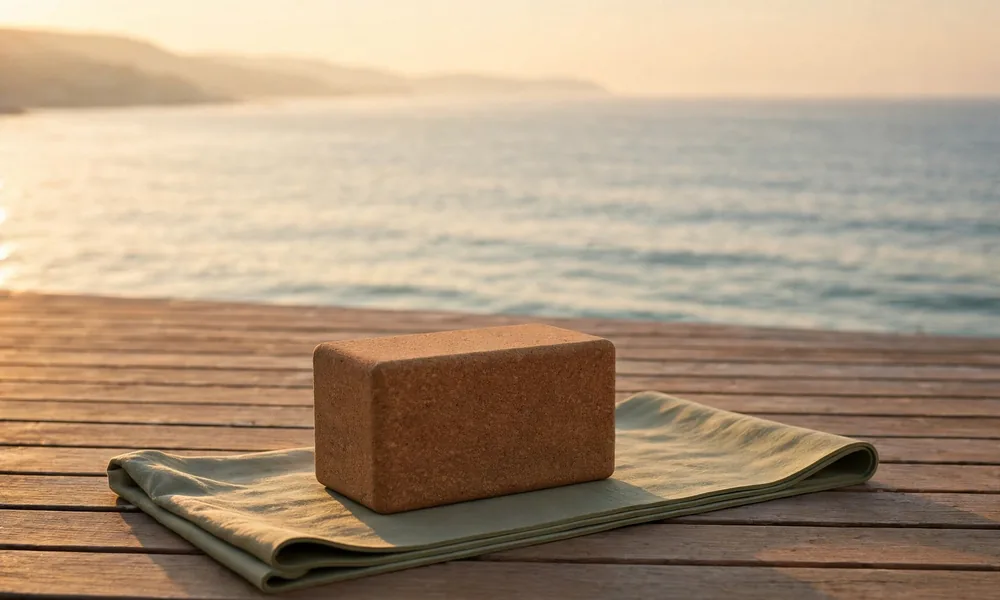
Material is the biggest decision when buying a travel block, because it affects weight, grip, durability, and comfort. Cork is the best all-rounder for most travellers: naturally grippy, firm, sustainable, and resistant to moisture and odours. It is heavier than foam by only about 150 to 200 grams, which most people will not notice in a suitcase.
Foam wins outright on weight and comfort: it is the lightest option by a wide margin, and its slight give is kinder on knees, hips, and the spine in restorative poses. The downside is grip in sweaty conditions and a shorter lifespan, since foam eventually dents and softens. If you fly often or walk long distances, foam is the practical choice. Wood and bamboo are the most stable and durable materials, but they are heavy and unforgiving, suiting travellers who drive and stay in one place. Whatever you choose, a block that dries quickly beats one that stays damp in a closed bag.
How to Pack a Yoga Block
Lay the block flat at the bottom of your suitcase as a stable base for soft clothes packed on top. Clothes folded around it stay in place, and the block stops softer items shifting in transit.
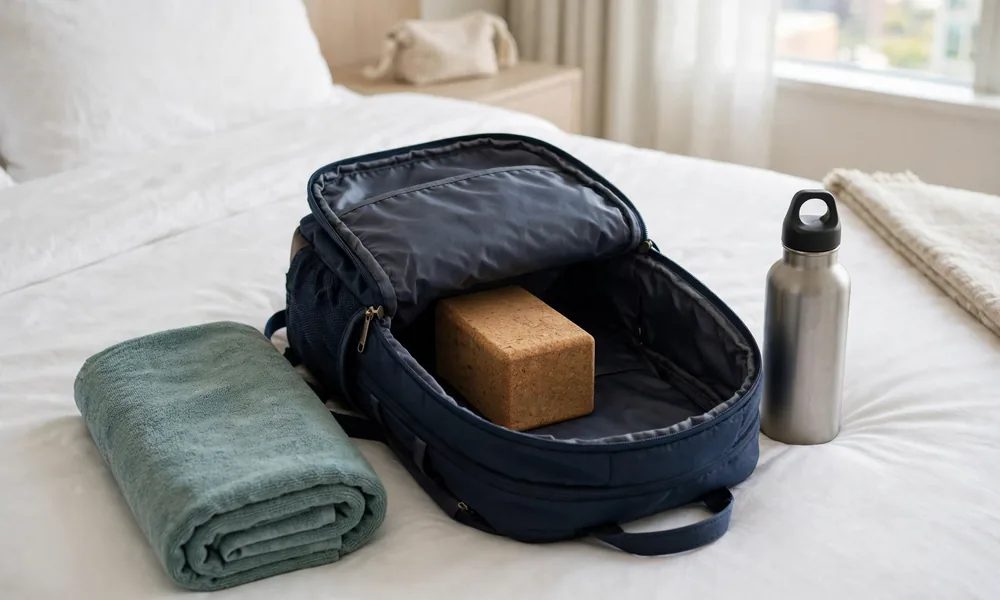
In a backpack, slide the block into the laptop sleeve or against your back, where its weight sits closest to your body and feels lightest. A slim block fits beside a rolled travel mat, and a packing cube can hold block, strap, and towel as one grab-and-go kit. If you travel with the best travel yoga mats, a thin mat rolled around the block protects both and saves space.
For flights, keep the block in your carry-on rather than checked luggage, where heavier bags can crush it. Security staff occasionally ask about dense cork or bamboo blocks on the scanner, so keep it near the top of your bag. Quick-dry travel towels fold down small, dry fast in a hotel room, and double as a cover for a hard cork block in restorative poses.
Yoga Block Travel Checklist
- Weigh your packed block and mat together, keeping the total under one kilogram if you will carry them far.
- Measure your bag before you buy: the block should fit flat without forcing the zip.
- Choose rounded edges and a non-slip surface so the block stays put on unfamiliar floors.
- Pack a small microfibre towel to improve grip in heat and cushion hard cork or bamboo.
- Keep the block in your carry-on on flights, not in checked luggage.
- Wipe the block clean and let it dry fully before packing it away, to prevent odours.
Frequently Asked Questions
Can I take a yoga block on a plane?
Yes, in both carry-on and checked luggage. Dense cork or bamboo blocks sometimes attract a second look on the scanner, so keep the block near the top of your bag.
What size yoga block is best for travel?
A slim block of about 22 by 11 by 7 centimetres suits most travellers: it fits in a carry-on, offers three usable heights, and supports the hand, hip, or head comfortably. Half-thickness blocks pack flatter but offer only two heights.
Is cork or foam better for a travel yoga block?
Cork is better for grip, stability, and durability, especially outdoors or in sweaty conditions. Foam is better for weight and comfort, and the best choice if you fly with hand luggage only. If you buy one block for varied conditions, cork is the safer all-round pick.
Do I need one block or two for travel?
One block is enough for most travellers and most poses, including seated twists, lunges, and supported bridge. Two blocks help with symmetrical poses such as supported fish, but they double the weight and space.
How do I clean a travel yoga block?
Wipe cork, foam, and bamboo blocks with a damp cloth and a drop of mild soap, then air dry fully before packing. Avoid soaking foam, and never use harsh cleaners or alcohol sprays, which can damage the surface.
Can a yoga block replace a yoga mat when travelling?
No, they do different jobs: a mat gives you a non-slip surface for hands and feet, while a block brings the floor closer and supports your body in specific poses. For the lightest kit, pair a slim block with a thin foldable travel mat; together they still weigh less than a standard studio mat.
The Bottom Line
The best yoga blocks for travel in 2026 are slim, light, and firm enough to trust in real poses. The Travel Cork Slim is the best all-round choice, the FeatherFoam Travel is the pick for ultralight packing, and the DualGrip Travel Duo is the most versatile single block. Measure your bag, choose cork for grip or foam for weight, and pack the block flat at the bottom of your case. A block you actually carry is worth far more than a perfect block you leave at home.