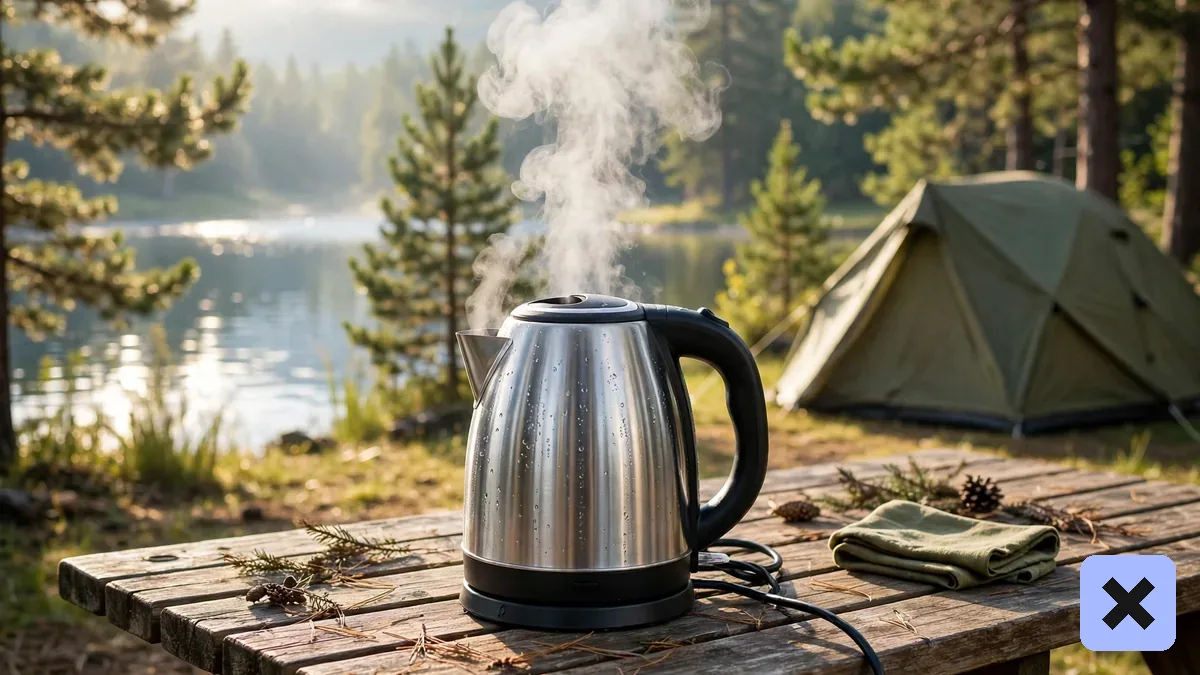
Finding the best electric kettles for camping means matching a small appliance to a very different kind of kitchen. At home, a kettle just needs to boil water fast. At a campsite, it also needs to run on the power you actually have.
An electric kettle earns its place in a camp kit because it does one job better than anything else: hot water, quickly, with no flame to watch. That means coffee and tea in minutes, instant noodles without a stove, and hot water for washing up. For campers on sites with electric hook-ups, it can be the most-used piece of kit in the tent.
This guide explains how camping kettles differ from kitchen kettles, compares the main types, and covers power, capacity, safety and packing so you can choose one that fits your trips.
Key takeaways
- Check your power source first: a 1,500-watt kettle will trip a 10-amp campsite hook-up, while a 600 to 1,000-watt kettle usually runs fine.
- A 0.8 to 1 litre capacity suits two people; families of four or more should look at 1.5 to 1.7 litres.
- Look for a cool-touch handle, an automatic shut-off, and boil-dry protection, especially when children are around.
- Stainless steel handles knocks better than glass, and a wide lid makes a kettle easier to fill and clean.
- Measure your packed size before you buy: a compact or collapsible kettle can save the space of a whole extra bag.
Why an Electric Kettle Earns a Place in Your Camp Kit
Hot water is the quiet workhorse of a campsite. It starts the morning, warms hands on cold evenings, and turns a packet of soup into dinner. A kettle delivers it faster and more safely than a pan on a burner, because the water is enclosed and it switches itself off.
What Makes a Good Camping Electric Kettle
A good camping kettle balances four things: power draw, capacity, size, and toughness. Get it wrong and you end up with a kettle that trips the electrics, boils too little water, or takes up half a storage box.
Power and Wattage
Wattage is the first number to check. Most campsite hook-ups supply 10 amps, roughly 2,300 watts, but many sites limit each pitch to 6 or 10 amps. A 3,000-watt kitchen kettle will trip a 10-amp breaker in seconds. Look for one rated between 600 and 1,200 watts: it takes four to six minutes to boil a litre, but it finishes the job instead of cutting power. The best tea kettles for camping cover the stove-top alternatives too, which are worth knowing about if your power supply is uncertain.
Capacity and Group Size
A 0.5-litre kettle is enough for one large mug or two small cups, which suits solo campers and couples who drink at different times. A 1-litre kettle covers two generous mugs in one boil, the sweet spot for most couples and small families. For a family of four, a 1.5 to 1.7-litre kettle is the practical choice, boiling enough for four mugs of tea plus a bowl of instant porridge. The trade-off is size and weight, so check it against your storage boxes first.
Weight and Pack Size
A compact travel kettle weighs between 500 and 800 grams, while a full-size stainless steel kettle can weigh 1.2 kilograms or more before you add water. Look for a kettle with a short, foldable handle or a body that nests inside a cooking pot. Collapsible silicone kettles fold almost flat and are a genuine space-saver, though they boil more slowly. A detachable base is also easier to pack, because it can sit flat while the body nests with other kit.
Build Quality and Safety Features
Camping kit gets knocked, dropped and stacked. A stainless steel body will dent but keep working, while a glass kettle is a poor choice on a campsite, where one knock on a metal table can crack it. Plastic-bodied travel kettles are lighter and will not shatter, but check that the plastic is food-grade and rated for boiling water. Boil-dry protection, which cuts the power if the kettle is switched on empty, prevents accidents, and a cool-touch handle and wide, stable base matter because a kettle that tips on uneven ground is a burn waiting to happen.
Electric Kettles for Camping Compared
The table below compares the five main types of electric kettle that work well at a campsite. There is no single winner: the right type depends on your group size, your power, and your space.
| Type | Capacity | Typical wattage | Weight | Best for |
|---|---|---|---|---|
| Compact travel kettle | 0.5 to 0.6 litres | 600 to 800 watts | 500 to 700 grams | Solo campers and couples on powered pitches |
| Standard 1-litre kettle | 1.0 litres | 800 to 1,200 watts | 800 grams to 1 kilogram | Couples and small families who want one boil for two mugs |
| Family-size kettle | 1.5 to 1.7 litres | 1,000 to 1,500 watts | 1.0 to 1.3 kilograms | Families of four or more on 16-amp hook-ups |
| Gooseneck kettle | 0.8 to 1.0 litres | 800 to 1,200 watts | 700 to 900 grams | Pour-over coffee lovers who want a slow, controlled pour |
| Collapsible kettle | 0.5 to 0.8 litres | 600 to 900 watts | 400 to 600 grams | Campervans and small cars where space is tight |
The Best Electric Kettles for Camping 2026
Best Compact Travel Kettle
A compact travel kettle is the easiest way to add hot water to a camp kit. At 0.5 to 0.6 litres it boils enough for two small mugs, and at 600 to 800 watts it will run on almost any hook-up without tripping the breaker. The best ones have a dual-voltage switch, handy if you ever camp abroad, and a carry case for the cable.
Best 1-Litre Kettle for Couples
The 1-litre kettle is the all-rounder of the camping world. It boils two generous mugs in one go, it is light enough to carry in one hand, and at 800 to 1,200 watts it sits comfortably within a 10-amp hook-up. Most models in this size have a 360-degree swivel base, so the kettle can be picked up from any angle. A wide spout pours fast and is easy to fill, while a narrow spout gives more control and spills less on uneven ground.
Best Family-Size Kettle
A family-size kettle of 1.5 to 1.7 litres is the right choice when four or more people want hot drinks at the same time. It turns a morning routine of two or three boils into one, which matters when everyone is hungry. At this size, look for a kettle rated at 1,000 to 1,200 watts rather than a full-power kitchen model. The downside is bulk: a full 1.7-litre kettle weighs close to three kilograms with water in it. If your family also cooks with a stove, the best coffee makers for camping are worth a look alongside a kettle.
Best Gooseneck Kettle for Pour-Over Coffee
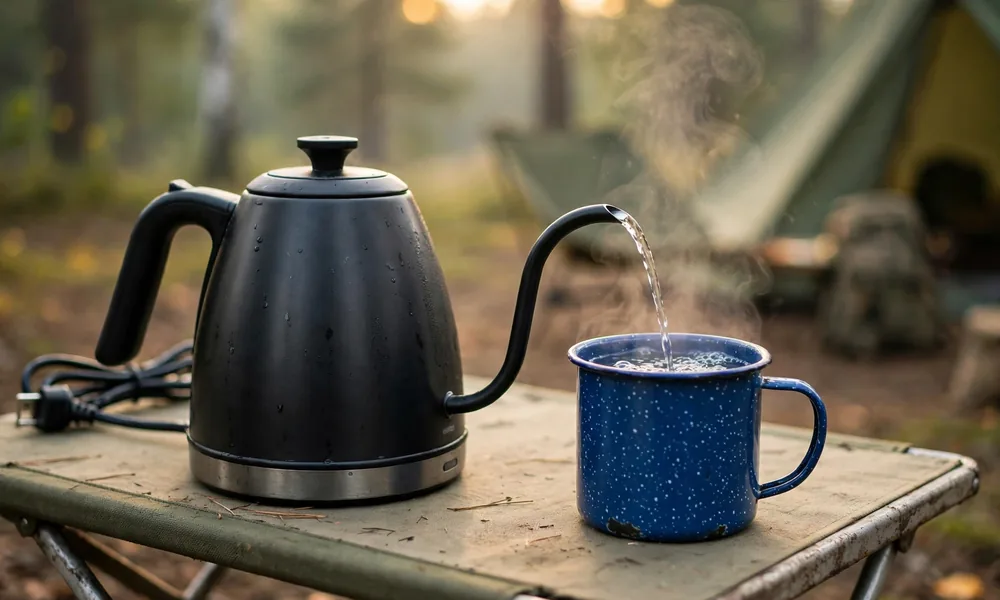
A gooseneck kettle has a long, thin spout that gives you precise control over the pour, which is exactly what pour-over coffee needs. If you brew with a V60 or a similar dripper at camp, a gooseneck kettle will make noticeably better coffee, because you can pour slowly and evenly over the grounds. Most hold 0.8 to 1 litre, enough for two cups. The best camping stoves for families pair well with a gooseneck kettle on trips where you want both a stove and precise coffee.
Best Collapsible Kettle for Small Spaces
A collapsible kettle folds down to a fraction of its full height, making it the best choice for campervans, roof tents and small cars where every centimetre counts. The body is usually food-grade silicone with a stainless steel base that houses the heating element, and it expands to 0.5 to 0.8 litres when in use. Collapsible kettles boil a little more slowly than rigid ones, and they must be fully expanded before boiling and stored dry so the silicone keeps its shape.
How to Use an Electric Kettle Safely at Camp
Choose a flat, stable surface that is out of the main walkway and away from the edge of the table. A camping table with a solid top is better than a fabric-topped one, and a kettle should never sit on a sleeping bag or the ground inside a tent. Fill it only to the level you need, and never above the maximum mark, because overfilling causes boiling water to spit from the spout.
Keep children away from the kettle while it boils and while it cools, since the body stays hot for several minutes after it switches off. Teach older children to ask an adult to pour, and store the kettle out of reach when it is not in use. When you pack up, let it cool completely, empty it, and dry the inside before you put it away.
Buying Checklist for a Camping Electric Kettle
Use this checklist before you buy. A kettle that passes all six is a good fit for most trips.
- Power rating: is it between 600 and 1,200 watts, and does it fit your usual campsite hook-up?
- Capacity: does it boil enough for your group in one go, without dominating your storage?
- Weight and size: can you lift it comfortably when full, and does it fit in your storage box?
- Safety features: does it have automatic shut-off, boil-dry protection, and a cool-touch handle?
- Build: is the body stainless steel or tough food-grade plastic, with a wide lid?
- Cable and base: is the cable long enough, and does the base sit flat and stable on a camping table?
Frequently Asked Questions
Can I use a normal kitchen kettle when camping?
You can, but only on a pitch with a high enough amperage. Most kitchen kettles draw 2,200 to 3,000 watts, which will trip a 6-amp or 10-amp campsite breaker. A low-wattage travel kettle is safer, lighter, and easier to pack.
How much power does a camping kettle use?
A 600-watt kettle uses about 0.1 kilowatt-hours to boil a litre of water, which takes roughly five to six minutes. A 1,000-watt kettle uses about the same energy but boils faster, in about three to four minutes. The difference is how quickly the power is drawn.
What size electric kettle is best for camping?
For one or two people, a 0.5 to 1-litre kettle is best. For a family of four, a 1.5 to 1.7-litre kettle is better, because it boils enough for everyone in one go. Match the size to your group rather than buying the largest one.
Can I run an electric kettle from a portable power station?
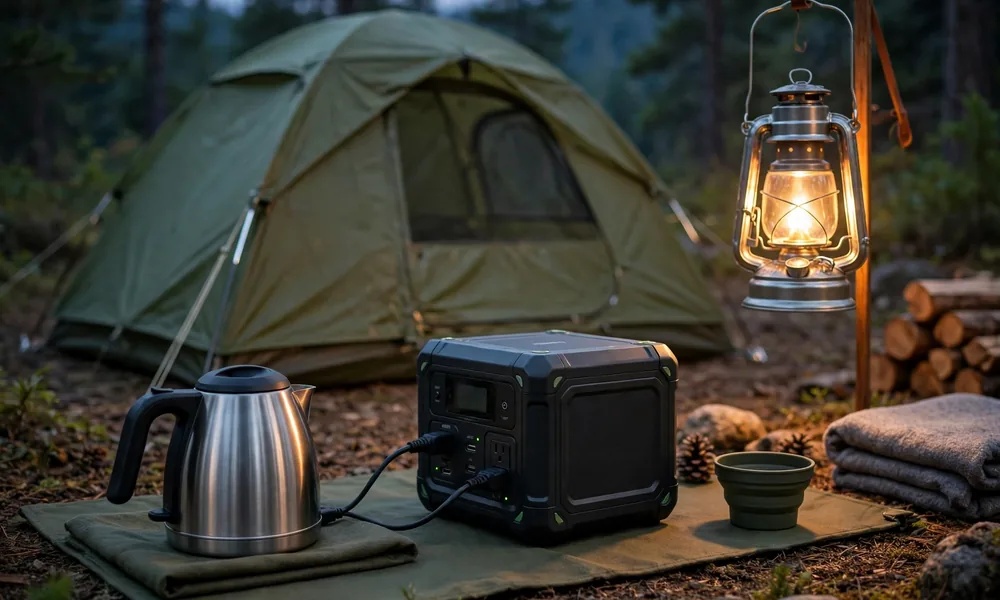
Yes, if the power station’s continuous output is higher than the kettle’s wattage. A 1,000-watt station can run a 600 to 800-watt kettle, but not a 1,500-watt one. Each boil uses a noticeable chunk of battery, so use a kettle sparingly off grid.
Are collapsible kettles safe?
Collapsible kettles from reputable brands are safe when used as directed. The silicone body is food-grade and heat-resistant, and the heating element sits in a stainless steel base. Make sure the kettle is fully expanded before you switch it on, never overfill it, and let it cool before collapsing it for packing.
How do I clean an electric kettle at a campsite?
Empty the kettle after each use and wipe the inside dry. If limescale builds up, boil equal parts water and white vinegar, leave it for half an hour, then rinse well. Do not submerge the base or the electrical parts in water.
The Bottom Line
The best electric kettles for camping are the ones that fit your power, your group, and your car. For most campers, that means a low-wattage kettle of 600 to 1,200 watts, a capacity of 0.8 to 1.5 litres, and a tough stainless steel body with automatic shut-off and boil-dry protection. Check your pitch amperage before you buy, and keep the kettle on a stable surface away from the edge of the table. Get those basics right, and hot water becomes the easiest part of the trip.