
Good art supplies do not make anyone a better artist overnight, but bad ones can quietly ruin the habit before it starts. A brush that sheds hairs into wet paint, paper that buckles the moment it gets damp, pencils that snap every time they are sharpened, or markers that bleed through to the next page all teach the same lesson: that making art is frustrating, messy and not worth the trouble. The best art supplies of 2026 avoid that trap. They are the paints, brushes, papers, pencils, markers, canvases and sketchbooks that behave the way a beginner expects them to, last long enough to be worth their price, and stay out of the way so the person holding them can focus on the picture instead of the tools.

What Makes Art Supplies Good
The first thing to look for is consistency. A paint should be the same colour from one tube to the next, a pencil should sharpen to a clean point without the core crumbling, and a sheet of paper should take a wash without tearing. Consistency matters because beginners learn by repeating the same stroke and watching what happens, and if the tool behaves differently every time, there is nothing reliable to learn from. Student-grade supplies from established makers are usually consistent, while unbranded bargain sets often are not, even when the colours on the box look identical.
The second thing is honesty about what a supply is for. A set labelled for sketching should contain pencils and paper suited to drawing, not a random mix of dry pastels, glitter glue and a tiny watercolour pan. A painting set should include the brushes and surfaces that go with its paints. The best art supplies are sold as tools with a clear purpose, and their packaging says plainly what is inside, how many pieces there are and what surfaces they suit. Vague claims, missing counts and photographs that show far more than the box contains are all warning signs.
Durability is the third test, and it is the one that separates a bargain from a false economy. A brush whose ferrule loosens after a week, a sketchbook whose binding falls apart, or a marker that dries out after a few uses will need replacing, and the replacement usually costs more than the saving. Check the small details before buying: the brush ferrule should be firmly crimped with no wobble, the sketchbook binding should open flat without cracking, and pencil wood should be smooth cedar rather than rough, splintery wood that catches the sharpener.
How to Choose: Start With How You Want to Make Art
Before buying anything, decide what kind of making appeals to you most. Someone who loves drawing faces will use pencils and paper every day and may never touch a canvas. Someone who wants bold colour on a wall will need paints, brushes and a primed surface. Someone who likes to carry art in a bag will want a sketchbook and a few portable tools. There is no single correct starting point, and the best art supplies are the ones that match the kind of art you actually want to make, not the kind you think you ought to make.
Paints: The Heart of a Colour Kit
Paint is where most beginners start, and it is also where the most money is wasted. The choice is between watercolour, acrylic and gouache, and each behaves differently. Watercolour is transparent, portable and easy to clean up, but it dries fast and is hard to correct. Acrylic is opaque, dries quickly to a waterproof finish and works on paper, canvas, wood and fabric, which makes it the most versatile choice for a first paint set. Gouache sits between the two: opaque like acrylic, but it can be reworked with water after drying.
For a first set, acrylic is usually the safest bet. A small set of six to twelve tubes in the basic colours, plus white and black, is enough to mix almost any colour, and learning to mix is one of the most useful skills a beginner can build. Buying every colour in the shop is unnecessary and expensive; mixing teaches colour far better than collecting tubes. Our guide to the best acrylic paints of 2026 looks at which sets cover boldly, stay true as they dry and are worth the price for someone starting out.
Brushes: Small Tools That Make a Big Difference
A brush is a simple tool, but it does more work than any other supply in the kit. The shape decides what it can do: a round brush makes lines and details, a flat brush lays down broad areas of colour, a filbert blends soft edges, and a fine liner draws thin, steady lines. A beginner needs only three or four brushes to start: a medium round, a flat, a small round for detail and a larger wash brush for covering paper quickly.
Paper and Sketchbooks: The Surface Everything Depends On
Paper is the most underestimated supply in art. Thin, smooth copy paper is fine for pencil sketches, but it buckles under watercolour, tears under erasing and lets markers bleed through. The weight of the paper, measured in grams per square metre, tells you what it can handle: light paper around 90 gsm suits dry drawing, medium paper around 140 to 200 gsm handles light washes and markers, and heavy paper of 300 gsm and above is needed for wet watercolour work.
A sketchbook should be chosen for the medium you use most. A book with smooth paper suits pencil and pen, while one with a slight tooth grips charcoal and pastel better. The binding matters too: a spiral binding lets the book lie flat and pages can be folded back, while a stitched hardcover book lasts longer and travels better in a bag. For daily drawing, a sketchbook that opens flat and has paper thick enough to take a pen without showing through is worth paying a little more for, and our guide to sketchbooks for daily drawing in 2026 explains which ones hold up to everyday use.
Pencils, Pens and Markers: The Drawing Tools
Drawing pencils come in grades, and the grade decides how dark and soft the mark is. Hard pencils marked H make light, fine lines that are good for outlines and construction, while soft pencils marked B make dark, rich marks for shading. A beginner needs only a small range: an HB for general drawing, a 2B for shading and a 2H for light construction lines. A set of twelve grades looks impressive but most of them will go unused for months.
Coloured pencils are a different tool. The best ones lay down smooth, even colour that can be layered and blended, while cheap ones feel waxy, scratch the paper and leave pale, uneven marks. Test a coloured pencil by layering two colours on scrap paper: good pencils blend into a smooth third colour, while poor ones sit on top of each other in visible streaks. A set of twelve to twenty-four colours is plenty to start; a set of a hundred is a collection, not a tool.
Canvases and Surfaces Beyond Paper
A canvas changes how a painting feels. The woven texture grips paint, the stiff surface takes heavy brushwork, and the finished piece can be hung on a wall without a frame. Ready-primed canvases and canvas boards are the easiest start: canvas boards are flat, cheap and good for practice, while stretched canvases on a wooden frame are better for finished work and for display.
A Sensible Starter Kit
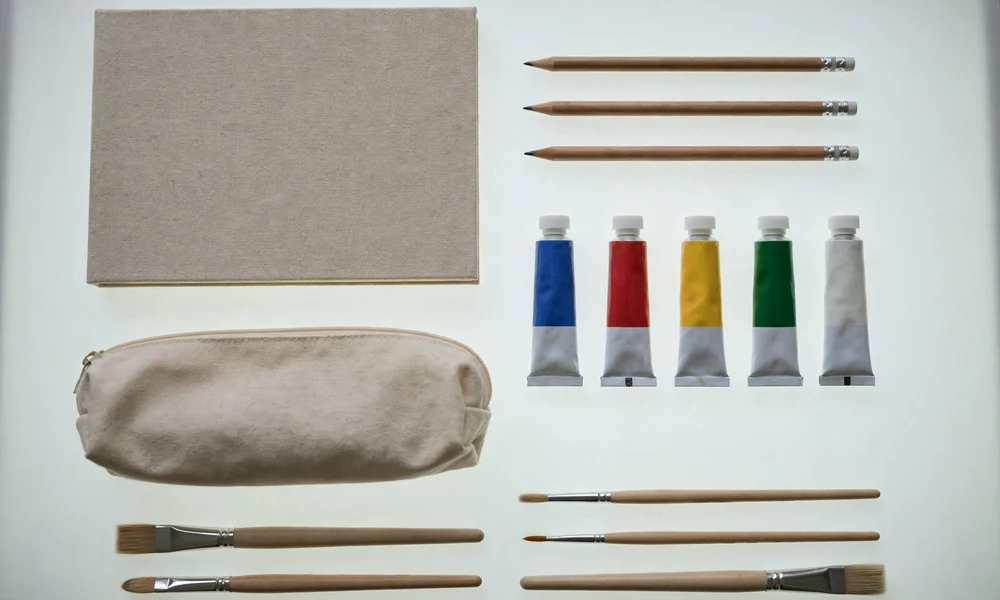
A good starter kit fits in a small bag and costs less than most people expect. It needs a sketchbook, a set of drawing pencils in three grades, a sharpener and an eraser, a small set of acrylic paints, three or four brushes, a palette or old plate for mixing, a water jar, a few sheets of heavier paper and a pencil case to keep it together. That is the whole kit, and it covers drawing, painting and colour mixing.
What to Avoid When Buying Art Supplies
Avoid the giant bargain box. A box of two hundred pieces looks like extraordinary value, but it is usually filled with low-quality paints, brittle pencils, thin paper and brushes that shed. Most of the pieces will never be used, and the ones that are used will disappoint. A small set of good supplies teaches more and lasts longer than a huge set of poor ones.
Looking After Your Supplies
Art supplies last far longer with a little care. Keep paints out of direct sunlight and away from heat, because heat dries tubes and fades colours. Keep paper flat, dry and out of damp rooms, because damp paper buckles and grows spots. Keep pencils in a case rather than loose in a bag, where they snap against other objects. These are small habits, and they cost nothing, but they can double the life of a kit.
Setting Up a First Workspace
A workspace does not need to be a studio. A kitchen table, a corner of a bedroom or a desk by a window is enough, provided it has good light, a flat surface and a place to keep the kit within reach. Natural daylight is best for judging colour, so set up near a window if possible, and add a daylight lamp for evening sessions. A chair at the right height matters more than a fancy easel.
Frequently Asked Questions
How much should a beginner spend on art supplies? Less than you think. A sketchbook, three pencils, a sharpener, an eraser and a small paint set with a few brushes is a complete start, and it costs about the same as a few takeaway meals. Spend more only when you know which medium you enjoy, because that is when the extra quality makes a real difference.
Can children use the same art supplies as adults? Children need washable, non-toxic supplies made for their age, with chunky pencils and brushes that are easy to hold. Adult supplies are not dangerous for older children, but they are often too small, too hard to control and too expensive to waste on experiments. A child who can use their own supplies freely will make far more art than a child who is told to be careful with expensive tools.
What is the single most useful art supply? A sketchbook. It is a place to practise, to try ideas, to make mistakes and to keep finished drawings, and it costs very little. Every other supply in the kit serves the sketchbook in the end, because drawing every day is the habit that improves art more than any paint or brush.

The best art supplies are the ones that get used. A small, reliable kit that lives within reach will make more pictures than a cupboard full of impressive tools that never come out. Choose supplies that suit the art you want to make, look after them, and replace them as they wear out, and the kit will grow with you. Start with a sketchbook, a few pencils and a small paint set, and let the habit, not the shopping, do the work.


