
Why an Avocado Slicer Saves Time at Breakfast in 2026
An avocado slicer is a small, inexpensive tool that solves a surprisingly fiddly problem: getting a ripe avocado out of its skin, away from its stone, and onto your toast in neat, even slices without a knife slipping or the flesh turning to mush. If you eat avocado at breakfast most mornings, an avocado slicer saves time every single day, keeps your hands and the worktop clean, and gives you slices that look as good as they taste. A good one pits, slices and scoops in a few seconds; a bad one mangles the fruit and ends up at the back of a drawer. This guide explains how avocado slicers work, what makes a good one, and whether the tool deserves a place in your kitchen in 2026.
Key Takeaways
- A three-in-one avocado slicer pits, slices and scoops, so one tool replaces a knife, a spoon and a lot of mess.
- Even slices cook and look better: they fan neatly on toast, layer evenly in sandwiches and stay put in salads.
- Stainless steel slicing wires cut cleanly through ripe flesh without tearing, while plastic blades tend to drag and bruise.
- The pitter must grip the stone firmly and twist it out safely, without your fingers anywhere near a sharp edge.
- An avocado slicer is worth buying if you eat avocado at least twice a week; occasional eaters can manage with a knife and spoon.

What an Avocado Slicer Does
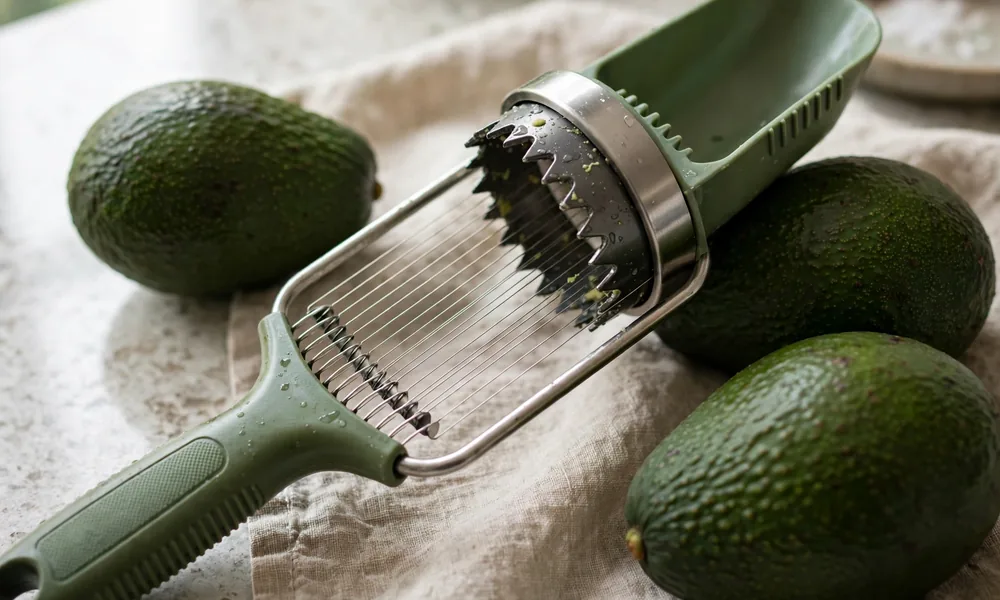
Most avocado slicers are a single handheld tool with three jobs. One end has a small, sharp-edged scoop or pitter that twists the stone out of the halved fruit. The middle is a fan of thin wires or blades that press through the flesh to make even slices. The other end is a curved scoop that lifts the sliced flesh out of the skin in one piece. You halve the avocado with a knife, twist out the stone with the pitter, press the slicer through the flesh, and scoop the slices out onto your plate. The whole process takes under a minute.
Some designs split these jobs across separate tools, and some are little more than a wire frame with a handle. The three-in-one design is the most popular because it does everything with one tool that is easy to wash and store. It is also the design most likely to be well made, because makers who combine three functions have to get each one right for the tool to work at all.
The appeal is not just speed, although speed is real: a practiced user can go from whole avocado to finished toast in about ninety seconds. The appeal is also safety and consistency. Cutting an avocado with a knife means holding a slippery, round fruit in one hand and a sharp blade in the other, and every year people injure themselves doing exactly that. A slicer keeps the blade, such as it is, inside the tool and away from your fingers.
Why Breakfast Is Where It Earns Its Keep
Breakfast is the meal where avocado appears most often, and it is also the meal where time is shortest. Avocado on toast, avocado with a poached egg, avocado in a breakfast wrap: all of them need the fruit sliced quickly, before the toast goes cold and the egg overcooks. Fumbling with a knife and spoon while the toaster pops is a small daily frustration, and it is exactly the kind of frustration a single-purpose tool removes.
Even slices matter at breakfast more than at other meals because they sit on display. A fan of neat avocado slices on sourdough looks appetising and stays in place when you pick the toast up; a spoonful of mashed avocado slides off and makes a mess of your hands. If you eat avocado toast most mornings, the difference between a tidy fan and a smear is the difference between a breakfast that feels considered and one that feels rushed.
There is also the matter of the toaster. While the bread is toasting, you can halve, pit and slice the avocado, and by the time the toast pops, the slices are ready to go on. That rhythm, toast down, avocado sliced, toast up, avocado on, is what makes the tool feel like it saves time rather than merely adding a step. Pair it with a reliable toaster and the whole breakfast comes together in the time it takes to brew coffee.
How to Choose a Good Avocado Slicer
The slicing wires are the heart of the tool. They should be stainless steel, evenly spaced, and taut enough not to flex when they meet the flesh. Wires that are too far apart produce thick, clumsy slices; wires that are too close together produce thin slices that fall apart. A spacing of around a centimetre gives slices that are substantial enough to handle but neat enough to fan out.
The pitter is the second thing to check. It should be a small, serrated cup or claw that grips the stone firmly when you press and twist. A pitter that slips will leave you fishing the stone out with a knife, which defeats the purpose of the tool. Some pitters have a small lever or button that pushes the stone off the claw once it is out, which keeps your fingers away from the stone and the tool clean.
Comparing the Main Avocado Slicer Designs
| Design | Functions | Best for | Cleaning | Drawback |
|---|---|---|---|---|
| Three-in-one tool | Pit, slice, scoop | Daily breakfast use | Easy, dishwasher safe | Needs a ripe avocado |
| Wire slicer only | Slice | Neat slices for salads | Very easy | No pitter or scoop |
| Scoop and pitter | Pit, scoop | Guacamole and mash | Easy | No even slices |
| All-steel slicer | Pit, slice, scoop | Long-term durability | Easy | Heavier and pricier |
| Plastic three-in-one | Pit, slice, scoop | Occasional use, tight budgets | Easy | Wires can flex and dull |
The three-in-one design wins for most people because it handles the whole job with one tool. The wire-only slicer is a good second tool for salads, where you want perfect slices and already have a way to remove the stone, but on its own it leaves you reaching for a knife and spoon anyway. The all-steel version is the best choice if you eat avocado daily and want a tool that will last for years.
Using an Avocado Slicer Properly
Start with a ripe avocado. This matters more than the tool itself: an under-ripe avocado will resist the wires and come out in chunks, while an over-ripe one will collapse into mush no matter how good the slicer is. A ripe avocado yields gently to pressure at the stem end and feels heavy for its size. Cut it in half lengthways with a knife, going around the stone, and twist the halves apart.
Remove the stone with the pitter, pressing it onto the stone and twisting sharply. The stone should come away cleanly; if it does not, the avocado may be under-ripe. Then place the slicer over the flesh, wires down, and press firmly and evenly until the wires reach the skin. Do not saw or wiggle the tool, because that tears the slices. Lift the slicer, run the scoop between the flesh and the skin, and lift the whole fan of slices out in one piece.
If the slices stick together, fan them gently with a fork or the side of a knife. A squeeze of lemon over the slices keeps them green for the few minutes before serving, and a pinch of flaky salt and a drizzle of good oil turn a simple slice of toast into something worth sitting down for. If you cook with avocado oil as well, our guide to avocado oil explains which bottles are worth the shelf space, and the comparison of avocado oils shows which ones to avoid.
Cleaning, Storage and Durability
Avocado flesh sticks to wires and scoops, so clean the slicer straight after use. A rinse under warm water and a quick brush between the wires is usually enough; most slicers are dishwasher safe, but the top rack is kinder to plastic handles. Dry the wires before storing, because even stainless steel will spot if it is put away wet.
Durability depends on the wires and the pivot between the parts. Stainless steel wires last for years if they are not bent, so store the slicer where it will not be crushed under heavier tools. A blade cover or a hanging hook helps. Plastic slicers can last just as long with gentle use, but their wires tend to loosen over time, and once they flex, the slices become uneven.
What to Avoid When Buying
Avoid slicers with plastic slicing blades instead of wires or steel edges: they drag through the flesh, bruise it, and go dull quickly. Avoid pitters that are just a sharp point, because they are dangerous and ineffective. Avoid very cheap three-in-one tools with flimsy handles, because the handle is where your hand meets the tool, and a handle that flexes or cracks makes the whole thing unpleasant to use.
Be wary of slicers that promise to do everything, including mashing and dicing, because a tool that tries to do too much usually does none of it well. The best avocado slicers do three things, pit, slice and scoop, and do them cleanly. Anything beyond that is a gimmick.

Avocado Slicer Checklist: Before You Buy
- Stainless steel slicing wires, evenly spaced and taut, that cut without flexing.
- A pitter that grips the stone firmly and releases it safely.
- A thin, curved scoop that lifts slices out in one piece.
- A comfortable, non-slip handle with enough length for leverage.
- Dishwasher-safe materials that dry quickly and resist staining.
- A size that matches the avocados you actually buy.
Frequently Asked Questions
Is an avocado slicer worth buying?
Yes, if you eat avocado at least twice a week. It pits, slices and scoops in under a minute, keeps your hands clean, and produces neat slices that a knife and spoon rarely match.
Does an avocado slicer work on unripe avocados?
No. Under-ripe flesh is too firm for the wires and will come out in chunks. Wait until the avocado yields gently to pressure, then slice it.
How do you clean an avocado slicer?
Rinse it straight after use and brush between the wires to remove stuck flesh. Most are dishwasher safe on the top rack, but hand washing is kinder to plastic handles.
Can an avocado slicer make guacamole?
Not well. It is designed for neat slices, not mashing. For guacamole, scoop the flesh out with a spoon and mash it with a fork.
Is an avocado slicer safe?
Yes, it is safer than a knife for this job, because the cutting wires are held inside the tool and your fingers stay clear of the stone and the blade. Keep the pitter away from children, though, as it is sharp.
What is the best avocado slicer design?
A three-in-one tool in stainless steel, with a firm pitter, taut wires and a curved scoop, suits most kitchens. Plastic versions work for occasional use but their wires loosen sooner.
The Bottom Line
An avocado slicer saves time at breakfast because it turns the fiddliest part of the morning, getting a ripe avocado onto toast in neat slices, into a job that takes seconds and leaves no mess. Choose a three-in-one tool with stainless steel wires, a pitter that grips, and a scoop that lifts the slices out cleanly, use it on properly ripe fruit, and it will earn its place in the drawer within a week.


