
The Best Biscotti for Coffee, Gifting and Everyday Dunking in 2026
The best biscotti in 2026 are the ones that survive the dunk. A good biscotti is crisp all the way through, golden at the edges, studded with whole almonds, and firm enough to hold its shape in hot coffee for a few seconds before softening into something buttery and fragrant. A bad one is either tooth-threateningly hard or so soft it crumbles into the cup. This guide sorts the difference, so whether you buy or bake, you end up with biscotti worth the coffee.
Biscotti are Italy’s twice-baked answer to the cookie jar. The name comes from Latin bis coctus, twice cooked: dough is baked as a log, sliced, and baked again until dry and crisp. That second bake gives biscotti their famous crunch and long shelf life, and makes them the rare cookie that improves when dunked. Below: what makes a great biscotti, the flavours worth trying, how to judge a shop-bought bag, and how to bake a batch at home.
Key Takeaways
- The best biscotti are baked twice until dry and crisp, golden with a clean snap, never soft in the middle or burnt at the edges.
- Classic almond is the benchmark: whole almonds, a little orange or anise, and a crumb that softens in coffee without falling apart.
- Dunking is the test that matters: a good biscotti holds together for five to ten seconds in hot coffee, then yields; a bad one shatters or never softens.
- Store-bought biscotti should list butter, eggs, flour, sugar and nuts first, with no long list of preservatives or artificial flavourings.
- Homemade biscotti keep for three to four weeks in an airtight tin — one of the best make-ahead gifts in the kitchen.
What Biscotti Actually Are
Biscotti are not ordinary cookies, and judging them like ordinary cookies is the fastest way to buy the wrong ones. A cookie is meant to be soft or chewy; a biscotti is meant to be dry, crisp and durable. The traditional Tuscan recipe, cantucci, contains no butter at all — just flour, sugar, eggs and almonds — which is why it keeps for weeks. Modern recipes often add a little butter for richness, but the texture should still be firm and dry.
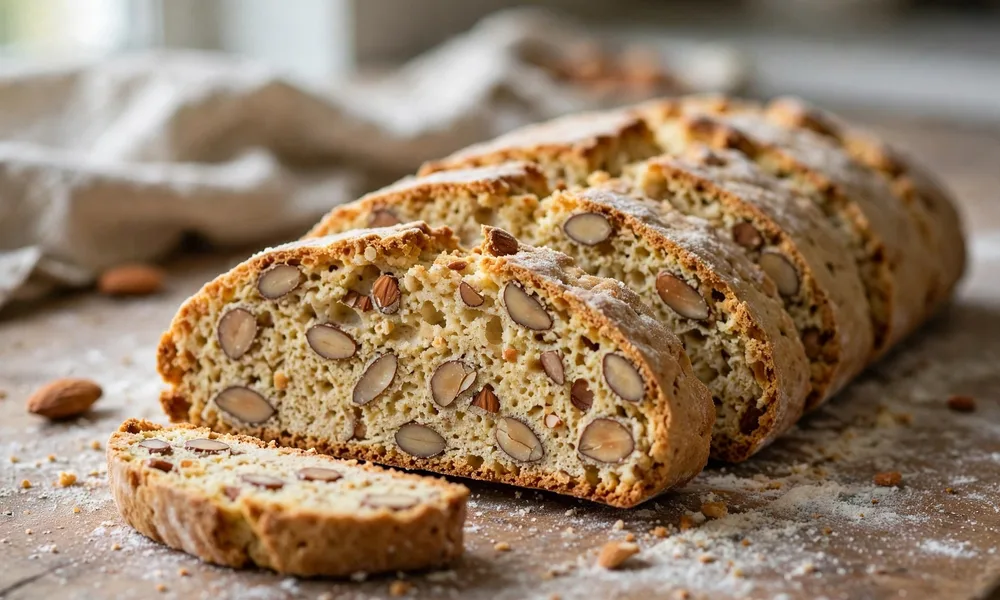
The shape tells you a lot before you take a bite. Real biscotti are oblong slices cut on the diagonal from a baked log, with a flat cut face showing crumb and nuts. Perfectly uniform, pale, smooth slices were probably machine-made from soft dough with a token second bake. Uneven, golden slices showing whole almonds and an open crumb were made the slow way — uneven is a good sign.
Biscotti vs Cookies: The Real Difference
The difference between biscotti and an ordinary cookie is structure, not flavour. Cookies are baked once, and their charm is softness: crisp edge, chewy middle, a centre that bends. Biscotti are baked twice, and their charm is the opposite: a hard, dry crunch that only softens when it meets liquid. That is why biscotti are a coffee cookie first and a snack second — eaten dry, a good biscotti is pleasant but severe; dunked, it turns fragrant and tender in a way no soft cookie can copy. It is also why biscotti last so long: a soft cookie starts going stale the day it is baked, while a well-made biscotti is already dry.
Biscotti vs Brownies: No Real Contest
Biscotti have almost nothing in common with brownies. A brownie is dense, moist and rich, built around melted chocolate or cocoa and meant to be eaten as it is, preferably still slightly warm. A biscotti is lean, dry and crisp, built around eggs and flour, and meant to be dunked. One is a dessert; the other is a companion to a drink. Want something fudgy and chocolatey? Bake brownies. Want something crisp with morning coffee? Bake biscotti.
The Flavours Worth Trying
Almond is the original and still the best place to start: classic cantucci use whole almonds, sometimes with a little orange zest or anise, and nothing else. The almond gives crunch and a warm, marzipan-like note. If a bakery cannot make a good almond biscotti, nothing else on its shelf will save it, so taste this one first.
Chocolate biscotti are the most popular variation: the best use cocoa in the dough plus dark chocolate chunks, so the flavour runs all the way through. Chocolate-dipped biscotti, where one end is dipped in dark chocolate, are a different pleasure and the better gift, because they look the part. Pistachio and hazelnut versions are worth seeking out too, especially pistachio, with a gentle, almost savoury richness that pairs beautifully with espresso. Cranberry and orange is the festive favourite; lemon biscotti, lighter and brighter, suit tea drinkers best.
Store-Bought vs Homemade
Good shop-bought biscotti exist, worth buying when a bakery makes them in small batches and sells them quickly. Look for a short ingredient list: flour, sugar, eggs, almonds, baking powder, salt, and perhaps butter and vanilla. Be wary of bags listing palm oil, glucose syrup or artificial flavourings — factory biscuits wearing an Italian name, usually sweet, flat and oddly soft in the middle. Price is a guide too: two bakes and hand slicing make genuinely handmade biscotti cost more than a packet of digestives.
Homemade biscotti are where the real value is. The dough takes fifteen minutes to mix, the first bake half an hour, the second another fifteen. The ingredients cost little, the result keeps for weeks, and you control the nuts, the sweetness and the bake.

Biscotti Compared: The Main Styles
| Style | Texture | Best dunked in | Keeps for | Best for |
|---|---|---|---|---|
| Classic almond (cantucci) | Very crisp, dry | Espresso, black coffee | 3–4 weeks | Everyday coffee |
| Chocolate chunk | Crisp with soft chocolate pockets | Black coffee | 2–3 weeks | Chocolate lovers |
| Chocolate-dipped | Crisp, soft chocolate end | Espresso, milky coffee | 2–3 weeks | Gifts, parties |
| Pistachio | Crisp, rich crumb | Espresso, cappuccino | 3 weeks | Espresso drinkers |
| Cranberry and orange | Crisp, chewy fruit | Tea, milky coffee | 2–3 weeks | Festive gifts |
| Lemon | Crisp, light | Tea, Earl Grey | 3 weeks | Tea drinkers |
How to Judge a Biscotti Before You Buy
Start with the snap. Break a biscotti in half: it should break cleanly with a sharp snap, not bend or crumble into dust. The broken face should be dry and evenly golden, with small, even holes in the crumb. A pale, doughy centre means the second bake was too short; a very dark, almost burnt edge means it ran too hot and the biscotti will taste bitter.
Next, look at the nuts. Whole almonds should be visible in every slice, not just a few; sparse nuts or nut dust means the maker is saving money. Finally, smell it. A good biscotti smells of toasted nuts, vanilla and warm flour. If it smells of nothing, it was baked too gently or too long ago; if it smells of artificial vanilla or almond essence, put it back.
The Dunking Test
Dunking is not a gimmick; it is how biscotti were designed to be eaten. The traditional pairing is vin santo, the sweet Tuscan dessert wine, but in everyday life the partner is coffee. Dip only the bottom third, hold it five to ten seconds, then lift and eat. Any longer and even a good biscotti will drop a chunk into the cup; any shorter and you get crunch without the softening that makes dunking worthwhile.
Espresso is the best partner: its intensity stands up to the sweetness and its small volume keeps the biscotti from getting soggy. A long black works well too. In milky drinks, dunk for only three or four seconds, since hot milk softens biscotti faster. Our guide to the best espressos is a useful starting point for matching the coffee to the cookie: a bold, dark roast holds up better against sweet almond biscotti than a light, fruity one.

Baking Biscotti at Home
The method is simple, but the details decide the result. Mix the dough until it just comes together — overmixing makes tough biscotti. Shape it into two flat logs, about 30 cm long and 8 cm wide, on a lined tray. Bake at 180°C for 25 to 30 minutes, until firm and lightly golden. Cool ten minutes, slice on the diagonal about 1.5 cm thick, then bake again 8 to 10 minutes per side, until dry and golden.
The most common mistake is slicing too soon, while the log is still hot and soft: the slices crumble and the edges tear. Ten minutes of cooling is the minimum; fifteen is safer. The second is slicing too thick — thick slices never dry out in the middle and go soft in the tin within days, while thin slices dry evenly and keep far longer. Leave the twice-baked slices on a wire rack until completely cold, since any warmth left in the biscotti will steam inside a closed tin and soften the batch overnight.
Storing and Gifting Biscotti
Storage is where biscotti earn their reputation. An airtight tin at room temperature keeps them crisp for three to four weeks; a glass jar with a clip lid works just as well. Keep them away from steam: a biscotti left near a steaming sink will go soft within a day. If a batch softens, ten minutes at 150°C will crisp it up again.
As a gift, biscotti are hard to beat: they travel well, keep for weeks, and look beautiful in a tin or a cellophane bag tied with ribbon. A tin of homemade biscotti with good coffee beans is a thoughtful, cheap present. Our guide to the best gifts for coffee lovers has plenty of ideas for what to pair them with, from a proper grinder to beans roasted for espresso.
The Biscotti Checklist
- Choose whole nuts you can see in every slice, not nut dust.
- Check the snap: clean break, dry golden crumb, no pale doughy centre.
- Read the ingredients: flour, sugar, eggs, nuts first; no palm oil or artificial flavourings.
- Slice thin (about 1.5 cm) and cool the log ten minutes before cutting.
- Bake twice and cool fully on a rack before the tin, or trapped steam softens the batch.
- Store airtight, away from steam; re-crisp soft biscotti ten minutes at 150°C.
Frequently Asked Questions
Are biscotti supposed to be hard?
Yes. Biscotti are twice-baked on purpose, so they are meant to be dry and crisp, and designed to be dunked in coffee or dessert wine. A biscotti that is soft all the way through was underbaked on the second bake.
How long do homemade biscotti last?
Three to four weeks in an airtight tin at room temperature. Classic almond lasts longest, since it contains no butter; butter-enriched or chocolate-dipped versions keep two to three weeks.
Can you freeze biscotti?
Yes, for up to three months in a sealed bag or container. Thaw at room temperature for an hour, and crisp for five minutes at 150°C if they have softened at all.
Why did my biscotti crumble when I sliced them?
Almost always because the log was sliced while still hot, or with a blunt knife. Cool the log ten to fifteen minutes, then slice with a sharp serrated knife using a gentle sawing motion.
What is the best coffee to dunk biscotti in?
Espresso or a long black: strong coffee stands up to the sweetness, and the small volume keeps the biscotti from going soggy. In milky coffee, dunk for only three or four seconds.
Are biscotti gluten-free?
Traditional biscotti are not; they are made with wheat flour. Gluten-free versions exist using rice or almond flour, but they are more fragile and need a gentler second bake.
The Bottom Line
The best biscotti in 2026 are simple things done properly: whole nuts, a real second bake, a clean snap, and a crumb that softens in coffee instead of falling apart. Start with classic almond, buy small-batch or bake a batch yourself, and judge every biscotti by the dunk.


