Blinds Cleaners That Reach Every Slat in 2026
Blinds cleaners are the difference between blinds that look freshly fitted and blinds that quietly collect a grey film of dust on every slat. A blind is a dust magnet by design: dozens of horizontal surfaces stacked in still air, each catching whatever floats past. Wipe the front of a slat and the back stays dirty; dust the top and the dust falls onto the slat below. The best blinds cleaners of 2026 solve that problem, cleaning both sides of several slats at once and reaching the narrow gaps where dust settles thickest.
This guide compares the tools that actually work on real blinds, from microfibre slat cleaners and vacuum brush attachments to damp cloths used the right way. We judged each one on slats cleaned per pass, how it copes with different materials, how much effort it takes, and whether it removes dust or just moves it. If your blinds have not been properly cleaned since they went up, the right tool will turn an afternoon’s job into minutes.
Key takeaways
- Microfibre slat cleaners are the fastest option for Venetian blinds, cleaning both sides of three to six slats in a single pass.
- Vacuum brush attachments remove the most dust overall, because they take it away instead of moving it around the room.
- Match the tool to the slat: wide flat slats suit clamp-style cleaners, while narrow or curved slats need a flexible glove or cloth.
- Wooden blinds should be cleaned dry or barely damp, since soaking water into real wood causes warping and staining.
- Cleaning little and often beats one big annual deep clean, because fresh dust lifts off easily and old dust sticks.
Why blinds get so dirty, so fast
A blind presents far more surface area than it appears to. A single window blind can have forty or fifty slats, and each slat has a top and a bottom, which means a hundred dusty surfaces facing the air in one window. The cords, headrail and tilt mechanism give dust even more places to lodge. Because blinds sit still in moving air, every draught that passes through the room deposits a little more dust on them, and the slats closest to the window collect the most, since that is where outside air and pollen arrive first.
The main types of blinds cleaners
Every blinds cleaner is a variation on a few basic ideas: how many slats it touches at once, whether it traps dust or just disturbs it, and whether it works wet or dry.
Microfibre slat cleaners
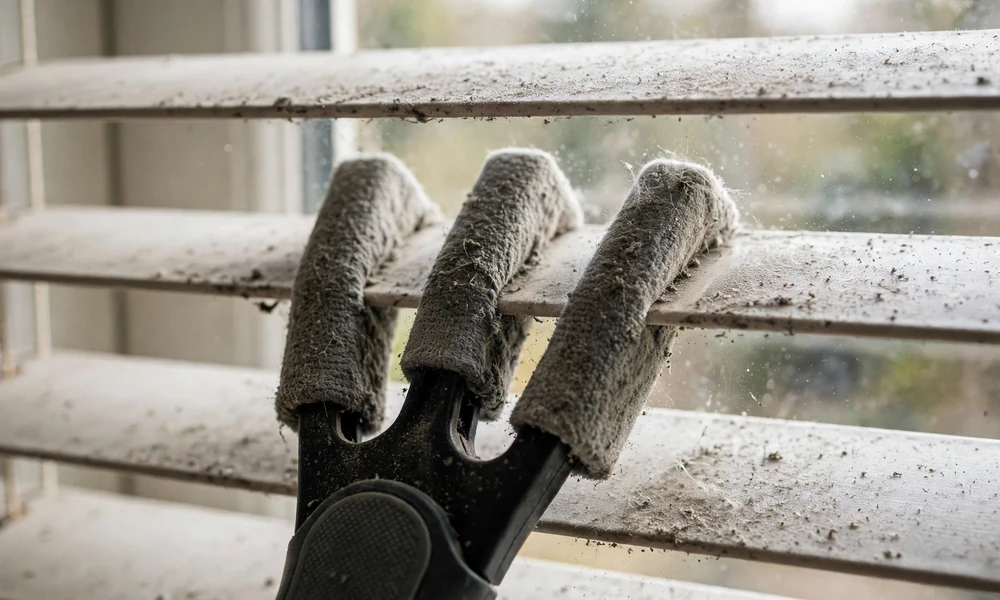
A microfibre slat cleaner looks like a small pair of tongs with soft sleeves. You slide it over a slat so the sleeves grip the top and bottom at once, then pull it along the blind. The better designs have three or more prongs, so one pass cleans three slats, top and bottom, and the microfibre traps dust instead of flicking it into the air. Sleeves that come off for washing last far longer than fixed ones. These tools suit flat Venetian slats five to nine centimetres wide, which covers most homes.
Vacuum brush attachments
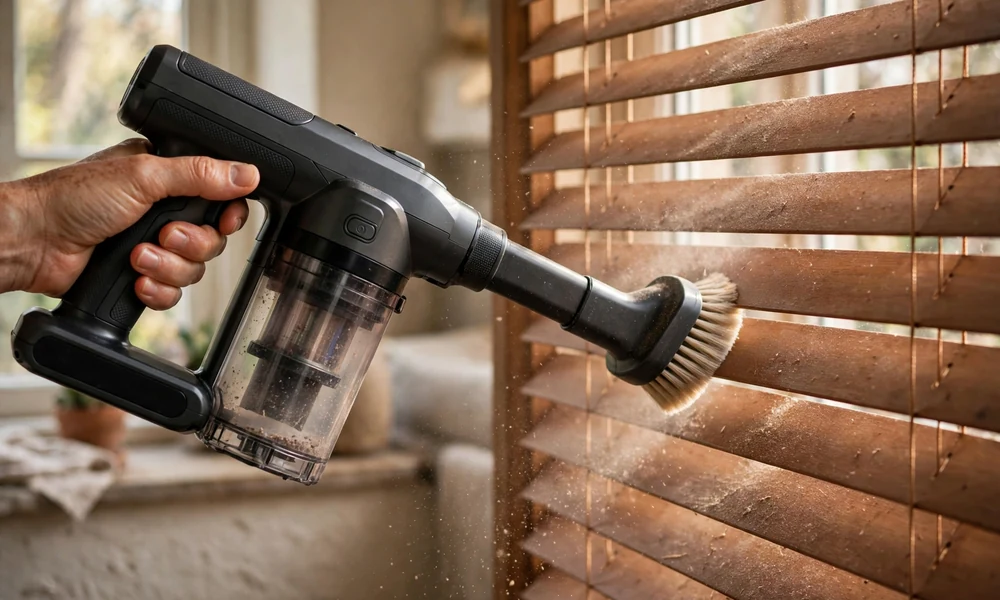
A vacuum with a soft brush nozzle is the most thorough way to clean blinds. The brush loosens dust while the suction carries it straight out of the room, so nothing settles back onto the blind or the furniture below. A long, narrow brush head works best, since it slides between slats without bending them, and a low suction setting is usually enough; full power can pull lightweight aluminium slats out of shape. Vacuum attachments are especially good for fabric blinds, where rubbing with a cloth can mark the material.
Damp cloths and sprays
Sometimes the simplest tool is the right one. A damp microfibre cloth, wrung out until barely moist, lifts the bonded grime that dry tools leave behind, and it works on any slat shape, including curved and narrow ones that clamp-style cleaners cannot grip. Fold the cloth over the slat, pinch gently, and draw it along, turning to a clean section every few slats. Plain water suits most dust; a drop of washing-up liquid handles kitchen grease. Avoid harsh sprays and bleach, which can stain coloured slats and damage cords. Our guide to microfibre cloths that clean without chemicals explains which weaves work best.
Cleaning gloves and mitts
A microfibre cleaning glove turns your hand into the tool, which sounds like a gimmick until you try it on unusually shaped blinds. The glove follows the curve of each slat, reaches into the gaps beside the cords, and cleans the headrail and tilt wand at the same time. Gloves are slower than a three-prong cleaner on standard slats, but they are the best choice for vertical blinds, where each vane hangs separately, and for very narrow slats that no clamp can grip.
What to look for before you buy
The best blinds cleaner is the one that fits your blinds. Start by measuring a slat. Most Venetian slats are between five and nine centimetres wide, and a clamp-style cleaner should match that width closely: too narrow and it misses the edges, too wide and it wobbles and skips. Check the gap between slats too, since a thick tool cannot slide between tightly spaced ones without bending them.
Blinds cleaners compared
| Tool | Best for | Slats per pass | Effort | Price range |
|---|---|---|---|---|
| Microfibre slat cleaner | Flat Venetian slats | Three to six | Low | Budget |
| Vacuum brush attachment | Heavy dust, fabric blinds | One to two | Medium | Free if owned |
| Damp microfibre cloth | Grease and bonded grime | One | High | Budget |
| Electrostatic duster | Light, frequent dusting | One to two | Low | Budget |
| Cleaning glove | Vertical and narrow slats | One | Medium | Budget |
The table shows why most homes end up with two tools: a slat cleaner for the weekly clean, and a vacuum attachment or damp cloth for the deep clean every few months. Avoid the cheapest slat cleaners: their thin sleeves shed fibres and lose grip after a few washes, while a mid-priced one with washable sleeves lasts for years.
How to clean blinds properly, step by step
Good technique matters more than an expensive tool. Start by closing the blinds fully in one direction, so the slats overlap into a single flat surface. Dust or vacuum that face from top to bottom, so dust falls onto slats you have not cleaned yet rather than clean ones. Then tilt the slats the other way and repeat on the reverse face. This two-face method is the single biggest improvement most people can make.
Next, open the blinds and clean the edges and cords; a glove or cloth is best, since the cords and ladder tapes collect dust in their weave. Wipe the headrail and bottom rail, often the dirtiest parts because nobody looks at them. Finally, if the blinds still look dull, go over them once more with a barely damp cloth, and let them dry fully open before closing them again.
Wooden, faux-wood, metal and fabric blinds
Different blind materials need different care, and the wrong method can do real damage. Real wooden blinds hate water: clean them dry, and use a barely damp cloth only for stubborn marks, drying each slat straight away. Faux-wood blinds are far more forgiving and can be wiped down or even rinsed in the bath for a deep clean. Aluminium blinds handle damp cleaning but bend easily, so use a light touch and never press hard with a clamp-style tool. Fabric blinds should be vacuumed rather than wiped, since rubbing can leave watermarks and shiny patches. If you are still deciding which type suits each room, our guide to the best blind for every room in your home covers the trade-offs room by room.
Mistakes that damage blinds
The most common mistake is cleaning blinds closed in only one direction and calling the job done, which leaves one face of every slat untouched. The second is pressing too hard with a clamp-style cleaner, which can crease aluminium slats and snap the thin ladder cords. A third is using too much water, especially on wooden blinds and fabric tapes, where trapped moisture causes staining and mildew. Spraying cleaner directly onto the blind is another error: it runs down and leaves streaks, so spray onto the cloth instead. Finally, never use an abrasive pad on a blind; the scratches catch dust faster than a smooth surface, and on coloured slats the damage is permanent.
How often to clean blinds
How often you clean depends on where the blind hangs. Blinds in a kitchen or beside a busy road need a quick pass every week, since grease and traffic dust build up fast. Bedroom and living-room blinds can go two to three weeks between cleans, with a deep clean every two to three months. Run a finger along a slat: if it comes away grey, the blind is overdue. Fresh dust lifts off with a dry tool, while old dust needs moisture and elbow grease, so a five-minute weekly pass keeps blinds looking new for years. Dusters have their place too, and our comparison of the best versus the worst dusters shows which ones actually trap dust instead of scattering it.

Checklist: choosing and using a blinds cleaner
- Measure your slat width and the gap between slats before buying any clamp-style cleaner.
- Pick washable microfibre sleeves so the tool keeps working instead of spreading old dust.
- Use a vacuum brush attachment for the deep clean, and a slat cleaner for the quick weekly pass.
- Clean both faces of every slat by tilting the blind each way in turn.
- Keep wooden blinds dry and wipe fabric blinds with a vacuum, never a wet cloth.
- Replace worn sleeves and frayed gloves promptly, since a worn tool sheds fibres.
Frequently asked questions
What is the best way to clean blinds without taking them down?
Close the blinds one way and dust that face top to bottom, then tilt them the other way and do the reverse face. A slat cleaner or vacuum brush both work well, and the job takes about ten minutes per window.
Can I use a vacuum cleaner on blinds?
Yes, it is one of the best methods. Use the soft brush attachment on low suction, work from the top down, and keep the nozzle moving so it does not pull lightweight aluminium slats out of shape.
How do I clean blinds with grease on them?
Use a microfibre cloth dampened with warm water and a drop of washing-up liquid, one slat at a time, then go over each slat with a clean damp cloth to remove the soap.
Are microfibre slat cleaners worth it?
For standard flat Venetian blinds they are the fastest option, cleaning both sides of several slats per pass. They are less useful on very narrow, curved or vertical blinds, where a glove or cloth works better.
How do I clean vertical blinds?
Vacuum each vane from top to bottom with a brush attachment, or wipe each one with a microfibre glove. Work vane by vane, since vertical vanes swing and tangle easily.
Can blinds be cleaned in the bath?
Faux-wood and aluminium blinds can be taken down and soaked in a bath of warm soapy water, then rinsed and dried fully before rehanging. Never soak real wooden or fabric blinds, which water will damage.
Bottom line
The best blinds cleaners in 2026 are the ones that match your blinds: a microfibre slat cleaner for the weekly clean of standard Venetian blinds, a vacuum brush attachment for the deep clean, and a damp microfibre cloth for grease and bonded grime. Buy a tool that fits your slat size, keep its sleeves clean, and clean both faces of every slat.