A Guide to Body Pillows for Better Sleep in 2026
A body pillow is the simplest upgrade most side sleepers never try, and it can change how you wake up. It is a full-length pillow, long enough to hug with your arms and tuck between your knees at the same time, and it works by keeping your hips, shoulders and spine in line through the night. In 2026 the best body pillows come in several shapes and fills, and choosing well means matching the pillow to how you sleep rather than buying the biggest one on the shelf. This guide explains the shapes, the fills, the sizes and the care, so you can pick one that actually helps you sleep better.
Key Takeaways
- Length is the point: a body pillow should run from your chest to your knees, usually 120 to 140 centimetres.
- Shape follows sleep position: straight pillows suit side sleepers, U and C shapes suit pregnancy and restless sleepers.
- Fill decides feel: memory foam is firm and supportive, down alternative is soft and light, latex is springy and cool.
- A removable, washable cover is essential: body pillows are big, and you will want to wash the cover often.
- Give it a week: your body needs several nights to adjust to sleeping with something long beside you.
What a Body Pillow Actually Is
A body pillow is a long, narrow pillow designed to support your whole body, not just your head. You hug it with your top arm, rest your head near its top end, and tuck its lower half between your knees. That three-point contact keeps your top leg from pulling your hip forward, keeps your shoulders from collapsing inward, and keeps your spine closer to neutral while you sleep on your side.
That full-length job is what separates a body pillow from its neighbours. A bed pillow supports your head and neck only. A throw pillow is decoration for a sofa. A travel pillow supports your neck on a journey, and a camping pillow is built to pack down small for a night outdoors. None of them runs the length of your body, and none is designed to be hugged all night. A body pillow is a sleep tool first, judged on how it supports you, not on how it looks on the bed.
Why Side Sleepers Love Them
Side sleeping is the most common position, and also the one that puts the most uneven pressure on the body. Without support, the top leg drops forward and twists the lower back, and the top shoulder rolls inward. A body pillow fills the gaps: between the knees, under the top arm, and along the chest. Many side sleepers find their morning hip and lower-back stiffness eases within a week, and our guide to the best pillows for side sleepers covers the head pillow that pairs with it.
The Four Shapes
Shape is the first decision, and it matters more than brand. Each shape suits a different sleeper, and buying the wrong shape is the most common reason a body pillow ends up in a cupboard.
Straight
The classic: a long tube, usually 120 to 140 centimetres, that you hug along its length. Straight body pillows are the most versatile, the easiest to move, and the simplest to find covers for. They suit side sleepers who want knee and arm support without feeling surrounded, and they are the best starting point if you have never used one before.
U-Shaped
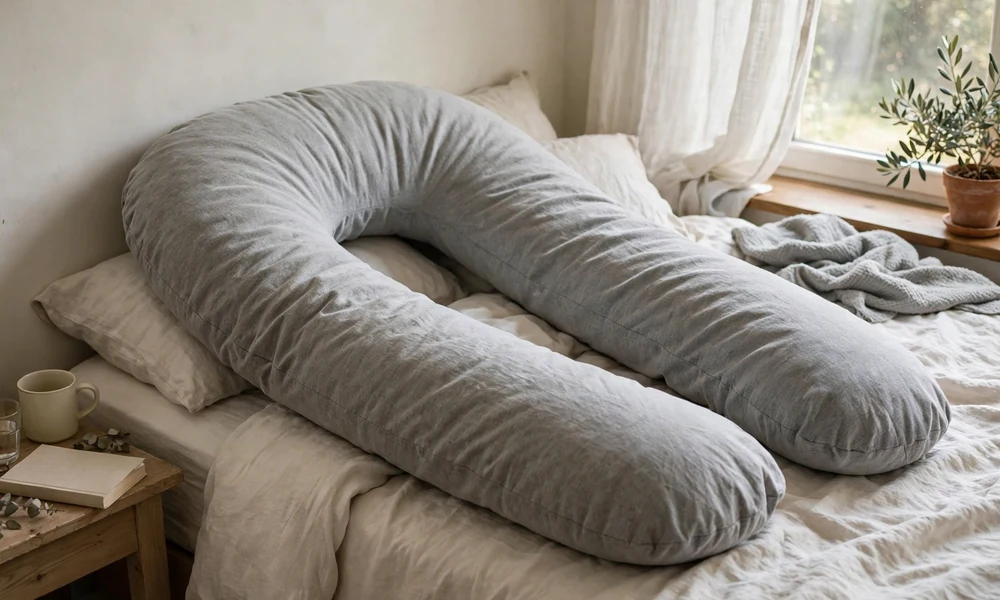
A U-shaped pillow wraps around both sides of your body, supporting your back as well as your front. It is the favourite for pregnancy, when rolling over is difficult, and for restless sleepers who change sides during the night. The trade-off is size: it takes up a lot of bed, and suits a double bed better than a single.
J-Shaped
A J-shaped pillow is a straight pillow with a curved hook at one end, which supports your head and neck while the long section runs down your body. It suits sleepers who want head support built in, and people who find a full U-shape too much pillow. The hook also works as a cushion for reading in bed.
C-Shaped
A C-shaped pillow curves around your body in a single arc, supporting your head, back and knees at once. It is popular in pregnancy and for anyone recovering from an injury, because it cradles the body without needing to be rearranged when you turn. Like the U-shape, it is large, so measure your bed first.

Body Pillow Comparison
| Shape | Best for | Typical length | Watch out for |
|---|---|---|---|
| Straight | Side sleepers, first-timers | 120 to 140 cm | Can slide away at night |
| U-shaped | Pregnancy, restless sleepers | 140 cm across | Takes up a lot of bed |
| J-shaped | Head and neck support | 130 to 150 cm | Hook may not suit all sleepers |
| C-shaped | Pregnancy, recovery | 140 cm around | Large and hard to store |
Choosing the Fill
The fill decides how the pillow feels, how long it holds its shape, and how warm you sleep. There is no single best fill, only the best fill for you.
Memory Foam
Memory foam moulds to your body and holds its shape through the night, which makes it the most supportive fill. It suits people with back, hip or shoulder pain, and anyone who wants the pillow to stay where it is put. It sleeps warmer than other fills, so look for ventilated or gel-infused foam if you run hot.
Down Alternative
Down alternative, usually microfibre, is soft, light and huggable, and it feels closest to a traditional pillow. It suits sleepers who want comfort rather than firm support, and it is the easiest fill to wash and dry. The trade-off is that it flattens faster than foam, so it needs regular plumping.
Latex
Natural or blended latex is springy, cool and durable, and it holds its shape for years. It suits hot sleepers and anyone who dislikes the sinking feeling of memory foam. Latex body pillows cost more and are heavier to move, but they are the longest-lasting option.
Shredded Foam
Shredded foam is adjustable: you can add or remove fill to make the pillow firmer or softer, which makes it the best choice if you are unsure what firmness you want. It is also cooler than solid foam. The downside is that it can clump over time, so it needs shaking out.
Size, Covers and Washing
Size matters more than most buyers expect. A pillow that is too short will not reach both your chest and your knees, which defeats the purpose. Measure from your shoulder to your knees while lying on your side, and choose a pillow at least that long. Most adults need 120 to 140 centimetres for a straight pillow. If you are tall, look for an extra-long option rather than settling for a standard length.
The cover is almost as important as the pillow. Choose a removable cover that unzips fully, so you can wash it every week or two, and look for cotton or bamboo, which breathe better than polyester and feel cooler. A body pillow without a removable cover is hard to keep fresh, because the pillow itself rarely fits in a home washing machine. Our guide to the best pillowcases explains which fabrics stay coolest through the night.
Washing needs a plan. Most fills can be spot-cleaned, and some down-alternative pillows can be machine washed on a gentle cycle, but memory foam and latex should never go in a washing machine. Check the label before you buy, and if in doubt, protect the pillow with a washable cover underneath. Air the pillow regularly, and replace it when it no longer springs back.
Who Benefits Most
Side sleepers benefit most, because the pillow directly fixes the alignment problems side sleeping creates. Pregnant sleepers are the second group, because a U or C-shaped pillow supports the belly, the back and the knees at once, and many find it the only way to sleep comfortably in the later months. People with lower-back pain, hip pain or a recent injury also benefit, because the pillow reduces twisting and takes pressure off sore joints.
Body pillows also help people who sleep alone in a large bed and miss having something to lean against, and anyone recovering from surgery who needs to keep a limb supported. They are less useful for strict back sleepers, who usually need a thinner pillow under the knees instead, and for stomach sleepers, who may find a long pillow gets in the way. If you are unsure, a straight pillow is the cheapest way to test the idea, and our round-up of the best pillows will help you sort the head pillow at the same time.

Mistakes to Avoid
The most common mistake is buying too short. A pillow that ends at your waist leaves your knees unsupported, which is where most of the benefit comes from. The second mistake is choosing by softness alone in the shop: a pillow that feels lovely for thirty seconds may flatten under your weight all night.
The third mistake is skipping the washable cover, which turns a pillow you love into one you cannot keep clean. The fourth is giving up after one night. Sleeping with a long pillow feels strange at first, and most people need four or five nights before it feels natural. Give it a full week before you decide it is not for you.
Body Pillow Checklist
- Length measured from shoulder to knees, usually 120 to 140 centimetres.
- Shape matched to how you sleep: straight, U, J or C.
- Fill chosen for firmness and temperature, not just softness.
- Removable, washable cover in cotton or bamboo.
- Washing instructions checked before buying.
- One full week of trial before judging it.
Frequently Asked Questions
How long should a body pillow be?
Long enough to run from your chest to your knees while you lie on your side, which is 120 to 140 centimetres for most adults. Tall sleepers should look for an extra-long option rather than settling for a standard length.
Are body pillows good for back pain?
They can help, especially for side sleepers, because the pillow keeps the hips level and stops the top leg from twisting the lower back. A medium-firm memory foam or latex fill gives the most support. A body pillow is not a treatment, though, and if your back pain is severe or persistent, speak to a doctor.
Can I wash a body pillow?
It depends on the fill. Many down-alternative pillows can be machine washed on a gentle cycle, but memory foam and latex should only be spot-cleaned and aired. The cover should always be removable and washable. Always check the label before washing.
Do body pillows help in pregnancy?
Yes, and they are one of the most recommended sleep aids in pregnancy. A U or C-shaped pillow supports the belly, the back and the knees at the same time, and helps side sleeping, which is the advised position in later pregnancy.
How often should I replace a body pillow?
Every two to three years for most fills, or sooner if it no longer springs back or has lumps that will not smooth out. Latex pillows last longer, often four to five years.
Can a body pillow make me sleep hot?
It can, because a long pillow against your body traps heat. Memory foam sleeps warmest, while latex and down alternative sleep cooler. A cotton or bamboo cover helps, as does keeping the bedroom cool.
The Bottom Line
A good body pillow in 2026 is a simple idea done well: long enough to support your chest, arms and knees, in a shape that fits how you sleep, with a fill that holds its shape and a cover you can wash. Measure first, choose the shape before the brand, and give it a week.