How to pick moving boxes that survive the trip in 2026 comes down to three things: the right sizes, cardboard strong enough for the weight inside, and packing habits that keep the box from bursting at the worst moment. Moving boxes look like the simplest part of a move, yet the difference between a good box and a bad one shows up on the stairs: one carries a load of books without complaint, while the other splits at the bottom and drops everything on the landing.
Key Takeaways
- Small boxes are for heavy things like books, medium boxes are the workhorse, and large boxes are only for light, bulky things like bedding.
- Double-wall cardboard is worth the extra cost for books, dishes, and anything heavy or fragile.
- Check the edge crush test rating: a higher ECT number means a stronger box that can be stacked without collapsing.
- Never pack a box heavier than about 20 kilograms, and tape the bottom with an H pattern, not a single strip.
- Count your rooms before you order: a one-bedroom flat needs around 20 boxes, a three-bedroom house needs 60 or more.
What Makes a Moving Box Different
A moving box is not just any cardboard box. It is made from corrugated cardboard of a known strength, in sizes designed to stack neatly in a van, and with flaps that fold into a flat, tapeable base. A supermarket box or an old delivery box might look similar, but it has already been through one journey, its cardboard is often single-wall and tired, and its size is whatever it happened to be. Moving boxes are built for the job, and the difference shows when they are stacked three high in a van on a hot day.
The key measure is the edge crush test, or ECT. It measures how much pressure the cardboard can take on its edge before it collapses, and it is printed on most proper moving boxes. A box rated 32 ECT is the standard for general moving: strong enough to stack and to carry a normal load. A box rated 44 ECT or higher is heavy-duty, and it is what you want for books, dishes, and anything that will sit at the bottom of a stack. If a box has no rating printed on it, treat it as light-duty and do not trust it with anything heavy.
The Main Types of Moving Boxes
Most moves need a mix of standard sizes plus a few specialist boxes. Buying one size in bulk is the most common mistake: a house packed into large boxes alone will be full of boxes too heavy to lift, and a house packed into small boxes alone will take twice as long to load.
Small Boxes
Small boxes, roughly 40 by 30 by 30 centimetres, are for heavy things: books, records, tools, tins, and jars. A small box full of books is already heavy, and that is the point: the size stops you overfilling it. If you pack books into a large box, no one will be able to lift it, and the box will probably burst.
Medium Boxes
Medium boxes, roughly 45 by 45 by 40 centimetres, are the workhorse of the move. They suit most household goods: kitchenware, toys, clothes, shoes, and general clutter. Buy more medium boxes than any other size, because they are the ones you will reach for in every room.
Large Boxes
Large boxes, roughly 60 by 45 by 45 centimetres, are for light, bulky things only: bedding, pillows, lampshades, towels, and soft toys. A large box full of books is a back injury waiting to happen, and a large box full of dishes is a disaster. Use large boxes for volume, never for weight.
Dish Packs and Specialty Boxes
Dish packs are extra-strong double-wall boxes with dividers, made for plates, glasses, and crockery. They cost more than a standard box, but they are the cheapest insurance for a set of plates. Wardrobe boxes are tall boxes with a hanging rail, so clothes travel on their hangers instead of folded in a bag. For the clothes you care about, the wardrobe boxes that protect clothes in a move are worth every penny. Picture boxes are flat, adjustable boxes for framed art and mirrors, and they are the only safe way to move a large framed picture.
Moving Boxes Compared
| Box type | Typical size | Best for | Weight limit | Watch out for |
|---|---|---|---|---|
| Small box | About 40 x 30 x 30 cm | Books, tools, tins | About 20 kg | Too small for bulky items |
| Medium box | About 45 x 45 x 40 cm | Kitchenware, toys, clothes | About 20 kg | Can get heavy with books |
| Large box | About 60 x 45 x 45 cm | Bedding, pillows, lampshades | About 15 kg | Never fill with books |
| Dish pack | About 45 x 45 x 45 cm | Plates, glasses, crockery | About 20 kg | Costs more per box |
| Wardrobe box | About 120 cm tall | Hanging clothes | About 20 kg | Awkward in narrow halls |
| Picture box | Adjustable, flat | Framed art, mirrors | Light | Needs corner protectors |
How Many Boxes Do You Need
The honest answer is more than you think. Most people underestimate by a third, and the shortage is always discovered on the last evening before moving day. A rough guide: a studio or one-bedroom flat needs around 20 to 25 boxes, a two-bedroom home needs 35 to 45, and a three-bedroom house needs 60 to 80. Those numbers include the specialist boxes, and they assume you have already cleared out the things you do not want to take with you.
Packing a Box So It Survives
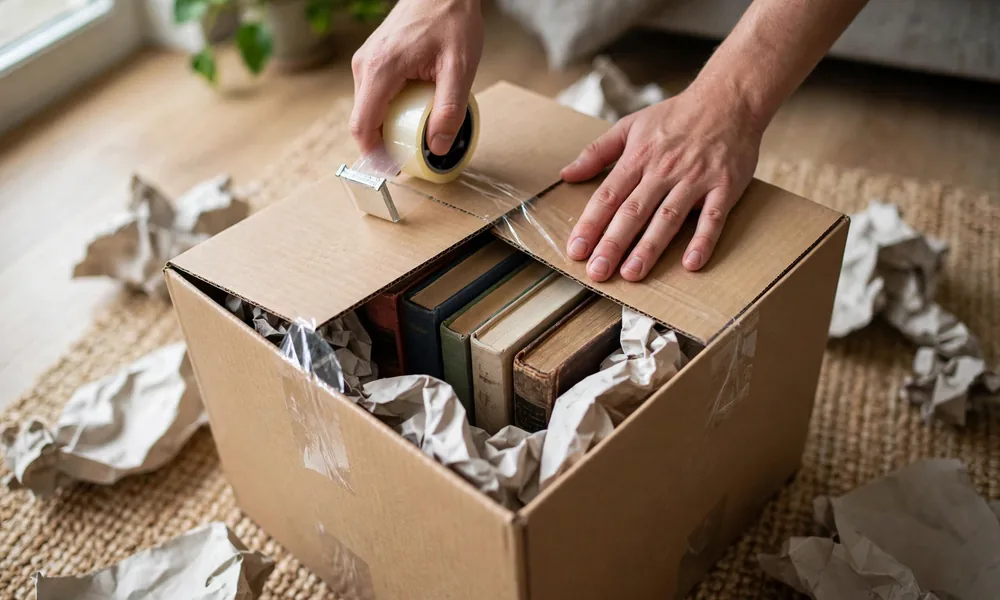
Start with the base. Fold the bottom flaps in, then tape the centre seam with two strips of packing tape, and run a strip across each edge to form an H pattern. A single strip down the middle is not enough for a heavy box: it peels, the flaps open, and the contents fall out. The H pattern is the single best habit in all of moving.
Pack heavy things at the bottom and light things on top, and fill every gap. A box that is half empty will crush when another box is stacked on it, and its contents will shift and break in transit. Crumpled packing paper, towels, or soft clothes make good filler, and they are better than leaving air. Do not overfill either: a box that will not close flat cannot be stacked, and its flaps will tear.
Wrap fragile items individually. Plates should be wrapped one by one and packed on their edges, like records, not stacked flat: a plate on its edge is far stronger than a plate lying flat. Glasses should be wrapped and packed upright with paper between them. Label every box on two sides with the room it belongs to and a short note of what is inside, plus the word fragile where it applies. Labelling saves hours at the other end, because boxes go straight to the right room instead of piling up in the hall.
New, Used, or Recycled Boxes
New boxes are the safest option for a move that matters. They are clean, dry, full-strength, and a known size, so they stack properly in the van. They cost more, but the cost of a burst box full of dishes is far higher.
Used boxes can work if you choose them carefully. Take them only from a dry, clean source, check that the cardboard is not damp, torn, or already crushed, and never reuse a box that carried something heavy or wet. Supermarket boxes are free, but they are often damp, oddly sized, and already weakened, so use them only for light, unbreakable things. Never use a box that smells of food or chemicals, and never trust a used box with anything fragile.
After the Move: What to Do With the Boxes
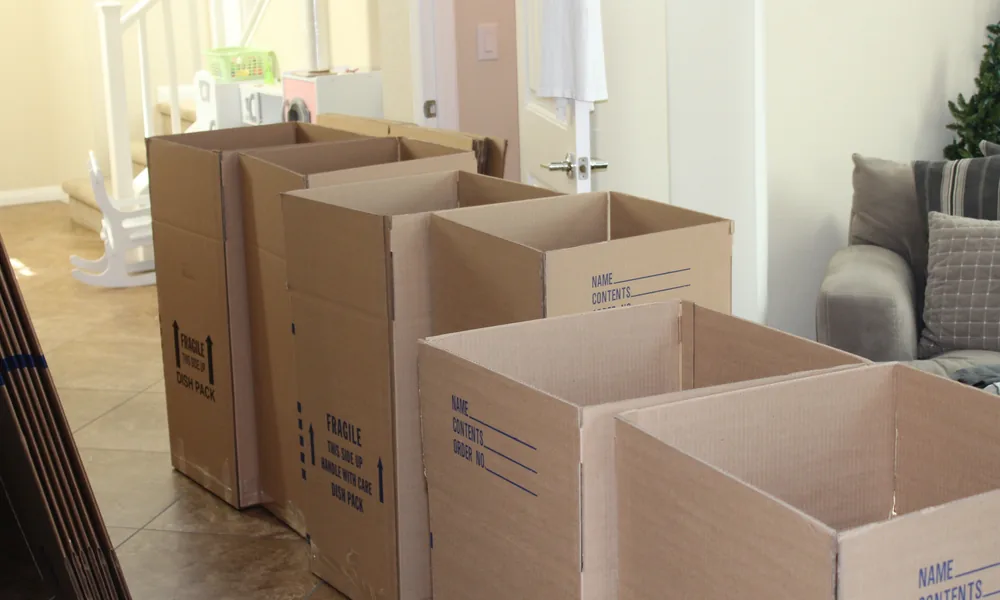
Unpack the essentials first: the box with the kettle, the bedding, the toiletries, and the phone chargers. Then work room by room, flattening each box as you empty it so the pile does not take over the house. A flattened box stacks neatly against a wall, and a room full of empty boxes is far easier to live with than a room full of open ones.
Keep a few boxes back for storage. The boxes that held seasonal clothes or spare bedding can go straight into storage rather than being unpacked and repacked, and under-bed storage that hides the clutter is a good home for the flatter boxes and the things you only need twice a year. For the garage, a proper system beats a pile of boxes: the garage storage systems that hold heavy gear keep the boxes you keep off the floor and easy to reach.
Mistakes That Break Boxes and Backs
Packing books into large boxes is the classic mistake, and it breaks both the box and the person carrying it. Packing dishes flat instead of on edge is the second, and it breaks the dishes. Skipping the H tape pattern is the third, and it breaks the box at the bottom, which is the worst place for a box to fail.
Moving Box Checklist
- Buy a mix of sizes: small for heavy things, medium for everyday things, large only for light and bulky things.
- Choose double-wall boxes rated 32 ECT or higher for books, dishes, and anything heavy or fragile.
- Count room by room before ordering, then add a few spare boxes for the last-minute packing.
- Tape the base with an H pattern, pack heavy things at the bottom, and fill every gap with paper.
- Keep every box under about 20 kilograms, and label the room and contents on two sides.
- Flatten and recycle or pass on boxes after the move, and never store empty boxes somewhere damp.
Frequently Asked Questions
How many moving boxes do I need for a two-bedroom home?
Plan for 35 to 45 boxes, mostly medium, with about 10 small, 10 large, 2 dish packs, and 2 wardrobe boxes. Count room by room to be accurate, and add a few spares: most people underestimate by a third.
What is the difference between single-wall and double-wall boxes?
Single-wall cardboard has one layer of corrugated fluting and suits light loads. Double-wall has two layers, which makes the box far stiffer and harder to crush. For books, dishes, and anything heavy or fragile, double-wall is worth the extra cost.
Can I reuse old delivery boxes for moving?
For light, unbreakable things, yes, if the box is dry, clean, and undamaged. For anything heavy or fragile, buy proper moving boxes: delivery boxes are often single-wall, already weakened, and oddly sized, so they stack badly and burst more easily.
How heavy can I pack a moving box?
Keep it under about 20 kilograms. If you cannot lift the box comfortably with both hands, it is too heavy. Heavy things belong in small boxes, which stop you overfilling them.
Should I buy dish packs or use normal boxes for plates?
Buy dish packs for plates and glasses you care about. They are double-wall boxes with dividers, and they are the cheapest insurance for a set of crockery. Pack plates on their edges, wrapped individually, with paper between them.
Where can I get rid of moving boxes after the move?
Flatten them and recycle them, or offer them to local community groups, where clean moving boxes are always in demand. Keep a few back for storage, but do not store them somewhere damp, or they will be useless next time.
The Bottom Line
The best moving boxes in 2026 are a mix of small, medium, and large double-wall boxes rated 32 ECT or higher, with dish packs for the kitchen and wardrobe boxes for hanging clothes. Pack heavy things small, tape the base in an H pattern, keep every box under 20 kilograms, and label everything. Do that, and the boxes become the easiest part of the move instead of the thing that breaks on the stairs.