
Under-Bed Storage That Hides the Clutter in 2026
Under-bed storage that hides the clutter in 2026 turns the most wasted space in the bedroom into a whole extra drawer, without a single new piece of furniture. The gap under a bed is usually a dusty strip of floor, but it is also the largest empty rectangle in most bedrooms. A low box that slides under it holds the out-of-season clothes, the spare bedding and the shoes spilling out of the wardrobe.
Most people buy under-bed storage the wrong way round. They fall for a pretty box, bring it home, and then discover it is two centimetres too tall to slide under the bed, or that it has no lid and fills with dust. This guide works the other way, starting with the gap under your bed. Measure first, buy second.
Key Takeaways
- Measure the clearance before you buy: a box one centimetre too tall will not slide under at all.
- Low-profile boxes on wheels are the easiest to use: pull them out with one hand.
- Lids matter under a bed more than anywhere else, because the floor there collects dust.
- Store seasonal things under the bed, not everyday things, so you only open the boxes twice a year.
- One box, one category, with a label on the end you see, keeps under-bed storage from becoming a hidden junk drawer.
Why the Space Under the Bed Matters
A bedroom does not get messy because people own too much. It gets messy because the things they own have nowhere sensible to live, so they end up on chairs and in piles on the floor. The wardrobe holds the clothes you wear now, and everything else needs a home out of sight but still reachable.
The other advantage is that under-bed storage is invisible when it works. A storage system on a shelf is always on show, and it has to look good as well as work well. A box under the bed only has to work, so you can choose it for practical reasons: a lid that seals, wheels that roll, a height that fits.
Measure First: The Clearance Rule
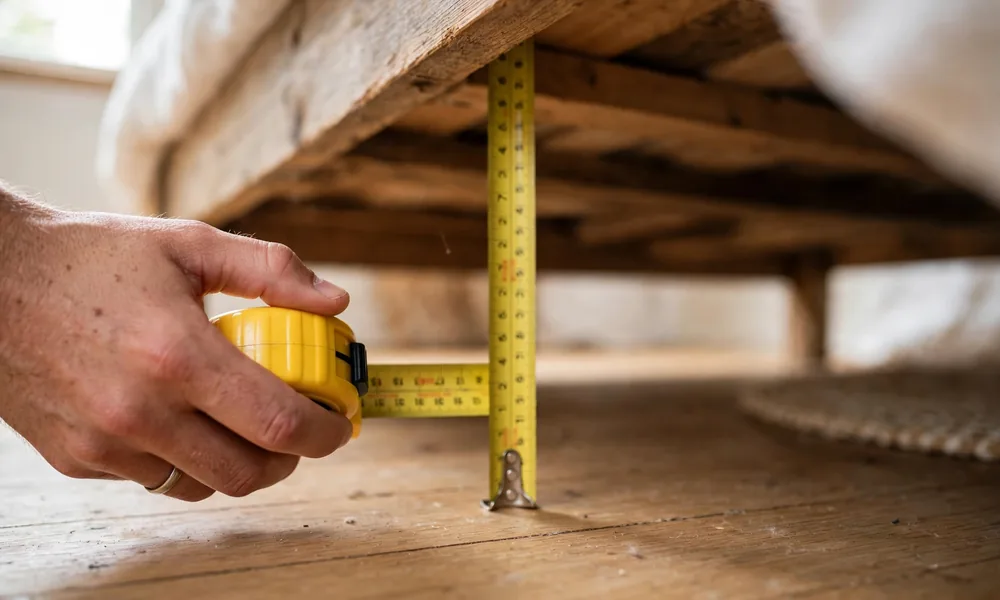
Every under-bed storage decision starts with a tape measure and three numbers: the height of the gap, the depth, and the length along the side of the bed. The height is the one that catches people out. A divan base can sit as low as ten centimetres off the floor, a standard frame is usually fifteen to twenty, and a tall frame can be thirty or more. Measure at the lowest point.
Once you have the height, subtract two centimetres for clearance, and that is the tallest box you can buy. A box that fits exactly will scrape and stick. Check the depth too, because a box deeper than the gap sticks out, and check the length, because two shorter boxes are almost always easier to pull out than one long one that weighs a fortune when full.
The Under-Bed Storage Types Worth Knowing
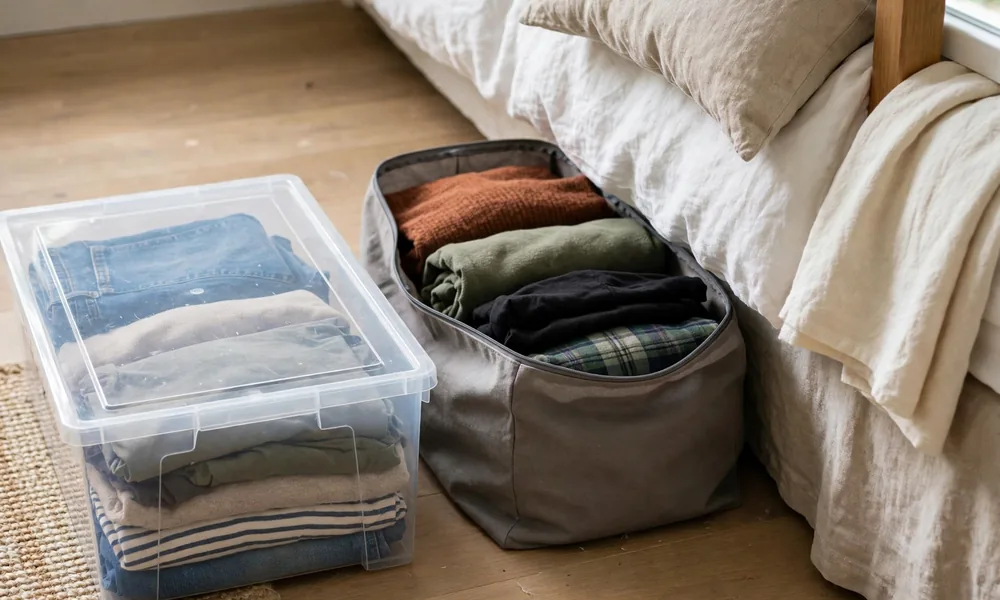
Under-bed storage comes in four main forms, for different gaps and budgets. A rigid box and a soft bag behave completely differently under a bed, and choosing the wrong one is how a tidy idea becomes a dusty mess.
Rigid low-profile boxes with lids
The workhorse. A rigid plastic box, long and low with a snap-on or hinged lid, is the right answer for most under-bed storage. The lid keeps dust out, the rigid walls stop the contents being crushed, and a clear box lets you see what is inside without pulling it out.
Soft fabric bags with zips
Soft under-bed bags are for the gaps that rigid boxes cannot fit, especially under low divan beds where every centimetre counts. A fabric bag squashes down to fit a ten-centimetre gap, folds flat when empty, and weighs almost nothing. The trade-off is structure: a soft bag sags, it cannot be stacked, and it offers less protection against damp and dust.
Rolling drawers and wheeled frames
Rolling under-bed drawers are the closest thing to adding a real drawer to your bed. They are usually a low wooden or plastic drawer on castors, sometimes sold as a pair to match a divan base, and they pull out smoothly like a chest of drawers. They cost more than a box or a bag, but they are the easiest to use every day, which makes them right for things you reach for weekly, such as shoes or spare bedding.
Vacuum bags for bulky soft things
Vacuum bags are not storage boxes, but they are the trick that makes under-bed storage hold twice as much. A spare duvet, a pile of winter jumpers or a set of bulky coats takes up a third of the space once the air is sucked out. Use them inside a rigid box or a fabric bag, not on their own, because a bare vacuum bag is easily punctured by a bed slat.
Under-Bed Storage Compared
| Storage type | Best for | Watch out for | Price in 2026 |
|---|---|---|---|
| Rigid box with lid | Most beds, seasonal clothes | Too tall for low beds | Low to mid |
| Soft fabric bag | Low divan beds, light items | Sags, less dust protection | Low |
| Rolling drawer | Weekly-use items, shoes | Bad on thick carpet | Mid to high |
| Vacuum bag inside a box | Bulky duvets and coats | Can puncture | Low |
| Flat shoe organiser | Shoes and boots | Needs a lid to stay dust-free | Low |
What to Store Under the Bed, and What Not To
Under-bed storage works best for things you need a few times a year. Out-of-season clothes are the classic case: winter coats in summer, summer dresses in winter, the jumpers you will want again in three months. Spare bedding is the second, because a spare duvet and a set of sheets are bulky and rarely needed. Shoes you wear occasionally are the third, along with spare blankets and guest bedding.
What does not belong under the bed is almost as important. Everyday clothes do not, because pulling a box out every morning is a chore that lasts a week before the clothes end up on a chair instead. Heavy things do not, because a box full of books is too heavy to slide out. Anything damp, anything that needs air, and anything valuable or fragile does not either.
Keeping Dust Out and Clothes Fresh
Dust is the real enemy of under-bed storage, because the floor under a bed is rarely vacuumed and the air barely moves. A lid is the first defence, and it needs to fit properly, not just rest on top. A clear rigid box with a snap-on lid is the best protection, a zipped fabric bag is the next best, and an open box is barely protection at all. Wash or air the contents first, because a single damp item can make a whole box smell musty.
A few small habits keep the boxes fresh. Put a lavender sachet or a cedar block in each box, because it discourages moths, and check the boxes when the seasons change, airing the contents and wiping the boxes out before you refill them. Vacuum under the bed when the boxes are out, and never store anything still damp from the wash. If the rest of your storage needs the same treatment, our guide to storage bins worth buying for a tidier home in 2026 covers the bins for shelves, garages and lofts, while closet organizers that double your storage space in 2026 shows how to make the wardrobe itself hold more. Shoes deserve their own system too, and a guide to shoe organizers that actually save space in 2026 covers the same problem.
Seasonal Rotation: The System That Makes It Work
Under-bed storage only works as a system if you rotate it. Twice a year, when the seasons change, pull the boxes out, take out what you need, wash and fold what you are putting away, and put the boxes back. That one habit is the difference between storage that stays tidy and storage that becomes a hidden junk drawer, because a box that is never opened is a box whose contents are forgotten.
Labelling is what makes rotation painless. Put a label on the end of each box that faces out, so you can read it without pulling the box out, and keep the labels honest: winter jumpers, spare bedding, walking boots. One box, one category, no exceptions, because a mixed box is a junk drawer with a lid. Two boxes are usually enough for one person, and four for a couple.

The Mistakes That Fill the Gap With Junk
The first mistake is buying before measuring, because a box that does not fit ends up in the garage. Measure the gap, subtract two centimetres, and buy to those numbers. The second mistake is buying boxes with no lids, because an open box under a bed fills with dust in weeks. The third is filling the boxes with things you use every day, because the daily drag of pulling a box out wears out the habit, the wheels and your patience, all at once.
The fourth mistake is overfilling. A box stuffed so full that the lid will not close cannot slide under the bed, and a box too heavy to pull out will stay put until moving day. Leave a little room at the top, and remember that under-bed storage is for the overflow, not for everything you own. The fifth mistake is forgetting the boxes exist, which is why the label and the seasonal reminder matter more than the box itself.
Your Under-Bed Storage Checklist
- Measure the gap first: height, depth and length, then subtract two centimetres from the height.
- Choose the type by the gap: rigid boxes for most beds, soft bags for low divans, rolling drawers for weekly use.
- Store seasonal things only, one category per box, with a label on the end.
- Use lids that seal, and vacuum bags for bulky soft things; never store anything damp.
- Vacuum under the bed and wipe the boxes out when you rotate them.
- Keep the weight manageable, leave a little room at the top, and set a reminder for the swap.
Frequently Asked Questions
How much clearance do I need under my bed for storage?
Measure the gap at its lowest point, then subtract two centimetres. Most standard frames give fifteen to twenty centimetres, low divans as little as ten, and tall frames thirty or more.
Are under-bed storage boxes better than bags?
Rigid boxes protect better against dust and crushing and slide out more easily, so they suit most beds. Soft bags fit lower gaps and fold flat when empty, so they suit low divan beds and light items.
What should I store under my bed?
Out-of-season clothes, spare bedding, spare blankets and shoes you wear occasionally. Avoid everyday clothes, heavy items, anything damp, and anything fragile or valuable.
How do I stop under-bed storage getting dusty?
Use boxes with lids that seal or bags with a full zip, store only clean dry items, and vacuum under the bed when you rotate the boxes twice a year.
Can I store shoes under the bed?
Yes, and a low flat shoe organiser with a lid is ideal for shoes you wear occasionally, such as walking boots or formal shoes. Clean the shoes first and keep pairs together.
Do vacuum bags work under a bed?
Yes, used inside a rigid box or a fabric bag, where they protect bulky duvets and coats and cut their size by about two thirds. Never use a bare vacuum bag on its own, because it can be punctured by a bed slat.
The Bottom Line
Under-bed storage that hides the clutter in 2026 is not about the prettiest boxes. It is about measuring the gap, choosing a low box with a lid that fits, and storing seasonal things in it, one category per box, with a label you can read without pulling it out. Measure first, rotate twice a year.


