Why a Good Bike Lock Is Worth the Weight in 2026
A good bike lock is the least glamorous thing you will buy for your bicycle, and the one that decides whether it is still there when you come back. A weak cable lock can be cut in seconds, in daylight, while people walk past. The locks worth their weight in 2026 make a thief look at your bike, look at the lock, and move on to an easier target.
Weight is the honest trade-off here. A lock that weighs almost nothing is easy to carry and easy to defeat, while one that genuinely resists attack is heavy because it is hardened steel. Buy the right amount of security for where you park, and carry it in a way that makes the weight disappear. The right lock also depends on where you park, and it must be one you will actually use, because a superb lock left at home protects nothing.
Key Takeaways
- A U-lock with a hardened steel shackle is the best all-round daily lock: it resists bolt cutters and leverage far better than a cable.
- Match the lock to the risk: a quick cafe stop needs far less security than an all-day park at a station.
- Always lock the frame, not just a wheel, to something fixed, solid and taller than the lock.
- A second lock, even a light one, makes your bike a much less attractive target.
- The weight is worth it only if you carry the lock properly: a frame mount beats one swinging from the handlebars.
What Makes a Bike Lock Worth Its Weight
A bike lock earns its weight in its steel. The shackle or chain of a good lock is hardened steel, heat-treated to resist cutting, sawing and bending. A cheap lock looks similar, but its steel is soft, and bolt cutters go through it like scissors through ribbon. A lock that feels suspiciously light for its size is usually soft steel or a thin core hidden under thick plastic.
The locking mechanism matters just as much as the steel. A good lock uses a disc-detainer or well-made pin-tumbler cylinder that resists picking, and a key that cannot be copied at an ordinary stall. A good cylinder has a cover that keeps rain and grit out, so the keyway does not jam in winter.
Size is the third thing to judge. A lock that is too large leaves room for a thief to fit a jack or lever inside the shackle, while one too small will not fit around the frame and the stand. The best U-locks leave only a finger’s width of space once closed, because a tight fit gives a thief nothing to work with.
The Main Types of Bike Lock Compared
Every lock type is a compromise between security, weight and convenience.
| Type | Best for | Strength | Weakness |
|---|---|---|---|
| U-lock (D-lock) | Daily commuting and city parking | Hardened shackle resists cutters and levers | Heavy; only fits certain stands |
| Chain lock | Awkward stands and long-term parking | Flexible; reaches around thick posts | The heaviest type; awkward to carry |
| Folding lock | Riders who want security without bulk | Compact; folds flat in a frame mount | Less strong than a U-lock of the same weight |
| Cable lock | Quick stops and locking accessories | Light; flexible; very cheap | Cut in seconds; never use alone |
| Armoured cable lock | Low-risk areas and short stops | Lighter than a chain; harder to cut than cable | Steel links can be prised apart |
| Frame lock | Quick stops in safe areas | Built into the bike; always there | Only locks the wheel; bike can be carried away |
The U-lock is the best all-round choice, giving the most security per kilogram. A chain suits thick posts a U-lock cannot reach, and a folding lock is the best compromise in a neat frame-mounted package.
U-Locks: The Best All-Round Bike Lock
The U-lock, also called a D-lock, is a hardened steel shackle closed by a crossbar. The shackle is a solid bar, usually 13 to 16 millimetres thick, and the crossbar holds both ends, so a thief must cut the steel twice to free the bike. Two cuts in hardened steel take time, noise and tools that attract attention.
Buy the thickest shackle you will carry, hardened all the way through, with a security rating from an independent testing body. A small U-lock is stronger than a large one of the same model, because the shorter shackle leaves less room for a lever.
A lock rattling in a bag damages the bike, and one hanging from the handlebars changes the steering. The best answer is a frame mount, which holds the lock along the seat tube or top tube, where its weight sits low and central.
Chain Locks and Folding Locks
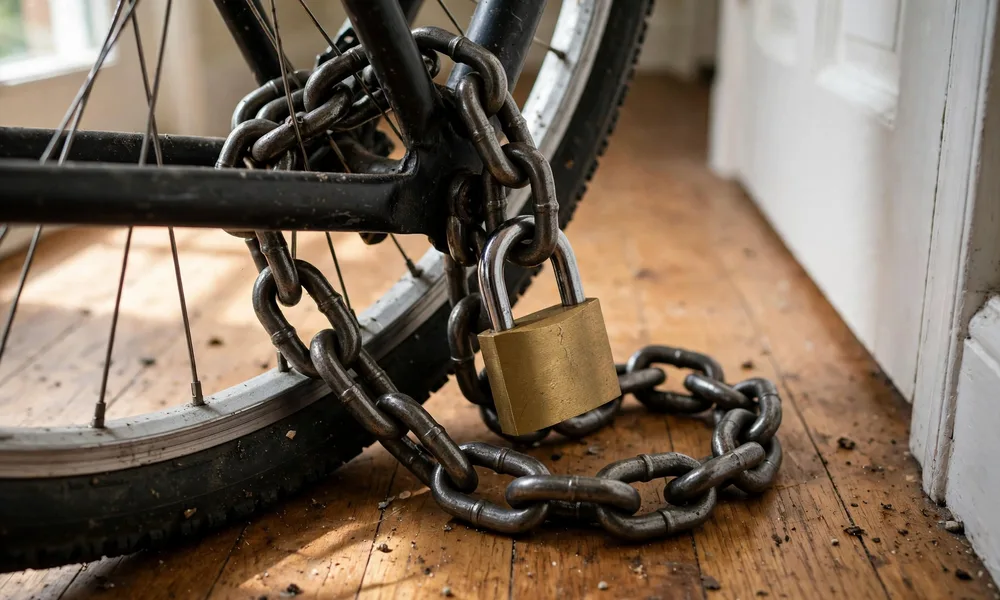
A chain lock is hardened steel chain inside a fabric sleeve, closed by a padlock. It wraps around anything, from a thick lamp post to a chunky stand, and can lock both wheels and the frame in one loop. Its disadvantage is weight: a strong chain weighs well over two kilograms. It suits riders who park in the same place daily and can leave the chain locked to the stand overnight.
A folding lock is steel plates joined by rivets, folding into a compact bundle that mounts neatly on the frame. It weighs less than a chain and rides more neatly than a U-lock, so it is the lock many riders actually use. Its weak point is the rivets, so buy thick plates and a good rating.
Both need the same care: keep the mechanism clean, oil the keyway occasionally, and never let the lock drag on the ground. Wipe it down after wet rides and store it somewhere dry.
The Worst Bike Locks: What to Avoid
The worst bike lock is the thin cable lock. It is a steel cable inside a plastic sleeve, and it can be cut in seconds with cutters small enough to fit in a jacket pocket, almost silently. As a second lock for a front wheel it is fine, but as the only lock it is barely better than none.
The second failure is a cheap cylinder. A four-digit combination has only ten thousand possibilities, and a thief who can feel the dials can open one quickly. If the lock costs less than a decent meal, the cylinder is almost certainly the weak point, and no amount of thick steel will save it.
The third failure is a lock that is too big. The empty space inside an oversized U-lock is exactly what a thief needs to fit a bottle jack and pop it open. Buy the smallest lock that fits, keep the fit tight, and fill any space with a second lock or a cable through the front wheel.
How to Lock Your Bike So It Stays There
Always lock the frame to the stand, never just a wheel, because a wheel comes off with a quick-release in seconds. If the stand allows it, lock through the rear wheel and the frame together. Lock to something fixed, solid and taller than the lock: a Sheffield stand, a thick railing or a purpose-built rack. Never lock to a signpost that can be lifted out, a short post the bike can be lifted over, or a thin railing that can be cut.
Park where people walk past, in good light, with the lock visible. Thieves prefer quiet corners where they can work unwatched. Take anything that comes off quickly, such as lights or a saddlebag, because those disappear first. With quick-release wheels, use locking skewers or a second cable through the front wheel.
The rest of your kit plays a part too. A good light keeps you visible on the way home after dark, and our guide to the best and worst bike lights of 2026 covers which ones actually last a winter. And if you are still choosing a bike, our guide to the best and worst bicycles of 2026 explains what separates a bike worth locking up from one that is not.

Matching a Lock to Where You Park
A short stop outside a cafe, with the bike in sight, needs very little security. The risk rises the moment the bike is out of sight, and again with the time it is left alone: ten minutes buying bread is very different from nine hours outside a station, and overnight in a city centre is the hardest test of all.
For daily commuting, a U-lock is the right answer, ideally paired with a cable through the front wheel. For overnight parking, use two serious locks of different types, such as a U-lock and a chain: a thief equipped to defeat one may not defeat both, and two locks take twice as long. For a bike you cannot replace, buy a higher rating than you think you need.
A rack on the car gets the bike to the trail, and our guide to the best bike racks for cars in 2026 covers which ones hold the bike steady without damaging the frame. The lock takes over once you arrive, and one that rides on the frame is ready the moment you lift the bike off the rack.
Buying Checklist: Six Checks Before You Pay
- Check the security rating from an independent testing body, and buy the highest rating you can afford.
- Measure the stands where you usually park, and buy the smallest lock that fits around the frame and the stand.
- Feel the weight: a lock that feels suspiciously light is probably soft or hollow steel.
- Test the key in the shop: it should turn smoothly, and the cylinder should have a rain cover.
- Check how the lock carries: it should sit firmly without rattling or swinging.
- Confirm the fit at home: lock the bike to your usual stand on day one, and return the lock if it does not reach or leaves too much space.

Frequently Asked Questions
Is a U-lock better than a chain lock?
For most riders, yes: a U-lock gives more security per kilogram, carries better on the frame, and resists leverage attacks. A chain is better only for thick posts or awkward stands a U-lock cannot reach.
How heavy should a good bike lock be?
A serious U-lock weighs one to two kilograms, and a strong chain weighs more than two. A lock claiming high security at under a kilogram should raise suspicion: the steel is probably thinner or softer than claimed.
Should I use two locks?
Yes, where the risk is high or the bike is left long: two locks of different types mean two sets of tools and twice as long, and most thieves will move on.
Where is the best place to lock a bike?
A busy, well-lit place with a proper bike stand. Avoid quiet corners, dark alleys, and anything the bike can be lifted over or the lock cut away from.
Do cable locks have any use at all?
Yes, as a second lock: a cable can secure a front wheel, helmet or saddlebag to a bike already locked with a U-lock or chain. It should never be the only lock on a bike left out of sight.
How do I look after a bike lock?
Keep it clean and dry, oil the keyway occasionally, and never let it drag on the ground. Wipe it down after wet rides, because road salt and grit make a good lock stiff and hard to open.
The Bottom Line
A good bike lock is worth the weight because the weight is the security: hardened steel, a strong cylinder and a tight fit keep a bicycle where you left it. Buy a U-lock for daily use, add a second lock where the risk is high, lock the frame to something solid, and carry the lock on the frame. The best lock is the one you use every time.