
The best cake pans for even bakes in 2026 are the ones you forget about once the oven door closes. A good pan does its job so quietly that all you notice is the result: a sponge that rises level, browns evenly, and slides out in one piece instead of tearing in half. A bad pan announces itself at every step: the corners burn while the middle stays pale, the cake sticks to the base, and the pan warps halfway through baking. The difference is rarely the recipe. It is the metal, the shape, and the weight of the pan underneath it.

Key Takeaways
- Heavy-gauge aluminised steel bakes the most evenly. Thin, lightweight pans create hot spots that burn edges while the centre stays underbaked.
- Light-coloured pans bake more gently than dark ones. A dark pan in a hot oven is the most common reason the bottom of a cake burns.
- An 8-inch or 9-inch round pan is the most useful size for everyday baking. Buy a pair of the same size for layer cakes first.
- Parchment on the base beats greasing alone. Line the bottom, grease the sides lightly, and most cakes release cleanly.
- Springform pans are for cheesecakes and delicate tortes, not everyday sponges. Their seams leak thin batters and bake less evenly than a solid pan.
What Makes a Cake Pan Bake Evenly
Even baking starts with how heat reaches the batter. A heavy pan spreads heat across its whole surface before it reaches the batter, so the edges and the centre bake at nearly the same rate. A thin pan passes oven hot spots straight through, leaving a cake that domes in the middle, browns hard at the rim, and stays damp in the centre.
Aluminised steel is the professional standard. It is steel coated in an aluminium-silicon alloy, combining the strength of steel with the even heat conduction of aluminium, and it browns a sponge more evenly than plain aluminium or thin non-stick steel. Warping is the enemy of an even bake: a pan that buckles lifts part of its base off the rack, and that section bakes slowly while the rest overbakes. If your cakes have ever come out lopsided, a warped pan is the first thing to check.
Colour matters just as much as metal. Dark pans absorb more radiant heat than light ones, so a cake in a dark pan browns faster and can burn on the bottom if the recipe was written for a light pan. Light-coloured pans bake more gently and forgive an oven that runs a little hot. If you bake in a dark pan, drop the temperature by about 10 degrees and check five minutes early.
The Best Cake Pans of 2026
The strongest cake pans of 2026 fall into five clear groups. Start with the round pans, because they handle nine out of ten cakes, and add the rest only when a recipe actually asks for them.
Best overall: heavy aluminised steel round pans
A pair of heavy aluminised steel round pans, 8-inch or 9-inch, is the default choice for serious home bakers. They bake evenly from edge to centre, resist warping, and release well with a parchment-lined base and a light greasing. Buy two, because layer cakes need two identical pans. They handle sponges, chocolate cakes, and carrot cakes, and they will still be baking evenly in five years if you treat them kindly. Look for a reinforced rolled rim, which resists warping and gives you something sturdy to grip with oven mitts.
Best non-stick: premium coated steel
A premium non-stick cake pan is the easiest to live with. Cakes release with a gentle tip, cleanup takes seconds under warm water, and you can bake with little or no greasing. The catch is durability. Non-stick coatings wear out, typically after two or three years, and fail faster with metal utensils, stacking without protection, or dishwasher cycles. Most non-stick pans are also dark, so drop the temperature slightly. Buy the best coating you can afford, use silicone or wooden tools, and hand-wash it every time.
Best for layer cakes and cheesecakes: springform pans
A springform pan has a removable base and a clasped side that opens, so a delicate cake comes out without being turned upside down. That makes it the right pan for cheesecakes, flourless tortes, and tall layer cakes that would break in a solid pan. The trade-off is the seam: thin batters can leak through the join, so set the pan on a baking sheet, and never expect a springform to bake as evenly as a solid pan. Buy one in your most-used size and keep solid rounds for everyday sponges.
Best for sheet cakes and brownies: square and rectangular pans
A 9-inch square pan or a 9-by-13-inch rectangular pan is the workhorse for sheet cakes, brownies, and traybakes. The straight sides give clean corners for slicing, and the larger surface bakes thinner cakes faster. Look for the same heavy-gauge aluminised steel as the round pans, because thin rectangular pans warp more visibly than round ones.
Best for showpiece cakes: bundt and tube pans
A bundt pan turns a plain batter into a cake that needs no decoration. The central tube carries heat into the middle of a deep cake, so a large bundt bakes through where a deep round pan would stay raw in the centre. The catch is release: every ridge is a place for cake to stick. Grease it thoroughly with a pastry brush, dust with flour, and let the cake cool for ten minutes before turning it out.
| Pan type | Best for | Evenness | Release | Care |
|---|---|---|---|---|
| Aluminised steel round | Everyday sponges | Excellent | Good with parchment | Hand wash |
| Premium non-stick | Easy cleanup | Very good | Excellent | Hand wash, no metal |
| Springform | Cheesecakes, tortes | Good | Excellent | Hand wash, check seal |
| Square / rectangular | Sheet cakes, brownies | Very good | Good with parchment | Hand wash |
| Bundt / tube | Showpiece cakes | Very good | Needs careful greasing | Hand wash, brush clean |
Best vs Worst: What Separates a Great Pan From a Bad One
The difference between the best and the worst cake pans shows up in the cake itself. A great pan gives you a level sponge with an even golden crust. A bad pan gives you a burnt rim, a pale sunken middle, and a base that tears when you try to lift it out. Most of that difference comes down to three things: weight, colour, and the state of the surface.
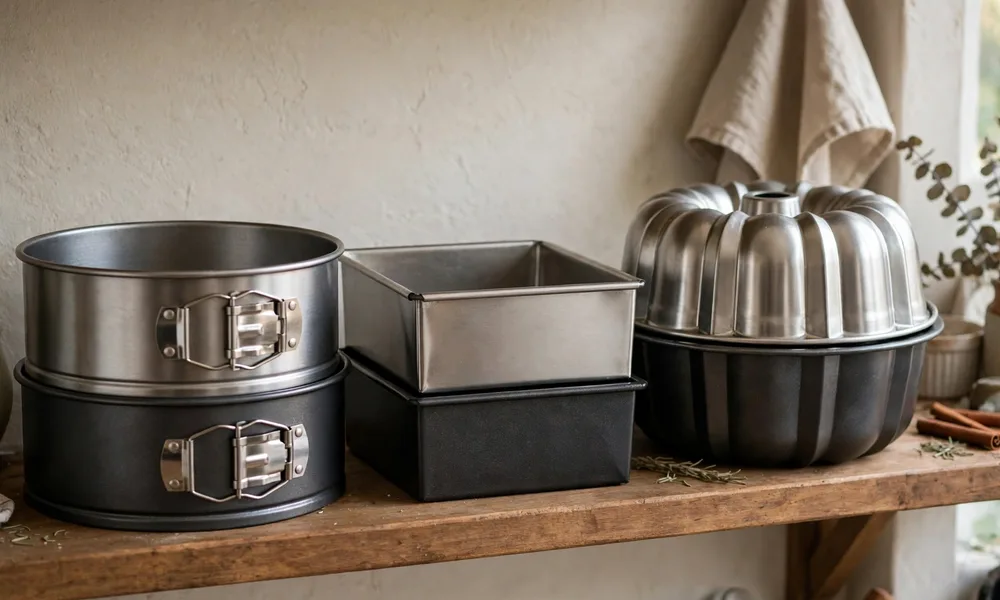
Weight is the first divide. A heavy-gauge pan spreads heat and holds its shape, while a thin bargain pan passes hot spots through and buckles in a hot oven. Judge it in the shop: pick the pan up. If it feels light and flimsy, it will bake like it feels. The same test applies across your bakeware, and the best muffin pans for 2026 follow the same rule: heavy steel bakes evenly, thin steel does not.
Colour is the second divide. The worst cake pan mistakes usually trace back to a dark, thin pan used at the temperature written for a light one. The edges dry out, the bottom burns, and the baker blames the recipe. If you already own dark pans, lower the temperature by 10 degrees, move the rack to the centre, and check the cake early.
Release is the third divide. A good pan releases a cake with a parchment-lined base and a light greasing. The worst pans hold on: the cake tears, the base stays in the pan, and you spend ten minutes scrubbing baked-on sponge out of the corners. Release gets worse as cheap coatings age, so replace any pan whose coating is scratched, flaking, or rusting.
How to Stop Cakes Sticking for Good
Even the best pan sticks sometimes, and the fix is usually preparation rather than a new purchase. Line the base with a round of parchment paper and grease the sides lightly with softened butter or baking spray. For a bundt pan, brush every ridge with melted butter and dust with flour, because a missed ridge is where the cake will tear.
Timing matters as much as preparation. Let a cake rest in the pan for ten minutes after baking, then run a thin knife around the edge and turn it out onto a rack. Waiting too long lets steam condense under the cake and glue it down; turning it out too soon tears the soft crumb. Ten minutes is the sweet spot for most sponges.

One more habit protects your pans for years. Never cut a cake while it is still in the pan, never stack pans without a cloth between them, and never use a scouring pad on a non-stick surface. Gentle tools and hand washing keep the surface smooth, and a smooth surface is what releases cleanly. The same care applies to the rest of your baking kit: a good mixing bowl lasts a decade when treated gently. And when a recipe needs serious beating, the best hand mixers for baking roundup covers the mixers that handle thick cake batter without straining.
How to Choose the Right Cake Pan
Choosing well takes five minutes and saves years of uneven cakes. Work through this checklist before you buy.
- Choose heavy-gauge aluminised steel for the most even baking, and avoid pans that feel light and flimsy in your hand.
- Buy a pair of 8-inch or 9-inch round pans first. Two identical pans are what layer cakes actually need.
- Pick light-coloured pans over dark ones, or drop the oven temperature by 10 degrees if you bake in dark pans.
- Check the rim. A reinforced rolled rim resists warping and gives you something sturdy to grip with oven mitts.
- Measure your oven. A pan that does not fit with airflow around it will bake unevenly whatever it is made of.
- Buy one great pan before buying three cheap ones. A single heavy pan outperforms a drawer full of thin ones.
Frequently Asked Questions
What size cake pan should I buy first?
An 8-inch or 9-inch round pan, ideally a matching pair. Most recipes are written for one of those sizes, and a pair lets you bake layer cakes without waiting for one pan to cool. Add a 9-inch square pan next for sheet cakes and brownies.
Do I need to grease a non-stick cake pan?
Yes, lightly, and line the base with parchment too. Even the best non-stick coating releases more reliably with a thin brush of butter or baking spray, especially for recipes with fruit, caramel, or sticky toppings. It also protects the coating over time.
Why do my cakes burn on the bottom?
The most common causes are a dark pan, an oven running hot, or a rack set too low. Try a lighter pan, drop the temperature by 10 degrees, or move the pan to the centre rack. A thin warped pan can cause the same problem.
Are springform pans worth buying?
Yes, for cheesecakes and delicate tortes that cannot be turned upside down. For everyday sponges, a solid round pan bakes more evenly and never leaks. Buy one springform in your most-used size.
Can I put a cake pan in the dishwasher?
Metal cake pans should be hand-washed. Dishwasher detergent is harsh on non-stick coatings, and uncoated steel pans can rust if they stay damp in the machine.
How long should a good cake pan last?
A heavy steel pan should last five years or more with gentle care. A non-stick pan typically lasts two to three years. Replace any pan that warps, rusts, flakes, or sticks despite greasing and parchment.
The Bottom Line
The best cake pan is heavy, light-coloured, and the right size for the recipe: aluminised steel rounds for everyday baking, a springform for cheesecakes, and a bundt pan when you want a cake that decorates itself. Line the base with parchment, grease the sides lightly, and treat the pan gently. Good cakes start with a good pan, and a good pan is one of the cheapest upgrades in any kitchen.


