
Candy Thermometers That Get Sugar Right in 2026
Candy thermometers are the difference between fudge that sets and syrup that never does. Sugar changes completely within a few degrees: five too cool and caramels stay soft; five too hot and toffee turns bitter. Guessing is why so many home candy batches fail — and why a good thermometer is the cheapest insurance a candy maker can buy.
Candy thermometers that get sugar right in 2026 do one job well: they read boiling sugar accurately and safely, clipped to the side of the pan. This guide explains the sugar stages that matter, the types worth buying, and how to choose one that reads true.
Key Takeaways
- A candy thermometer measures boiling sugar in a pan, from about 100°C to 200°C — a different job from an oven, meat, or room thermometer.
- Sugar stages are decided by temperature, not time: soft ball at 112–116°C, hard ball at 121–130°C, and hard crack at 149–154°C.
- A secure pan clip matters as much as accuracy: if the probe moves or touches the bottom of the pan, the reading is wrong.
- Glass dial thermometers are cheap and reliable; digital probes are faster and easier to read, and worth the extra money if you make candy often.
- Test in boiling water before every batch: at sea level it should read 100°C, and any error should be added or subtracted from every reading.
What a Candy Thermometer Actually Is
A candy thermometer is a long thermometer designed to sit in a pan of boiling sugar, jam, or syrup, with a clip holding it to the side of the pan so the tip stays in the liquid without touching the bottom. Its scale runs far hotter than a meat or room thermometer — typically 40°C to 200°C — because sugar boils well above water, and the difference between stages can be just a few degrees.
That job is easy to confuse with nearby thermometers. An oven thermometer hangs in the oven and measures hot air, not liquid, as our guide to why an oven thermometer fixes uneven baking explains — it cannot be dipped into syrup at all. A meat thermometer measures the inside of a roast and tops out far below candy temperatures, and most are not built to sit in a boiling pan. A general-purpose thermometer, covered in our guide to the best thermometers, is useful at home but rarely reads high enough or clips to a pan. The candy thermometer is the only one built for boiling sugar, and anything else means guessing.
How We Judged
We judged every thermometer by making candy with it: fudge, caramels, toffee, and jam, comparing each reading against a laboratory reference at every sugar stage. We noted how fast the reading settled, whether the clip held steady, whether the scale was readable through steam, and whether it survived repeated use. A thermometer scored well when it matched the reference within one degree, its clip held firm, and it stayed accurate after a dozen batches.
The Main Types of Candy Thermometer, Compared
Most candy thermometers fall into three types, and the right one depends on how often you make candy and how much you want to spend.
Glass Dial Thermometers
The classic: a long glass tube or round dial on a metal stem, with a clip that grips the pan. Cheap, needing no batteries, and lasting for years if not dropped. Their weakness is speed — the reading climbs slowly — and readability through steam. Best for occasional candy makers and anyone wanting a reliable spare.
Digital Probe Thermometers
Digital probes show the temperature on a clear display, update in seconds, and usually beep at the target temperature. Many have a programmable alarm, so you can set soft-ball stage and walk away until it sounds. They need batteries and cost more, and the electronics must stay clear of steam — but for regular candy makers, the speed and alarm are worth it.
Spatula and Instant-Read Thermometers
Spatula thermometers build a probe into a heatproof spatula, so you can stir and measure at once — handy for fudge, where constant stirring matters. Instant-read thermometers are dipped in for a quick check rather than left in the pan. Neither replaces a clipped thermometer for a long boil, but both are useful second tools.
| Type | Best for | Speed | Watch out for |
|---|---|---|---|
| Glass dial | Occasional candy, tight budgets | Slow | Hard to read in steam |
| Digital probe | Regular candy making | Fast, with alarm | Batteries; keep dry |
| Spatula / instant-read | Stirring, quick checks | Fast | Not for long boils |

The Sugar Stages: The Temperatures That Matter
Sugar syrup passes through named stages as it boils, each making a different candy. The stage is decided by temperature alone — not time or colour — which is exactly why a thermometer matters. A recipe that says “cook to soft ball” really means “cook to 112–116°C”, and only a thermometer tells you when you are there.
| Stage | Temperature | What it makes |
|---|---|---|
| Thread | 106–112°C | Syrups, fruit glazes |
| Soft ball | 112–116°C | Fudge, fondant, pralines |
| Firm ball | 118–121°C | Caramels, soft toffee |
| Hard ball | 121–130°C | Nougat, marshmallows |
| Soft crack | 132–143°C | Butterscotch, taffy |
| Hard crack | 149–154°C | Toffee, brittle, lollipops |
Two things catch beginners out. First, altitude: water boils below 100°C above sea level, and every sugar stage drops by roughly the same amount, so a thermometer tested in boiling water tells you the correction. Second, the temperature climbs fast near the end — the last ten degrees can pass in under a minute — so watch closely past 130°C, and take the pan off a degree or two early, because the sugar keeps cooking in the hot pan.
Accuracy: How to Know It Reads True
Accuracy is the whole point, and it is easy to check. Put the thermometer in vigorously boiling water: at sea level it should read 100°C. If it reads 98°C, add two degrees to every target — cook fudge to 114–118°C instead of 112–116°C. If it reads 102°C, subtract two. Test before every batch, because a knock in a drawer can shift the reading, and two degrees is the difference between fudge that sets and fudge that stays soft.
Calibration is simple on most digital models, which reset in boiling water at the press of a button. Glass thermometers cannot be recalibrated, so if one reads more than a few degrees off, replace it — they are cheap, and an inaccurate one ruins more candy than it costs. Also check the range: one topping out at 150°C cannot measure hard crack at 149–154°C.
The Clip and the Pan: Fit Matters
A candy thermometer is only as good as its clip. It must grip the pan firmly so the thermometer does not slip, and hold the tip in the middle of the liquid — not touching the bottom, where the metal is far hotter than the syrup, and not so shallow the tip sits above the liquid. A thermometer touching the bottom can read ten degrees high, which ruins a batch as surely as a broken one.
Check the clip against your own pans before you buy: a clip made for a thick pan may not grip a thin saucepan, and one that fits a deep stockpot may be too short for a shallow jam pan. The stem should reach the syrup in your smallest batch — at least 20 centimetres is a good rule — and the scale should sit above the rim, clear of steam.
How to Use a Candy Thermometer Well
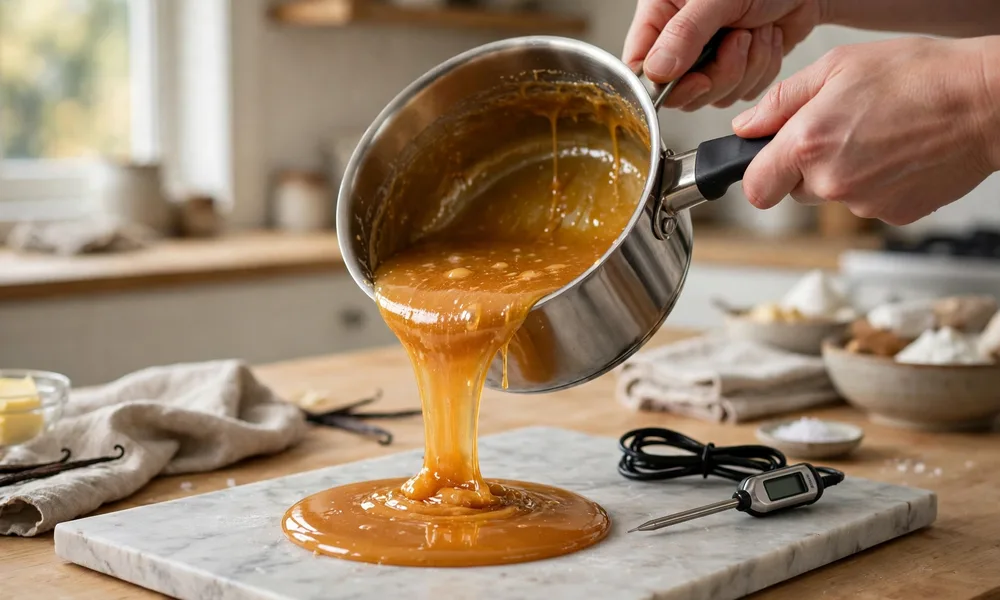
Clip the thermometer to the pan before the sugar goes in, with the tip where the liquid will be. Add sugar and water, stir once to dissolve, then leave it alone — stirring while sugar boils encourages crystals, which make candy grainy. Keep the pan on steady medium heat so the temperature climbs evenly.
When the syrup nears its target, watch the thermometer, not the clock. Lift the pan off a degree or two early, since the sugar keeps cooking in the hot pan. Never leave a thermometer in while you pour — take it out first, because hot glass on a cold worktop can crack. Wash it while warm, before the sugar sets hard, and dry it before storing.
What to Avoid
The worst candy thermometers share a few flaws: a weak clip that slips or lets the probe touch the bottom, making every reading wrong; a scale too small or faint to read through steam; a short stem that cannot reach the syrup; a range topping out below hard crack; and a thermometer that fogs up inside after one use. A meat thermometer pressed into candy duty is a false economy: our guide to meat thermometers that read fast and true explains what those are built for, and boiling sugar is not it — they read too slowly, top out too low, and cannot clip to a pan.

Checklist: Before You Buy a Candy Thermometer
- It reads from below 100°C to at least 200°C, covering every sugar stage.
- It is accurate within one degree in boiling water, and you know how to test it.
- The clip grips your pans firmly and holds the tip clear of the bottom.
- The stem is long enough to reach the syrup in your smallest batch.
- The scale or display is large and readable through steam at a glance.
- It is easy to clean, with no joints or crevices where sugar can set hard.
Frequently Asked Questions
Can I make candy without a thermometer?
You can, using the cold-water test — dropping syrup into cold water and feeling whether it forms a soft or hard ball — but it takes practice and is far less reliable. For fudge and toffee, where a few degrees decide success, a thermometer is the simplest way to get consistent results.
Why did my fudge not set?
Almost always, the syrup did not reach soft-ball stage — 112–116°C — or the thermometer reads low, so test it in boiling water first. Undercooked fudge can sometimes be saved by returning it to the pan with a splash of water and cooking it again to the right temperature.
Can I use a meat thermometer for candy?
No. Meat thermometers top out too low for most sugar stages, read too slowly for a fast-climbing syrup, and cannot clip to the side of a pan. They are built for roasts, not boiling sugar, and using one means guessing at the exact moment the sugar is ready.
How do I clean sugar off a candy thermometer?
Wash it while it is still warm, under hot running water, before the sugar sets. If sugar has hardened on the stem, stand the thermometer in a jug of hot water for a few minutes until it dissolves. Do not scrape it with a knife, which can scratch glass and damage a digital probe.
Does altitude change the sugar stages?
Yes. Water boils below 100°C above sea level, and every sugar stage drops by roughly the same amount. Test your thermometer in boiling water and apply the same correction to every stage — if water boils at 97°C where you live, cook fudge to 109–113°C instead of 112–116°C.
Glass or digital — which is better?
Digital is better if you make candy often: faster, easier to read through steam, and usually alarmed. Glass is better for occasional use or as a cheap spare needing no batteries. Either works, provided it is accurate — test it in boiling water before you trust it.
The Bottom Line
The best candy thermometer for your kitchen in 2026 reads true, clips firmly, and is easy to read through steam. A glass dial thermometer is the cheapest reliable choice for occasional makers, and a digital probe with an alarm is worth the extra money if you make candy often. Test it in boiling water before every batch, watch the temperature rather than the clock, and your fudge, caramels, and toffee will come out right far more often.


