Why an Oven Thermometer Fixes Uneven Baking in 2026
An oven thermometer is a small, cheap tool that solves one of the most frustrating problems in any kitchen: an oven that does not cook at the temperature it claims. The best oven thermometers hang from a rack or sit on a shelf and tell you the real temperature inside your oven, so you can stop guessing why one tray of cookies burns at the edges while another stays pale in the middle. In 2026, when home baking is more popular than ever, it remains the single most useful purchase a baker can make.
Most ovens lie, and most of them lie by a lot. Home ovens commonly run 10 to 25 degrees hotter or colder than the dial says, and the gap often changes depending on the temperature setting. A dial set to 180 degrees might actually be 165 on a cool day and 195 on another, and the top of the oven is almost always hotter than the bottom. You cannot fix what you cannot measure, and that is exactly what an oven thermometer is for.
Key takeaways
- Most home ovens are off by 10 to 25 degrees, and the error changes with the temperature setting.
- A hanging dial oven thermometer gives a constant, at-a-glance reading of the real oven temperature.
- Hot spots are normal: the back and top of most ovens run hotter, so rotating trays still matters.
- Test your oven at three temperatures, then adjust the dial by the average error and verify again.
- Calibrate or replace a thermometer that reads more than a few degrees off in boiling water or a known oven.
Why your oven cannot be trusted
Oven thermostats cycle the heating element on and off, and they measure the temperature at one sensor, usually near the top or back wall. The temperature where your food actually sits can be quite different, and a door that leaks heat and a thermostat that drifts with age make the dial more of a suggestion than a fact.
The symptoms are familiar: cookies that spread and burn at the edges, cakes that sink in the centre, roasts that take an hour longer than promised. Each failure gets blamed on the recipe or the baker, when the real culprit is usually an oven running colder or hotter than claimed.
Uneven heat makes it worse. In most ovens the back runs hotter than the front, because the heating element and the wall radiate more heat there, and the top runs hotter than the bottom when the upper element is on. That is why the tray at the back of the oven browns first and why the bottom of a pizza can stay pale while the cheese burns. No amount of recipe tweaking fixes a hot spot you do not know about.
How an oven thermometer works
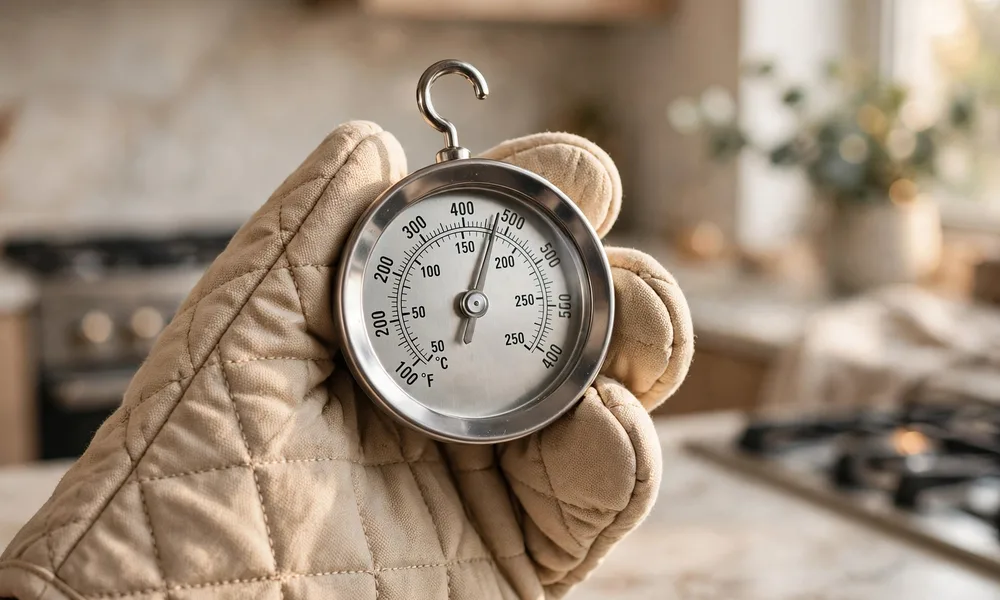
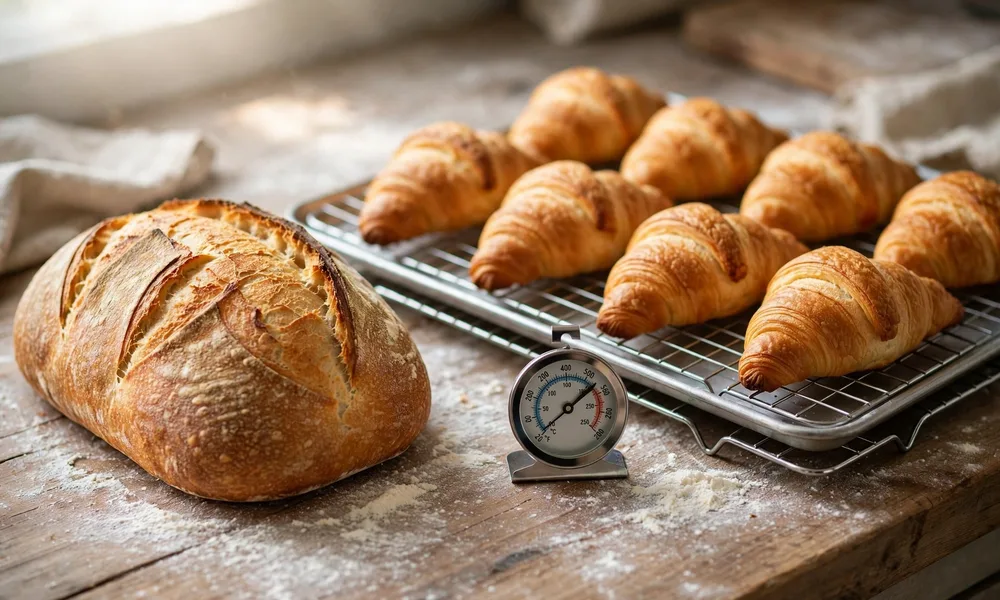
A classic oven thermometer is a simple analogue dial: a bimetallic coil inside the metal case expands as it heats, moving a needle around a scale marked in Celsius and Fahrenheit. There are no batteries and nothing to break. Hang it from the middle rack, preheat the oven, and read the dial through the window or by opening the door quickly.
Digital oven thermometers take a different approach. A probe sits inside the oven, connected by a heat-resistant cable to a display outside, or a wireless probe sends the reading to a unit on the counter. Digital models are more precise, often within a degree or two, and they can alarm when the oven reaches the target temperature or drifts too far. They cost more and the probe and cable need care, but for a serious baker they are worth it.
The main types of oven thermometer
Choosing between dial and digital comes down to how you bake and how much precision you want. Both fix the same problem, but they fit different kitchens.
Hanging dial thermometers: simple and reliable
The hanging dial is the classic. A stainless steel case with a hook that clips over a rack, a large clear face, and a needle you can read through the oven glass. It costs very little, needs no batteries, and survives years of heat. Its weakness is accuracy: most dial models are accurate to within about 5 to 10 degrees, which is good enough to spot a 20-degree error but not enough for fussy work like macarons.
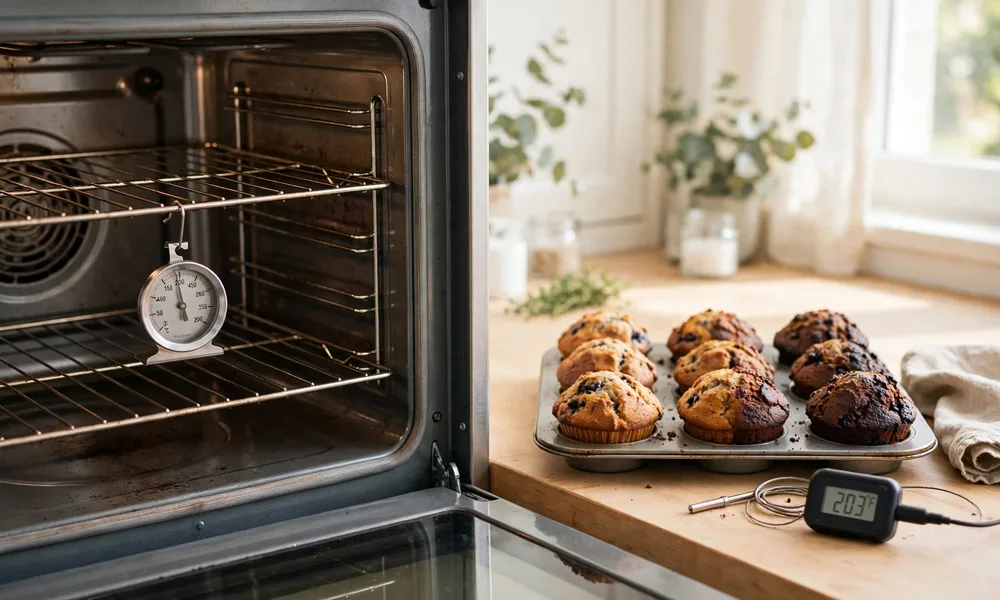
Placement matters. Hang it on the centre rack, near the middle of the oven, where your food will be. A thermometer hung at the very top or pushed to the back will read the hottest part of the oven and mislead you. Some models also stand on a flat base, which is handy if your racks are full.
Digital probe thermometers: precision and alarms
A digital oven thermometer uses a metal probe inside the oven and a display outside. The probe measures the air temperature, not the food, and the display updates constantly. Some models have an alarm you can set: the unit beeps when the oven reaches your target, and again if it drifts beyond a range you set. That is genuinely useful during a long preheat, because you can walk away and be called back when the oven is ready.
Digital models are more accurate, typically within one or two degrees, and easier to read than a small dial through steamed-up glass. The downsides are cost, batteries, and the cable, which can be pinched by the oven door. Keep the cable away from the heating element and never let the probe touch the oven wall.
How to test your oven in 20 minutes
Testing your oven is a simple job and it is worth doing properly, because the result tells you exactly how to adjust every recipe you bake. Start with the oven cold and the thermometer on the centre rack. Set the oven to 180 degrees Celsius, or 350 Fahrenheit, and wait until the oven signals it is ready. Then wait another ten minutes, because the ready light comes on before the temperature has truly settled.
Read the thermometer through the window if you can, or open the door briefly and read it fast. Note the reading, then repeat the test at 150 degrees and at 220 degrees. Most ovens are not wrong by the same amount at every setting.
Once you have the numbers, the fix is simple. If your oven runs 15 degrees cool at 180, set the dial to 195 when a recipe calls for 180. Write the correction on a note inside a cupboard door so you do not have to remember it. Then bake something you know well, a tray of cookies or a loaf, and see if the result improves. Most bakers notice the difference immediately.
Hot spots: finding them and working around them
Every oven has hot spots, and a thermometer is the best way to map them. Place slices of white bread across a tray and bake for a few minutes: the slices that brown first mark the hot spots. Most ovens are hottest at the back and near the top, coolest at the front and near the door.
Once you know the map, work with it. Rotate trays halfway through baking, swapping front to back. Bake one tray at a time on the centre rack when even browning matters most. A good baking sheet helps too, because thin, dark trays absorb more heat and exaggerate hot spots, while heavy, light-coloured sheets spread the heat more gently.
Oven thermometers compared at a glance
| Type | Accuracy | Price | Best for | Watch out for |
|---|---|---|---|---|
| Hanging dial | Within 5 to 10 degrees | Low | Everyday baking | Hard to read through steamy glass |
| Standing dial | Within 5 to 10 degrees | Low | Full racks, no hook space | Can tip over on a crowded rack |
| Digital probe | Within 1 to 2 degrees | Medium | Precise baking, long preheats | Cable can be pinched by the door |
| Wireless probe | Within 1 to 2 degrees | Higher | Watching temperature from afar | Batteries and pairing can fail |
| Infrared | Surface only | Medium | Pizza stones and steels | Cannot measure oven air temperature |
Common oven thermometer mistakes
The most common mistake is leaving the thermometer in the wrong place. Pushed to the back corner or hung from the top rack, it measures the hottest part of the oven, not the part where your food sits. Centre rack, centre of the oven, every time.
The second mistake is trusting the first reading. An oven that has just beeped ready is still stabilising, and the temperature can swing by 10 degrees or more over the next few minutes. Wait ten minutes after the ready signal, and judge the average over a few minutes, not a single snapshot.
The third mistake is never checking the thermometer itself. A dial thermometer can be knocked out of calibration if dropped, and a cheap one may be inaccurate from new. Test it in boiling water, where it should read close to 100 degrees Celsius, or compare it with a second thermometer in the same oven.
A related mistake is confusing an oven thermometer with a food thermometer: one measures oven air, the other measures food. Our guide to choosing a good thermometer explains the food side in detail.
Oven thermometer checklist: before you buy
- Choose a dial thermometer for everyday use or a digital probe if you want precision and alarms.
- Make sure the scale shows both Celsius and Fahrenheit if your recipes mix the two.
- Hang or stand it on the centre rack, in the middle of the oven, where your food sits.
- Test your oven at three temperatures and write the correction on a note in the kitchen.
- Wait ten minutes after the ready light before trusting a reading, and watch the average, not one snapshot.
- Check the thermometer in boiling water once a year and replace it if it reads more than a few degrees off.
Frequently asked questions
How accurate are oven thermometers?
A good dial thermometer is accurate to within 5 to 10 degrees, enough to catch the 10 to 25 degree errors most ovens have. A digital probe is accurate to within 1 to 2 degrees, which suits precise baking like macarons.
Where should I put an oven thermometer?
On the centre rack, near the middle of the oven, where your food will sit. The top or back measures the hottest part and gives a misleading reading.
Should I leave the thermometer in the oven all the time?
Yes, a dial thermometer can live in the oven permanently. Digital probes should be removed after use to protect the cable and batteries.
Why does my oven temperature keep changing?
The thermostat cycles the heating element on and off, so the temperature naturally rises and falls. The average over several minutes is what matters.
Can I use a meat thermometer as an oven thermometer?
No. A meat thermometer measures the temperature of food, and its probe and range are designed for that job. An oven thermometer measures the air temperature inside the oven. They are different tools for different measurements.
Do I still need to rotate trays if I use a thermometer?
Yes. A thermometer fixes the temperature, but it does not fix hot spots. Rotating trays halfway through a bake is still the best way to get even browning in an oven with uneven heat.
The bottom line
An oven thermometer is the cheapest fix for the most common baking problem. It tells you the truth about your oven, lets you correct the dial, maps your hot spots, and turns mysterious failures into simple adjustments. Buy a hanging dial model for everyday baking, add a digital probe if you want precision, place it on the centre rack, and test your oven at three temperatures. Your cookies will brown evenly, your cakes will rise properly, and your roasts will finish on time. Pizza bakers can go further still with a dedicated appliance; see our guide to the best pizza ovens.