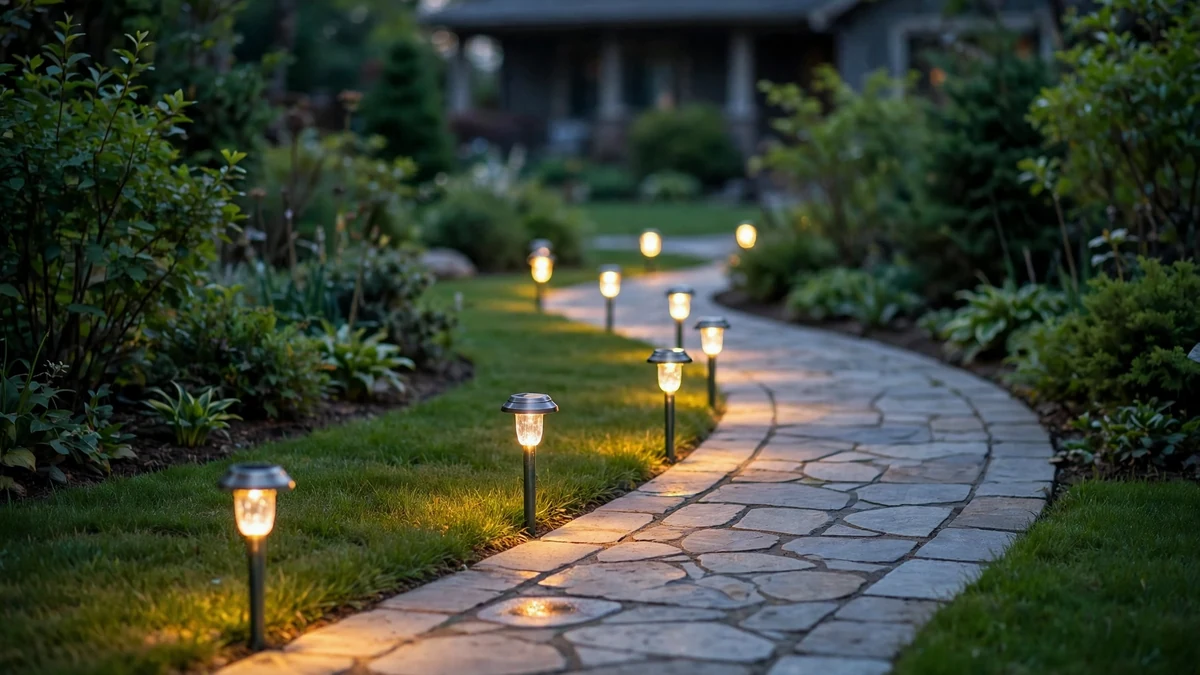
A dark path is a small problem that feels much bigger at night. One missed step, one wet stone you did not see, and a garden you love in daylight turns into somewhere you would rather not walk. Solar path lights fix that without a trench, a cable, or an electrician. You push a stake into the ground, the sun does the charging, and by dusk the walkway glows. It sounds almost too simple, and in a way it is — but the difference between a path that looks inviting and one that looks like a runway is in the details: how bright each light is, how far apart you set them, and how well the little panel on top actually works through a cloudy week.
How solar path lights actually work
Every solar path light is the same small machine, whatever shape it wears. A photovoltaic panel on top collects daylight and turns it into electricity, a rechargeable battery stores it, and a light sensor switches the LED on when the light fades. There is no switch to remember and no timer to set. The panel charges whenever there is daylight, even on an overcast day, though it charges far more slowly when the sky is grey. The battery is usually a single AA or AAA-sized nickel-metal hydride cell, or a small lithium cell in the better models, and it is the part that decides whether your lights are still glowing at midnight or have faded by ten o’clock.
The main types, and where each one belongs
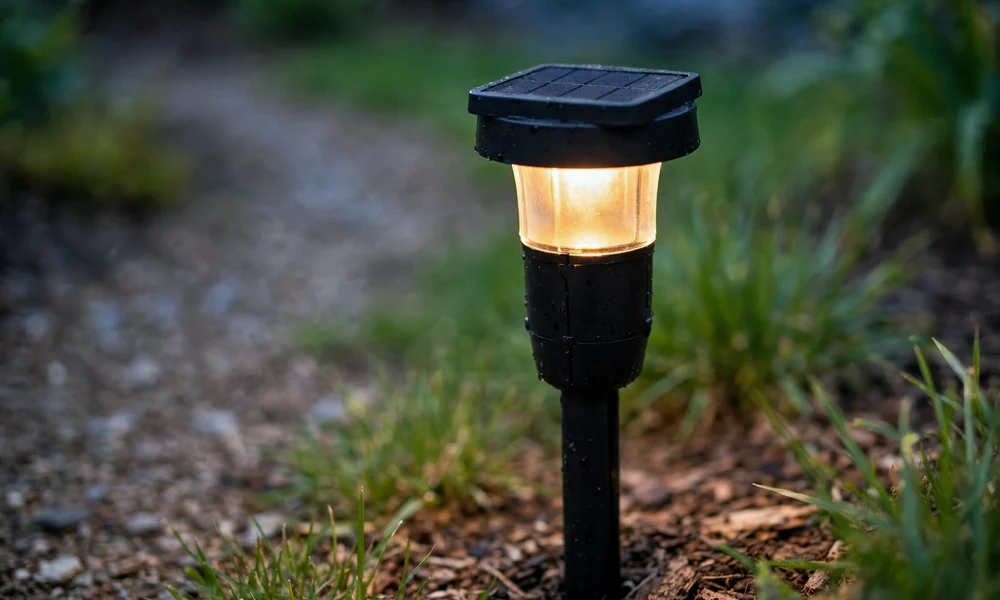
Stake lights are the classic. A slim post pushes into soft ground, the lamp head sits at knee height or lower, and the light washes a small pool onto the path. They are the right choice for most garden walks, lawn edges, and flower-bed borders, and they are the easiest to move when you change your mind. Their weakness is softness: in very loose or sandy soil they lean, and in a garden with a dog or a football they get knocked over. A wider ground stake or a short concrete footing solves the first problem; nothing solves the second except putting them just inside the bed rather than on the open lawn.
Bollard lights are the taller, sturdier cousins. They stand thirty to sixty centimetres high, usually in metal, and suit driveways and the edges of a patio where a stake light would look lost. Because they are heavier and often bolt down, they survive mowers and clumsy feet better, but they also cost more and throw a wider pool of light, so spacing them the same distance apart as stake lights will make the path look over-lit. Use fewer of them and let the gaps stay dark; a path lit in gentle pools looks far better than one lit like a corridor.
Brightness: what the lumens really mean
Lumens are the honest number, and for path lights the honest number is small. A single solar stake light typically produces ten to twenty-five lumens, which sounds feeble next to a household bulb but is plenty for a familiar path. Your eyes adapt to the dark quickly, and a gentle pool of warm light on the stones is all you need to see where to put your feet. Anything much brighter starts to glare, and glare is the enemy of a good path: it shrinks your pupils, makes the shadows beyond the light darker, and leaves you less able to see, not more.
Colour temperature matters as much as brightness. Warm white, around 2700 to 3000 kelvin, flatters stone, wood, and planting, and it feels like candlelight rather than a car park. Cool white, above 5000 kelvin, looks clinical and makes a garden feel like a forecourt. Most solar path lights are warm white by default, which is one reason they look so good, but check the box if you are buying online: a cool-white set will change the whole mood of the garden, and not for the better. If you already own a set of outdoor lights, matching the colour temperature matters more than matching the brand, so it is worth reading our guide to the best outdoor lights for porches, paths and patios before you add solar lights to a garden that already has wired ones.
Spacing and placement that looks natural
The single most common mistake is putting the lights too close together. A row of lights every metre looks like an airport runway, and it costs twice as much as it needs to. The better rule is two to three metres apart, staggered slightly from side to side rather than lined up in a rigid row. Staggering does two things: it breaks the runway effect, and it lights the path more evenly, because each pool of light overlaps the next one at the edges instead of leaving a bright stripe down the middle.
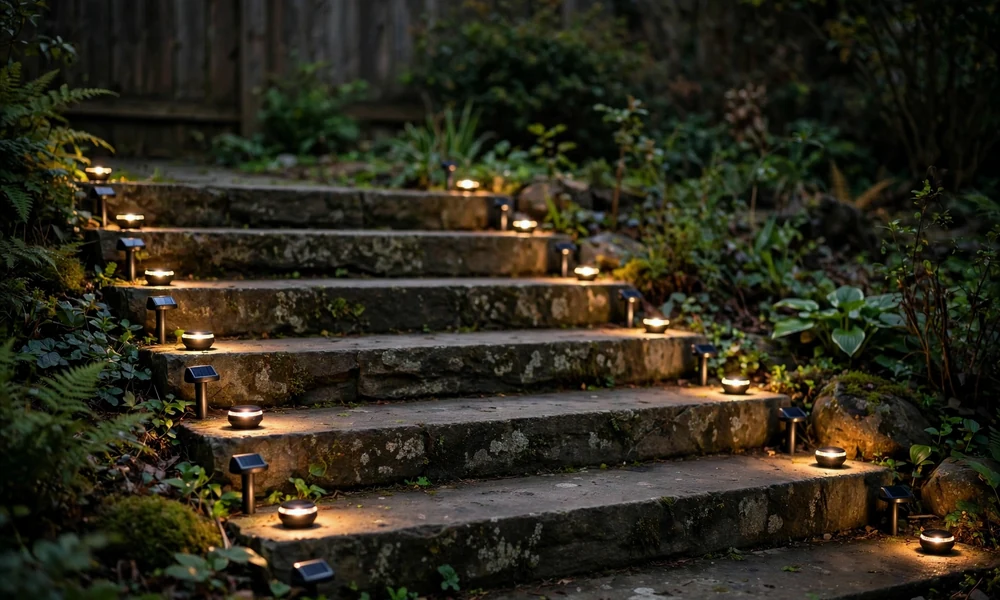
Think about where the light falls, not where the light sits. A stake light two or three feet from the path edge, angled slightly toward the stones, will wash the surface; the same light right on the edge will throw most of its glow onto the grass and leave the path itself in shadow. On a curved path, put the lights on the outside of the bend, where they show the curve coming, and on a straight path, alternate sides every other light. For steps, one light at the top and one at the bottom of each flight matters more than lights on every tread, though a recessed light on alternate risers is the gold standard if you are willing to fit them.

Batteries, panels and how long they last
The battery is the part that wears out first. A nickel-metal hydride cell in a garden light typically lasts one to two years of nightly use before its capacity drops noticeably; a lithium cell lasts longer, often three years or more, and handles cold better. When a light that used to run all night starts fading by nine, the battery is almost always the cause, not the panel. Many models let you swap the cell — a standard rechargeable AA — and a fresh battery can give a tired set another year of life for a few pounds. Sealed units cannot be repaired, so if longevity matters, buy a model with a removable battery and a panel you can wipe clean.
Weatherproofing and winter
Outdoor lights live outside, and the rating that tells you how well they cope is the IP code. IP44 is the minimum worth buying: it resists splashing water from any direction, which covers rain and a hose. IP65 is better, shrugging off driven rain and dust, and it is the rating to look for on lights that will sit low in a bed where soil splashes up in a storm. Anything below IP44 — and some decorative lights are only IPX3 or unrated — will let water in eventually, and water inside a solar light kills the battery and corrodes the contacts.
What to look for when you buy a set
Start with the set size, not the price. A pack of ten sounds generous until you realise your path needs fourteen lights at proper spacing, and a pack of four is a false economy if you end up buying a second pack that does not quite match. Measure the path, divide by two and a half metres, and add two spares. Spare lights are useful anyway: one will eventually get knocked over or drowned, and a matching replacement beats a lone odd one out.
Finally, think about the rest of the garden. Path lights do not live alone: they sit beside seating, planting, and the front of the house, and they look best when the garden feels considered as a whole. A bench at the end of a lit path gives the eye somewhere to land, and our guide to the best garden benches is a good place to start if the far end of your path needs a destination. The same applies to the front of the house: a lit path leading to a tired front door wastes its welcome, so it is worth making sure the entrance looks as cared for as the walk up to it.
Common mistakes, and how to avoid them
The third mistake is shade. A light under a dense shrub or a north-facing fence will never charge properly, and no brand will change that. Walk the path at midday and note where the sun actually falls; if a spot is in shade all day, move the light or accept that it will be the first to fade. The fourth mistake is forgetting the mower. Lights in the open lawn get hit, and a strimmer will take the top off a plastic stake in one pass. Set them inside the bed, or ring them with a flat stone, and they will last years longer.
The last mistake is expecting a solar light to do a wired light’s job. Solar path lights are gentle guides, not security lighting. They will not light a long, uneven walk well enough to walk it confidently in the dark, and they will not deter anyone. If you need real brightness for a long driveway or a dark corner, a wired floodlight or a motion-sensor light is the honest answer, and solar path lights can handle the pretty part of the job alongside it. Knowing which job each light is doing is half the skill of lighting a garden.
Frequently asked questions
Do solar path lights need direct sunlight? Direct sun is best, but they will charge in bright shade and on overcast days, just more slowly. What they cannot do is charge in deep shade all day. A spot that gets a few hours of sun will run a light happily; a spot under a thick evergreen will not.
How many solar path lights do I need? Measure the path and divide by two and a half metres, then add two spares. A ten-metre path needs about four to five lights, and a twenty-metre path needs eight or nine. Stagger them from side to side rather than lining them up, and the path will look lit rather than lined.
The bottom line
The best solar path lights are the ones you forget about: low, warm, evenly spaced, and still glowing when you come home late. They do not need to be bright, and they do not need to be expensive. They need a decent panel, a battery you can replace, a warm colour, and a spot in the garden where the sun actually reaches them. Get those four things right, space them two to three metres apart with a slight stagger, and the path will take care of itself — night after night, with no cable, no bill, and nothing to remember except a wipe of the panel now and then. A well-lit path is also the first thing a visitor sees, and the frame around it matters too: if the approach to your house could use the same care as the path itself, our guide to the best mailboxes is a sensible next stop, because the details at the end of a lit walk are the ones people remember.