Why a Canister Vacuum Beats an Upright for Hard Floors in 2026
A canister vacuum beats an upright for hard floors because it puts almost nothing between you and the floor. The motor and dust collection live in a wheeled body that trails behind you, so the part in your hand is a light wand with a slim floor head. That head glides across wood, tile and laminate without scattering crumbs, reaches flat under low furniture, and turns around chair legs with a flick of the wrist. An upright pushes its whole weight across the floor on every pass, and its wide brush head is built for carpet pile, not smooth surfaces.
Key Takeaways
- A canister keeps the heavy motor in a trailing body, so only a light wand rests in your hand, making long cleans far less tiring than pushing an upright.
- A dedicated hard-floor head with a soft roller picks up fine dust without blowing it across the room, the biggest advantage over a spinning carpet brush.
- Canisters reach further under beds, sofas and radiators than any upright, because the wand lies almost flat while the body stays out in the open.
- Sealed HEPA filtration and bagged models trap fine dust best, which matters most in homes with allergies, asthma or pets.
- The trade-offs are real: the trailing body can bump into furniture, storage needs more thought, and a canister is rarely best for deep-pile carpet.
What Makes a Canister Vacuum Different
A canister vacuum splits the machine in two. The canister holds the motor, the filter and the dust bag or bin, and follows you on small wheels. A flexible hose connects it to a long wand, and at the end of the wand sits the floor head. Your arm carries perhaps a kilogram instead of five or six, the head can swivel and lie flat, and you can clean a staircase by parking the body on a step and working the wand, rather than carrying a whole machine up and down.
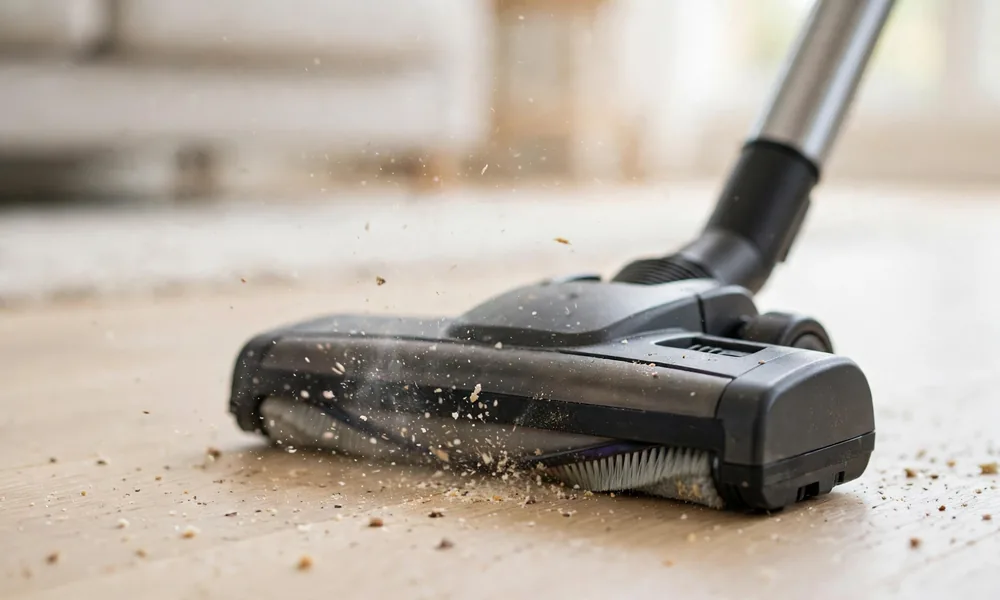
On hard floors, that design solves the exact problems uprights create. An upright relies on a motorised brush roll to agitate carpet fibres, and that brush is a liability on wood and tile. Spun on a hard surface, it can fling crumbs ahead of the head, scatter fine dust, and mark a soft floor finish. A canister with a hard-floor head is shaped for smooth floors from the start: a low, wide opening and soft strips that trap dust instead of chasing it.
The Best Canister Vacuums of 2026 at a Glance
| Pick | Best For | Standout Strength | Typical Price |
|---|---|---|---|
| Best overall | Mixed hard floors | Strong suction, quiet motor | $400–$650 |
| Best for hard floors | Wood and tile | Soft-roller floor head | $350–$550 |
| Best for stairs | Multi-storey homes | Light wand, long hose | $300–$500 |
| Best for allergies | Allergy-prone homes | Sealed HEPA, bagged | $450–$700 |
| Best value | Smaller homes | Simple, light, reliable | $180–$320 |
Best Overall Canister Vacuum for Hard Floors
The best overall canister for hard floors balances suction, silence and handling rather than winning any single specification. Look for a sealed airway and two heads in the box: a suction-only hard-floor head and a motorised head for rugs. The hard-floor head does the daily work on wood and tile, while the motorised head earns its keep on the living-room rug. Variable suction matters, because full power can suck a lightweight rug onto the head, while a gentle setting glides over polished floors. The best models run noticeably quieter than uprights, usually around 60 to 65 decibels. Expect to pay $400 to $650.
Best Canister Vacuum for Pure Hard Floors
If your home has no carpet at all, buy a simpler machine and spend the saving on build quality. A dedicated hard-floor canister needs no motorised brush head, which removes the heaviest and most failure-prone part of the design. It relies on a wide suction head with a soft roller, and that is genuinely all a smooth floor needs: dust, crumbs, pet hair and grit all lift cleanly under steady suction, and the soft roller stops fine dust being blown sideways. The machine can be lighter and smaller, which makes storage easier and the body less likely to clatter into skirting boards. Check that the head swivels freely and the wand adjusts to your height.
Best Canister Vacuum for Stairs and Small Homes
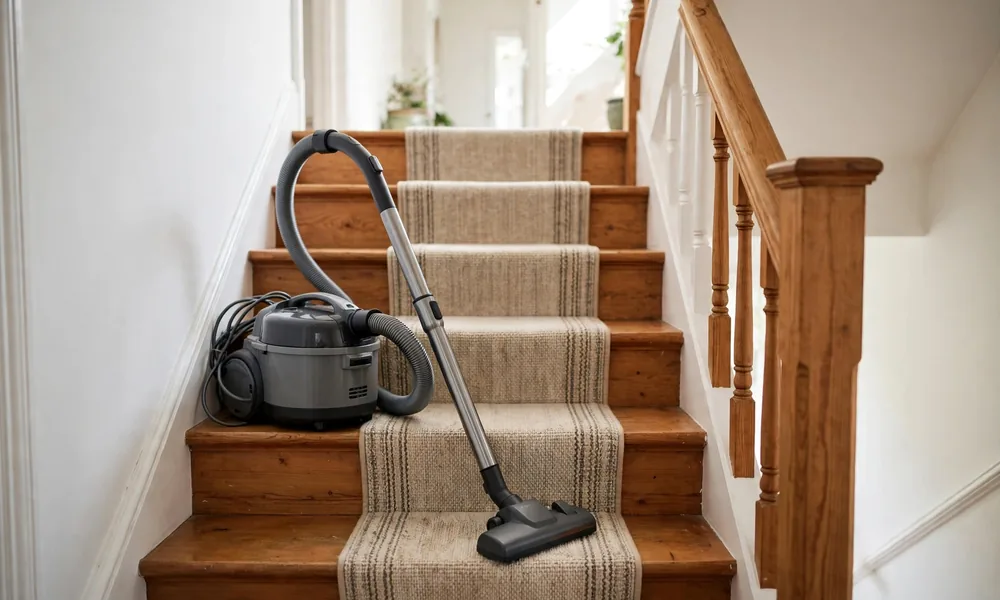
Stairs are where canisters leave uprights behind completely. An upright has to be carried step by step with its full weight in your arms, and its wide head barely fits a single tread. A canister parks on a step or the landing, and you work the tread with a wand that weighs almost nothing. The hose should be at least two metres long so the body can sit two or three steps below you, and a small stair tool makes the job faster still. The same lightness pays off in a small home, where a compact canister tucks into a cupboard.
Best Canister Vacuum for Pets and Allergies
Pet hair and allergies separate a good canister from a mediocre one. Pet hair on a hard floor looks easy to clean, yet it clings to skirting boards, gathers in corners and wraps around brush rolls. A canister with a motorised mini turbo brush for upholstery and a hard-floor head that does not scatter hair is the right combination, and a bagged model has a clear edge: the bag seals shut when you remove it, so the dust you collected never puffs back into the room. For allergies, look for a genuinely sealed system with a HEPA filter, not just a filter labelled HEPA in a leaky body.
Best Value Canister Vacuum
The best value canister is the simplest one that still does the fundamentals well. You do not need a digital display, an app or a dozen attachments. You need steady suction, a decent hard-floor head, a hose that does not kink, and a body that follows you without tipping over. Machines between $180 and $320 cover that ground comfortably, and they are often lighter than premium models because they carry fewer features. What you give up is refinement: a shorter cord, a smaller dust capacity and a noisier motor. Check the warranty and the availability of bags and filters before the price tag.
Hard Floors: Where Canisters Win
Hard floors reward a vacuum that is gentle, low and precise, and those are the three words that describe a canister wand. The head sits flat, so suction seals evenly across its full width instead of leaking at the edges. The soft roller underneath gathers fine dust rather than flicking it away, which is why a canister leaves a visibly cleaner line along skirting boards and around table legs. An upright’s wide head cannot get as close to an edge, and its weight makes it harder to lift and reposition. The canister also wins on delicate surfaces: polished concrete, oiled oak and large-format tile all scratch more easily than people expect, and a heavy upright with a spinning brush is the most likely culprit.
Suction, Filtration and Noise
Suction figures are the least useful numbers on a vacuum box, because manufacturers measure them in different units. Air watts are the most comparable figure, and a good canister for hard floors sits around 200 to 300 air watts at the head, which is ample for dust, crumbs and hair on a smooth surface. What matters more is how much suction survives the journey through the hose and head, and that depends on seals, not power. A machine with a well-sealed airway and a clean filter will out-clean a more powerful machine with a leaky hose joint, and the gap grows as the bag fills. Filtration decides whether the dust stays collected: a sealed HEPA system traps particles down to 0.3 microns, covering pollen, dust mite waste and most pet dander.
Canister vs Upright: The Honest Comparison
Choosing between a canister and an upright comes down to your floors, not brand loyalty. A home that is mostly deep-pile carpet still belongs to the upright, because its wide motorised brush and heavy body press into the pile and lift dirt a canister wand passes over. A home that is mostly hard floor belongs to the canister, for every reason in this guide. Mixed homes are the middle ground, and there the canister with a motorised head is the more flexible machine: it cleans hard floors better than any upright and handles low and medium pile rugs well, while the upright cleans deep carpet better and hard floors worse. Our guide to the best vacuum cleaners of 2026 compares all four main types side by side, and our guide to the best cordless vacuums of 2026 covers the stick alternative for quick daily cleans.
What to Check Before You Buy
- Floor heads in the box: a suction-only hard-floor head plus a motorised head for rugs, not one head forced to do both jobs badly.
- Suction control: a slider or dial on the handle or body, so you can turn the power down for rugs, curtains and delicate floors.
- Filtration: a sealed HEPA system and a filter you can buy easily, with bagged models preferred for allergy-prone homes.
- Hose and cord length: a hose of two metres or more and a cord that covers your largest room without swapping sockets.
- Weight and storage: a body you can lift with one hand, and a wand that parks neatly on the body or on a wall hook.
- Running costs: the price and lifespan of bags and filters, plus a warranty of at least two years from a brand that stocks spares.

Frequently Asked Questions
Are canister vacuums better than uprights on hard floors?
Yes, for most homes. The light wand and dedicated hard-floor head clean wood, tile and laminate more thoroughly and gently than an upright, because the head seals flat, reaches under furniture, and does not scatter dust with a spinning carpet brush.
Can a canister vacuum clean carpet as well?
A canister with a motorised brush head cleans low and medium pile carpet well, and it is excellent on rugs and runners. It is not as strong as a good upright on deep-pile carpet, where the upright’s weight and wide brush press deeper into the fibres.
Are canister vacuums hard to store?
They take a little more thought than an upright, but not much. The wand clips to the body, the hose wraps around a hook, and the compact body fits in a cupboard.
Bagged or bagless: which is better for a canister?
Bagged is better for allergies and hygiene, because the bag seals when removed and holds fine dust inside. Bagless saves the cost of bags but needs careful emptying and a filter washed or replaced on schedule.
How long does a good canister vacuum last?
A well-built canister lasts eight to twelve years with basic maintenance: replacing bags before they overfill, washing or replacing filters on schedule, and clearing the hose and head of blockages.
Do canister vacuums work well on stairs?
They are the best vacuum type for stairs. Park the body on a step, work the tread with the light wand, and use a small stair tool for the corners. You never carry the full weight of the machine.
The Bottom Line
If your floors are mostly wood, tile or laminate, a canister vacuum is the best tool for the job in 2026. Its light wand, dedicated hard-floor head and quiet motor clean smooth surfaces more thoroughly and gently than an upright, and it reaches the stairs, edges and under-furniture spaces an upright leaves behind. Buy the best sealed, bagged model your budget allows, with both a hard-floor head and a motorised rug head, and check the cost of bags and filters first. For quick spot cleans between deep cleans, our guide to the best hand vacuums of 2026 covers the ones worth owning.