
Collagen powder has moved from a niche supplement to a kitchen-shelf staple, promising firmer skin, stronger joints, thicker hair and better gut health. The truth is more modest and more useful. Collagen powder can be a sensible addition to a diet short on protein, but only if you buy the right type, at the right dose, from a source you can trust. The difference between a good tub and an expensive jar of flavoured powder comes down to a handful of facts on the label.
A good collagen powder is hydrolysed: the long chains have been broken into small peptides your body can absorb. It states its grams of peptides per scoop, names its source, and lists almost nothing else. This guide covers what it is, how the types differ, how much you need, and how to spot a quality product in 2026.
Key Takeaways
- Buy hydrolysed collagen peptides, not whole collagen, because peptides are small enough for your body to absorb and use.
- Choose types I and III for skin, and type II if joint cartilage is your main concern.
- Aim for 10 to 15 grams of peptides a day, and avoid tubs that hide their dose inside a blend.
- Check the source on the label, and pick products that are third-party tested.
- Expect gradual support over eight to twelve weeks, not overnight change, because collagen is a supplement, not a medicine.
What Collagen Powder Actually Is
Collagen is the most abundant protein in the human body, making up roughly a third of all the protein you carry. It is the structural scaffolding of skin, tendons, ligaments, cartilage and bone, the fibres that hold tissue together. Your body makes its own collagen from amino acids, but production slows with age. By their forties, most people produce noticeably less than they did at twenty, and the effects show up first in skin and joints.
Collagen powder is made by breaking down collagen-rich tissue, usually bovine hide or fish skin, with enzymes into short chains called peptides. This process is called hydrolysis, and it matters for one reason: whole collagen molecules are too large to be absorbed well, while peptides are small enough to pass into the bloodstream. Once absorbed, those peptides act as building material and as a signal, prompting the body to make more of its own collagen. That is why the word hydrolysed on the label is the first thing to look for.

Collagen Types I, II and III Explained
Three types do almost all the work that matters. Type I is the most common, found in skin, bones, tendons and ligaments, and it is most closely tied to skin firmness. Type II is the main collagen in cartilage, the tissue that cushions your joints. Type III sits alongside type I in skin, blood vessels and organs. Most powders are types I and III from bovine hide, which suits the most common goal: skin and general support. Marine collagen is almost entirely type I. Type II usually comes from chicken sternum at just 40 milligrams a day, working by calming the immune response in joints.
Collagen Powder Types Compared
| Collagen Type | Main Source | Best For | Typical Daily Dose |
|---|---|---|---|
| Bovine peptides (types I and III) | Cattle hide | Skin, hair, nails, general support | 10 to 15 grams |
| Marine peptides (type I) | Fish skin and scales | Skin elasticity and hydration | 5 to 10 grams |
| Chicken type II | Chicken sternum | Joint cartilage and comfort | 40 milligrams |
| Multi-collagen blends | Mixed animal sources | Broad coverage across types | 10 to 20 grams |
| Vegan collagen builders | Plant amino acids and vitamin C | Supporting your own collagen production | One serving a day |
| Collagen with vitamin C | Bovine or marine plus ascorbic acid | Skin support with a production cofactor | 10 to 15 grams |
How to Read a Collagen Label
Read the supplement facts panel, not the front of the tub. The front is advertising; the panel is where the useful facts live. First, find the amount of collagen peptides per serving, printed in grams. A serving below 10 grams is underdosed for skin and general support, and a tub that lists a proprietary blend without breaking out the collagen amount is hiding its dose. Second, find the source: bovine, marine, chicken or a named blend, stated plainly.
Next, look at the ingredient list. A good powder has one ingredient, hydrolysed collagen peptides, and perhaps vitamin C. A long list of sweeteners and fillers is a sign the product is built for taste rather than dose. Finally, look for third-party testing: collagen comes from animal tissue, so heavy metals such as lead and cadmium are a real concern, and a trustworthy brand publishes test results or carries an NSF or USP seal.
Bovine vs Marine Collagen: Which Source Is Better?
Bovine and marine collagen are the two sources most buyers choose between, and the honest answer is that both work, but they suit different priorities. Bovine collagen is made from cattle hide, contains types I and III, and is the most studied and most affordable option. Most skin studies used bovine peptides at 10 grams a day, so for value and evidence, bovine is the sensible default.
Marine collagen is made from fish skin and scales, is almost entirely type I, and its smaller peptides absorb slightly faster. It suits people who avoid beef or whose goal is narrowly skin. The trade-offs are price, roughly double per gram, and a faint fishy taste in cheap products. People with a fish allergy should avoid it entirely. A bowl of bone broth is not a substitute for a measured dose, but it is the same family of nutrition, and our guide to the best bone broth of 2026 explains what to look for there.
How Much Collagen Do You Need Each Day?
Most studies that found a benefit used 10 grams of collagen peptides a day, and the range across the research is roughly 5 to 15 grams. Skin studies cluster around 10 grams a day for eight to twelve weeks, with improvements showing up gradually rather than suddenly. The type II studies are the exception, using just 40 milligrams a day through a different mechanism.
Timing matters less than consistency: take it at any time of day, with or without food, every day for at least eight weeks. If you notice nothing after twelve weeks, stop paying for it. One note: collagen is not a complete protein, it lacks tryptophan, so it should sit alongside a varied diet. If you are comparing powders generally, our guide to the best protein powder of 2026 covers complete proteins and how to choose between whey and plant options.

What the Evidence Actually Says
The evidence is real but modest. A 2019 review of eleven randomised trials found hydrolysed collagen improved skin elasticity and hydration, with the clearest results after eight to twelve weeks of daily use. The effects were small to moderate, so most people notice a subtle difference rather than a transformation, and the studies were generally short and often industry-funded. For joints, a 2021 review found peptides reduced discomfort in athletes and people with osteoarthritis, again modestly.
Two numbers are worth keeping in mind. First, the skin studies that worked used 10 grams a day, not the 2 or 3 grams found in many gummies and beauty drinks. Second, the benefit took at least eight weeks to appear in most trials, so a one-week test tells you nothing. Collagen powder is best thought of as a dietary top-up with a plausible, modest benefit for skin and joints, not as a treatment.
How to Take Collagen Powder Every Day
The easiest way to take collagen powder is to stir it into something you already drink. Unflavoured peptides dissolve well in hot coffee, tea or soup, and mix into cold water or a smoothie with a quick stir. A good powder has almost no taste, so the barrier is habit rather than flavour. Keep the tub next to the coffee maker or blender as a daily reminder.
A smoothie is the most forgiving vehicle, because the powder disappears into the texture and the fruit covers any faint taste. Stir a scoop into a morning smoothie with greens and protein. If you already take a greens powder, the two mix well together, and our guide to the best greens powders of 2026 explains how to choose one worth the money. Avoid very acidic drinks if you are sensitive to clumping.
Storing Collagen Powder So It Stays Fresh
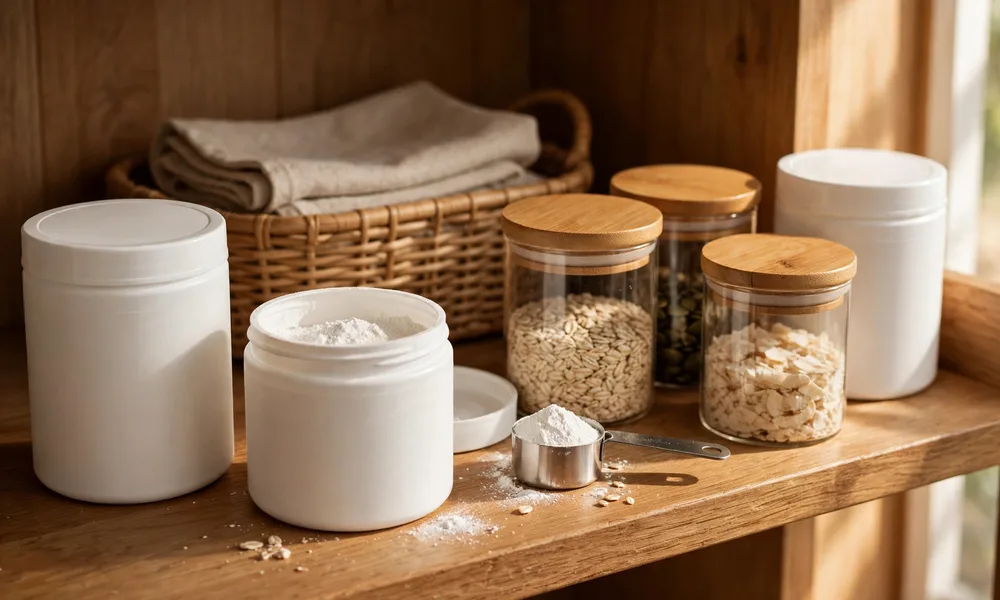
Collagen powder still has enemies: moisture, heat and air. Store it in a cool, dry cupboard with the lid on tight, away from steam. A tub left open in a humid bathroom will clump within weeks. Buy a size you will finish within two to three months.
Common Mistakes When Buying Collagen Powder
The first mistake is buying gummies or beauty drinks instead of powder. Gummies hold only a gram or two of collagen each, so reaching a 10-gram dose would mean eating a handful of sweets a day. The second mistake is choosing by front-label claims rather than dose, paying extra for added biotin or hyaluronic acid in tiny amounts. The third mistake is expecting fast results and giving up after two weeks, when the research says eight to twelve weeks is the minimum fair trial. Other mistakes are choosing a blend that hides its dose, buying marine collagen with a fish allergy, and assuming expensive means better tested. A mid-priced bovine peptide with published results beats a luxury tub with no testing.
Collagen Powder Buying Checklist
- Choose hydrolysed collagen peptides, and check the dose is 10 to 15 grams per serving for types I and III.
- Match the type to your goal: types I and III for skin, type II for joints.
- Check the source on the label, bovine, marine or chicken, and avoid marine collagen if you have a fish allergy.
- Look for third-party testing or published heavy-metal results.
- Keep the ingredient list short: peptides and optionally vitamin C, with no added sugar or long filler list.
- Commit to a daily routine for eight to twelve weeks, then judge the result honestly before reordering.
Frequently Asked Questions
What is the best collagen powder for skin?
A hydrolysed bovine or marine powder delivering 10 grams of types I and III a day is the best-supported choice, based on trials showing better elasticity and hydration after eight to twelve weeks.
How long does collagen powder take to work?
Most studies found measurable skin benefits after eight to twelve weeks of daily use. Less than a month is not a fair test.
Is collagen powder safe to take every day?
For most healthy adults, 10 to 15 grams a day is well tolerated, with mild bloating the most common side effect. People with a fish allergy should avoid marine collagen, and anyone pregnant or on medication should check with a clinician first.
Can collagen powder replace protein powder?
No, because collagen is not a complete protein: it lacks tryptophan. It can sit alongside a protein powder as a top-up, but it should not replace your main protein source.
Does collagen powder help hair growth?
The evidence for hair is weaker than for skin and joints. There are no large trials proving faster growth, so treat hair claims as a possible bonus, not a reason to buy.
What is the difference between collagen peptides and gelatin?
Both come from collagen, but peptides are broken down further, so they dissolve in hot and cold liquids and absorb more easily. Gelatin gels when cooled and suits cooking.
The Bottom Line
The best collagen powder in 2026 states its dose plainly, names its source, and proves its purity with third-party testing. For most people that means 10 to 15 grams a day of bovine types I and III, or marine type I if you prefer fish-sourced peptides. Take it daily for at least eight weeks, and judge it on what you notice rather than what the label promises.


